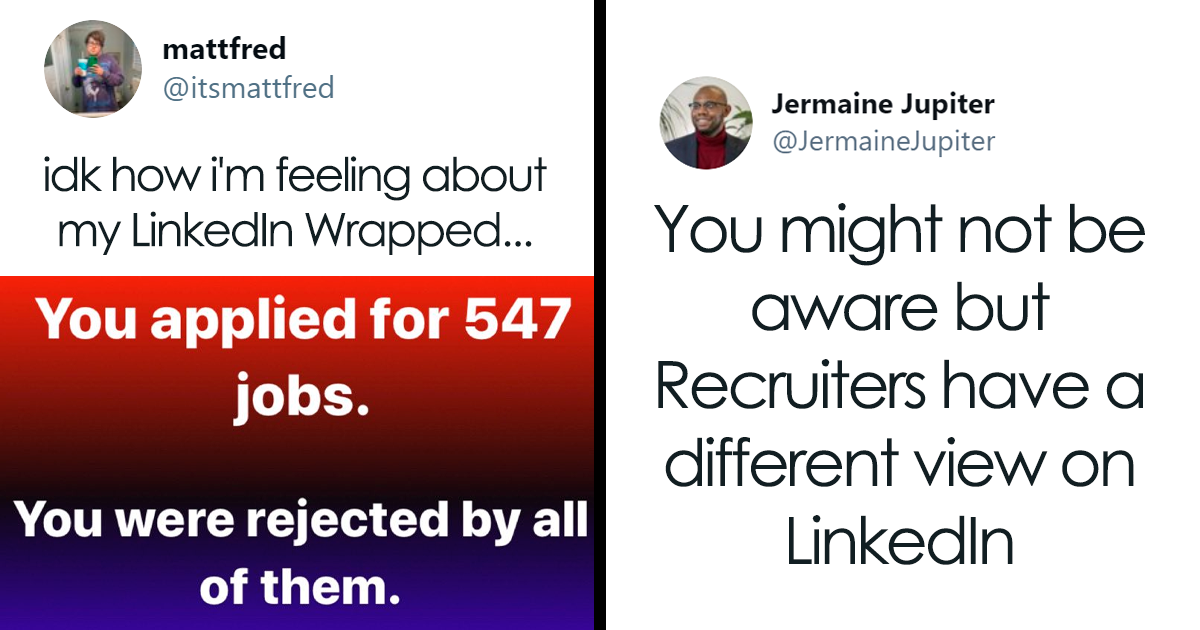
There are two types of job seekers in this world: the ones who carefully tailor every application with the precision of a NASA launch, and the ones who fire off résumés at 1:13 a.m. while eating cereal from a mug. Somewhere between those two groups lives the viral joke about a guy who “applied” to 547 jobs and was “rejected” from all of them. It is funny because it feels painfully real. It is also useful because it points to a bigger truth: today’s job search is not only about applying. It is about being searchable, memorable, credible, and easy for recruiters to understand.
The story gained attention because of its perfect mix of comedy and career anxiety. A man joked about a fictional “LinkedIn Wrapped” that showed hundreds of job applications and zero wins. Then career coach Jermaine used the moment to share practical advice about LinkedIn profiles, recruiter searches, and how job seekers can improve their visibility. The internet came for the joke, but many people stayed for the advice. That is the modern career market in one sentence: laugh first, optimize later.
In a job market where candidates may face silence, automated rejections, old postings, crowded applicant pools, and recruiter keyword searches, a weak LinkedIn profile is like showing up to a networking event wearing an invisibility cloak. Dramatic? Maybe. Accurate? Annoyingly, yes.
Why the “547 Rejections” Joke Hit So Hard
The joke works because almost every job seeker has experienced the strange emotional workout of applying, waiting, refreshing email, checking spam, rereading the job description, and then receiving either a cold rejection or, worse, nothing at all. Being ghosted by a company is like being stood up by a spreadsheet. Nobody enjoys it.
But beneath the humor is a serious issue. Job hunting has become more digital, more automated, and more competitive. Many companies use applicant tracking systems to organize resumes. Recruiters search LinkedIn using job titles, skills, industries, certifications, locations, and other keywords. Hiring teams may receive hundreds of applications for a single role. Meanwhile, candidates often apply broadly because they feel they have no choice. The result is a noisy system where good people can look invisible and average profiles can get lost faster than a sock in a hotel laundry room.
This is why Jermaine’s advice mattered. He did not simply say, “Try harder,” which is the least helpful career advice in human history, just barely beating “follow your dreams” written on a mug. Instead, he focused on improving how a candidate appears inside LinkedIn’s search ecosystem. In plain English: make it easier for recruiters to find you, understand you, and believe you.
LinkedIn Is Not Just an Online Resume
Many people treat LinkedIn like a dusty digital filing cabinet. They create a profile, upload a photo from three haircuts ago, list a few job titles, and then wonder why recruiters are not forming a conga line in their inbox. The problem is that LinkedIn is not only a résumé page. It is also a search engine, a professional directory, a networking platform, and a credibility signal.
A resume is usually sent after you find a job posting. A LinkedIn profile can be discovered before you ever apply. That difference is huge. Recruiters often search for candidates based on skills, titles, industries, and experience. If your profile does not include the words they are searching for, you may not appear even if you are qualified. That is not because the universe hates you. The universe may be neutral. The algorithm, however, needs clues.
Your Headline Should Say What You Do
The LinkedIn headline is one of the most valuable pieces of profile real estate. Too many people waste it on vague phrases like “Hardworking professional seeking opportunities” or “Passionate problem solver.” Those may be true, but they do not tell a recruiter what role you fit.
A stronger headline is specific: “Digital Marketing Specialist | SEO, Content Strategy, Google Analytics” or “Junior Data Analyst | SQL, Excel, Tableau, Python.” This kind of headline gives recruiters searchable keywords and an instant snapshot of your value. Think of it as the label on the jar. If it says “miscellaneous sauce,” nobody knows whether to put it on pasta or run away.
Your About Section Should Prove, Not Perform
The About section should not sound like a motivational poster that got trapped in an elevator. It should explain who you are, what you do, who you help, and what results you create. The best LinkedIn summaries are clear, human, and proof-based.
Instead of writing, “I am a dynamic professional with a passion for excellence,” try something more useful: “I help small e-commerce brands improve organic traffic through SEO audits, content planning, and conversion-focused product pages. In my last role, I helped increase blog-driven leads by 38% in six months.” See the difference? One sounds like corporate soup. The other gives evidence.
Why Keywords Matter More Than Job Seekers Think
Recruiters do not always search for “nice person who would probably be great once trained.” They search for specific phrases: “project manager,” “Salesforce,” “paid media,” “registered nurse,” “JavaScript,” “supply chain,” “customer success,” “QuickBooks,” “bilingual,” “remote,” and so on. These keywords help them narrow a large talent pool.
That does not mean you should stuff your LinkedIn profile like a Thanksgiving turkey. Keyword stuffing looks awkward and can make your profile hard to read. Instead, place important terms naturally in your headline, About section, Experience descriptions, Skills section, certifications, and project descriptions.
A simple trick is to collect five to ten job descriptions for roles you genuinely want. Highlight the recurring words. If “CRM,” “pipeline management,” and “B2B sales” appear again and again, those terms probably belong somewhere on your profile if they honestly match your experience. Your LinkedIn profile should speak the same professional language as the jobs you want.
The Experience Section Needs Achievements, Not Chore Lists
Many LinkedIn profiles read like a list of tasks: “Responsible for emails. Responsible for reports. Responsible for meetings.” Congratulations, you have described office life. Unfortunately, recruiters need more than that.
Turn responsibilities into outcomes. Instead of “Managed social media accounts,” write, “Managed Instagram and LinkedIn content calendars, increasing average engagement by 27% over four months.” Instead of “Handled customer service,” write, “Resolved 40–60 customer tickets per day while maintaining a 95% satisfaction score.” Specific examples help recruiters picture your impact.
Numbers are helpful, but they are not the only form of proof. You can mention tools used, problems solved, processes improved, teams supported, deadlines met, clients served, or projects completed. The point is to show evidence that you can do the work, not just claim you once stood near it.
Skills, Recommendations, and Activity Still Matter
The Skills section is not decoration. It supports search visibility and helps recruiters quickly scan your fit. Add skills that match your target roles, remove outdated ones, and avoid listing every tool you touched for seven minutes during a group project in 2019.
Recommendations can also help, especially when they are specific. A recommendation saying “Great person!” is nice, but “She led our CRM migration, trained six team members, and reduced duplicate lead entries by 30%” is stronger. Specific praise acts like professional social proof.
Activity matters too. You do not need to become a LinkedIn influencer posting sunrise selfies with leadership quotes. Please do not feel forced to announce that coffee taught you project management. But thoughtful comments, occasional posts, shared work samples, and professional discussions can show that you are active in your field.
#OpenToWork: Helpful Tool or Green Circle of Desperation?
LinkedIn’s #OpenToWork feature lets users signal that they are looking for opportunities. Some people love it. Others worry it looks too eager. In reality, the feature is simply a tool. Like any tool, it depends how you use it.
You can choose whether the signal is visible to all LinkedIn members or only recruiters. You can also specify job titles, locations, work types, and preferences. That information can help your profile appear in more relevant searches. If you are currently employed and searching discreetly, privacy settings matter. If you are openly looking, the public badge may help your network understand how to support you.
The bigger lesson is this: do not just turn on #OpenToWork and wait for destiny to knock politely. Pair it with a strong headline, relevant keywords, a clear About section, updated experience, and direct networking.
Applying to 547 Jobs Is Not a Strategy by Itself
There is nothing wrong with applying to many jobs, especially in a tough market. But volume without targeting can become exhausting. It is like throwing 547 paper airplanes into a hurricane and blaming the airplanes for not landing in HR.
A better job search combines three approaches: targeted applications, LinkedIn optimization, and relationship-building. Targeted applications mean you choose roles where your background has a realistic connection to the requirements. LinkedIn optimization helps recruiters find and understand you. Relationship-building means you talk to real people: former coworkers, alumni, industry peers, hiring managers, and professionals at target companies.
The strongest job seekers often create a simple system. They track applications, tailor resumes, follow up when appropriate, save job descriptions, identify contacts, and review what is working. If one resume version gets no responses after 40 applications, they adjust it. If one job title produces better interviews, they lean into it. Job hunting is emotional, but the process should be partly analytical.
How to Fix a LinkedIn Profile Before Applying Again
Before sending another wave of applications, do a profile audit. Start with the basics: professional photo, clear headline, accurate location, current role, and updated contact settings. Then move to the sections that influence search and credibility.
Step 1: Rewrite the Headline
Use job titles and skills connected to your target role. A good formula is: “Target Role | Key Skill 1, Key Skill 2, Key Skill 3 | Industry or Outcome.” For example: “Customer Success Specialist | SaaS Onboarding, CRM, Retention | Helping Teams Reduce Churn.”
Step 2: Make the About Section Skimmable
Use short paragraphs or compact bullet points. Mention your target role, core strengths, measurable wins, tools, industries, and what opportunities you are seeking. Recruiters are busy. Give them the good stuff before they need a snack break.
Step 3: Add Proof to Experience
Each role should include three to five strong bullets focused on outcomes. Use action verbs and include metrics where possible. If you do not have metrics, describe scope: team size, project type, budget range, number of customers, tools used, or deadlines handled.
Step 4: Match Skills to Target Jobs
Review job postings and update your Skills section with relevant, honest terms. If a skill appears in many job descriptions and you have it, it should not be hiding in your professional basement.
Step 5: Add Featured Work
Use the Featured section for portfolios, writing samples, case studies, GitHub repositories, presentations, certifications, or project links. This is especially powerful for marketers, designers, developers, writers, analysts, consultants, and students with project-based experience.
What Recruiters Actually Need From Your Profile
Recruiters are not reading your profile for fun while relaxing with tea. They are trying to answer a few quick questions: What do you do? Are you qualified? Are you relevant to this role? Do you have evidence? Are you reachable?
Make those answers obvious. If a recruiter needs to decode your profile like an ancient treasure map, they may move on. Not because they are evil. Because they are busy, measured on speed, and often juggling multiple roles at once.
A strong LinkedIn profile reduces friction. It gives recruiters keywords for search, proof for confidence, and context for outreach. It also helps hiring managers validate what they saw on your resume. In a crowded market, clarity is kindnessto yourself and to the person deciding whether to message you.
The Emotional Side of Rejection
Repeated rejection can make even talented people question themselves. After enough silent applications, a job seeker may start thinking, “Maybe I am the problem.” Sometimes the profile needs work. Sometimes the resume needs targeting. Sometimes the market is slow. Sometimes a company already has an internal candidate. Sometimes the job posting is stale. Sometimes the hiring process is just a circus with a login portal.
The key is to separate your worth from the outcome of each application. A rejection is information, not a verdict on your entire future. If applications are not converting, review the process: Are you applying to realistic roles? Is your resume tailored? Does your LinkedIn profile match your resume? Are you networking? Are you tracking results? Are you following up professionally?
Career progress often comes from iteration. Adjust, test, learn, repeat. That may sound less exciting than “manifest your dream job,” but it works better and requires fewer crystals.
Practical Example: Weak Profile vs. Strong Profile
Weak headline: “Recent Graduate Looking for Opportunities.”
Stronger headline: “Entry-Level Data Analyst | SQL, Excel, Tableau, Python | Business Reporting & Data Visualization.”
Weak About section: “I am passionate about data and excited to grow in a company where I can use my skills.”
Stronger About section: “I am an entry-level data analyst trained in SQL, Excel, Tableau, and Python. I have built dashboards that track sales trends, customer behavior, and monthly performance metrics. I am seeking a junior analyst role where I can turn messy data into clear business insights.”
The second version is not magic. It is simply clearer. It gives recruiters keywords, tools, role direction, and value. That is often the difference between being skipped and being considered.
of Real-World Experience: What the “547 Jobs” Story Teaches Job Seekers
The “547 jobs” joke feels exaggerated, but many job seekers have lived some version of it. A person starts with optimism. They clean up their resume, create a spreadsheet, apply to ten roles, and imagine choosing between offers like a contestant on a career-themed game show. Then the silence begins. One company sends an automated rejection at 2:04 a.m. Another says they moved forward with candidates whose experience “more closely aligns,” which is corporate for “please do not ask us to explain.” Several never reply at all. After a while, the job search stops feeling like a process and starts feeling like yelling into a very expensive cloud.
From experience, the candidates who improve their results are usually not the ones who simply apply harder. They apply smarter. They stop using the same generic resume for every role. They rewrite their LinkedIn headline so it matches the jobs they want, not just the job they had. They replace vague claims with proof. They begin reaching out to people at target companies with short, respectful messages. They ask former managers for recommendations. They share a small project, a portfolio piece, or a thoughtful post that shows how they think.
One common mistake is hiding good work behind boring language. A customer service worker may say, “Answered calls,” when the real value is, “Handled high-volume customer issues, reduced repeat complaints, and trained new team members on support scripts.” A student may say, “Completed class project,” when the better version is, “Built a market research presentation analyzing three competitors and recommending a launch strategy.” A junior marketer may say, “Posted on social media,” when the stronger version is, “Created weekly content that increased click-through rates and improved campaign consistency.” The facts did not change. The framing did.
Another lesson is that networking does not have to be awkward. You do not need to beg strangers for jobs or write a dramatic monologue about your career destiny. A simple message can work: “Hi, I saw your team works on customer analytics. I am building experience in SQL and dashboard reporting, and I would appreciate any advice on what skills your team values most.” That is polite, specific, and easy to answer. Not everyone will respond, but some people will. Those conversations can lead to referrals, advice, and hidden opportunities.
The biggest experience-based takeaway is this: job searching is a campaign, not a lottery ticket. Track what you do. Review response rates. Improve your profile. Update your resume. Keep learning. Take breaks before burnout turns every job description into a personal insult. And remember that one “yes” can change the story. Until then, make sure your LinkedIn profile is not quietly sabotaging you while you are busy blaming the universe.
Conclusion: Make LinkedIn Work Before You Work Overtime Applying
The viral joke about 547 applications and 547 rejections is funny, but it also captures the exhaustion of modern job hunting. The lesson is not that LinkedIn can magically fix everything. It cannot. A polished profile will not turn every rejection into a parade. But it can improve discoverability, clarify your value, support your applications, and help recruiters understand why you belong in the conversation.
Before applying to hundreds of jobs, make sure your LinkedIn profile answers the basics: who you are, what you do, what roles you want, what skills you bring, and what proof supports your claims. Use keywords naturally. Show results. Stay active without turning into a motivational billboard. Build relationships. Track your applications. Adjust when the data says something is not working.
In the end, the best job search strategy is not “apply everywhere and pray.” It is “be visible, be clear, be credible, and be consistent.” That may not make a hilarious LinkedIn Wrapped, but it is much more likely to lead to an interview.
Note: This article is written in original American English for web publishing, based on real career-advice patterns, LinkedIn profile best practices, recruiter behavior, ATS keyword guidance, and the viral 547-jobs rejection story, with unnecessary source-code references removed.