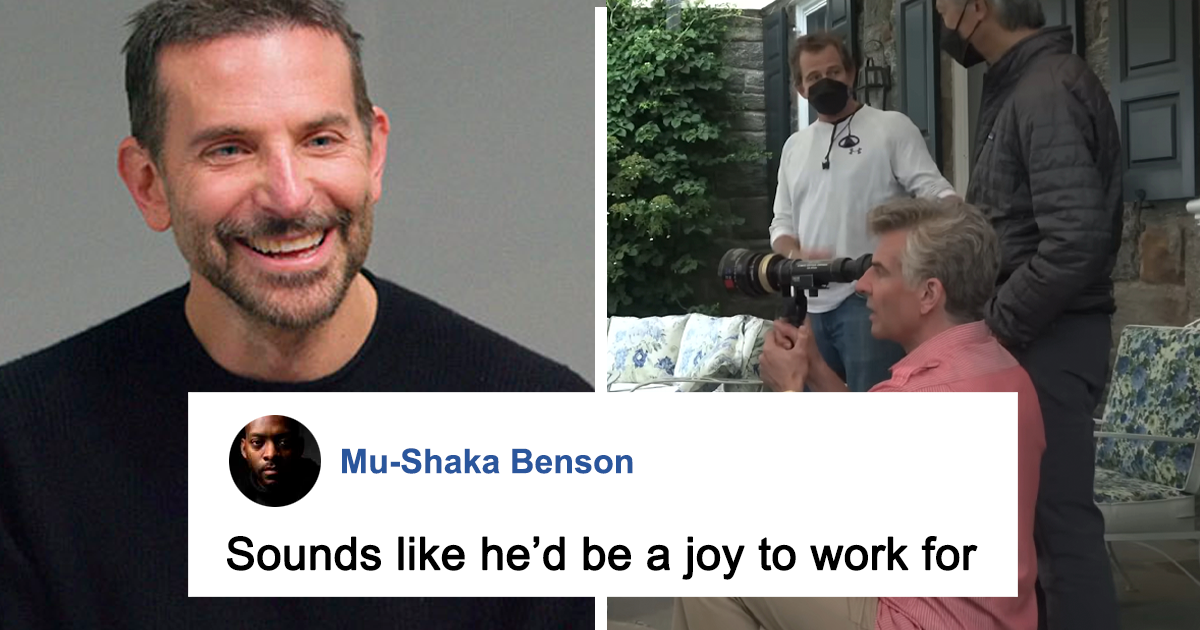
Bradley Cooper has built a reputation as one of Hollywood’s most intense actor-directors, the kind of filmmaker who seems to treat every frame like it has a heartbeat, a backstory, and possibly unresolved childhood issues. But when he revealed that he does not like having chairs on the sets he directs, the internet did what the internet does best: pulled up a chairmetaphorically, of courseand started debating.
The conversation began after Cooper discussed his directing habits during a public filmmaker interview connected to Maestro, his Leonard Bernstein biographical drama. Cooper explained that when he directs, he avoids watching playback, dislikes the “video village” setup, and does not want chairs on set because he feels energy drops once people sit down. He suggested an apple boxa basic wooden box used on film setscan work as a more casual alternative when someone needs to sit.
That may have sounded to Cooper like a philosophy of creative momentum. To many online commenters, however, it sounded like a workplace policy designed by a gym teacher with a megaphone. Some people praised his focus and commitment. Others called the rule unnecessary, uncomfortable, and unfair to crew members who already work long, physically demanding days. The result was a classic celebrity-workplace debate: where does artistic discipline end, and where does basic comfort begin?
What Bradley Cooper Actually Said About Chairs On Set
Cooper’s comments came while he was promoting Maestro, the 2023 film he directed, co-wrote, produced, and starred in as composer and conductor Leonard Bernstein. The movie also stars Carey Mulligan as Felicia Montealegre, Bernstein’s wife, and explores the pair’s complicated lifelong relationship.
In discussing his directing process, Cooper said that he does not watch playback while directing and prefers not to have a video village, the cluster of monitors where directors, producers, and other team members often watch what the camera is capturing. His reasoning was simple: he wants to stay physically close to the actors and the action rather than retreat into a monitor station.
Then came the line that sparked the reaction: no chairs. Cooper said he has “always hated chairs” on sets because, in his view, energy dips the moment someone sits down. He framed the idea as part of a larger preference for togetherness, immediacy, and creative alertness. Instead of traditional set chairs, he mentioned apple boxes, which are common on productions and used for everything from adjusting an actor’s height to propping equipment.
To be fair, Cooper’s remarks did not necessarily mean that nobody could ever rest under any circumstances. The apple box comment suggests he was talking partly about removing the formal chair culture around a director’s station. Still, the phrase “no chairs” landed loudly, especially among people familiar with how long film production days can be.
Why The “No Chairs” Rule Hit A Nerve
Movie sets are glamorous from a distance. Up close, they are often long, repetitive, cold, hot, muddy, noisy, and powered by coffee strong enough to negotiate a hostage situation. Crew members may spend hours setting lights, moving gear, waiting for resets, and standing through multiple takes. Even on a highly organized set, downtime is part of the job.
That is why the idea of banning chairs struck many people as more than a quirky director preference. Critics argued that sitting is not laziness; it is recovery. A camera assistant, production assistant, makeup artist, sound technician, or background actor may spend most of the day on their feet. For them, a chair during a pause is not a luxury throne. It is a small act of survival.
Some commenters described the rule as potentially ableist because not everyone can comfortably stand for long periods. People with chronic pain, disabilities, pregnancy-related needs, injuries, circulation problems, or fatigue may require seating as a reasonable accommodation. Others argued that even fully able-bodied workers perform better when their basic physical needs are respected.
The sharpest criticism was not really about furniture. It was about leadership. Many people read the “energy dips” argument as a sign that a director might mistake discomfort for productivity. In modern workplaces, that idea is increasingly unpopular. Whether the office has cubicles, cameras, or a craft services table full of suspiciously dry granola bars, people tend to work best when they feel trusted and supported.
Why Some People Defended Cooper’s Directing Style
Not everyone saw Cooper’s comments as a scandal. Some viewers defended him, arguing that directors are allowed to build a set culture that matches their creative approach. Cooper is known for being deeply involved in the emotional and technical details of his films. From A Star Is Born to Maestro, his work behind the camera has leaned into intimacy, live performance, and intense actor-to-actor connection.
Supporters also pointed out that film sets have many different zones. A director saying there are no chairs near the active set does not automatically mean no one can sit during official breaks, at base camp, in holding areas, or away from the shooting space. Hollywood language can be messy. “No chairs on set” might sound absolute to the public but function more specifically inside production culture.
There is also a real creative argument behind Cooper’s preference. Some directors believe that sitting behind monitors creates distance between the filmmaker and the performers. By staying near the camera and actors, the director can respond more intuitively, make faster adjustments, and keep the emotional temperature of a scene alive.
That approach makes sense for Cooper’s style. Maestro required him to direct while also performing as Bernstein, often under prosthetics, period costumes, complex lighting setups, and musical demands. His creative process appears to value immersion. If he wants everyone close to the action, he may see chairs and video villages as symbols of separation rather than comfort.
The Christopher Nolan Comparison
Cooper is not the first famous filmmaker to be associated with a chair-free set. Christopher Nolan has long been discussed in similar terms, especially after Anne Hathaway once said he did not allow chairs because he believed people would sit instead of work. That comment became a mini Hollywood legend.
Nolan’s team later clarified that he had not banned chairs for cast and crew in the way the internet imagined. The clarification said the only things truly banned on Nolan’s sets were cell phones and smoking, and that the chairs Hathaway referred to were director-style chairs clustered around monitors. In other words, the situation was less “no human may bend at the knees” and more “the director does not use the usual monitor-chair hierarchy.”
Robert Downey Jr. later joked about the lack of set chairs while discussing Oppenheimer, which kept the topic alive. Zack Snyder has also spoken about preferring a standing-room approach on set, saying it can keep him close to actors and more directly engaged.
These examples show that the chair debate is part of a larger conversation about directorial style. Some filmmakers want the set to feel like a charged creative arena. Others prefer a more traditional setup with monitors, chairs, and defined stations. Neither approach is automatically good or bad. The key question is whether the method respects the people doing the work.
What The Reaction Says About Modern Celebrity Culture
The phrase “A joy to work with” is often used sarcastically online when a celebrity describes a strict or unusual working method. In Cooper’s case, the joke practically wrote itself. A director bans chairs? What a joy to work with. Next up: everyone must blink only during lunch.
But beneath the jokes is a shift in how audiences talk about Hollywood. In earlier eras, stories of extreme artistic discipline were often framed as proof of genius. If a director demanded difficult conditions, people might shrug and say that great art requires sacrifice. Today, audiences are more likely to ask: sacrifice by whom?
That question matters. A star-director has power, visibility, and creative ownership. A crew member may not have the same freedom to challenge a rule, even if the rule affects their body more than the director’s. Social media has made viewers more aware of production labor, from long hours to safety concerns to the invisible work behind every finished film.
So when Cooper talked about chairs, the reaction was not only about Cooper. It was about a broader suspicion of workplace cultures that romanticize exhaustion. Many people are tired of hearing that discomfort equals dedication. Sometimes discomfort equals discomfort. Very cinematic, perhaps, but still uncomfortable.
Bradley Cooper’s Intensity Has Always Been Part Of His Brand
Cooper’s career as a filmmaker has been defined by seriousness of purpose. His 2018 directorial debut, A Star Is Born, was a major critical and commercial success, earning multiple Academy Award nominations and introducing Cooper as more than a movie star with leading-man cheekbones. He proved he could direct actors, stage musical performances, and handle emotionally loaded material.
Maestro took that ambition even further. The film required Cooper to portray Leonard Bernstein across decades, conduct music convincingly, work with complex makeup, and shape a story about art, marriage, identity, and public performance. The production involved black-and-white cinematography, color sequences, shifting aspect ratios, and a carefully designed period atmosphere.
Cooper has spoken about the years of preparation behind the film, and collaborators have described the production as deeply committed to detail. Maestro earned seven Academy Award nominations, including Best Picture, Best Actor for Cooper, and Best Actress for Carey Mulligan. That recognition suggests his intensity produced serious results.
Still, artistic success does not erase workplace questions. A film can be beautiful and still raise debates about process. In fact, the better the movie, the more interested people become in how it was made. Cooper’s chair rule became a lightning rod because it sitssorry, standsright at the intersection of artistry, celebrity, labor, and public image.
Is A Chair-Free Set Good Leadership Or Just A Bad Perk?
The best argument for Cooper’s approach is that it encourages presence. Film is collaborative, and physical proximity can change the mood of a set. When a director is not hidden behind monitors, actors may feel more connected. Decisions may happen faster. The set may feel less hierarchical and more alive.
The best argument against it is that the human body is not a mood board. People need rest. Long production days can already be grueling, and removing comfortable seating may signal that image matters more than well-being. Even if the intention is creative unity, the effect can feel like unnecessary toughness.
There is an obvious middle ground: keep the energy, lose the rigidity. A director can discourage unnecessary lounging near active shooting areas while still making sure cast and crew have real places to sit during pauses and breaks. A set can be focused without becoming a standing-room-only concert where the opening act is lower back pain.
Leadership is not just about getting people to match your intensity. It is about knowing when your intensity needs translation. A director may thrive on motion, pressure, and constant engagement. A crew of hundreds includes people with different jobs, bodies, ages, and needs. The strongest leaders make space for that variety without sacrificing the work.
The Bigger Lesson For Hollywood Sets
The Bradley Cooper chair debate became popular because it is easy to understand. Everyone has sat in a chair. Everyone has stood too long. Everyone knows the tiny joy of finally sitting down after a brutal day. You do not need a film degree to have an opinion.
But the discussion also points to a serious truth: behind every celebrity quote is a workplace. Movie sets are not just magical factories of art. They are job sites with schedules, safety rules, unions, departments, physical demands, and real people trying to do excellent work without wrecking their knees.
The entertainment industry has spent years rethinking labor expectations, from on-set safety to meal breaks to work-life balance. Audiences now pay closer attention to the people behind the camera. A director’s process may still be fascinating, but it is no longer immune to scrutiny.
Cooper’s rule may have been intended as a small insight into his creative rhythm. Instead, it became a public conversation about how much discomfort should be tolerated in the name of art. That conversation is useful, even if it began with something as ordinary as a chair.
Personal Experience And Everyday Lessons From The Chair Debate
The reaction to Bradley Cooper’s no-chair rule feels familiar because many people have experienced a version of it outside Hollywood. Maybe it was a manager who believed a busy office should always look frantic. Maybe it was a restaurant shift where sitting for thirty seconds seemed like a moral failure. Maybe it was a school, warehouse, salon, hospital, retail store, event venue, or startup where “high energy” quietly became code for “ignore your body until it sends a strongly worded resignation letter.”
In many workplaces, leaders set the tone through small details. A chair can become more than furniture. It can represent permission to pause, breathe, think, recover, or simply be human. Removing it may seem efficient, but efficiency is not always the same as excellence. People can look busy while producing mediocre work. They can also be seated, calm, and doing something brilliant.
Creative work especially needs rhythm. There are moments for intensity and moments for stillness. A film set, writing room, design studio, or marketing team cannot run at peak adrenaline forever. If everyone is constantly “on,” the work may become tense rather than alive. Rest is not the enemy of momentum. Often, it is what makes momentum possible.
Anyone who has worked on a demanding project knows the difference between inspiring urgency and performative pressure. Inspiring urgency makes people feel part of something meaningful. Performative pressure makes people afraid to look relaxed, even when thinking deeply. The first creates commitment. The second creates eye twitching and group chats with dramatic names.
The best leaders I have observedwhether in media, business, hospitality, or creative productiondo not measure dedication by who looks the most uncomfortable. They build systems where people can do their best work consistently. They protect focus, but they also protect breaks. They ask for excellence, but they do not confuse exhaustion with loyalty.
That is why the Cooper conversation matters beyond celebrity gossip. It reminds us that workplace culture is often shaped by tiny rules that reveal big beliefs. Are people trusted to manage their energy? Are physical needs treated as interruptions or as part of the work? Does a leader’s personal style leave room for other people’s realities?
To be clear, a passionate director wanting an alert set is not a villain origin story. Cooper’s desire for closeness, focus, and emotional electricity is understandable, especially given the kind of intimate films he makes. But the public pushback shows that modern audiences expect more nuance. They can admire artistic commitment while still asking whether the process is humane.
In the end, the smartest version of the “no chairs” philosophy might not be no chairs at all. It might be no unnecessary distance. No lazy communication. No hiding behind monitors when actors need direction. No hierarchy that turns a set into a furniture-based caste system. But chairs for people who need them? Absolutely. Let the crew sit. The movie will survive. It may even be better because the people making it are not silently negotiating with their hamstrings.
Conclusion
Bradley Cooper’s comments about banning chairs on movie sets sparked a reaction because they touched a cultural nerve. On one side, people saw a passionate filmmaker trying to keep a set energized and connected. On the other, critics saw an unnecessary rule that could make already demanding production days harder for cast and crew.
The truth is probably somewhere in the middle. Cooper’s creative intensity has helped produce acclaimed films, including A Star Is Born and Maestro. His preference for staying close to actors rather than sitting behind monitors fits his hands-on directing style. But great leadership also means understanding that comfort, accessibility, and rest do not weaken creativity. They often protect it.
The chair debate may sound funny because, well, it is about chairs. But it is also about power, labor, art, and the modern expectation that brilliant work should not require unnecessary discomfort. Hollywood can keep its passion, its apple boxes, and its dramatic lighting. It should probably keep a few chairs too.
Note: This article is based on publicly reported interviews and entertainment coverage. It discusses the public reaction to Bradley Cooper’s stated directing preferences without making unsupported claims about private working conditions on any specific production.