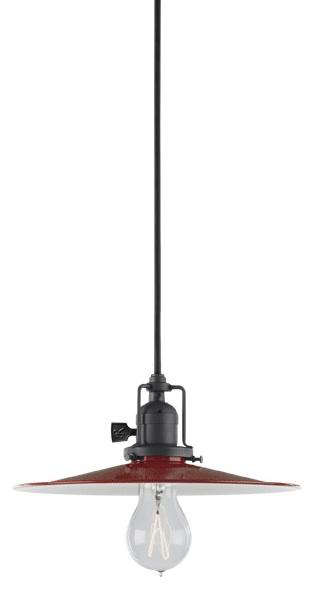
Some light fixtures try very hard to be noticed. They arrive dripping with drama, waving polished brass arms around like they are auditioning for a period film. The McCoy Industrial Pendant at Rejuvenation takes the opposite route. It wins you over by being simple, hardworking, and just a little bit gritty in the best possible way. It does not beg for attention. It earns it.
That is exactly why the McCoy has such lasting appeal. This pendant sits at the sweet spot between vintage utility and stylish restraint. It feels rooted in old workshops, corner diners, and hardworking American interiors, yet it fits surprisingly well in modern kitchens, breakfast nooks, bar areas, and even pared-down entryways. In a world full of lights trying to be sculptures first and fixtures second, the McCoy reminds us that good design often starts with a practical idea and then ages beautifully.
If you are searching for industrial pendant lighting that has character without chaos, the McCoy is the kind of piece that makes a room feel more intentional. It brings shape, focus, and personality overhead without turning the ceiling into a circus. And honestly, that is a rare skill.
What Makes the McCoy Industrial Pendant So Memorable?
The charm of the McCoy Industrial Pendant comes from its straightforward design language. Historically, the fixture was presented as a stripped-down industrial pendant inspired by old drop-cord lights once sold as practical electrical supplies. That origin story matters because you can feel it in the silhouette. Nothing is overworked. Nothing is trying to be precious. The lines are honest, the materials feel purposeful, and the overall look is grounded in utility.
Part of the pendant’s identity also comes from the little details. Archived descriptions tied to Rejuvenation’s McCoy highlighted a black porcelain canopy, cotton-covered cord options, and a 10-inch steel industrial shade offered in several classic enamel colors. Those choices gave the fixture flexibility. Black enamel feels moody and graphic. Ruby red adds a shot of retro confidence. Flint blue feels collected rather than flashy. Dark green brings an old-school workshop vibe that somehow still plays nicely with contemporary cabinetry.
That color range is a big reason the McCoy never feels one-note. It is industrial, yes, but not in the cold, warehouse-for-the-sake-of-warehouse sense. It has warmth. It has personality. It has the kind of visual honesty that lets it work with wood, stone, brass, painted cabinets, and even softer, more traditional interiors.
Why Industrial Pendant Lighting Still Works
It prioritizes function without looking boring
The best industrial pendant lights do not pretend to be something they are not. They are built to direct light where people actually need it: onto countertops, tables, bars, and work surfaces. That is why the style continues to survive trend cycles. Kitchens are still kitchens. Tables are still tables. People still need to chop vegetables without squinting like they are solving a mystery.
The McCoy fits this logic perfectly. Its downlight-friendly shade shape helps create focused illumination, which makes it a strong candidate for kitchen islands and dining spots where you want practical light with visual punch. In other words, it works hard, but it does not look like office lighting. That balance is the whole game.
It adds structure to open spaces
Modern American homes often blur the boundaries between kitchen, dining, and living areas. Pendant lights help carve out visual zones, and industrial pendants do this especially well because they bring a clear outline and a sense of purpose. A McCoy-style fixture over an island says, “This is the prep zone.” Over a breakfast table, it says, “This is where the pancakes happen.” Design can be poetic, but it is also wonderfully bossy.
It plays well with layered lighting
One pendant alone should not be expected to carry an entire room on its metal shoulders. Great spaces usually rely on layered lighting: ambient, task, accent, and decorative. The McCoy shines when it becomes part of that mix. Pair it with recessed ceiling lights for overall brightness, under-cabinet lights for prep tasks, and dimmers for evening mood. Suddenly, your kitchen is not just lit. It is calibrated.
Where the McCoy Pendant Looks Best
Over a kitchen island
This is the most natural setting for a McCoy Industrial Pendant. The fixture’s practical, downward glow makes it ideal for islands where cooking, serving, homework, snacking, and dramatic late-night refrigerator speeches all happen. In a kitchen, the McCoy can bring an old-factory edge without making the room feel harsh.
In white kitchens, a black or dark-colored McCoy adds contrast and keeps the space from floating away into blandness. In wood-heavy kitchens, it reinforces warmth and craft. In mixed-material kitchens with stone counters and metal hardware, it acts like a bridge between textures.
Above a dining table
Industrial pendants can work beautifully in dining areas, especially when you want something less formal than a chandelier. The McCoy is especially appealing in casual dining rooms, breakfast nooks, or open-plan eating spaces where you want atmosphere without fuss. It says, “Yes, dinner matters,” but it also says, “Relax, you can still order pizza.”
Over a bar or counter
The pendant’s utilitarian roots make it a natural above home bars, coffee stations, and long counters. It suits these smaller functional zones because it looks intentional rather than decorative-for-decoration’s-sake. This is a light with a job description.
In an entry or mudroom
If you love a little industrial style, a single McCoy-style pendant can make an entryway or mudroom feel sharper and more memorable. It gives compact spaces identity. Suddenly, the zone where shoes pile up and keys vanish into another dimension starts to look curated.
How to Style a McCoy Industrial Pendant Without Making Your Home Look Like a Movie Set
This is where many people go wrong with industrial lighting. They assume one metal shade means they now need exposed brick, iron stools, distressed floors, and a giant sign that says COFFEE. Please do not do that to yourself.
The McCoy works best when it is allowed to be the industrial note, not the whole song. Pair it with natural wood for warmth, painted cabinets for softness, or marble and quartz for contrast. Let it mingle with traditional millwork, modern counters, or vintage furniture. The magic comes from contrast. A slightly rugged pendant in a polished room feels collected. A slightly polished kitchen with one rugged pendant feels human.
Finish coordination matters too, but matching everything exactly is not the goal. A black pendant can work with brass hardware, bronze faucets, stainless appliances, or aged metals as long as the room feels intentional overall. Think coordinated, not cloned.
Bulb choice also matters more than people think. A fixture like the McCoy can look fantastic with a warm bulb that softens the industrial edge. Go too cool and the room can start feeling like a dental exam. Go too dim and your countertop becomes decorative rather than usable. Aim for warmth, clarity, and dimmable control.
Placement Tips That Keep Industrial Pendants Looking Smart
Good pendant lighting is not just about picking the right fixture. It is also about hanging it at the right height and spacing it properly. This is where great taste meets tape measure.
Height over islands and tables
A common rule for pendants over kitchen islands and dining surfaces is to hang them roughly 30 to 36 inches above the countertop or tabletop. That usually keeps the light low enough to feel connected to the surface, but high enough that no one has to lean around it like it is an awkward dinner guest.
Spacing between fixtures
If you are using more than one pendant, keep enough breathing room between them. In many design guides, around 24 to 36 inches between fixtures is a reliable range, with a tighter sweet spot often used for balanced visual rhythm. The exact number depends on fixture size and island length, but the goal stays the same: even light, even spacing, no accidental clutter.
Distance from the island edge
Another smart rule is to leave some space between the outer pendants and the ends of the island. This keeps the composition centered and avoids the “my pendant is about to fall off the countertop” effect. A margin at each end helps the lights feel anchored rather than random.
Dimmers are not optional in spirit
Technically, yes, you can install a great pendant without a dimmer. Spiritually, that is a mistake. A dimmer lets the same fixture handle meal prep, late-night cleanup, weekend entertaining, and that magical hour when the kitchen somehow looks cleaner under low light.
The Rejuvenation Difference
Part of the reason the McCoy pendant feels credible rather than costume-y has to do with Rejuvenation itself. Rejuvenation’s brand roots are tied to architectural salvage, restoration, and hardware, and that background shows in how it approaches lighting. There is a respect for period-inspired design, material authenticity, and pieces that feel like they belong in real homes, not just pretty photographs.
That heritage helps explain why a fixture like the McCoy resonates. It is not industrial as a gimmick. It is industrial as a design language with history behind it. Rejuvenation has long occupied that territory between restoration-minded detail and everyday usability, which is exactly where a fixture like this thrives.
And that is ultimately why the McCoy still feels relevant. It is not trying to chase the newest look. It is grounded in an older idea: make the object useful, make it handsome, and let the materials speak. Funny enough, that approach ends up looking fresh almost every time.
Why the McCoy Still Belongs in Today’s Homes
So many lighting trends burn hot and disappear fast. One year it is oversized globes. The next year it is sculptural clouds. Then suddenly every fixture looks like abstract jewelry. Some of that can be beautiful, of course, but the McCoy Industrial Pendant offers something more durable: clarity.
It knows what it is. It is a focused, hardworking pendant with vintage industrial DNA, enough visual weight to anchor a room, and enough simplicity to survive changing tastes. It can live in a farmhouse kitchen, a loft-inspired condo, a classic American renovation, or a transitional family home without needing to redecorate the entire room around it.
That is the real benefit of good lighting. It does not just brighten a space. It gives the room a point of view. And the McCoy’s point of view is refreshingly direct: useful things can still be beautiful, beautiful things should still be useful, and a great pendant should never act like it deserves its own publicist.
Extended Experience: Living With the McCoy Industrial Pendant Look
Living with a McCoy-style pendant is less about admiring it once from across the room and more about noticing, day after day, how naturally it settles into daily life. That is where this kind of lighting really earns its reputation. It does not rely on novelty. It relies on usefulness, atmosphere, and the quiet confidence of an object that keeps showing up well.
In the morning, a pendant like this can make a kitchen island feel like the command center of the home. Coffee looks better under it. Toast somehow looks more intentional under it. Even the ordinary clutter of a weekday morning feels slightly more cinematic when there is a focused pool of light pulling the eye downward. Not in a dramatic, “Oscar-worthy breakfast scene” way, but in a grounded, practical way that makes the room feel awake.
During the day, the McCoy look tends to hold its own without overpowering natural light. That is important. Some statement fixtures look impressive at night but become visually noisy in daylight. Industrial pendants usually avoid that problem because their forms are simple and legible. They read clearly from across the room, and they add structure overhead without becoming visual static.
By late afternoon, this is where many homeowners start appreciating the emotional side of the fixture. The pendant becomes less about task lighting and more about mood. Turn on a warm bulb, soften the dimmer, and the island or table suddenly feels like a destination instead of a surface. That shift matters in open-plan homes where the kitchen is not just for cooking. It is for talking, working, grazing, entertaining, and occasionally pretending the unfolded laundry does not exist.
There is also something satisfying about how the McCoy style ages in a room. Because it is not overly ornate, it tends to absorb the life around it rather than fight it. It looks good near worn wood stools, old cutting boards, painted cabinetry, stone counters, and metal hardware that develops a little patina over time. In fact, the pendant often looks better once the room stops feeling newly installed and starts feeling lived in.
That makes it especially appealing for people who want a home with soul, not just polish. The McCoy vibe says you care about design, but you also actually use your kitchen. You cook. You host. You pile mail on the island for a few hours. You wipe everything down and do it all again. The light is there for all of it.
Another experience people often mention with industrial pendants is how surprisingly flexible they are. You might install one because you love vintage utility style, only to discover that it also works with cleaner modern lines, softer textiles, or more traditional furniture than you expected. That adaptability is a gift. It means you can change stools, paint, art, or accessories later without the fixture suddenly looking stranded in a different decade.
And then there is the intangible part: the personality overhead. Every room needs at least one element that gives it backbone. In some spaces, that is a range hood. In others, it is a dramatic faucet, a huge antique cabinet, or a slab of incredible stone. In smaller or simpler kitchens, it might just be the pendant. A McCoy-style fixture can do that job beautifully. It gives the eye a focal point, gives the room a hint of history, and gives everyday routines a little more style than they strictly require. Which, frankly, is one of the best reasons to care about lighting in the first place.
Conclusion
The McCoy Industrial Pendant at Rejuvenation remains a compelling example of why industrial lighting has never really gone out of style. It blends utility, character, and timeless shape in a way that feels grounded rather than trendy. Whether you are designing a kitchen island, upgrading a breakfast nook, or trying to give an open-plan room a stronger focal point, this style of pendant proves that simple design can still make a strong statement.
If your goal is a home that feels warm, practical, and just rugged enough to have a pulse, the McCoy is a smart direction. It is not fussy. It is not fragile. It is not trying to be the star of the room while forgetting to actually light the room. That, in lighting terms, is a beautiful thing.