The Wegner Swivel Chairmaker, an ergonomics-minded doctor, a sculptural chunk of hardwood, and a set of wheels all agree to collaborate. Designed by Danish furniture legend Hans J. Wegner, this remarkable chair combines the warmth of handcrafted wood with the precision of metal engineering. It is part office chair, part functional sculpture, and part convincing argument that your desk deserves better than a squeaky plastic throne.
Most references to the Wegner Swivel Chair mean the JH502, introduced in 1955 by cabinetmaker Johannes Hansen and now produced as the PP502 by PP Møbler. Its carved wooden backrest, upholstered seat, stainless-steel structure, adjustable height, and mobile base make it instantly recognizable. The Metropolitan Museum of Art describes the design as a response to calls for improved chair ergonomics, noting its combination of handcrafted natural materials and industrial components. eader>
What Is the Wegner Swivel Chair?
The Wegner Swivel Chair is a Danish modern office chair created by Hans J. Wegner in 1955. Early examples were manufactured by Johannes Hansen and are commonly identified as the JH502. Contemporary authorized versions are produced by PP Møbler under the model number PP502.
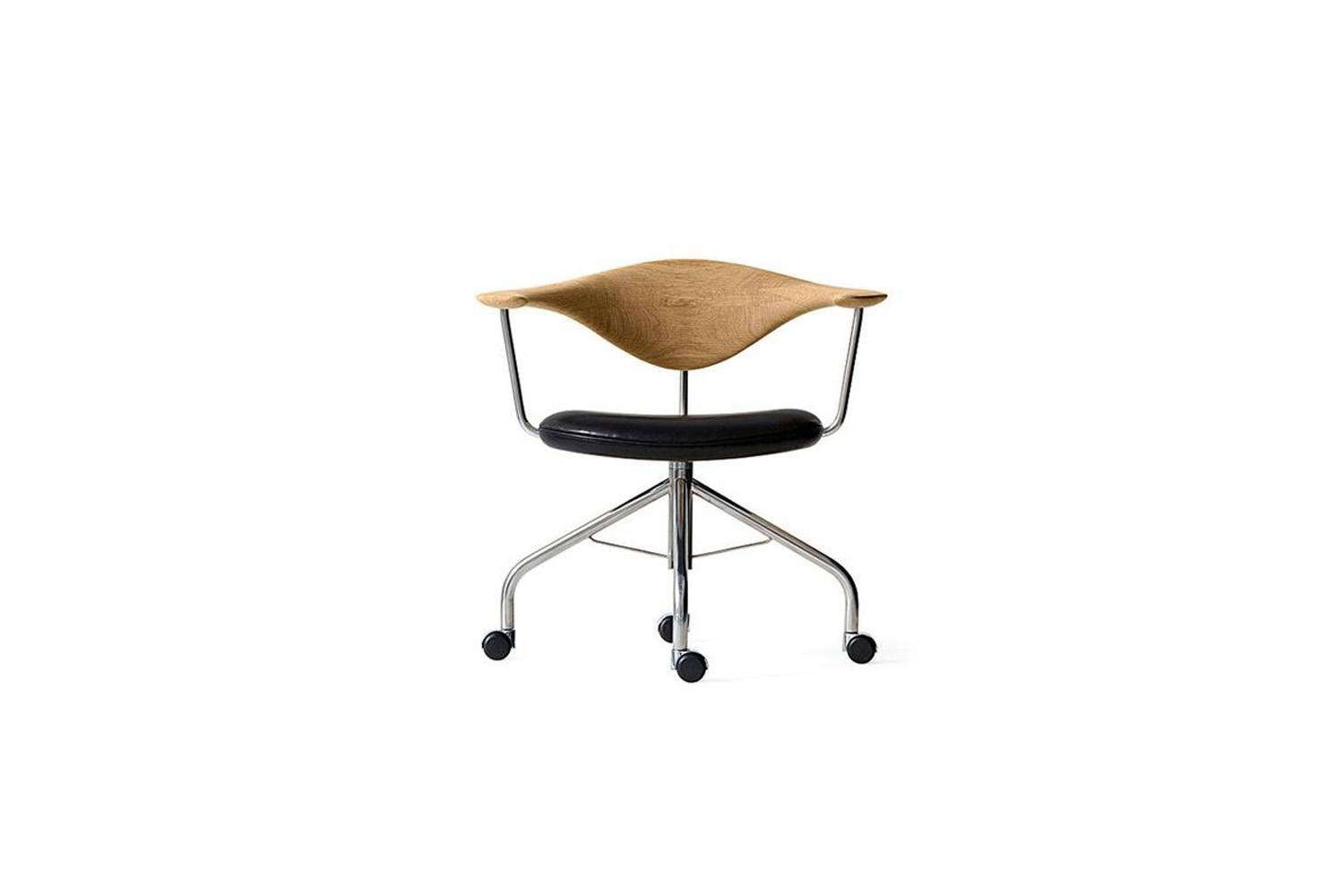
Unlike many mid-century office chairs, the PP502 does not attempt to hide its mechanics. The metal support, swivel mechanism, adjustment hardware, and casters are displayed openly. Above this industrial-looking foundation sits a generously upholstered seat and an extraordinary solid-wood back rail that curves around the body.
The result is a chair filled with contrasts. It looks substantial but visually light. It feels traditional yet mechanical. It belongs beside a handcrafted writing desk but can also hold its own in a glass-walled contemporary office. Few chairs can sit comfortably in both a woodworker’s studio and a corporate boardroom without experiencing an identity crisis.
JH502 Versus PP502
The JH502 designation generally refers to chairs produced by Johannes Hansen, particularly vintage examples from the mid-20th century. The PP502 refers to the authorized version made by PP Møbler. Both represent Wegner’s core 1955 design, although materials, casters, mechanisms, dimensions, and production details may vary by period.
What About the CH621?
The CH621 is another Hans Wegner swivel chair, but it is not the same model. Designed in 1948 and relaunched by Carl Hansen & Søn, it uses a more linear wooden structure, brushed stainless steel, five casters, and a modern gas-lift mechanism. The PP502 is more sculptural, particularly around its dramatic propeller-like back support. ection>
The History Behind the Wegner Swivel Chair
Hans J. Wegner was trained as a cabinetmaker before becoming one of the most influential furniture designers of the 20th century. That background matters because he did not approach chairs as attractive shapes waiting to be manufactured. He approached them as physical relationships between wood, joints, tools, movement, and the human body.
During the 1940s and 1950s, Danish designers were developing furniture that emphasized functional simplicity, natural materials, skilled craftsmanship, and human comfort. Wegner became one of the movement’s defining figures. His work ranged from the Wishbone Chair and Round Chair to folding chairs, lounge chairs, stools, desks, and highly experimental seating.
The Swivel Chair grew partly from a discussion about ergonomics. Physician and consultant Egill Snorrason had criticized the Danish furniture industry for paying insufficient attention to bodily support. Wegner responded seriously rather than retreating dramatically into a workshop and refusing to speak to doctors ever again.
The conversation contributed to the PP502’s large solid-wood back support, shaped to meet the lower back and encourage a comfortable seated position. PP Møbler states that the chair was presented at the Cabinetmakers’ Guild Autumn Exhibition in 1955.
Its design was never intended as an inexpensive mass-market solution. The complicated wood shaping, upholstery, metalwork, joinery, and mechanical components demanded several kinds of specialized craftsmanship. That complexity remains central to the chair’s characterand, less romantically, to its price tag.
Design Details That Make the PP502 Special
The Sculpted Solid-Wood Backrest
The wooden backrest is the visual and ergonomic heart of the chair. It is carved into a broad, flowing form that wraps around the sitter while supporting the lower back. PP Møbler describes the top rail as being twisted like a propeller, an appropriate comparison because it appears to rotate through space even when the chair is standing still.
This component shows why Wegner is frequently associated with organic modernism. The backrest is not decorated with applied ornament. Its beauty comes from grain, proportion, shaping, joinery, and the way the surface changes as it curves.
On a well-made example, the wood does not merely look smooth. It appears almost liquid. That is a dangerous quality in furniture because it may cause otherwise sensible adults to spend several minutes gently touching a chair in a showroom.
The Upholstered Seat
The seat provides a soft visual counterweight to the hardwood back. Leather is strongly associated with the design, although vintage chairs may appear with fabric, vinyl, replacement upholstery, or materials selected for a particular commission.
Upholstery condition is especially important when evaluating an older Wegner chair. Original leather may develop attractive creasing and patina, but dry cracking, torn seams, collapsing padding, or amateur repairs can reduce comfort and complicate restoration.
The Steel Frame and Mobile Base
The steel structure gives the chair its industrial edge. Rather than attaching the carved wooden elements to traditional wooden legs, Wegner suspended them over a metal base with casters. The Metropolitan Museum of Art highlights this union of handcrafted wood, leather, chrome-plated steel tubing, and mobility as characteristic of Scandinavian modernist experimentation.
The base allows users to turn toward a desk, file cabinet, visitor, or strategically hidden snack drawer. More importantly, it gives the chair a functional reason to be placed in a working environment rather than treated only as a collectible object.
Dimensions and Practical Fit
Dimensions vary among original, vintage, and contemporary versions. One current U.S. retailer lists the PP502 at approximately 29 inches wide, 21.6 inches deep, and 29 to 31.5 inches high. The listed seat height ranges from about 18.5 to 20.8 inches, depending on adjustment. Available modern materials include oak, ash, or cherrywood, leather upholstery, and a stainless-steel frame.
A 1950s example in the Metropolitan Museum of Art measures roughly 29 inches in width and is made from teak, leather, and metal. Auction records reveal additional dimensional differences, which may reflect production periods, caster types, upholstery, measurement methods, or later modifications.
Before purchasing, compare the exact chair with your desk rather than relying on a generic model description. Measure the following:
- Floor-to-desktop height
- Clearance beneath the desk
- Armrest height at the chair’s lowest and highest positions
- Available turning space behind the desk
- Doorways, elevators, and stair landings
The wraparound back and arms require more lateral space than a narrow armless task chair. In a compact home office, the PP502 may become the room’s dominant object. Fortunately, it is a rather handsome dictator.
Is the Wegner Swivel Chair Comfortable?
The chair was designed with comfort and lower-back support as major priorities. Its curved backrest meets the body in a way that feels more architectural than cushiony. Instead of surrounding the sitter with thick foam, it uses careful shaping to provide support where it is most useful.
However, buyers should not assume that a celebrated 1955 design will behave like a current high-performance ergonomic task chair. The PP502 does not typically offer the extensive adjustments found on modern office chairs, such as independently adjustable lumbar tension, arm width, seat depth, synchronized recline, or a tall headrest.
Its strongest applications may include executive offices, design studios, writing desks, meeting areas, libraries, and home offices where visual quality matters as much as technical adjustability. Someone working at a computer for ten uninterrupted hours should test the chair carefully and continue taking regular movement breaks.
Comfort is also personal. Height, body proportions, posture, desk dimensions, upholstery firmness, and previous repairs can all affect the experience. A chair can be historically important and still disagree with your knees.
Why Is the Wegner Swivel Chair So Expensive?
The price reflects far more than the presence of a famous designer’s name. The PP502 requires difficult wood carving, refined joinery, upholstery, precision metal fabrication, assembly, finishing, and mechanical adjustment. It is built more like a cabinetmaker’s showpiece than a conventional office product.
Recent authorized U.S. retail listings have priced new PP502 configurations above $20,000, with the final cost depending on wood and finish. Vintage examples can also command substantial prices, although auction results and dealer asking prices vary considerably.
Several factors influence market value:
- Original Johannes Hansen production versus later PP Møbler production
- Documented provenance and ownership history
- Presence of labels, stamps, receipts, or original sales records
- Original wood, upholstery, casters, and hardware
- Quality and reversibility of restoration
- Rarity of the material or production variation
- Overall structural and cosmetic condition
A dealer’s asking price should not be treated as a guaranteed market value. Auction results, private sales, restoration costs, shipping, and buyer premiums may tell very different stories. Collectible furniture pricing occasionally behaves like jazz: recognizable structure, plenty of improvisation.
How to Identify an Authentic Wegner Swivel Chair
Examine the Maker’s Marks
Vintage Johannes Hansen examples may carry a metal manufacturer’s label identifying the cabinetmaker and Hans J. Wegner as the designer. PP Møbler versions may be stamped or marked with the company name, production information, and designer attribution. Auction records document both types of identification.
A mark is useful, but it should not end the investigation. Labels can be damaged, removed, reproduced, or incorrectly associated with later components. Evaluate the entire chair.
Study the Backrest and Joinery
The sculpted back should display confident shaping, balanced proportions, fine finishing, and high-quality wood selection. Visible joints should appear intentional and carefully executed. Crude carving, uneven symmetry, suspiciously lightweight materials, or poorly fitted metal connections deserve additional scrutiny.
Inspect the Casters and Hardware
Caster designs may help indicate production period, but they can also be replaced after decades of use. Some documented early examples have been described with Bakelite wheels, while later examples may use other caster systems. Treat caster style as supporting evidence rather than a one-step authenticity test.
Request Provenance
Ask for invoices, previous auction records, restoration reports, photographs of labels, ownership history, and correspondence from recognized specialists. Sotheby’s guidance for collecting mid-century chairs emphasizes the importance of provenance because popular Wegner designs have frequently been copied.
For an expensive purchase, an independent condition report or expert inspection is sensible. Enthusiasm is delightful, but it is not an authentication method.
How to Style a Wegner Swivel Chair
In a Warm Modern Office
Pair an oak or ash PP502 with a clean-lined walnut desk, wool rug, ceramic lamp, and off-white walls. The mixture of wood tones prevents the room from looking like it was ordered as a matching set during one highly caffeinated afternoon.
In a Minimalist Interior
Allow the chair to serve as the room’s primary sculptural object. Use a simple desk, restrained lighting, and limited accessories. The steel base adds enough visual detail that the surrounding furniture does not need to perform acrobatics.
In a Traditional Study
A cherrywood version or vintage teak JH502 can complement bookcases, aged brass, leather-bound volumes, and darker wall colors. Its modern frame introduces contrast without making the room feel disconnected from its traditional architecture.
As Occasional Seating
The chair can work beside a console, in a library corner, or as a conversation chair in a design-focused living room. Still, it is best appreciated where its swivel and mobility remain useful. Purchasing a rolling office chair and permanently parking it against a wall feels slightly like buying a sports car to store gardening gloves.
Care and Maintenance
Dust the wooden surfaces regularly with a clean, soft cloth. Avoid saturating the wood, placing the chair beside a heating vent, or exposing it to prolonged direct sunlight. Abrupt changes in heat and humidity may affect wood, leather, adhesives, and older finishes.
Follow the manufacturer’s recommendations for the specific finish. Soaped, oiled, and lacquered surfaces require different maintenance. A cleaner appropriate for one finish may stain or dull another.
Leather should be cleaned conservatively with products suitable for its type and finish. Test any treatment in an inconspicuous area. Vintage leather with important patina may require guidance from an upholstery conservator rather than an enthusiastic application of whatever conditioner happens to be under the kitchen sink.
Check the casters periodically for debris, uneven movement, or damage. Protect delicate wood flooring with an appropriate mat if necessary. If the swivel or height mechanism develops a problem, consult a professional familiar with collectible furniture instead of forcing the controls.
Major restoration should balance usability with historical integrity. Replacing worn upholstery may improve comfort, but removing original material can affect collector value. Document every repair and retain any original components that are removed.
Is the Wegner Swivel Chair Worth Buying?
The PP502 can be worth its considerable price for buyers who value authentic Danish modern design, exceptional craftsmanship, sculptural furniture, and long-term collectibility. It offers a distinctive combination of office function and museum-level visual presence.
It may be less suitable for shoppers who primarily need maximum ergonomic adjustment, easy replacement parts, compact dimensions, or an office chair that can be replaced without holding a small financial summit.
Reasons to Buy
- Historically important Hans Wegner design
- Exceptional hardwood shaping and craftsmanship
- Functional swivel and mobile base
- Strong visual impact in home and professional offices
- Potential long-term appeal among design collectors
Reasons to Look Elsewhere
- Extremely high purchase price
- Fewer adjustments than a modern ergonomic task chair
- Specialized maintenance and restoration needs
- Risk of reproductions, altered examples, and uncertain provenance
- Relatively large visual and physical footprint
Living With a Wegner Swivel Chair: The Ownership Experience
The practical experience of owning a Wegner Swivel Chair begins before anyone sits down. The chair changes the visual hierarchy of a room almost immediately. A perfectly respectable desk may suddenly look like supporting furniture. Lamps become background actors. The wastebasket quietly hopes nobody notices it.
From the front, the chair feels broad and welcoming. From the side, the relationship between the floating seat, steel structure, and carved back becomes more obvious. Walking around it reveals changing curves and reflections, making the PP502 more visually active than a conventional office chair.
The First Sitting Experience
When sitting down, the first noticeable quality is usually not plush softness. It is the way the wooden back meets the lower torso. The support feels shaped rather than padded, creating a clear point of contact while leaving the upper body relatively free.
The wraparound arms make the chair feel secure without creating the enclosed sensation of a high-backed executive chair. Depending on the sitter’s proportions, the back may encourage a more upright posture. The chair feels especially natural during reading, writing, conversation, and shorter periods of concentrated desk work.
Users accustomed to heavily adjustable mesh chairs may initially reach for controls that do not exist. There is no dashboard of levers competing for attention. This simplicity can feel refreshing, although anyone who requires highly individualized adjustments should test the chair for an extended period before purchasing.
Using It at a Desk
At a well-proportioned desk, the swivel action makes transitions smooth. You can turn from a computer to a visitor, side table, bookshelf, or filing cabinet without repeatedly dragging the chair across the floor. The casters add mobility, but their performance depends on the production period, condition, and flooring.
Armrest clearance deserves special attention. At the wrong desk, the sculpted arms may prevent the chair from moving close enough to the work surface. At the right desk, the chair creates a comfortable and visually balanced workstation. Measuring first is significantly less exciting than buying first, but it is also less likely to result in expensive geometric disappointment.
Daily Visual Enjoyment
One of the strongest ownership benefits is that the PP502 remains interesting when unoccupied. Morning light emphasizes the grain in the backrest. Evening light reflects from the metal frame. Leather gradually records patterns of use, while wood develops subtle tonal changes.
This evolving appearance is part of the chair’s appeal. A carefully maintained example does not need to remain clinically perfect. Small signs of age can provide depth and character, particularly on vintage chairs. The goal is graceful use, not neglect disguised with the glamorous word “patina.”
Visitors and Conversation
The chair is also an effective conversation starter. Even guests unfamiliar with Danish design tend to notice the backrest and construction. Some will ask who designed it. Others will ask whether they are allowed to sit in it. A few may perform an immediate online price search and then rise with the caution normally reserved for handling ancient manuscripts.
In a client-facing office, the chair communicates attention to detail without relying on logos or obvious decoration. It suggests that the owner values materials, design history, and craftsmanship. Whether that impression is worth the investment depends on the space and the owner’s priorities.
The Emotional Side of Ownership
Collectible furniture creates a different relationship from disposable furniture. Owners are more likely to notice humidity, sunlight, caster noise, finish condition, and the behavior of guests carrying red wine. Maintenance becomes part of stewardship.
That responsibility can be satisfying. The chair was designed to survive changing interiors and generations of users. Caring for it creates a sense of continuity with the craftspeople who shaped the wood, fabricated the metal, and upholstered the seat.
The experience is therefore larger than comfort alone. The Wegner Swivel Chair offers movement, support, craftsmanship, history, and daily visual pleasure. It may not be the most technically adjustable office chair available, but very few task chairs can transform an ordinary work area into a room worth lingering in after the laptop closes.
Conclusion
The Wegner Swivel Chair remains one of the most ambitious office chairs of the Danish modern era. Its carved solid-wood back, upholstered seat, steel frame, casters, and adjustable mechanism demonstrate how traditional craftsmanship can coexist with industrial materials.
For collectors, the JH502 offers historical significance and the character of early Johannes Hansen production. For buyers seeking a newly manufactured example, the PP502 delivers authorized craftsmanship with contemporary material and finish options. In either case, authentication, condition, dimensions, comfort, and restoration history deserve careful evaluation.
This is not an inexpensive chair, nor is it intended to disappear quietly beneath a desk. It is a functional design statement created for people who believe a workplace can be practical without looking painfully practical. The Wegner Swivel Chair rolls, turns, supports, and occasionally steals the entire roomwhich, to be fair, it has been practicing since 1955.