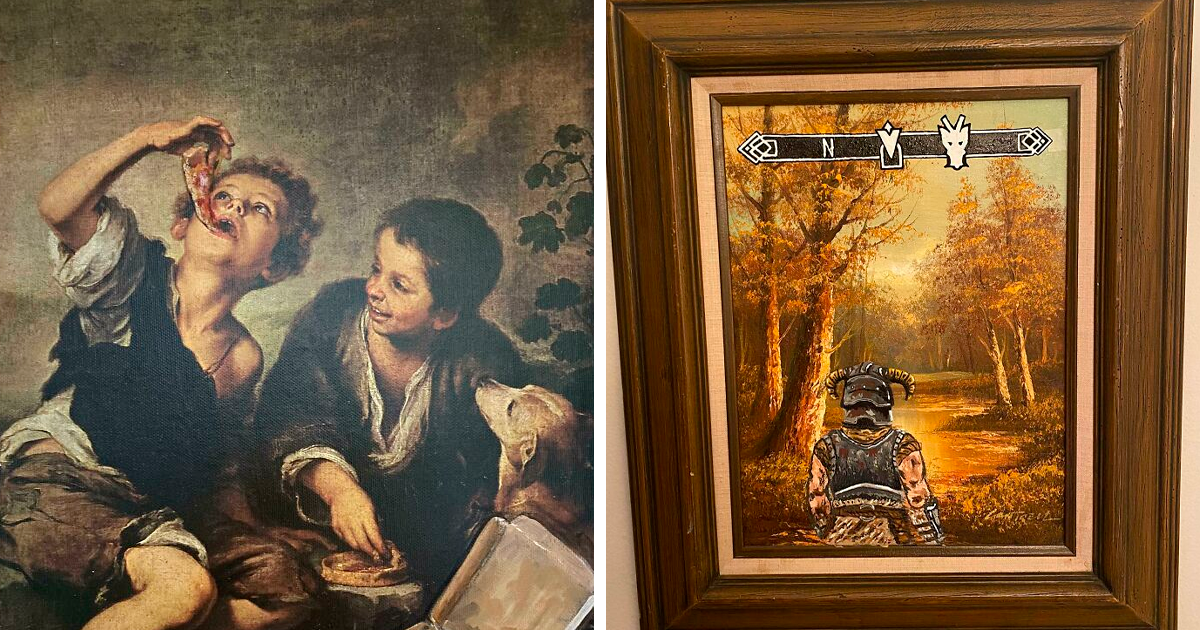
A thrift-store painting is rarely just a painting. It is also a mystery, a time capsule, a decorating decision someone eventually regretted, andif the creative internet gets involveda perfectly good place to add Godzilla.
Across thrift shops, flea markets, estate sales, garage sales, and dusty curbside boxes, artists are finding forgotten landscapes and giving them wonderfully strange second lives. A peaceful mountain scene gains a UFO invasion. A quiet cottage becomes haunted. A formal portrait suddenly features laser eyes, tentacles, or a suspiciously cheerful dinosaur.
This creative practice is often called thrift-store repainting, redirected art, altered art, or upcycled art. Communities devoted to “repaintings” focus on changing the context or content of existing physical artwork with real paint rather than simply applying a digital filter. Museums and art educators also recognize the broader tradition of using found objectsmaterials that were not originally created for a new artistic purposeas a legitimate way to explore history, imagination, and transformation.
The following 30 thrift-store painting upgrades show why this trend is so addictive. They are funny, clever, occasionally spooky, and far more memorable than another mass-produced sign telling us to “live, laugh, love.”
Why Artists Keep Repainting Thrift-Store Art
The appeal begins with accessibility. A new stretched canvas can be expensive, but a framed secondhand painting may cost less than lunch. The artist receives a ready-made surface, an existing composition, and often a frame that would be costly to replace. The original scene also provides a creative prompt: What unexpected character belongs on this road? What is hiding behind that barn? Why does that fisherman look as though he has just seen a sea monster?
Artists such as Dave Pollot, David Irvine, and Wesley Altena have become known for blending contemporary characters, science-fiction references, monsters, and visual jokes into overlooked paintings. Their strongest pieces do not merely place a cartoon figure on top of an old landscape. They study the original lighting, perspective, color, and brushwork so the new addition appears to have been waiting there all along.
Repainting also supports the basic idea behind creative reuse: extending the life of something that might otherwise be discarded. Organizations involved in secondhand retail describe reuse as part of a circular economy in which products and materials remain useful for longer instead of immediately becoming waste.
30 Brilliant Ways Old Paintings Were Given New Lives
1. Godzilla Interrupts a Quiet Coastal Morning
An ordinary seaside painting becomes considerably less ordinary when Godzilla rises behind the lighthouse. The upgrade works best when the creature is partially hidden by sea mist, giving viewers a moment to admire the scenery before noticing that the local property values are about to collapse.
2. A UFO Hovers Over a Country Farm
Few things improve a peaceful rural landscape faster than unexplained lights in the sky. By matching the UFO’s colors to the sunset and adding a subtle beam near the barn, an artist can turn inexpensive farmhouse decor into a complete science-fiction story.
3. A Dinosaur Wanders Through an Autumn Forest
A large dinosaur painted between tiny orange trees instantly changes the scale of the original scene. Instead of looking pasted on, the creature can be softened with atmospheric haze so it feels naturally presentassuming enormous prehistoric reptiles in New England are considered natural.
4. A Giant Cat Takes Over the Village
Some thrifted landscapes feature tiny streets and miniature houses that are perfect for a colossal cat. One raised paw and a few alarmed villagers create a disaster movie with whiskers.
5. A Sea Monster Appears Beside a Fishing Boat
Old maritime paintings practically volunteer for this treatment. A curling tentacle, dark shape beneath the water, or pair of glowing eyes introduces danger without covering the original artist’s waves, clouds, and carefully painted boat.
6. Ghosts Move Into an Abandoned Mansion
A gloomy house painting already contains most of the necessary atmosphere. Adding transparent figures in upper windows turns it into haunted-house art that feels spooky without relying on buckets of fake blood or a plastic skeleton from the seasonal aisle.
7. A Robot Walks Across a Mountain Valley
The contrast between natural scenery and polished machinery makes this type of repainting especially effective. The robot’s metal surfaces can reflect the valley’s colors, helping the addition blend into the original composition.
8. A Dragon Claims the Castle
Many secondhand paintings depict castles that look suspiciously dragon-free. An artist can fix this historic oversight by curling a winged creature around a tower and adding a thin trail of smoke above the roof.
9. Tiny Astronauts Explore a Desert
A faded desert landscape can become another planet with surprisingly few changes. A pair of astronauts, unusual shadows, and a distant moon are often enough to transform Arizona-style scenery into an interstellar expedition.
10. A Shark Swims Through a Living Room
Formal interior paintings are excellent settings for surreal intrusions. A shark passing through a wall or floating above antique furniture creates the sort of decorating statement that guarantees guests will stop discussing the weather.
11. A Skeleton Joins a Romantic Picnic
Pastoral paintings often feature couples relaxing beside rivers or beneath trees. Adding one politely seated skeleton creates an unexpectedly charming reminder that romance is temporary but awkward third wheels may be eternal.
12. A Wizard Appears on a Woodland Path
A winding trail naturally invites a character into the scene. A small cloaked figure carrying a staff can turn generic woodland art into the opening chapter of a fantasy adventure.
13. A Spaceship Lands Behind a Barn
This upgrade succeeds through restraint. Rather than dominating the entire painting, the spacecraft sits partly concealed in the distance, rewarding viewers who take a second look.
14. Monsters Hide Beneath a Peaceful Lake
A lake does not need a fully visible creature to become unsettling. A few ripples, a dark silhouette, and the suggestion of a fin allow the viewer’s imagination to handle the frightening part.
15. A Superhero Flies Over a City
Older cityscapes provide architecture, depth, and dramatic skies for free. The repainting artist only needs to add a small airborne figure, matching highlights, and perhaps a few startled pedestrians.
16. A Friendly Alien Joins a Family Portrait
Formal portraits can feel stiff, which is exactly why they become so funny when an alien is placed among the relatives. The best versions reproduce the original clothing style and pose, as though the extraterrestrial cousin had always been invited.
17. A Kraken Attacks an Old Sailing Ship
In this transformation, the original ship remains the dramatic center while tentacles wrap around the hull. Matching the age and texture of the paint prevents the monster from looking too clean or digitally modern.
18. A Zombie Strolls Through a Flower Garden
A cheerful garden provides the ideal contrast for a mildly decomposed visitor. The joke becomes even better when the zombie is painted carrying a watering can or admiring the roses.
19. A Video Game Character Enters a Classical Landscape
Recognizable gaming figures can turn nostalgic decor into a collision of two eras. The trick is to adapt the character to the painting rather than reproducing bright screen graphics without adjustment.
20. A Floating Whale Crosses the Sky
Surrealism does not always need explosions or monsters. A whale drifting through soft clouds can make an inexpensive landscape feel poetic, dreamlike, and just strange enough to deserve a prominent wall.
21. A Witch Opens a Portal in the Forest
Glowing circles and mysterious figures introduce a strong focal point to a dark woodland scene. Reflected light painted onto nearby rocks and branches makes the portal feel convincingly bright.
22. Dinosaurs Replace Farm Animals
Cows are pleasant, but triceratops are better conversation starters. By preserving the original pasture and replacing only a few animals, the artist creates a believable alternate history of American agriculture.
23. A Spacesuit Replaces a Victorian Outfit
Portrait transformations do not always require changing the face. Replacing formal clothing with an elaborate spacesuit preserves the subject’s personality while completely rewriting the story.
24. A Haunted Train Crosses the Countryside
Railroad paintings can be upgraded with ghostly passengers, glowing windows, or spectral steam. The result combines industrial nostalgia with supernatural mystery.
25. A Giant Rubber Duck Invades the Harbor
Not every repainting needs to be dark or dramatic. A huge yellow duck floating among realistic boats is funny because the original scene takes itself so seriously.
26. An Octopus Becomes the Portrait’s New Hairstyle
In this clever alteration, tentacles follow the shape of a subject’s original hair. The transformation works because the addition responds to the existing portrait instead of ignoring it.
27. A Mushroom Village Appears Beneath the Trees
Tiny doors, windows, ladders, and lanterns can turn ordinary mushrooms into a miniature community. This approach rewards close viewing and allows artists to add dozens of narrative details without overwhelming the landscape.
28. A Mysterious Door Opens in the Mountainside
Sometimes the best upgrade is not a character but a question. A glowing doorway built into a cliff instantly makes viewers wonder where it leads and who left it open.
29. A Movie Monster Waits Behind a Suburban Home
Suburban scenes become wonderfully absurd when a giant creature peers over a roof. The calm front lawn and tidy driveway make the approaching disaster even funnier.
30. The Frame Becomes Part of the Artwork
Creative upgrades do not have to stop at the canvas. Artists may paint vines, tentacles, smoke, or tiny footprints across the frame, making it appear as though the new story is escaping into the viewer’s world. Designers also recommend reframing, repairing mats, or changing frame finishes as effective ways to modernize secondhand art.
What Makes a Thrift-Store Painting Upgrade Successful?
Respecting the Original Composition
The most convincing repaintings cooperate with the original artwork. Artists study where the eye naturally travels, which areas contain empty space, and how the scene uses depth. A flying saucer may belong in an open sky, while a monster might emerge from an existing shadow or body of water.
Matching Light and Perspective
A beautifully painted dinosaur will still look like a sticker if its lighting comes from the wrong direction. Successful artists identify the scene’s primary light source, copy its color temperature, and place shadows that follow the original perspective.
Imitating Texture and Age
Many thrift-store paintings have thick brushstrokes, yellowed varnish, faded colors, or visible canvas texture. New paint that is too smooth or bright can break the illusion. Some artists use thin layers, muted pigments, dry-brushing, or carefully applied glazing to help their additions belong.
Leaving Enough of the Original Painting Visible
The existing work is not merely a cheap background. It is half of the visual joke and often the source of the entire idea. Completely covering it may produce a good painting, but it loses the delightful collision between the old scene and the new intervention.
Tips for Trying Thrift-Store Repainting Yourself
Start with a low-cost decorative painting rather than anything that appears historically significant. Check the front and back for signatures, gallery labels, dates, unusual stamps, or handwritten notes. Rare thrift-store discoveries have occasionally turned out to be valuable works, so a few minutes of research may prevent an accidental art-history tragedy.
Clean the surface gently and determine whether it is oil, acrylic, or a printed reproduction. Test new materials in an inconspicuous area. Acrylic paint is convenient for many beginner projects, but adhesion can vary, especially on glossy varnish or slick printed canvases.
Sketch the new element on tracing paper before touching the artwork. This lets you test size, position, and perspective. When the design feels right, transfer only the essential guidelines and build the new image gradually with thin layers.
Artists planning to sell altered works should also think carefully about copyright and attribution. Purchasing a physical painting does not automatically transfer its copyright, and U.S. copyright protection generally begins when an original artwork is fixed in a tangible medium. Legal questions may depend on the age of the original work, its copyright status, the nature of the alteration, and how the finished piece is marketed.
Why Upcycled Paintings Deserve More Than a Laugh
Humor is the easiest way into these artworks, but the best examples offer more than a punchline. They encourage viewers to reconsider who gets to make art, which materials are worth saving, and whether an unwanted object has truly reached the end of its useful life.
The Metal Museum notes that artists working with repurposed materials change the meaning and value of objects that might otherwise be discarded. The Susquehanna Art Museum similarly describes upcycled art as work made by transforming commonplace, discarded, or unexpected materials into detailed and surprising pieces.
A secondhand landscape may not have attracted attention in its original form. After a careful intervention, however, it becomes personal. It carries evidence of at least two creative decisions made at different times: the first artist’s scene and the second artist’s response.
Experiences From Hunting for and Upgrading Forgotten Paintings
The first lesson of thrift-store art hunting is that patience matters more than luck. Walking into one shop and expecting to discover the perfect foggy castle is like visiting a grocery store and expecting the avocados to cooperate. Sometimes the racks contain nothing but inspirational word art, faded hotel prints, and seventeen paintings of fruit bowls. Then, behind a frame featuring an aggressively cheerful rooster, you find a moonlit forest with exactly enough empty space for a mysterious creature.
It helps to shop with possible stories in mind rather than a rigid checklist. A lake can support a submarine, serpent, or suspicious rubber duck. An old road can receive a robot, time traveler, or parade of ghosts. A portrait may only need one tiny changea strange pin, glowing eyes, or an unexpected hand emerging from behind the chairto become completely different.
One practical challenge is learning when to stop. The first addition often creates the joke. The fourth addition may explain the joke, underline it, circle it in red, and then hit it with a novelty hammer. Leaving quiet areas untouched allows the original painting to keep some authority and gives viewers the pleasure of discovering the alteration.
Color matching can be equally humbling. Paint that looks like a perfect forest green on a palette may become neon toothpaste once placed beside a decades-old landscape. Mixing small amounts of complementary colors helps reduce intensity. Photographing the piece in grayscale can also reveal whether the new object is too bright or dark for its surroundings.
Frames deserve attention as well. A damaged gold frame may look hopeless under fluorescent thrift-store lighting, yet minor cleaning and touch-up work can make it theatrical in the best possible way. Sometimes the frame suggests the entire concept. Ornate corners may resemble vines, waves, bones, or mechanical parts that can be extended into the painted scene.
Another lesson is to look beyond technically accomplished artwork. An imperfect painting may offer more creative freedom than a highly polished one. Crooked perspective, odd anatomy, and unusual color choices can become part of the new narrative. A strangely proportioned horse does not necessarily need correction; it may simply need wings.
Sharing the finished piece is often as satisfying as painting it. Viewers first recognize the familiar thrift-store aesthetic, then notice the invading character, and finally inspect the details used to connect old and new. That delayed reaction is the magic of repainting. The art does not announce the joke immediately. It lets the joke sneak up from behind a tasteful pine tree.
The strongest personal experience, however, comes from rescuing something ignored and treating it as creatively useful. Even when the final result is goofy, the process requires observation, problem-solving, color theory, patience, and respect for an existing composition. The artist is not starting with an empty canvas but joining a conversation that began yearsor perhaps decadesearlier.
Conclusion
Paintings from thrift stores and garage sales offer more than inexpensive wall decor. In the hands of imaginative artists, they become settings for monsters, spaceships, ghosts, dinosaurs, superheroes, and wonderfully unnecessary giant cats.
The charm of upgraded thrift-store paintings comes from contrast. Traditional scenery meets modern humor. Forgotten craftsmanship meets a fresh creative voice. An object headed toward storage or disposal becomes the centerpiece of a roomand possibly the only landscape painting in history to contain both a covered bridge and an alien abduction.
Whether you plan to create altered art yourself or simply enjoy browsing other artists’ transformations, these repaintings prove that old art does not always need to be restored to its former condition. Sometimes it needs a dragon.
Note: Before modifying a secondhand painting, inspect its signature, labels, construction, and provenance. Avoid altering artwork that may be historically, culturally, personally, or financially significant, and research copyright considerations before selling reproductions or commercially marketing an altered piece.