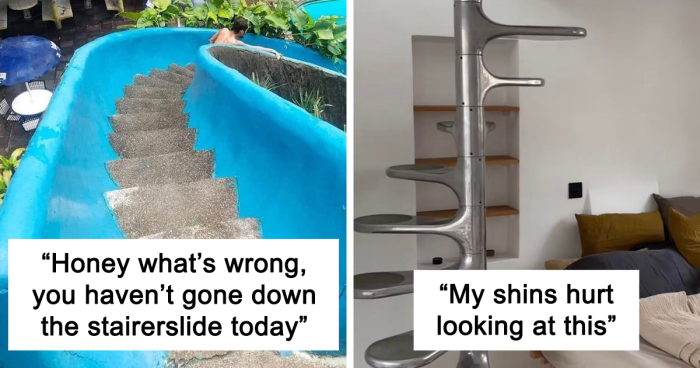
Some staircases whisper, “Come upstairs.” Others look you straight in the eye and say, “Update your will.” That is the strange, hilarious, and mildly terrifying charm behind the viral world of “death stairs,” where people share photos of horribly designed staircases that appear to have been planned by someone with a ruler, a dream, and absolutely no concern for knees.
The title “30 Horribly Designed Staircases That Are Just An Accident Waiting To Happen, As Shared On This Facebook Group” sounds funny at first, but the topic is not only internet comedy. Bad staircase design can create real hazards: falls, twisted ankles, missed steps, head bumps, broken railings, and the classic laundry-basket wipeout nobody wants to star in. Stairs are one of the most ordinary features in a home, yet they demand serious design discipline. A staircase is not just decoration; it is a daily transportation system for people, pets, groceries, furniture, and the occasional overconfident teenager.
Online communities that collect dangerous staircase photos often feature the same villains: steep steps, uneven risers, missing handrails, confusing patterns, slippery materials, tiny landings, low ceilings, and open gaps big enough to make parents inhale sharply. The best posts are funny because they are absurd. The worst ones are scary because someone actually has to use them.
Why Bad Staircase Design Goes Viral
Dangerous stairs are perfect internet material because they trigger two reactions at once: laughter and survival instinct. You see a floating staircase with no railing and think, “Wow, sleek!” Then your brain adds, “Also, goodbye.” A bright red spiral staircase squeezed into a corner may look like modern art, but carrying a suitcase down it feels like participating in a game show called Who Wants a Medical Bill?
The viral appeal also comes from how familiar stairs are. Everyone understands them. You do not need an architecture degree to know that a step shaped like a triangle, installed beside a glass wall, under poor lighting, with no railing, is not exactly a warm hug from building science. The danger is visible. The punchline is immediate.
What Makes a Staircase “Horribly Designed”?
A bad staircase usually fails in one of three ways: it is physically unsafe, visually confusing, or impractical for normal life. The truly legendary disasters manage all three before breakfast.
1. Uneven risers
Stairs work because your body learns the rhythm: step, step, step. When one riser is higher or lower than the rest, your foot expects one thing and the stair delivers another. That tiny mismatch can cause a trip. It is the staircase equivalent of someone moving the last step in the dark.
2. Treads too shallow for real feet
A tread is the horizontal part you step on. If it is too shallow, only part of your foot lands safely. That might be acceptable for a mountain goat, but most homeowners are not mountain goats, no matter how confidently they climb stairs while holding coffee.
3. Missing or decorative-only handrails
A handrail should be easy to grab, continuous, sturdy, and located where people naturally reach. A beautiful rail that cannot be gripped is basically a sculpture with liability issues. A staircase with no handrail at all may look open and minimalist, but gravity remains a maximalist.
4. Slippery surfaces
Polished stone, glossy tile, glass treads, and slick painted wood can look expensive. They can also turn socks into tiny escape vehicles. Smooth materials need traction, especially on stairs that connect kitchens, entries, basements, decks, or outdoor areas where moisture is common.
5. Optical-illusion patterns
Some staircases are covered in wild carpet, striped tile, mirrored finishes, or patterned paint that makes it hard to tell where one step ends and the next begins. A dramatic pattern belongs on a throw pillow, not on the surface your feet use to negotiate vertical reality.
The 30 Most Common “Death Stair” Design Fails
Instead of copying social media posts, here is a fresh, practical breakdown of the staircase sins that show up again and again in viral photos and real homes.
- The ladder pretending to be stairs: So steep you need emotional support before descending.
- The no-handrail wonder: Minimalist, airy, and one sneeze away from chaos.
- The glass staircase: Beautiful until depth perception files a complaint.
- The floating steps: Stylish gaps, scary shadows, zero forgiveness.
- The spiral too tight to carry laundry: Great for castles, bad for baskets.
- The uneven DIY basement stairs: Every step is a new personality.
- The carpeted camouflage stairs: Where tread edges disappear like socks in a dryer.
- The outdoor moss staircase: Nature’s slip-and-slide, now with more regret.
- The stairs with no landing: Open the door and immediately begin your descent into panic.
- The low-headroom stairwell: Perfect for anyone under five feet and nobody else.
- The single awkward step: The silent ankle assassin in sunken living rooms.
- The tiny triangular winder steps: One side has space; the other side has betrayal.
- The railing that stops too soon: Helpful until exactly when you need it most.
- The open-riser child hazard: Modern design with a side of parental dread.
- The glossy marble staircase: Hotel-lobby energy, emergency-room potential.
- The narrow attic stairs: Designed for ghosts, not adults carrying boxes.
- The basement stair with poor lighting: A horror movie set disguised as home improvement.
- The deck stairs with uneven settlement: Weather, soil, and time forming a conspiracy.
- The painted-black-on-black staircase: Moody, dramatic, and invisible at night.
- The stairs beside an unguarded drop: Open-concept anxiety.
- The novelty bookshelf stairs: Clever storage, questionable footing.
- The pet-unfriendly staircase: Tiny paws meet big design ego.
- The stairs with clutter on every step: Shoes, toys, and destiny waiting together.
- The rail made from pipe but not positioned correctly: Industrial style, accidental obstacle course.
- The shallow exterior steps: Rain arrives and suddenly everyone is ice-skating.
- The staircase with surprise height changes: Your knees did not consent.
- The decorative rope handrail: Nautical charm, limited rescue value.
- The stairway blocked by furniture: Because emergency exits love a challenge.
- The split-level step nobody sees: A small step with a large legal department.
- The “architectural statement” staircase: It makes a statement, and that statement is “hold my insurance premium.”
Real Safety Rules Behind the Internet Jokes
Behind every funny “bad stairs” photo is a serious design principle. In U.S. homes, stair safety commonly depends on predictable dimensions, adequate headroom, safe openings, proper handrails, sturdy guards, and lighting. The International Residential Code requires handrails on at least one side of stair flights with four or more risers. The International Building Code and accessibility standards also emphasize handrails, uniform step dimensions, and safe stair geometry for public and commercial spaces.
Accessibility standards are especially useful for understanding why uniformity matters. ADA stair provisions require consistent riser heights and tread depths, and they do not allow open risers in covered stairways. That is not because regulators hate fun. It is because people move safely when each step behaves like the last one.
Workplace standards tell the same story. OSHA requires stairs to have uniform riser heights and tread depths between landings, sufficient vertical clearance, and compliant handrails or stair rail systems. Whether a staircase is in a warehouse, office, shop, or home, the physics do not change. A bad step is a bad step everywhere.
Why Stair Falls Are More Than a Meme
Staircase fails are funny online because most viewers are safely sitting down. In real life, falls can be serious. Peer-reviewed research on stair-related injuries in the United States estimated more than 24 million emergency-department-treated stair injuries across a multi-decade study period, averaging more than one million patients per year. Falls are also a major injury concern for older adults, and the CDC identifies falls as a leading source of traumatic brain injuries and hip fractures among seniors.
That does not mean every odd staircase is a disaster waiting to happen. Historic homes, tiny houses, lofts, cabins, and renovated buildings often involve space constraints. But a staircase that looks quirky should still be usable, visible, stable, and forgiving. Charm is lovely. A handrail is lovelier.
Design Mistakes That Turn Pretty Stairs Into Problem Stairs
When aesthetics beat anatomy
Design magazines love dramatic staircases: thin treads, open sides, glass panels, sculptural rails, floating structures, and moody lighting. The trouble starts when a staircase is designed more for photography than walking. Humans need foot room, balance support, edge visibility, and a clear path. A staircase should not require the concentration level of landing a plane.
When lighting is treated as decoration
Lighting is not just ambiance. It is navigation. Poor lighting makes tread edges harder to see, especially for older adults, guests, children, and anyone carrying something. Wall sconces, tread lighting, overhead fixtures, and switches at both ends of a stair run can turn a scary stairwell into a normal one.
When handrails are an afterthought
A handrail should continue through the full stair run, sit at a usable height, and be shaped for a secure grip. Some “designer” railings look like they were made to impress a camera, not support a person. If someone cannot grab it quickly, it is not doing its main job.
When stairs become storage
Even a well-built staircase becomes dangerous when every other step holds shoes, bags, toys, books, tools, or a mysterious extension cord nobody admits owning. Stairs are not shelves. They are movement zones. The staircase should remain clear, especially near the top and bottom landings.
How To Tell If Your Staircase Is Accident-Prone
You do not need to be a building inspector to spot obvious problems. Walk your stairs slowly in daylight and at night. Ask: Can I see each tread edge? Is the handrail easy to grip? Are any steps taller, shorter, loose, sloped, cracked, slippery, or cluttered? Is there enough headroom? Does the stairway feel scary when carrying laundry, groceries, or a child?
Also notice how guests use the stairs. Visitors are excellent accidental safety testers because they do not know your home’s little traps. If everyone pauses before one step, grabs the wall, or jokes nervously about falling, your staircase is sending a message. Listen to it before someone sends a medical bill.
Practical Fixes for Dangerous Staircases
Some staircase problems require a licensed contractor, architect, engineer, or local building official. Structural issues, loose stringers, missing guards, major slope problems, and unsafe deck stairs should not be patched with optimism and a YouTube playlist alone. However, many hazards can be reduced with simple improvements.
- Add or repair handrails: Make sure they are continuous, sturdy, and graspable.
- Improve lighting: Use bright, even lighting at the top, bottom, and along the stairway.
- Add contrast: Use visible tread edges or nosing strips so each step is easy to distinguish.
- Increase traction: Install non-slip treads, textured finishes, or secure runners where appropriate.
- Remove clutter: Keep shoes, cords, toys, and loose rugs away from stairs and landings.
- Fix loose parts: Repair squeaky, cracked, tilted, or moving treads promptly.
- Check exterior stairs: Look for rot, moss, ice risk, poor drainage, and unstable railings.
The Funniest Part: Bad Stairs Often Have Confidence
The most memorable dangerous staircases are not shy. They are bold. They curve dramatically. They glow. They float. They use tile patterns that look like a magic-eye puzzle. They squeeze through spaces where stairs have no business squeezing. They sit in fancy homes, old cabins, renovated lofts, restaurants, shops, and rental listings that somehow forgot gravity exists.
That confidence is what makes them so funny. A badly designed staircase rarely looks apologetic. It stands there proudly, like, “Yes, I am 60 degrees steep, painted white, missing a railing, and located beside a window. You’re welcome.” The internet laughs because the design is outrageous. Safety experts wince because the risk is obvious.
What Homeowners Can Learn From “Death Stairs”
Viral staircase groups may look like comedy archives, but they are also informal safety lessons. Every photo teaches the same idea: people notice bad design when it threatens their body. A staircase can be beautiful, compact, unusual, historic, or dramatic, but it still has to work for tired mornings, midnight bathroom trips, excited kids, elderly relatives, wet shoes, pets, delivery boxes, and real life.
The best staircase design disappears into routine. You do not think about each step because the steps make sense. The risers are consistent. The tread depth feels natural. The edges are visible. The handrail is right where your hand expects it. The lighting helps. The landing gives you space. In other words, good stairs are boring in the best possible way.
Extra Experiences: Living With, Visiting, and Surviving Bad Staircases
Almost everyone has a bad-staircase memory. Maybe it was the basement staircase in a relative’s house where the last step was shorter than the others, a tiny prank played by architecture every Thanksgiving. Maybe it was a beach rental with outdoor wooden steps that became slippery after one misty morning. Maybe it was a stylish restaurant staircase so dimly lit that every customer descended with the careful dignity of a penguin crossing ice.
One common experience is the “laundry basket test.” A staircase may feel acceptable when your hands are free, but the moment you carry a full basket, the truth appears. Suddenly the railing is on the wrong side, the treads feel narrow, the turn is too sharp, and the lighting seems to have been designed by a candle enthusiast. If a staircase cannot handle normal household tasks, it is not just quirky. It is underperforming.
Another memorable category is the “guest trap.” Homeowners often adapt to awkward stairs without realizing how dangerous they are. They know to step wide on the third tread, duck near the beam, avoid the loose board, and turn sideways near the landing. Guests do not know the secret choreography. If a home requires a spoken tutorial before someone can use the stairs, the design has already failed the hospitality exam.
Pet owners have their own staircase stories. Dogs may hesitate at open risers because they can see through the gaps. Older pets may struggle on slick wood. Small dogs can find steep stairs intimidating, while cats treat every staircase as a stage for surprise athletic events at 3 a.m. Adding traction, closing visual gaps, or improving lighting can help animals as well as humans. A safer staircase is not only people-friendly; it is paw-friendly.
Parents also become instant staircase critics. Before children, an open staircase might look elegant. After children, every gap looks like a physics demonstration waiting to happen. Baby gates, secure railings, visible edges, and clutter-free landings become less like optional upgrades and more like daily peace-of-mind equipment. The same is true when older relatives visit. A staircase that seems normal to a healthy adult may feel intimidating to someone with balance issues, low vision, arthritis, or slower reaction time.
Renovation experiences can be eye-opening too. Many homeowners discover that older stairs were built before modern expectations or were modified by previous owners with more enthusiasm than skill. Painted treads may hide wear. Carpet may hide uneven boards. A stylish runner may slide if poorly secured. Deck stairs may settle after years of weather exposure. The lesson is simple: stairs deserve regular inspection, not just admiration from the hallway.
The funniest bad-stair stories often end with everyone being okay, which is why they become family legends. Someone missed the invisible last step into the sunken living room. Someone slid down three carpeted stairs in socks and pretended it was intentional. Someone carried a cake downstairs, saved the cake, and sacrificed their dignity. These stories are funny because they are survivable. Good design aims to keep them that way.
So yes, laugh at horribly designed staircases online. Laugh at the stairs shaped like abstract sculpture. Laugh at the spiral staircase that seems designed for a very elegant squirrel. Laugh at the deck steps that look like they were measured using vibes. But after laughing, look at your own stairs with fresh eyes. The best takeaway from “Death Stairs” is not fear. It is awareness. A safe staircase can still be beautiful, but it should never ask your ankles to sign a waiver.
Conclusion
Horribly designed staircases are internet gold because they combine comedy, design drama, and real danger in one unforgettable package. The “30 Horribly Designed Staircases That Are Just An Accident Waiting To Happen, As Shared On This Facebook Group” concept works because everyone instantly understands the risk. Steep steps, missing handrails, poor lighting, uneven risers, slippery surfaces, and confusing patterns are not just bad design choices; they are invitations for accidents.
The good news is that most staircase hazards are recognizable and many are fixable. Better lighting, secure handrails, consistent steps, visible edges, non-slip surfaces, clear landings, and professional repairs can turn a terrifying stairway into a safe, ordinary part of daily life. And ordinary is exactly what stairs should be. Save the drama for the living room wallpaper.