Open floor plans are greatuntil you realize you’re taking Zoom calls three feet from your laundry pile, your bed is visible from the front door,
and your “dining room” is also your “everything room.” That’s where room divider ideas come in: they help you carve out privacy, improve flow,
and make a small space feel intentionally designed instead of accidentally crowded.
The best part? You don’t need to build a wall (or fight your landlord). A smart space divider can be as simple as curtains on a ceiling track,
a bookcase turned sideways, or a slatted wood partition that lets light pass through while still creating a cozy boundary. Below are 26 room divider
ideasrenter-friendly and renovation-level options includedso you can separate your space without making it feel smaller.
How to Choose the Right Room Divider (So You Don’t Regret It Later)
1) Decide what you’re actually dividing
Are you separating a sleeping nook in a studio apartment, blocking a messy “office corner,” creating a mini entryway, or splitting a shared bedroom?
Your goal determines how solid the divider should be. Visual privacy is easy; sound privacy is harder.
2) Pick your “privacy level”
- Low privacy: plants, open shelving, bead curtains (more vibe than barrier).
- Medium privacy: slat walls, screens, translucent panels (light stays, sightlines soften).
- High privacy: curtains, solid panels, barn doors, half-walls with height (and sometimes a little compromise on light).
3) Think about light and airflow
If your space only has one good window, avoid anything that blocks daylight like it’s being paid to. Slatted wood dividers, open bookcases,
acrylic partitions, and glass-style panels can zone a room while keeping it bright.
4) Don’t ignore safety (especially with tall furniture)
If you’re using a bookcase room divider, wardrobe, or tall shelving, anchor it properly so it won’t tip. “Aesthetic” is not a safety feature.
It’s okay to be stylish and stable at the same time.
26 Best Room Divider Ideas to Separate Your Space
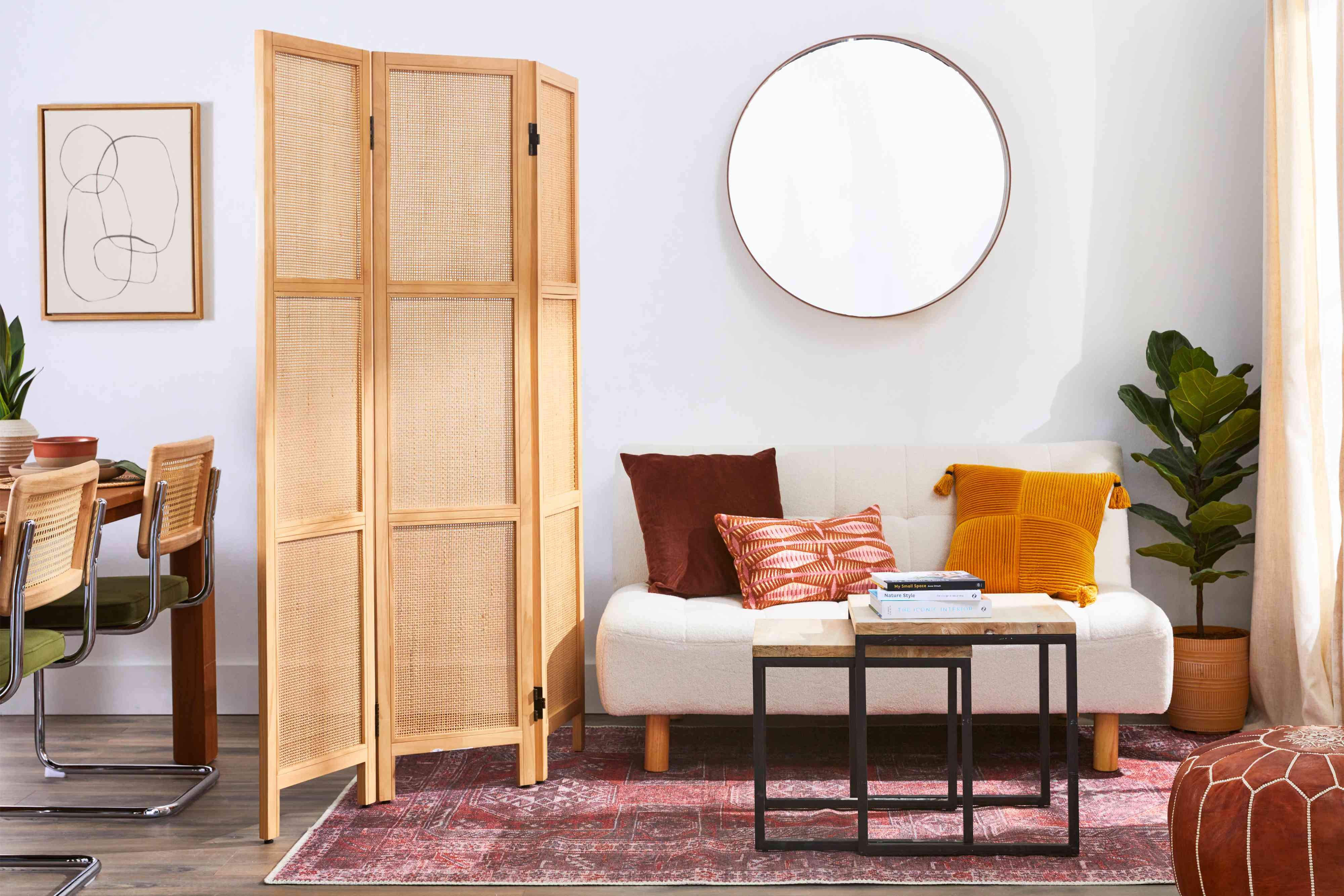
1) The Classic Folding Screen
The original room divider for a reason: it’s portable, quick, and instantly makes a corner feel like its own “room.”
Use it behind a desk, next to a bed, or to hide storage you swear you’ll organize “this weekend.”
2) Shoji-Style Screens for Soft, Glowy Separation
If you want a calm, spa-like look, a shoji-inspired screen adds privacy while still letting light filter through.
It’s perfect for bedrooms, meditation corners, or anywhere you want “serene” instead of “sealed off.”
3) Ceiling-Mounted Curtains (The Studio Apartment MVP)
A curtain room divider is one of the easiest ways to create a sleeping zone. Mount a ceiling track or rod, hang panels,
and suddenly your bed isn’t a permanent exhibit for guests. Bonus: curtains also help block light when you’re trying to sleep.
4) Double Curtains Across a Wide Opening
Two panels that meet in the middle feel more “intentional doorway” than “I stapled fabric to my ceiling.”
Choose velvet for drama, linen for breezy softness, or blackout panels if you and sunlight are in an ongoing feud.
5) A Sliding Barn Door for Big “Design Moment” Energy
Barn doors aren’t just for farmhouse fantasiesthey’re a practical space divider when you want something sturdier than fabric.
They’re great between a living area and bedroom, or to close off an office without swinging door clearance.
6) Modern Sliding Panels for Clean Lines
Think of this as “barn door’s minimalist cousin.” Sliding panels work beautifully in contemporary homes and lofts.
Use one solid panel for privacy or multiple panels for flexibility (open when you want air, closed when you want focus).
7) Pocket Doors if You’re Doing a Real Renovation
If you’re ready for a more permanent fix, pocket doors can give you real separation without eating up floor space.
They’re especially useful for turning a “flex area” into a true guest room or office.
8) Glass-and-Metal Partition for an Airy, Industrial Look
A black-framed glass-style partition creates a strong boundary while keeping your space bright.
It’s a favorite for separating living/sleeping zones in studios because it feels architectural, not temporary.
9) Acrylic Panels When You Want the Light but Not the Weight
Acrylic can mimic the look of glass with less weight and less “please don’t shatter” anxiety.
It’s a smart option for renters who want a semi-permanent divider that can be removed later.
10) Vertical Wood Slat Wall (The “Partial Wall” That Still Feels Open)
A slatted room divider creates definition without blocking airflow or daylight. It’s perfect for separating a dining zone from a living room
or creating an entryway moment in an open spacelike a visual “pause” before the rest of the room.
11) A Half Wall (Pony Wall) with a Ledge
Want separation without committing to full height? A half wall can define zones and give you a landing spot for lamps, art,
or your growing collection of “cute bowls that hold nothing.”
12) A Bookcase Room Divider (Storage + Separation in One)
Turn a bookcase perpendicular to the wall and you’ve got a space divider that also holds books, baskets, and decor.
Keep it open-backed to maintain light, and style both sides so it looks finished from every angle.
13) Cube Storage as a Divider (Great for Small-Space Living)
Cube shelving is basically a room divider idea disguised as organization. Add bins or doors on some cubes to hide clutter,
leave others open for display, and you get a divider that can be tailored to your exact mess level.
14) Open Shelving That Works Like a “Soft Wall”
Open shelving separates areas without creating a dark corner. It’s ideal between living/dining zones or for defining a work-from-home nook.
Use matching baskets to keep the “office supplies” side from becoming a crime scene.
15) A Freestanding Wardrobe to Create a Dressing Area
In a studio apartment, a wardrobe can act like a mini closet wall. Place it to block sightlines to your bed, and you’ll get both privacy
and clothing storage. Choose a unit with a finished back (or add a panel) so it looks intentional.
16) A Clothing Rack + Curtain Combo
This is a flexible, renter-friendly room divider for bedrooms: use a sturdy garment rack to “outline” the new zone,
then add a curtain behind it for privacy. The result feels like a boutique dressing areaminus the awkward lighting.
17) A Tall Plant Wall for a Living Divider
Plants make excellent space dividers because they soften a room visually. Use tall planters, a row of large floor plants,
or a long planter box with a mix of heights. It’s privacy with oxygenpretty hard to argue with that.
18) Hanging Plants for a Lightweight, Breezy Divider
If floor space is tight, go up. Hanging planters can mark a boundary without blocking airflow or traffic.
Just make sure you’re not creating a “drip zone” directly above electronics or your favorite rug.
19) A Beaded Curtain for Retro Charm
Beaded curtains are the definition of “fun divider.” They’re best for low-privacy zoneslike separating a closet, a pantry area,
or a hallway nookwhen you want a playful vibe more than a full barrier.
20) Macramé Hanging for Texture Without Bulk
Macramé is a great option when you want to break up sightlines but keep a space light and open.
It’s especially useful behind a desk to create a visual work zone that doesn’t feel boxed in.
21) Decorative Metalwork (A Divider That Doubles as Art)
Laser-cut metal panels or intricate ironwork can separate spaces while acting like a focal point.
This is a strong move for entryways and dining zones where you want “wow” without sacrificing light.
22) A Pegboard Divider for a Craft or Office Zone
Pegboard isn’t just for garages. A freestanding pegboard wall can define a home office or creative corner while storing tools, supplies,
and accessories. It’s organization and separation in the same breath.
23) Upholstered Panels for a Softer, Quieter Divider
If you want a cozier lookand a little sound dampeningupholstered panels or fabric-covered screens are a solid pick.
They’re great behind a desk, between beds in a shared room, or anywhere noise feels like the uninvited roommate.
24) A Rolling Divider on Locking Casters
Need a flexible layout that changes from “work mode” to “hangout mode”? Put your divider on wheels.
Rolling bookcases, panel screens, or even a plant stand divider can shift with your dayand lock in place when needed.
25) A Plywood Cutout Screen (DIY, But Make It Fancy)
A patterned cutout panel can look custom and high-end, even if it starts as a humble sheet of plywood.
The perforations let light through, and the pattern adds personalitylike a divider that’s also a statement piece.
26) Acoustic Felt Panels for Focus (and Fewer Echoes)
If you’re dividing a workspace, consider acoustic divider panels. They help reduce visual distraction and can soften sound in echo-prone rooms.
It’s the closest you can get to “quiet” without moving to a mountain cabin.
Common Experiences People Have with Room Dividers (The Stuff You Learn After Living With One)
Room dividers look effortless in photos, but real life has opinions. One of the most common experiences people report is that the first divider
they try solves the wrong problem. For example: a gorgeous folding screen might hide a bed, but it won’t stop light from a living room TV,
and it definitely won’t make a loud roommate quieter. That doesn’t mean dividers “don’t work”it just means you’ll be happier if you match the divider
to your actual pain point: light, sightlines, storage, traffic flow, or work focus.
Another frequent lesson: curtains are shockingly powerful. People love them because they’re renter-friendly and can cover a wide span, but the “experience”
depends on fabric choice. Sheer curtains feel airy and brighten a studio apartment, yet they won’t hide much beyond a vague silhouette. Heavier panels feel
more private and can reduce light (sometimes exactly what you want for a sleeping nook). The practical tip many renters learn: measure twice, then add length.
Curtains that hover awkwardly above the floor can make a divider look temporary, while floor-length panels instantly feel custom.
Storage dividerslike bookcases and cube shelvingoften become the favorite long-term option because they do double duty. The shared experience here is
that the “divider side” gets styled, and the “other side” becomes a dumping ground… unless you plan for it. People who love their bookcase room divider
usually treat both faces like real walls: baskets for clutter, a few display objects for balance, and enough negative space that it doesn’t look like a
thrift store shelf during a windstorm. There’s also a safety reality: tall furniture should be stabilized. Many households learn this after a near-miss
(or after realizing pets and kids interpret shelves as a climbing challenge).
Plant dividers come with their own learning curve. They’re beautiful and soften a space, but they work best when you embrace “layered privacy” rather
than expecting a solid wall. People who enjoy a plant wall divider typically choose hardy, upright varieties and use planters that won’t leak.
They also learn to leave a little breathing room behind the plantscramming greenery into a tight passage can turn a divider into an obstacle course.
Finally, there’s the “layout identity crisis” phase: once you add a divider, you may need to adjust lighting and rugs so each new zone feels intentional.
A small lamp in the sleeping nook, a runner to guide traffic flow, or a dedicated desk light can make the divided space feel like it was always meant to
be that way. The overall experience most people end up sharing is this: the best room divider isn’t the fanciest oneit’s the one that makes your everyday
life easier while still looking like it belongs in your home.
Conclusion
Room dividers are the design world’s best “small change, big impact” trick. Whether you need a quick renter-friendly solution like curtains and folding
screens, or a more built-in option like slats, sliding doors, or a glass-style partition, the right space divider helps your home feel calmer, more private,
and more functional. Start with your goal (privacy, storage, light, or focus), choose a divider that matches your lifestyle, and don’t be afraid to test and
tweakbecause your space should work for you, not just for your camera roll.