Some business cards say, “Nice to meet you.” Others whisper, “I know Ohm’s law, I can solder tiny parts without crying, and I may have watched Terminator 2 a heroic number of times.” The 2024 Business Card Challenge: T-800’s 555 Brain belongs firmly in the second category. It is not just a card. It is a tiny slab of PCB art, electronics nostalgia, movie love, and maker humor packed into a format that could technically fit in your pocketassuming your pocket is ready for judgment day.
Created by M. Bindhammer for Hackaday’s 2024 Business Card Challenge, the project recreates the famous T-800 brain chip from Terminator 2: Judgment Day as a functional electronic badge. Instead of using a microcontroller, artificial intelligence, or anything likely to become self-aware at 2:14 a.m., the badge relies on the wonderfully stubborn classic of hobby electronics: the TLC555 timer. Its job is simple but delightfulmake the Terminator’s eyes blink with a fading glow.
That is the charm of this project. It does not try to become the most complicated business card in the room. It understands something many gadgets forget: personality beats complexity. A well-designed PCB business card should make people stop, smile, ask questions, and remember who handed it to them. This one does all four before it even gets plugged into USB power.
What Is the 2024 Business Card Challenge?
Hackaday’s 2024 Business Card Challenge invited makers to build electronic creations in a business-card-like form factor. The rules were refreshingly maker-friendly: keep it roughly the size and shape of a traditional card, make it do something more interesting than paper, and show off your creativity. The challenge rewarded ideas that blended utility, beauty, cost control, thinness, fun, and technical cleverness.
In that context, the T-800’s 555 Brain is a near-perfect fit. It is recognizably a business card, but it also works as a badge, prop replica, conversation starter, and electronics lesson. It is the kind of object that would make a recruiter pause mid-handshake and say, “Wait, did you make this?” That is the exact moment a business card stops being stationery and starts being a portfolio.
The Idea: A T-800 Brain Chip Badge With a 555 Timer Soul
The project pays tribute to the Terminator franchise’s 40th anniversary, marking the span from the original 1984 film to 2024. The visual inspiration comes from the T-800 brain chip seen in Terminator 2: Judgment Day, a prop that has become iconic among sci-fi fans, robotics enthusiasts, and anyone who has ever looked at a circuit board and thought, “This could use more apocalyptic energy.”
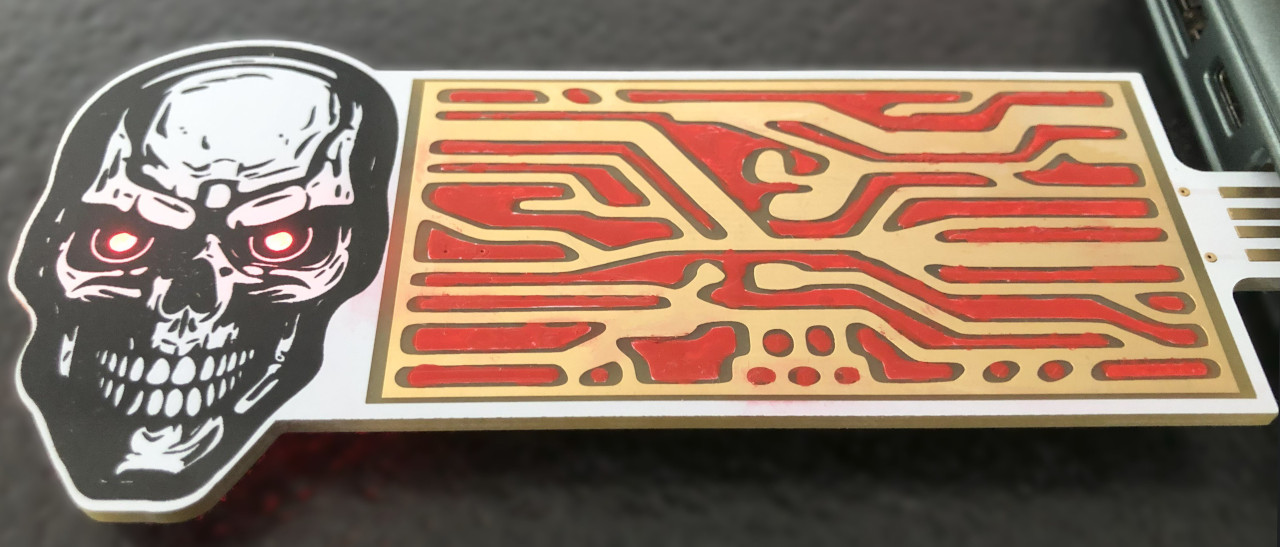
M. Bindhammer’s board recreates the brain-chip look using exposed copper, red paint, and careful PCB layout. The golden traces correspond to the chip-like pattern, while the red areas add an organic, almost living-machine feel. Even unpowered, the board has display value. Powered through USB, it adds the blinking red eyes that complete the T-800 personality. It is not trying to be a perfect movie prop clone; it is a maker interpretation that uses real fabrication layers as artistic material.
Why the TLC555 Timer Is the Perfect “Brain”
The funniest engineering joke in the build is also the smartest design choice: the “brain” is a TLC555 timer. The 555 timer family is legendary because it can generate pulses, delays, oscillations, blinking lights, tones, and other simple timing behavior with very few external components. The CMOS TLC555 version is low-power and well suited for compact projects where simplicity matters.
In this badge, the TLC555 is responsible for the eye effect. The circuit uses timing components and a transistor stage to make the LEDs blink in a fading or glowing manner instead of snapping on and off like a cheap alarm clock from 1998. That little fade matters. A hard blink says “debug LED.” A soft fade says “cybernetic assassin slowly waking up behind mirrored sunglasses.”
Simple Does Not Mean Boring
Many electronic business cards chase complexity: wireless chips, OLED displays, games, USB keyboards, synthesizers, or full development boards. Those are impressive, but they can also become expensive, fragile, and too precious to hand out. The T-800 badge takes the opposite route. It uses a small handful of parts, keeps the circuit understandable, and lets the artwork carry the emotional punch.
That design restraint is important. A business card is supposed to be given away. If every unit costs so much that handing one to someone feels like donating a kidney with silkscreen labels, the design has missed part of the assignment. The T-800’s 555 Brain feels practical enough to imagine making several copies, yet distinctive enough that nobody would confuse it with a boring rectangle of cardstock.
PCB Art: When Copper Becomes Character
PCB art works because circuit boards already have visual language. Copper traces look technical. Solder mask adds color and contrast. Silkscreen creates labels, graphics, icons, and personality. Surface finishes like ENIG give exposed copper a golden look, which is especially useful when the design calls for something futuristic, premium, or deliciously robotic.
The T-800 badge uses these PCB layers not merely as manufacturing necessities but as artistic tools. The exposed copper forms the brain-chip traces. The white solder mask and black silkscreen provide contrast. The red paint adds a hand-finished, biological-machine quality. The result feels somewhere between a circuit board, a movie relic, and a tiny warning from the future.
The Back Side Matters Too
The components are placed on the back side of the board, which is a smart visual decision. The front stays clean and dramatic, while the rear can carry the functional electronics and contact information. That is a classic trick in badge and PCB business card design: let one side impress, let the other side explain.
A business card must still answer basic questions. Who are you? What do you do? How can someone reach you? The best electronic cards do not forget this. They may blink, beep, calculate, emulate, or play music, but they still need to function as identity objects. The T-800 badge keeps that balance by turning its showpiece side into art and its reverse side into the practical zone.
Design Lessons From the T-800’s 555 Brain
This project is useful even for makers who are not Terminator fans. Under the sci-fi skin are several lessons about good hardware design, especially for small-format, low-cost builds.
1. Pick One Strong Idea
The badge does not try to do twelve things. It does one thing extremely clearly: it turns the T-800 brain chip into a glowing PCB card. That focus makes the project memorable. In hardware, a strong theme can be more powerful than feature overload.
2. Use Components That Match the Story
A 555 timer is not just electrically appropriate; it is thematically funny. The joke that the Terminator’s brain runs on a timer chip gives the badge personality. When a component choice supports both function and story, the design feels intentional.
3. Let Fabrication Do the Artwork
Instead of printing a picture of a chip onto a plain board, the project uses PCB fabrication layers to create the image. Exposed copper, mask openings, silkscreen, and finish choices become the artwork. That makes the final object feel authentic rather than decorative.
4. Keep the Bill of Materials Sensible
Business card projects live or die by cost. A beautiful design that costs too much per unit becomes a museum piece, not a card. By using a simple TLC555-based circuit, a few passives, LEDs, and a transistor, this build stays closer to something a maker could actually produce in small batches.
Why This Project Stands Out in the Business Card Challenge
The 2024 Business Card Challenge included many technically ambitious ideas. Some entries used microcontrollers. Others leaned into games, instruments, development tools, NFC, clocks, or motors. The T-800’s 555 Brain stands out because it competes less on raw computing power and more on emotional design.
That is a crucial point for anyone designing a PCB business card. The person receiving the card may not understand every circuit decision. They may not know the difference between astable and monostable operation. They may not have strong feelings about solder mask clearance, although frankly, they should. But they will understand a cool glowing sci-fi badge. They will understand craftsmanship. They will remember the person who handed it to them.
The Maker Culture Behind Electronic Business Cards
Electronic business cards are a small but fascinating corner of maker culture. They combine engineering, branding, design, and a little bit of theatrical confidence. A paper card says, “Here is my email.” An electronic card says, “Here is my email, and also I routed this board myself, probably at midnight, while arguing with a design-rule checker.”
These projects are especially popular among hardware engineers, embedded developers, artists, educators, and electronics hobbyists because they compress a person’s skills into a physical object. A good card can show PCB layout ability, component selection, soldering skill, firmware talent, low-power design knowledge, mechanical creativity, or visual taste.
The T-800 badge shows a specific mix: pop-culture fluency, PCB art skill, analog circuit simplicity, and a sense of humor. That combination is rare and valuable. It proves the designer can think beyond “does it work?” and into “will people care?”
Practical Tips for Building a Similar PCB Business Card
If this project inspires you to build your own electronic business card, start with the same principle: choose a clear concept before choosing parts. A circuit board shaped like your favorite spacecraft, a tiny synthesizer, a blinking logo, a pocket ruler, a USB tool, or a minimalist NFC card can all work. The idea should match your identity and be easy to explain in one sentence.
Choose a Power Source Early
USB power is convenient because it avoids batteries and makes the card easy to demonstrate. Coin cells make a card portable but introduce thickness, cost, and power-budget limits. NFC power is elegant but technically more demanding. For a simple light-up badge, USB is often the least dramatic pathand in electronics, “least dramatic” is a compliment.
Design for Assembly
A card that looks incredible but requires painful assembly will become a drawer project. Use parts you can solder reliably. Avoid unnecessary tiny packages unless the card absolutely needs them. Keep test points accessible. Leave enough spacing around LEDs, resistors, and connectors. Your future self, armed with tweezers and regret, will thank you.
Think About Durability
Business cards get handled. They flex, rub against other items, and sometimes suffer the unspeakable horror of being placed in a backpack with keys. If the card has exposed artwork, fragile LEDs, or painted details, consider how it will survive real use. A badge can be delicate; a giveaway card should be tougher.
Experience Notes: What the T-800’s 555 Brain Teaches Builders
Building or studying a project like the T-800’s 555 Brain is a reminder that successful hardware is not always about maximum complexity. In fact, the most memorable small projects often come from a tight constraint: one chip, one effect, one strong visual theme. That constraint forces better decisions. Instead of asking, “How many features can I cram in?” the builder asks, “What is the one moment I want the user to experience?”
In this case, the moment is obvious: plug it in, watch the eyes glow, smile at the absurdity of a Terminator brain powered by a 555 timer. That small interaction is stronger than a long feature list. It gives the object a beginning, middle, and punchline. The beginning is recognition: “That looks like the T-800 chip.” The middle is discovery: “Wait, it lights up.” The punchline is technical: “The brain is a 555.” That is storytelling through electronics.
For makers, the project also demonstrates the value of visible process. A PCB business card does not hide its construction. The traces, pads, vias, solder mask, and components are part of the appeal. Unlike consumer electronics, which often bury the circuit inside plastic, a PCB card celebrates the board itself. It says the quiet part loudly: the circuit is the design.
Another practical lesson is that cost awareness can be creative rather than limiting. Using a TLC555 instead of a microcontroller reduces complexity, avoids firmware, and keeps the behavior predictable. That simplicity makes the badge easier to replicate and easier to explain. It also leaves more attention for the physical design, which is where the project shines.
The badge also teaches patience with finishing. The red paint is not just color; it changes the emotional tone of the board. Without it, the PCB might look clean and technical. With it, the piece feels more like a cybernetic artifact. That kind of finishing detail can separate a nice board from a memorable object. Makers sometimes treat finishing as an afterthought, but here it is part of the identity.
Finally, this project is a strong reminder that humor belongs in engineering. Serious skills do not require serious faces at all times. A tiny business card that jokes about Skynet, uses a classic timer chip, and still looks beautifully crafted is exactly the kind of project that makes hardware communities fun. It invites beginners in, rewards experts with clever details, and gives everyone else something cool to talk about.
Conclusion: A Tiny Brain With a Big Personality
The 2024 Business Card Challenge: T-800’s 555 Brain proves that an electronic business card does not need an operating system, wireless stack, or miniature nuclear destiny to be impressive. It needs a strong idea, clean execution, and a reason for people to remember it.
M. Bindhammer’s Terminator-inspired badge succeeds because it blends recognizable pop culture with honest electronics. The TLC555 timer gives the project a simple heartbeat. The exposed copper and red paint give it a striking visual identity. The business-card format gives it purpose. Together, those choices create a piece that is funny, functional, and genuinely memorable.
If Skynet had really been built from 555 timers, humanity might have had a much easier time. The robots would still look intimidating, but they would mostly blink rhythmically, fade nicely, and wait for someone to plug them into USB. Honestly, that future sounds pretty manageable.