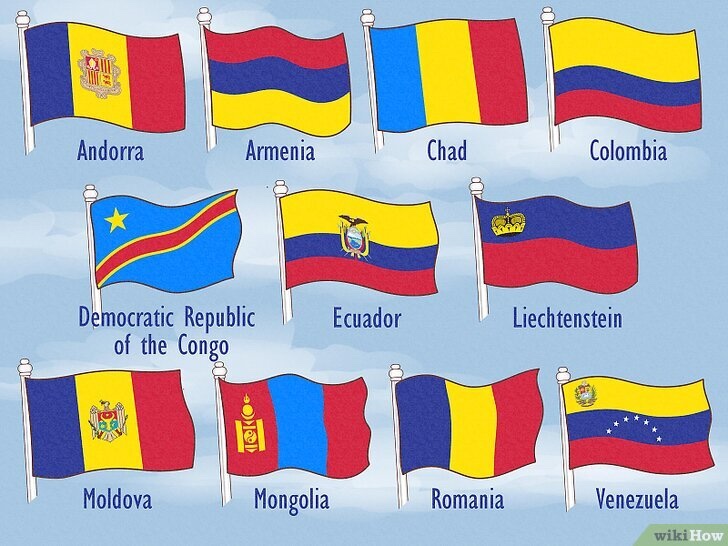
Some flag color combinations whisper. Others walk into the room wearing sunglasses and a marching band uniform. Red, blue, and yellow belong to the second group. Together, these colors create flags that feel energetic, memorable, and full of meaning. They show up across Europe, South America, Asia, and Africa, sometimes as simple stripes and sometimes with coats of arms, stars, suns, crowns, or ancient symbols doing extra storytelling duty.
But here is the fun part: a red-blue-yellow flag does not always mean the same thing. In one country, yellow may represent mineral wealth. In another, it may symbolize the sun, justice, or national prosperity. Blue can stand for the sky, the sea, peace, hope, or cultural heritage. Red often points to courage, sacrifice, patriotism, or the struggle for independence. Same colors, wildly different personalities. Flags are basically national autobiographies printed on fabric.
Below are 11 countries with flags that prominently feature red, blue, and yellow or gold, along with the symbolism behind each design.
Why Red, Blue, and Yellow Appear in So Many National Flags
Red, blue, and yellow are powerful visual colors. They are easy to recognize from a distance, work well in bold geometric designs, and carry strong symbolic meanings. Historically, these colors were also practical because they could be produced with recognizable dyes and reproduced in military, civic, and maritime settings.
In flag symbolism, red commonly represents bravery, sacrifice, revolution, or the blood shed in defense of the nation. Blue often suggests the sky, rivers, oceans, peace, vigilance, or loyalty. Yellow or gold frequently points to sunlight, wealth, grain, justice, hope, or national resources. Put them together and you get a flag palette that can say, “We have history, courage, resources, and a pretty good eye for design.”
11 Countries with a Red-Blue-Yellow Flag
1. Romania
Romania’s flag is one of the clearest examples of a red-blue-yellow flag. It has three equal vertical bands: blue at the hoist, yellow in the center, and red on the fly side. The design is simple, balanced, and instantly recognizable, which is exactly what a national flag should be. Nobody wants a flag that needs a magnifying glass and a committee meeting to identify.
The Romanian tricolor developed from historical colors associated with Romanian regions and 19th-century national movements. A common interpretation connects blue with liberty, yellow with justice, and red with fraternity. The current plain tricolor became especially symbolic after the 1989 Romanian Revolution, when the communist coat of arms was removed from the center. That left the clean blue-yellow-red vertical design used today.
2. Chad
Chad’s national flag looks very similar to Romania’s flag: three vertical bands of blue, yellow, and red. The difference is mostly in shade, with Chad’s blue traditionally described as a deeper indigo or dark blue. The resemblance has caused plenty of flag-spotting confusion, proving that even flags can accidentally show up to the party wearing the same outfit.
Chad adopted the design in the late 1950s as it moved toward independence from France. The colors combine influences from the French tricolor and Pan-African color traditions. Blue is often linked with the sky, hope, and the wetter southern part of the country. Yellow or gold represents the sun and the Sahara Desert in the north. Red stands for progress, unity, and sacrifice.
3. Andorra
Andorra’s flag features vertical bands of blue, yellow, and red, with the national coat of arms placed in the yellow band. At first glance, it may resemble the flags of Romania, Chad, and Moldova, but the coat of arms gives Andorra its own personality. Think of it as the tricolor wearing a family crest to a formal dinner.
The flag reflects Andorra’s unique political and geographic history. Andorra sits in the Pyrenees between France and Spain, and its flag combines colors associated with both neighbors: blue and red from France, and red and yellow from Spain. The coat of arms includes symbols connected to the historic powers and regions tied to Andorra, including Urgell, Foix, Béarn, and Catalonia. Its motto, often translated as “Strength united is stronger,” adds a neat little motivational poster momentbut with centuries of history behind it.
4. Moldova
Moldova’s flag has three vertical bands of blue, yellow, and red, with the national coat of arms centered on the yellow band. The color arrangement closely resembles Romania’s flag, reflecting Moldova’s cultural and historical links with Romania. However, Moldova’s coat of arms makes the design distinct.
The central emblem features an eagle holding a cross, an olive branch, and a scepter. On the eagle’s breast is a shield with an aurochs head, a star, a rose, and a crescent. The symbolism is dense, but the big idea is national identity, sovereignty, heritage, and continuity. Moldova’s flag says, “Yes, we share colors with Romania, but please notice the eagle. The eagle has paperwork.”
5. Colombia
Colombia’s flag uses three horizontal bands: yellow on top, blue in the middle, and red at the bottom. The yellow band is twice as tall as each of the other two bands, so it dominates the design visually. This makes Colombia’s flag one of the most recognizable yellow-blue-red flags in the world.
The common symbolism is straightforward and meaningful. Yellow represents the nation’s wealth, natural resources, or abundant land. Blue is associated with the seas that border Colombia, as well as the sky and rivers. Red represents the blood shed by those who fought for independence. The flag belongs to a family of yellow-blue-red tricolors influenced by the independence movements of northern South America.
6. Ecuador
Ecuador’s flag is closely related to Colombia’s. It also has horizontal bands of yellow, blue, and red, with the yellow band taking up the top half of the flag. The main difference is Ecuador’s coat of arms placed at the center. That detail helps distinguish it from Colombia’s flag and gives the design a deeper national story.
The yellow commonly symbolizes sunshine, grain, and mineral wealth. Blue represents the sky, sea, and rivers. Red honors the blood shed in the struggle for freedom and justice. The coat of arms includes the Andean condor, Mount Chimborazo, a river, a steamship, and zodiac signs connected to the 1845 revolution. In other words, Ecuador did not simply add a decoration; it added a mini history-and-geography lesson.
7. Venezuela
Venezuela’s flag also belongs to the yellow-blue-red family. It features three horizontal bands of yellow, blue, and red, with an arc of white stars in the blue band. The state version includes the national coat of arms, but the stars are the most familiar feature for many people.
The yellow is commonly associated with wealth, sovereignty, harmony, justice, agriculture, and sunlight. Blue represents the Caribbean Sea and Venezuela’s coastal identity. Red symbolizes the blood shed during the independence struggle from Spain. The stars represent historic provinces, and their curved arrangement gives the flag a graceful sense of motion. It is the kind of flag that looks like it might be quietly humming a revolutionary anthem.
8. Mongolia
Mongolia’s flag uses three vertical bands: red, blue, and red. The yellow element appears in the Soyombo symbol placed on the hoist-side red band. Because the yellow symbol is large and central to the flag’s identity, Mongolia belongs comfortably in a list of red-blue-yellow national flags.
The blue stripe represents the “eternal blue sky,” a powerful idea in Mongolian cultural tradition. The red bands are often linked with strength, progress, and national vitality. The yellow Soyombo is the star of the design. It includes stylized elements representing fire, sun, moon, earth, water, and balance. It is not just an emblem; it is a symbolic toolkit. If most flags are short poems, Mongolia’s flag is a compact philosophy class.
9. Philippines
The flag of the Philippines features blue and red horizontal bands with a white triangle at the hoist. Inside the triangle are a yellow sun and three yellow stars. The flag is famous not only for its symbolism but also for its special wartime display rule: when the country is at war, the red band is flown on top.
The blue stripe is commonly associated with peace, truth, and justice, while red represents patriotism and valor. The white triangle symbolizes liberty, equality, and fraternity. The yellow sun has eight rays, traditionally representing provinces that played major roles in the 1896 Philippine Revolution against Spain. The three stars represent the major island groups: Luzon, Visayas, and Mindanao. It is a flag packed with national geography, political ideals, and revolutionary memoryefficient, bright, and hard to ignore.
10. Liechtenstein
Liechtenstein’s flag has two horizontal bands: blue on top and red below. A yellow or gold crown appears near the hoist side of the blue band. The crown was added in 1937 after Liechtenstein realized its flag looked very similar to Haiti’s at the 1936 Summer Olympics. Nothing says “international awkwardness” quite like discovering your national flag has a twin during a global sporting event.
The blue represents the sky, while the red is often interpreted as the evening fires glowing in homes. The gold crown symbolizes the unity of the people and their prince. It also clearly identifies Liechtenstein as a principality. The result is a simple but charming flag: sky above, hearth below, crown at the side, and a useful lesson in brand differentiation.
11. Democratic Republic of the Congo
The flag of the Democratic Republic of the Congo features a sky-blue field, a yellow star in the upper hoist corner, and a red diagonal stripe bordered in yellow. It is one of the more dynamic designs on this list because the diagonal band creates movement across the flag.
The blue is commonly linked with peace or hope. The red diagonal stripe represents the blood of martyrs or national sacrifice. Yellow symbolizes the country’s wealth and prosperity, while the star points toward unity and the future. The Democratic Republic of the Congo has used several flags across its modern history, but the current design, adopted in 2006, revived elements of earlier post-independence symbolism with a fresh sky-blue field.
Quick Comparison of Red-Blue-Yellow Flags
| Country | Flag Layout | Key Yellow/Gold Symbolism | Most Distinct Feature |
|---|---|---|---|
| Romania | Vertical blue-yellow-red tricolor | Justice | Plain tricolor design |
| Chad | Vertical blue-yellow-red tricolor | Sun and desert | Deep blue shade |
| Andorra | Vertical blue-yellow-red tricolor | Spanish and regional heritage | Central coat of arms |
| Moldova | Vertical blue-yellow-red tricolor | Heraldic identity | Eagle and aurochs coat of arms |
| Colombia | Horizontal yellow-blue-red tricolor | Wealth and resources | Double-width yellow band |
| Ecuador | Horizontal yellow-blue-red tricolor | Sunshine, grain, mineral wealth | Central coat of arms |
| Venezuela | Horizontal yellow-blue-red tricolor | Wealth, justice, agriculture | Arc of stars |
| Mongolia | Red-blue-red vertical bands | Soyombo symbol | Ancient geometric emblem |
| Philippines | Blue-red bands with white triangle | Sun and stars | Wartime red-on-top display |
| Liechtenstein | Blue-red horizontal bands | Unity and princely crown | Gold crown |
| Democratic Republic of the Congo | Blue field with red diagonal stripe | Wealth and future | Diagonal red band and yellow star |
What These Flags Have in Common
Even though these 11 flags use the same basic color family, they tell very different stories. The European flags of Romania, Chad, Andorra, and Moldova rely heavily on vertical stripes, but their meanings are shaped by completely different histories. Romania’s flag is tied to national unity and revolution. Chad’s is connected to independence, geography, and Pan-African identity. Andorra’s reflects its position between France and Spain. Moldova’s points toward cultural connection and national sovereignty.
In South America, Colombia, Ecuador, and Venezuela form a famous yellow-blue-red group rooted in shared independence-era symbolism. Their flags are cousins, not copies. Colombia keeps the design simple. Ecuador adds a coat of arms. Venezuela places stars across the blue band. Each country adapts the same color sequence to its own political memory.
Meanwhile, Mongolia, the Philippines, Liechtenstein, and the Democratic Republic of the Congo show how red, blue, and yellow can move beyond basic stripes. Mongolia uses a yellow spiritual and national symbol. The Philippines uses a sun and stars to represent revolution and geography. Liechtenstein uses a crown to express unity and princely identity. The Democratic Republic of the Congo uses a star and diagonal stripe for hope, sacrifice, and national wealth.
Experience-Based Reflections: How to Read a Red-Blue-Yellow Flag Like a Traveler, Student, or Curious Human
Once you start noticing red-blue-yellow flags, you may develop a harmless but very real condition: flag recognition enthusiasm. Symptoms include pausing during sports events, zooming in on embassy buildings, and saying, “Wait, is that Chad or Romania?” while everyone else is just trying to enjoy the parade. Fortunately, this is one of the more educational hobbies you can have.
A good way to experience these flags is to treat them like visual introductions to a country. Before reading a long history book, look at the flag and ask three simple questions: What colors dominate? What symbols are included? What story would a country want to tell in such limited space? A flag cannot explain everything, but it gives clues. Colombia’s oversized yellow band immediately suggests abundance. The Philippines’ sun and stars invite questions about islands and revolution. Mongolia’s Soyombo looks mysterious at first, then becomes fascinating once you learn how many ideas are packed into it.
Another useful experience is comparing flags side by side. Romania and Chad are the classic example. Put them next to each other and you realize that shade, proportion, and historical context matter. Without context, they look almost identical. With context, one belongs to southeastern Europe and the other to north-central Africa, each shaped by different political and cultural journeys. It is a gentle reminder that design similarities do not always mean shared meaning.
Travelers can also use flags as cultural icebreakers. Asking a local person about their national flag often opens the door to stories about school ceremonies, independence days, sports matches, public holidays, and family memories. People may not give you a textbook answer, but they often share what the flag feels like to them. That emotional layer is where symbolism becomes real. A flag is not just a government-approved rectangle; it is something people wave, wear, paint on cheeks, hang from balconies, and sometimes argue about passionately over coffee.
For students, these 11 flags are perfect for learning geography through pattern recognition. Start with the horizontal yellow-blue-red flags of Colombia, Ecuador, and Venezuela. Then move to the vertical blue-yellow-red flags of Romania, Chad, Andorra, and Moldova. After that, study the symbol-heavy flags: Mongolia’s Soyombo, the Philippines’ sun and stars, Liechtenstein’s crown, and the Democratic Republic of the Congo’s diagonal stripe and star. By grouping flags visually, memorization becomes easier and far less boring than staring at a blank map until your brain files a complaint.
For writers, designers, and content creators, these flags offer a great lesson in visual storytelling. The best flag designs are not random decoration. They use color, shape, proportion, and symbols to compress history into a format people can recognize instantly. That is not easy. Imagine trying to summarize your entire family history, values, geography, struggles, and hopes on one small rectangle. Most of us would panic and add too many fonts. National flags somehow manage to do it with stripes, stars, crowns, suns, and a few very confident color choices.
The biggest takeaway is this: red, blue, and yellow may be common colors, but no two countries use them in exactly the same emotional way. These flags remind us that color is never just color when it belongs to a nation. It becomes memory, pride, identity, and sometimes even a diplomatic conversation starter. Or, in Liechtenstein’s case, a very stylish solution to an Olympic identity crisis.
Conclusion
The world’s red-blue-yellow flags prove that a shared color palette can create many different national stories. Romania and Chad show the power of a clean tricolor. Andorra and Moldova add heraldic depth. Colombia, Ecuador, and Venezuela carry the legacy of South American independence. Mongolia, the Philippines, Liechtenstein, and the Democratic Republic of the Congo use stars, crowns, suns, symbols, and diagonal movement to create flags with unmistakable character.
Whether you are researching national flags, studying geography, preparing a quiz, writing a travel article, or simply trying to win your next trivia night without sweating dramatically, these 11 countries offer a colorful starting point. Red, blue, and yellow may look simple, but in the language of flags, they can speak volumes.
Note: Flag symbolism can vary by official description, historical interpretation, and popular cultural meaning. This article summarizes widely accepted meanings in a reader-friendly format.