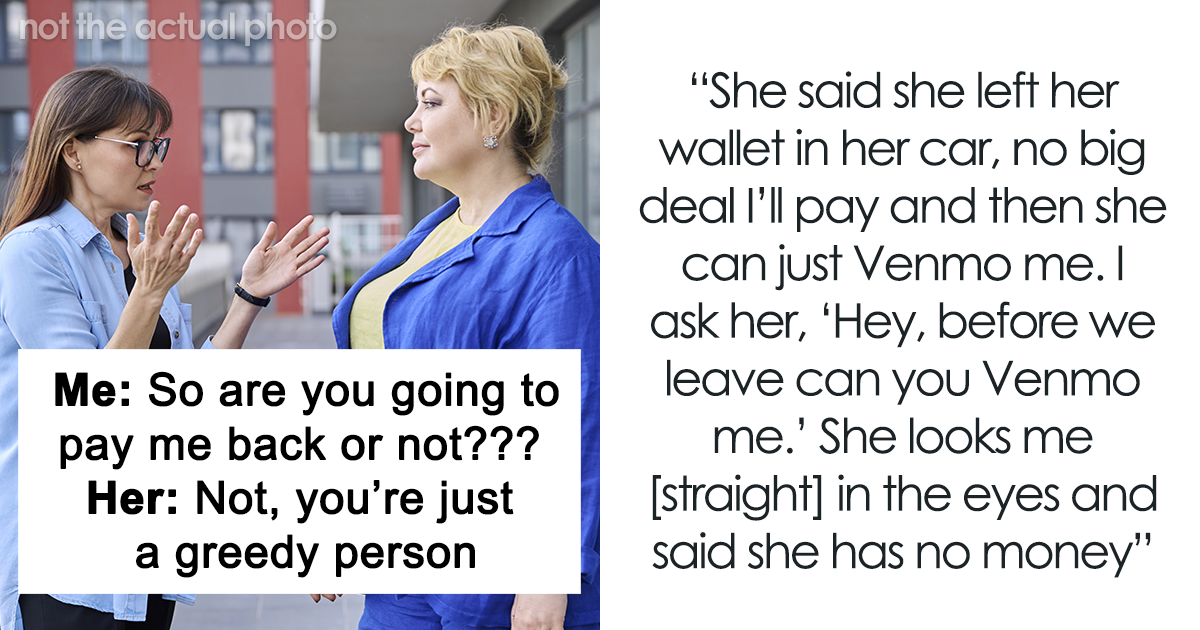
Friendship is supposed to be warm, supportive, and only slightly chaotic. It should involve laughter, inside jokes, and maybe one person who always orders fries for the table and then acts surprised when everyone eats them. What it should not involve is one friend quietly becoming the unofficial sponsor of another adult’s lifestyle.
That is why this viral story struck such a nerve. At the center of it was a woman who kept expecting her friend to cover meals, outings, and random extras, as if “I forgot my wallet” were a valid long-term financial strategy. When the paying friend finally stopped footing the bill and pointed out the pattern, the response was not gratitude, reflection, or even basic embarrassment. It was an insult: You’re just a greedy person. That accusation ended up doing what the unpaid tabs had been building toward for a long time. The friendship was cut off.
On the surface, this sounds like internet drama with a side of emotional whiplash. But underneath the headline is a very real issue: friendship money boundaries. When one person always pays, one person always takes, and nobody says the uncomfortable thing out loud, resentment starts cooking on low heat. Eventually, it boils over and makes a mess of everyone’s emotional kitchen.
The Story Hit Home Because It Was Never Just About The Money
Most people do not end a friendship over one coffee, one ride share, or one dinner bill. They end it over the pattern. That is what makes stories like this feel so familiar. The problem is rarely a single twenty-dollar meal. The problem is what repeated expectations communicate: your generosity is required, your discomfort is inconvenient, and your wallet is somehow a shared community resource.
Money conflict in friendship often becomes a stand-in for bigger questions. Is this relationship reciprocal? Does this person respect me? Can I say no without being punished for it? When the answer keeps coming back as “not really,” the financial issue stops being about receipts and starts being about dignity.
That is also why the “greedy person” comment lands so badly. It flips the story upside down. The person setting a reasonable financial boundary gets painted as selfish, while the person making the repeated demands acts offended. It is a classic move in one-sided relationships: the moment access is limited, the person benefiting from the arrangement suddenly discovers a deep concern for your character.
How A Generous Friendship Turns Into A One-Sided Friendship
At the start, these dynamics can look harmless. Maybe one friend is going through a rough patch, so the other covers lunch. No big deal. Then it happens again. And again. Soon, one person is paying because it feels easier than making things awkward. The other person gets used to being helped and stops seeing it as help. It becomes the default.
That is where a lot of financially lopsided friendships go off the rails. The giver keeps thinking, I’m just being nice. The taker starts thinking, This is how things work now. Nobody says the quiet part out loud, so the imbalance grows legs and starts walking around like it pays rent.
One-sided friendships are not always loud or obviously toxic. Sometimes they are built on little assumptions. One friend always books the tickets. One friend always drives. One friend always rounds up the bill, covers the tip, sends the grocery order, or fills the gap when “cash is tight.” Over time, the emotional message becomes clear: one person carries the load, the other enjoys the ride.
The Real Red Flags In A Friend Who Expects You To Pay For Everything
Not every friend who accepts help is entitled. People hit hard seasons. Jobs disappear. emergencies happen. Life occasionally drop-kicks the budget. Healthy friends are usually honest, appreciative, and eager to make it right when they can. The trouble starts when the behavior is repeated and the attitude gets worse instead of better.
1. Gratitude quietly disappears
At first there is a thank-you. Later there is an expectation. Eventually there is irritation when you do not automatically offer. That progression tells you a lot.
2. They always have money for what they want
Somehow the rent is a tragedy, brunch is your problem, and yet there is always cash for online shopping, cocktails, concert tickets, or a brand-new “little treat.” That is not hardship. That is priority math.
3. They frame your boundary as cruelty
If a simple “I’m only paying for myself” is treated like a betrayal, the issue is not your tone. The issue is that the arrangement only felt good while it benefited them.
4. They rewrite history
Suddenly all those times you paid were “gifts,” “what friends do,” or “not a big deal until you made it one.” Convenient memory is doing some very suspicious heavy lifting there.
5. They attack your character instead of addressing the pattern
Calling someone cheap, greedy, arrogant, or dramatic is often a distraction tactic. It shifts attention away from the original issue and puts you on trial for having limits.
Why Boundaries Trigger The Biggest Blowups
There is a reason some friendships seem peaceful right up until the moment a boundary appears. The peace was rented, not owned. It depended on one person staying flexible, available, and financially useful.
Once the paying friend says, “No, I’m not covering this anymore,” the arrangement changes. For a healthy friend, that might lead to an honest conversation, an apology, or at least an awkward-but-adult recalibration. For an entitled friend, it can feel like rebellion. They are not reacting to your boundary alone. They are reacting to the loss of access, convenience, and control.
That is why some people become surprisingly dramatic when you stop paying. The free meal mattered, sure. But the bigger loss is the old system where your discomfort stayed silent and their wants kept getting funded.
When Helping Crosses The Line Into Enabling
This is the part many generous people hate hearing. Constantly rescuing a friend does not always make you kind. Sometimes it makes the problem sturdier. Repeatedly covering someone’s expenses without limits can teach them that poor planning has a backup plan, and that backup plan is you.
That does not mean compassion is bad. It means compassion needs a spine. There is a difference between helping someone through a rough spot and becoming their unofficial subscription service. If your support keeps them from feeling the consequences of their choices, the arrangement may be helping in the moment while hurting in the long run.
Plenty of people fall into this because they hate conflict. Paying feels easier than confronting. Swiping the card is faster than saying, “This can’t keep happening.” But easy now often becomes expensive later, financially and emotionally.
How To Set Financial Boundaries With Friends Without Sounding Like A Cartoon Villain
The good news is that money boundaries do not have to sound harsh. They just have to be clear. You do not need a speech, a spreadsheet, and a dramatic monologue under restaurant lighting. You need a sentence that is firm enough to survive pushback.
Be direct
Try: “I’m only paying for my own meal tonight.” Or: “I can’t cover extra costs anymore.” Simple works. The more words you add, the more room you create for debate, guilt, and amateur courtroom theatrics.
Stop overexplaining
You do not need to perform your bank statement for the audience. A boundary does not require a TED Talk. Saying less often makes it stronger.
Suggest lower-cost alternatives
If you want to preserve the friendship, offer options that match your comfort level. Coffee at home. A walk. A movie night. A cheaper restaurant. Real friends are usually there for you, not your receipt total.
Set the consequence before you need it
If they keep expecting you to pay, decide what happens next. Maybe you stop going out with them. Maybe you split plans by cost. Maybe you step back altogether. Boundaries without follow-through are basically polite wishes wearing business casual.
What Healthy Friendship Around Money Actually Looks Like
A healthy friendship does not require identical incomes, matching lifestyles, or synchronized budgeting apps. It requires mutual respect. Friends can have different financial realities and still stay close if both people are honest and considerate.
That means checking in before making expensive plans. It means not assuming the wealthier friend should always cover the difference. It means saying thank you when someone treats you, and not building your whole social life around their card doing cardio.
Healthy friendships also leave room for dignity. If someone says they are cutting back, the correct response is not eye-rolling, guilt-tripping, or a lecture on how “memories matter more than money” right before ordering the lobster. The correct response is respect.
In strong friendships, generosity moves in both directions. Maybe one friend pays for dinner and the other cooks next time. Maybe one drives and the other handles the snacks. Maybe one has more money and the other brings time, thoughtfulness, reliability, or care. Reciprocity does not always look identical, but it should still feel fair.
Why Cutting Someone Off Sometimes Is The Healthy Choice
Not every friendship deserves endless repair attempts. If someone repeatedly takes advantage of you, dismisses your discomfort, and insults you the moment you stop funding the arrangement, distance is not cruelty. It is clarity.
Cutting a person off can feel dramatic, but sometimes it is simply the cleanest way to end a dirty pattern. You are not required to keep auditioning for the role of Nice Person Who Pays For Everything. If the relationship only functions when you overgive, it is not balanced. It is extractive.
And yes, it can be sad. People grieve toxic friendships all the time because there were still good moments mixed in with the nonsense. But nostalgia should not be allowed to rewrite reality. A friend who only likes you when your boundaries are missing is not losing your kindness. They are losing your compliance.
Experiences People Recognize All Too Well
One reason this story spread so quickly is because so many people have lived some version of it. Maybe not with the exact same insult, but with the same exhausting pattern.
Consider the friend who is always “temporarily broke” whenever the bill arrives but somehow never too broke for weekend shopping. At first, covering them feels compassionate. Then the pattern stretches into months. You start noticing they never initiate repayment, never offer to get the next one, and somehow become offended if you hesitate for even half a second. The moment you stop paying, the mood changes. Suddenly you are “counting pennies,” “acting weird,” or “making things awkward.” In reality, the awkwardness was there the whole time. You just stopped financing it.
Or think about the friend group vacation planner who quietly becomes the emergency fund with legs. One person books the rental house, fronts the gas, buys groceries, and covers the tickets because everyone promises to send money later. Most do. One person never quite gets around to it. There is always a reason: the banking app glitched, payday moved, the dog had a problem, Mercury is in retrograde, or the moon looked judgmental. Weeks later, the same person is posting expensive cocktails online while your messages sit unanswered. By the time you finally ask directly, they act shocked that you even remember the money. As if memory itself is rude.
Then there is the subtler version: the friend who never asks for cash outright but always engineers situations where you end up covering the difference. They choose the pricier restaurant. They “forget” tickets need to be bought in advance. They order extra items and then suggest splitting the bill evenly with the confidence of someone who has never feared arithmetic. Individually, each moment seems too small to fight over. Collectively, they form a pattern that leaves one person drained and the other strangely comfortable.
What these experiences have in common is not just money. It is the emotional residue they leave behind. You start second-guessing invitations. You feel tense before simple plans. You rehearse how to say no in the mirror like you are preparing for courtroom testimony over nachos. That is a sign the friendship is no longer easy in a healthy way. It has become easy for one person and expensive for the other.
And when people finally do speak up, they often discover something important. Respectful friends adjust. Entitled friends escalate. The response to your boundary tells you more than the original request ever could.
Final Thoughts
The viral headline works because it is dramatic, but the lesson is surprisingly simple. Paying for everything does not make you generous forever. At some point, it just makes you resentful. And calling someone greedy for refusing to bankroll a friendship is not honesty. It is entitlement wearing insult as a disguise.
If a friend expects you to pay for everything, the real issue is not whether you can afford it. The real issue is whether the relationship still has mutual respect. Healthy friendship can survive an awkward money conversation. What it cannot survive, at least not for long, is one person treating the other like a personal ATM with emotional benefits.
So no, saying no does not make you greedy. Sometimes it makes you the first person in the friendship willing to tell the truth.