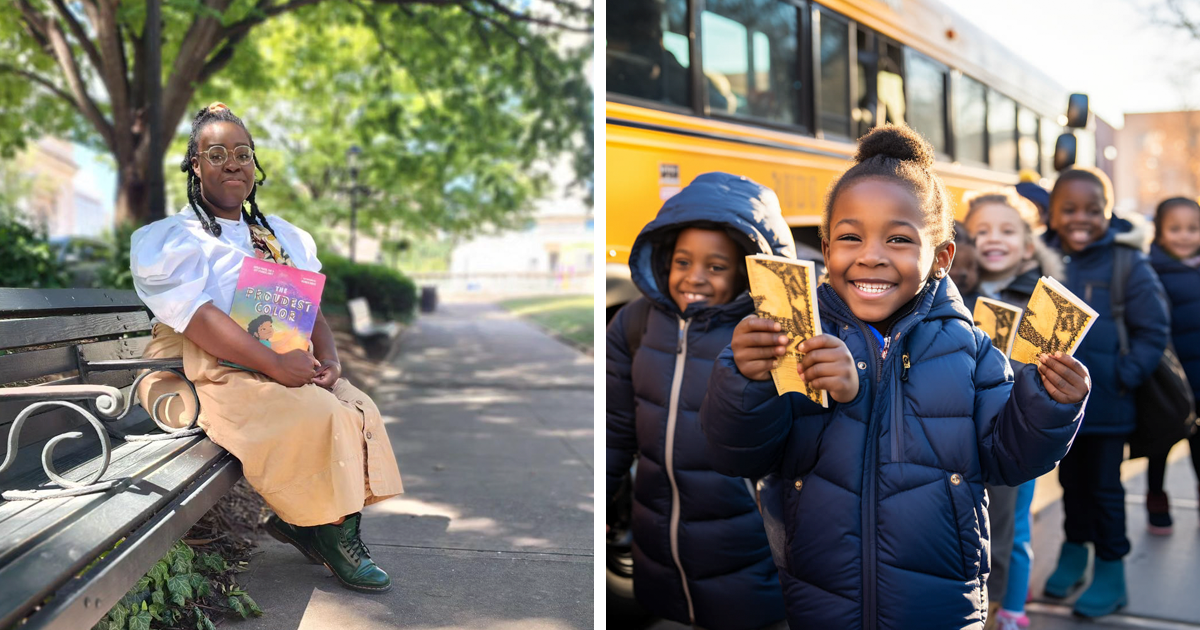
In Baltimore, some superheroes do not wear capes. Some wear comfortable shoes, carry armloads of children’s books, and appear on sidewalks, stoops, schools, community corners, andyesnear book vending machines. Araba Maze, known widely as the “radical street librarian,” has built a joyful movement around a simple but powerful idea: children should not have to go searching for books as if literacy were hidden treasure. Books should meet them where they already are.
Through her organization, Storybook Maze, Maze has helped distribute more than 7,000 free books to children in Baltimore. Her work targets “book deserts,” communities where children have limited access to age-appropriate books at home, in nearby stores, or through walkable libraries. In practical terms, a book desert means a child may want to read but have nothing to grab from a shelf. It means a bedtime story becomes a luxury item. It means imagination is available, but the entry ticket is missing.
Maze’s mission is not only about handing out books. It is about changing the emotional experience of reading. For many kids, reading can feel like a test, a chore, or a classroom performance. Storybook Maze flips the script. It makes reading feel like a neighborhood party where the guest list includes dragons, astronauts, clever girls, brave boys, funny grandmas, superheroes, Black main characters, and stories that look and sound like the communities children know.
Who Is Araba Maze?
Araba Maze is a Baltimore-based librarian, literacy advocate, and founder of Storybook Maze. Before becoming known for free book pop-ups and public book vending machines, she studied English at Bowie State University and later worked as a librarian. But the spark for her movement began in a much more ordinary place: her front stoop.
Maze has shared that she was reading to her nieces when neighborhood children began gathering around. The kids wanted storytime to continue. When she encouraged them to go home and read, their answer stopped her in her tracks: they did not have books at home. That moment became the seed for a mission. It was not a grant proposal, a board meeting, or a big-city initiative. It was a real child saying, in plain language, “We don’t have books.”
That answer revealed a gap that many literacy discussions can accidentally overlook. Schools matter. Libraries matter. Teachers matter. But a child’s relationship with reading also grows in bedrooms, kitchens, back seats, barber shops, laundromats, playgrounds, and living rooms. If books never make it into those everyday spaces, reading remains something that happens only under adult supervision. Maze wanted to make books feel personal, reachable, and fun.
What Is a Book Desert?
A book desert is a geographic area where children and families have limited access to books and reading culture. The term is often compared to a food desert. Just as some neighborhoods lack easy access to fresh groceries, some communities lack bookstores, well-stocked home libraries, and walkable places where children can regularly choose books. The result is not just inconvenience. It can shape vocabulary development, reading confidence, school readiness, and long-term academic opportunity.
Unite for Literacy’s Book Desert Map estimates the share of homes in different areas that have abundant books, often using 100 or more books in a home as an indicator of strong print access. In many areas of East and West Baltimore, estimates show that far fewer households have that level of access compared with wealthier neighborhoods. That does not mean families value reading less. It means access is uneven, and children notice.
Books cost money. Transportation takes time. Library hours may not match a caregiver’s work schedule. Some families are balancing rent, groceries, childcare, and bills before they can even think about buying a stack of picture books. When reading materials are scarce, children may miss the casual repetition that builds fluency: rereading a favorite book, flipping through pages alone, asking questions, memorizing funny lines, or proudly announcing, “I can read this one myself.”
How Storybook Maze Is Fighting Book Deserts In Baltimore
Storybook Maze uses a practical approach: bring books directly to children instead of waiting for every child to find a library. Maze’s outreach includes pop-up bookstores, street-corner storytimes, school partnerships, community events, and free book vending machines. The model is playful, but the strategy is serious. If children gather at parks, community centers, schools, YMCA locations, and busy neighborhood corners, then those places can become reading access points.
Free Book Pop-Ups
Pop-up book events are one of the most visible parts of Maze’s work. Instead of a traditional store where people pay, Storybook Maze creates temporary spaces where children can browse, choose, and keep books for free. Choice is important. A donated book is nice; a self-selected book is personal. When a child chooses a story because the cover looks cool or the hero looks familiar, that book has already done half its job.
These pop-ups also remove the pressure that sometimes surrounds reading. Nobody is grading the child. Nobody is timing them. Nobody is asking for a book report before dessert. Children can explore board books, picture books, graphic novels, chapter books, nonfiction, and culturally affirming stories in a relaxed environment. That sense of ownership matters because reading motivation often grows when children feel trusted to pick what interests them.
Free Book Vending Machines
One of Storybook Maze’s most eye-catching ideas is the free book vending machine. It has the charm of a snack machine, except the “treat” is a story. For children, that matters. A vending machine turns book selection into an event. Pressing a button and receiving a book can feel magical, especially for a child who rarely gets to pick out something new without worrying about cost.
Maze has used crowdfunding, community support, grants, and partnerships to make these projects happen. A book vending machine is more than a cute photo opportunity. It places books in public spaces where kids already pass by. It says, “Reading belongs here too.” It also makes book access visible, which can inspire more neighbors, donors, schools, and local organizations to participate.
Stoop Storytime And Reading Joy
The original stoop storytime remains central to Maze’s philosophy. Reading aloud is one of the simplest ways to build language, listening skills, attention, and imagination. The American Academy of Pediatrics encourages shared reading from infancy because it supports early literacy and strengthens caregiver-child bonds. Maze’s storytimes carry that same idea into the neighborhood: books can connect people, not just fill shelves.
There is also something culturally powerful about a stoop storytime in Baltimore. It does not require a fancy stage. It does not require a hushed room or a perfect schedule. It turns an ordinary outdoor space into a classroom, theater, and community circle at once. For a child, seeing an adult read with enthusiasm in public sends a message: books are not just school objects. They are part of life.
Why Diverse Books Matter
Storybook Maze places special emphasis on diverse books, especially books featuring Black characters, Black families, and communities that resemble the children Maze serves. Representation is not a decorative extra. It can influence whether a child feels welcomed by reading in the first place.
When children repeatedly encounter books where nobody looks like them, talks like them, worships like them, celebrates like them, or lives in neighborhoods like theirs, reading can feel distant. Diverse children’s books create mirrors and windows. Mirrors help children see themselves as worthy of stories. Windows help them understand other lives, cultures, and possibilities. Both are essential.
For Baltimore children growing up in historically underserved neighborhoods, culturally relevant books can turn reading from “something adults make me do” into “something that gets me.” That shift is enormous. A child who feels seen by a book is more likely to open another one. Then another. Suddenly, the home library starts growing, one chosen story at a time.
The Bigger Literacy Problem Behind The Story
Maze’s work matters because book access connects to a much larger literacy challenge. National reading data has shown persistent gaps in reading achievement, with many students performing below proficient levels. Baltimore City, like many large urban districts, has faced serious literacy challenges, although recent local reporting and district updates also point to gains in literacy performance. The lesson is not that books alone solve every problem. They do not. Children also need strong instruction, skilled teachers, school support, safe learning environments, and family resources.
But books are foundational. A child cannot practice reading widely without reading material. A family cannot build a bedtime reading habit if there are no books in the home. A teacher cannot encourage independent reading if students do not have appealing options beyond the classroom. Book access is not the whole literacy puzzle, but it is one of the pieces that must be on the table.
Research and literacy organizations have long pointed to the importance of home libraries. Children with more books at home tend to read more, develop stronger vocabulary, and build stronger reading habits. Of course, books do not magically teach themselves. But easy access creates more chances for reading to happen naturally. Books on a shelf are invitations. Books in backpacks are possibilities. Books beside the bed are quiet little billboards that say, “Pick me up.”
Why Meeting Kids Where They Are Works
One reason Storybook Maze stands out is that it respects children’s real lives. Traditional literacy programs sometimes assume families can travel to a central location at a specific time. That may work for some households. For others, transportation, work schedules, safety concerns, and caregiving responsibilities make it difficult. Maze’s model reduces friction by bringing books into the community’s daily rhythm.
This approach also builds trust. A familiar face on the corner with a box of books can feel less intimidating than an institution. A child may be more willing to browse when the experience feels casual. A parent may be more likely to accept books when there is no paperwork, no judgment, and no hidden cost. In communities where families have too often been studied, measured, or criticized, joyful access can be a form of respect.
The best part? The idea is beautifully low-tech. Yes, vending machines and social media help. But at its heart, the model is wonderfully human: one person reads, children gather, neighbors donate, partners show up, and stories move from hand to hand. No algorithm can compete with a kid clutching a new book like it is treasure.
Community Support Makes The Movement Stronger
Storybook Maze has grown because the community has helped it grow. Maze has used social platforms to raise awareness, attract donations, and invite support for projects such as book vending machines and mobile book outreach. Grants, local partnerships, book donations, and public enthusiasm have helped expand the mission beyond the original stoop.
This is a reminder that literacy equity is not only the responsibility of schools or libraries. Businesses can host book drives. Publishers can donate overstock. Community centers can provide space. Barbershops and laundromats can keep children’s books on hand. Parents can pass along gently used favorites. Local leaders can invest in book access the same way they invest in playgrounds, parks, and after-school programs.
Small efforts matter because book deserts are not solved by one heroic delivery. They are solved by consistent access. A child needs more than a single book once a year. Children outgrow reading levels, discover new interests, and reread favorites until the spine gives up and retires. Sustainable book access means books keep flowing.
What Other Cities Can Learn From Baltimore’s Radical Street Librarian
Araba Maze’s work offers a flexible blueprint for other communities. First, identify where book access is limited. Data tools like book desert maps can help, but local knowledge matters too. Ask teachers, parents, students, librarians, and community leaders where children naturally gather and where books are missing.
Second, prioritize choice and representation. A box of random books is helpful, but a curated collection is better. Children deserve funny books, beautiful books, silly books, challenging books, bilingual books, graphic novels, biographies, fantasy, poetry, and stories that reflect their lives. The goal is not to force every child into the same reading lane. The goal is to help every child find an entrance.
Third, make reading joyful. If a child has only experienced reading as correction, testing, or embarrassment, the first job is not instruction. The first job is repair. Let books be funny. Let kids laugh at ridiculous characters. Let them read about sports, hair, cooking, animals, space, ghosts, music, insects, superheroes, or whatever strange obsession currently owns their brain. A child who loves a book about sharks today may become a confident reader tomorrow.
Experiences And Reflections: What This Story Teaches Us About Book Access
The story of a Baltimore woman distributing thousands of books to children feels inspiring because it is both big and small at the same time. More than 7,000 books is a huge number. It represents thousands of moments when a child received something that belonged to them. But the real power is found in the smaller scenes: a child choosing a cover, a parent watching their kid get excited, a reluctant reader discovering a graphic novel, or a younger sibling asking an older one to read aloud.
Anyone who has seen a child connect with the right book knows the moment is almost electric. The child’s posture changes. Their eyes slow down. They stop performing and start exploring. Sometimes the right book is not the one adults expected. It may be a comic, a joke book, a book about dinosaurs, a princess story, a biography of an athlete, or a picture book with only a few words. Adults often want children to climb the reading ladder neatly. Children prefer trapdoors, secret tunnels, and slides. The important thing is that they enter.
Book access also changes the atmosphere of a home. A small home library does not have to look like a designer bookshelf on a lifestyle blog. It can be a basket, a crate, a windowsill, a shoebox, or a wobbly pile on a nightstand. What matters is that books are visible and reachable. When children can pick up books without asking permission, reading becomes part of the environment. It becomes as normal as grabbing a toy, choosing a snack, or asking a deeply philosophical question five minutes after bedtime.
There is also a dignity in owning a book. Library borrowing is wonderful, but ownership carries a different emotional weight. A child can write their name inside the cover. They can reread the same page ten times. They can sleep with the book beside them, spill a little juice on it, bend the corners, and make it part of their personal world. For children in book deserts, owning a book can feel like being trusted with something valuable.
Maze’s work also teaches adults to stop confusing lack of access with lack of interest. When children say they do not like reading, sometimes they mean they have not met the right book. Sometimes they mean reading has made them feel judged. Sometimes they mean books have never been presented as something meant for them. Put the right story in the right hands at the right moment, and the “non-reader” label can fall apart quickly.
Finally, this story reminds communities that literacy work does not always need to begin with a massive program. It can begin with one adult reading on a stoop. It can begin with a box of donated books at a community event. It can begin with a school hallway vending machine stocked with free stories. The work grows when people notice what children need and respond with creativity instead of excuses. Baltimore’s radical street librarian has shown that fighting book deserts is not only about books. It is about belonging, imagination, equity, and the radical idea that every child deserves a shelf of possibilities.
Conclusion
Araba Maze’s battle against Baltimore’s book deserts is a powerful example of community literacy in action. Through Storybook Maze, she has turned sidewalks, stoops, vending machines, and pop-up events into gateways to reading. Her work proves that book access does not have to feel formal or distant. It can be colorful, local, joyful, and deeply personal.
By distributing more than 7,000 books to children, Maze has done more than increase the number of books in homes. She has helped children see reading as something that belongs to them. In neighborhoods where books may be scarce, that message matters. A child with a book has more than paper and ink. They have a private doorway into language, confidence, imagination, and opportunity. And sometimes, all it takes to open that doorway is one radical street librarian with a cart full of stories and the nerve to believe that every child deserves one.
Note: This article is written as an original, web-ready feature based on real reporting about Araba Maze and Storybook Maze, combined with broader literacy research on book deserts, home libraries, shared reading, and children’s book access.