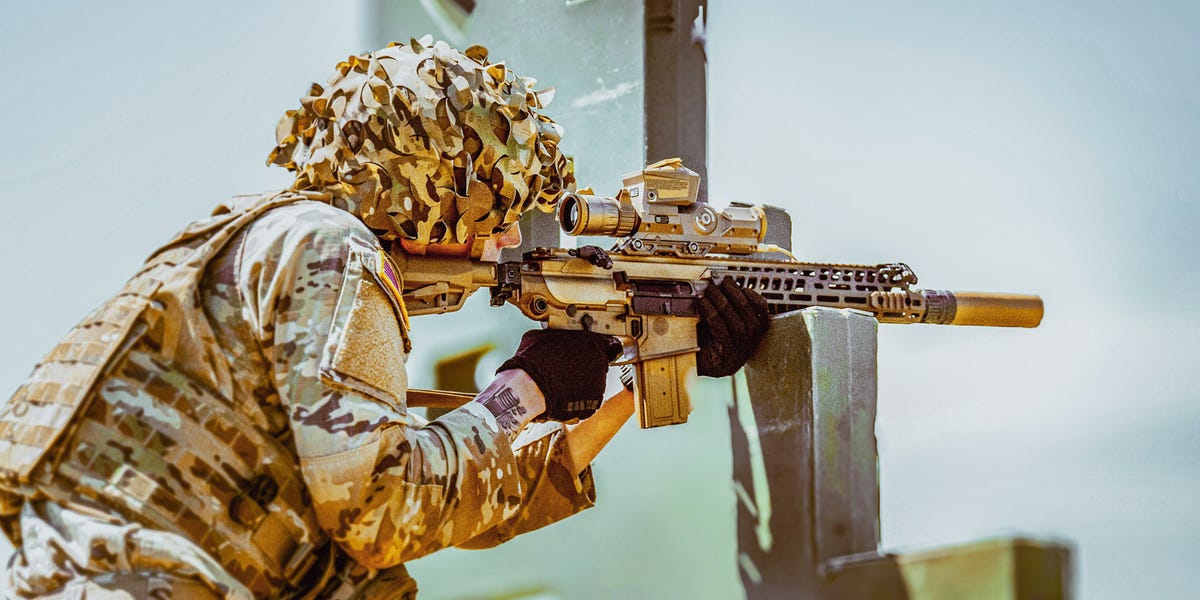
The U.S. Army did not spend years developing a new rifle, a new cartridge, a computerized optic, and an entirely new ammunition-production system merely because somebody wanted a shinier gun rack. The M7 rifleformerly known as the XM7was created in large part to restore infantry “overmatch” against opponents wearing increasingly capable body armor.
That mission sounds straightforward: build a rifle that hits harder than the M4A1 and can defeat protected targets at longer distances. In practice, however, the question of whether the Army’s new rifle can penetrate modern body armor has no tidy yes-or-no answer. The M7’s 6.8x51mm ammunition clearly delivers more ballistic performance than the Army’s 5.56mm M855A1 round. Public testing also indicates greater lethality against evaluated targets. What remains unavailable is the classified fine print: exactly which armor plates it can defeat, with which ammunition, at what range, and under what impact conditions.
The most defensible conclusion is that the M7 should be substantially more effective against many armored threats than the M4A1. It does not follow that every 6.8mm bullet will sail through every modern ceramic plate like a fork through warm pie. Ballistics rarely cooperate with advertising slogans.
Why the Army Wanted a More Powerful Rifle
For decades, the M4 and its 5.56x45mm ammunition gave American infantry a compact, controllable, and lightweight weapon. Soldiers could carry plenty of cartridges, maneuver through buildings, and deliver rapid fire without wrestling with punishing recoil.
The drawback is that 5.56mm performance drops as distance increases. Modern hard armor plates also present a more serious challenge than the soft armor commonly encountered in earlier conflicts. Potential adversaries now have broader access to ceramic-composite plates, improved plate carriers, ballistic helmets, and other protective equipment.
The Army therefore designed the Next Generation Squad Weapon program around a demanding objective: improve range, accuracy, and terminal effect while providing better performance against protected personnel. SIG Sauer won the production contract in 2022 with the rifle that became the M7 and the belt-fed weapon that became the M250.
The two weapons use a common family of 6.8x51mm ammunition. The M7 is intended primarily for the close combat force, rather than as an immediate rifle replacement for every soldier in the Army. That distinction matters because the new system is heavier, more expensive, and logistically more demanding than simply issuing another variation of the M4.
What Makes the M7 More Capable Against Armor?
A Larger, Faster 6.8mm Cartridge
The central advantage is not the rifle’s shape, suppressor, folding stock, or abundance of rails. It is the ammunition.
The 6.8x51mm common cartridge operates at substantially higher performance levels than standard 5.56mm ammunition. Its hybrid cartridge case was developed to tolerate the pressures required to launch a heavier projectile at high velocity from an infantry-sized weapon. That combination can preserve more energy and momentum at distance.
More retained energy does not automatically guarantee armor penetration. Projectile construction is equally important. A specialized penetrator behaves differently from an ordinary ball projectile, even when both leave the muzzle at similar speeds. The Army’s ammunition family therefore includes multiple rounds for different missions, including the M1186 General Purpose cartridge and a Special Purpose cartridge.
Public Pentagon reporting states that the 6.8mm Special Purpose ammunition generally produced greater lethality than M855A1 against the targets included in testing. The details of those targets and the full results were placed in a classified annex. That secrecy is frustrating for curious observers, but publishing an illustrated guide to the exact limitations of American ammunition would be rather considerate of potential opponents.
Better Performance at Extended Range
A bullet begins losing velocity as soon as it leaves the barrel. Because penetration usually depends partly on impact velocity, a cartridge that works against a target at 50 yards may produce a different result at 300 or 500 yards.
The M7’s 6.8mm cartridge is designed to retain useful energy farther downrange than the M4’s 5.56mm round. This does not merely increase maximum range on a specification sheet. It expands the distance at which a soldier may have enough velocity, accuracy, and projectile performance to threaten an armored opponent.
That is a major improvement in open terrain, where an enemy may engage from ridgelines, field edges, windows, or prepared positions well beyond typical close-quarters distances.
The M157 Fire Control System
Armor penetration is irrelevant when the bullet misses, which is why the Army treats the optic as part of the weapon system rather than a decorative accessory.
The M157 fire control combines a variable-power optic with a laser rangefinder, ballistic calculator, environmental sensors, compass, aiming lasers, and a digital display. It can calculate a corrected aiming point based on range and atmospheric conditions, reducing the guesswork involved in longer shots.
The official system is designed to support rapid engagements beyond 600 meters. A soldier still needs training, a stable position, target identification, and control of the rifle. The optic does not transform every trigger pull into a Hollywood headshot. It does, however, improve the probability that the 6.8mm projectile arrives where intended with enough remaining velocity to matter.
What Does “Modern Body Armor” Actually Mean?
The phrase “modern body armor” covers an enormous range of equipment. It may refer to soft armor intended primarily for handgun threats, a steel plate, an advanced ceramic-composite insert, or a proprietary military plate designed around a classified threat.
U.S. law-enforcement armor is commonly discussed using National Institute of Justice protection levels. The newer NIJ system uses HG categories for handgun threats and RF categories for rifle threats. RF3 corresponds to the highest rifle category in the current system and replaces the older Level IV terminology.
Those categories are useful, but they are not a universal scoreboard for military armor. NIJ standards define specific laboratory threats, velocities, conditioning procedures, shot locations, and performance requirements. They do not certify that a plate will stop every projectile of a similar caliber. Nor do they reveal how foreign military armor performs against classified American ammunition.
Plate composition also changes the outcome. Ceramic armor may fracture and erode a projectile while spreading the impact through a composite backing. Steel behaves differently. Polyethylene plates may perform well against some projectiles while being less suitable against others. Impact angle, plate curvature, previous hits, edge strikes, temperature, manufacturing quality, and projectile design can all affect the result.
In other words, asking whether the M7 defeats “modern armor” is a little like asking whether a truck can cross “a bridge.” Which truck? Which bridge? How heavily loaded? And has somebody already driven a tank into the guardrail?
Can the M7 Defeat High-End Rifle Plates?
Public information supports three conclusions.
First, defeating protected targets was an explicit part of the M7’s mission. Pentagon documents describe Next Generation Squad Weapons being employed against personnel with and without protective body armor. The Army would not have accepted the considerable weight and ammunition burden of a 6.8mm system if ordinary 5.56mm performance had been considered sufficient.
Second, public operational testing found increased lethality over M855A1 against tested targets. That establishes a genuine performance gain, not merely a manufacturer’s promise accompanied by dramatic music.
Third, the specific armor-defeat envelope is classified. No responsible public analysis can state that the M7 will reliably penetrate every advanced military plate at a particular distance. Claims such as “it defeats Level IV armor at 600 meters” should be treated cautiously unless accompanied by authoritative test conditions and identification of the exact cartridge and armor model.
The Special Purpose round is the ammunition most closely associated with difficult targets, but even specialized ammunition operates within physical limits. Armor can be upgraded. Plates can become thicker, heavier, or more sophisticated. The familiar contest between projectile and protection has been running for centuries, and neither side has filed for retirement.
The Price of Greater Penetrating Power
More Weight on the Soldier
The Army lists the M7 at approximately 8.4 pounds without its suppressor and about 9.8 pounds with it. The M157 adds roughly 2.7 pounds before a loaded magazine, laser accessories, sling, and other equipment enter the conversation.
The rifle is therefore significantly heavier than a typical configured M4A1. Its 20-round magazines also hold fewer cartridges than the M4’s standard 30-round magazines, while individual 6.8mm rounds weigh more.
That creates a classic infantry tradeoff: greater power per shot, but fewer shots for a given carried weight. A soldier who is tired, overheated, or moving slowly because of equipment weight may not receive the full benefit of superior ballistics.
Recoil and Controllability
A more powerful cartridge generally produces more recoil. The M7’s operating system, suppressor, weight, and design help manage it, but they cannot negotiate a complete cancellation of physics.
Greater recoil can slow follow-up shots and make automatic fire harder to control. Against fleeting targets at close range, shot placement and speed may matter more than maximum armor penetration. The M7 must therefore succeed as a complete fighting rifle, not merely as an impressive device for punching test materials.
Heat, Fumes, Reliability, and Optic Concerns
Independent Pentagon testing has identified several areas requiring improvement. Soldiers reported negative effects from weapon off-gassing and expressed concern about suppressors becoming extremely hot after firing. Testers also called for improvements in reliability, safety, cold-weather compatibility, and human-systems integration.
Ergonomic complaints about the M157 continued during operational assessment, and many M250 automatic rifles equipped with the optic did not retain zero in certain tests. Earlier testing also found low mission reliability for an M7-and-optic configuration, although the program subsequently made technical changes.
These findings do not prove the system is a failure. Developmental and operational tests are supposed to uncover problems before they become permanent companions. They do show why raw muzzle energy cannot be the only measure of effectiveness. A rifle capable of defeating armor is less useful when its optic is awkward, its suppressor becomes a branding iron, or the soldier cannot comfortably carry enough ammunition.
Fielding Status and the Lighter XM8 Carbine
The Army granted standard type classification to the M7 and M250 in May 2025, confirming that the weapons met the service’s requirements for operational performance, safety, and sustainment at that stage. Fielding has continued among close combat formations while testing and refinement proceed.
Soldier feedback also encouraged development of a shorter, lighter carbine variant. The Army approved procurement of that version, designated the XM8, and began accepting initial deliveries in 2026. The new carbine uses the same 6.8x51mm ammunition but is more than a pound lighter and several inches shorter than the original M7 configuration.
The XM8 is not officially replacing the M7 across the board. It represents an effort to preserve system lethality while improving mobility and handling. Its shorter barrel may reduce muzzle velocity somewhat, making future testing important when the mission involves difficult targets at extended range. Every inch and pound removed from a weapon is welcome until the missing inch or pound takes some desired performance with it.
Experience-Based Assessment: What the System May Feel Like in Real Use
A practical evaluation of the M7 begins with an important distinction: firing a few supported shots on a clean range is not the same experience as carrying a weapon through a multi-day field problem. A soldier must climb, crawl, enter vehicles, clear rooms, cross uneven ground, manage communications equipment, and remain alert while wearing armor and carrying ammunition, water, medical supplies, batteries, and assorted objects apparently selected by someone who dislikes shoulders.
In a deliberate engagement from a supported position, the M7’s advantages should be obvious. The shooter can range the target with the M157, receive an adjusted aiming solution, and send a heavier projectile with better retained energy than 5.56mm. Against a partially exposed or armored opponent several hundred meters away, that combination offers a meaningful increase in capability.
The experience changes in a building. The suppressor increases overall length, the optic adds bulk, and the loaded rifle is heavier than the M4A1 familiar to many soldiers. During rapid movement between doorways and awkward firing positions, ounces develop a mysterious ability to become pounds. Recoil also becomes more noticeable when firing quickly from unstable positions.
Ammunition management would influence behavior as well. Seven 20-round magazines provide 140 ready rounds, compared with 210 rounds in seven 30-round M4 magazines. Units can adjust combat loads, but additional 6.8mm ammunition adds weight quickly. Soldiers and leaders may place greater emphasis on disciplined semiautomatic fire, target prioritization, and coordination with the M250 gunner.
The suppressor presents another experience-based tradeoff. Reducing flash and sound signature can make a unit harder to locate and improve communication during a fight. After sustained firing, however, suppressors become extremely hot. A soldier moving through vegetation, entering a vehicle, or transitioning the rifle around equipment must remain aware of that heat. A moment of inattention can damage gear or skin with impressive efficiency.
Range feedback suggests that soldiers can qualify with the new system and engage targets at extended distances. That is encouraging because advanced ammunition has limited value without practical hit probability. Yet the optic’s menus, controls, eye relief, batteries, display, and added mass must remain manageable when the user is cold, exhausted, wearing gloves, or working in darkness.
The greatest experiential benefit may therefore be confidence. A soldier who knows the rifle can deliver useful effects beyond traditional carbine distances has more options. The squad can challenge protected opponents sooner, exploit open terrain, and rely less heavily on larger supporting weapons for every difficult rifle target.
The greatest experiential risk is overload. The Army has combined a powerful cartridge, suppressor, advanced optic, sensors, electronics, and wireless features into one individual weapon system. Each component offers capability, but capability carries weight, training requirements, maintenance demands, and opportunities for failure. The winning configuration will be the one soldiers can carry, understand, maintain, and employ under stressnot simply the one that produces the most impressive ballistic chart.
Final Verdict: More Capable, but Not an Armor-Crushing Magic Wand
Will the Army’s new rifle be able to take on modern body armor? Yes, within reasonable limits. The M7 and its 6.8x51mm ammunition were specifically developed to improve performance against protected targets, especially at distances where 5.56mm loses much of its advantage. Public Pentagon testing confirms greater lethality than M855A1 against the targets evaluated.
What the public record does not establish is universal penetration of every contemporary hard plate. Armor varies too much, ammunition types differ, and the decisive test results are classified. The M7 should be viewed as a stronger answer to the armor problem, not the final answer.
Its success will ultimately depend on more than whether one specialized round can break one plate in a laboratory. The Army must balance armor defeat with accuracy, controllability, reliability, ammunition load, suppressor safety, optic usability, and the physical burden placed on soldiers.
The M7 gives the infantry squad more range and striking power. Whether it delivers true battlefield overmatch will depend on continued testing, improved equipment, realistic training, and how quickly armor technology responds. In the eternal contest between better shields and better arrows, the Army has unquestionably built a bigger arrow. The shield manufacturers are unlikely to take the news personallyor quietly.
Editorial note: This analysis is based on publicly available information from the U.S. Army, Department of Defense testing reports, federal body-armor standards, program documentation, and reputable American defense publications. Detailed penetration data for the 6.8mm Special Purpose and General Purpose ammunition remain partly or fully classified, so claims about defeating a particular armor plate at a precise range should not be presented as confirmed unless supported by an official test release.