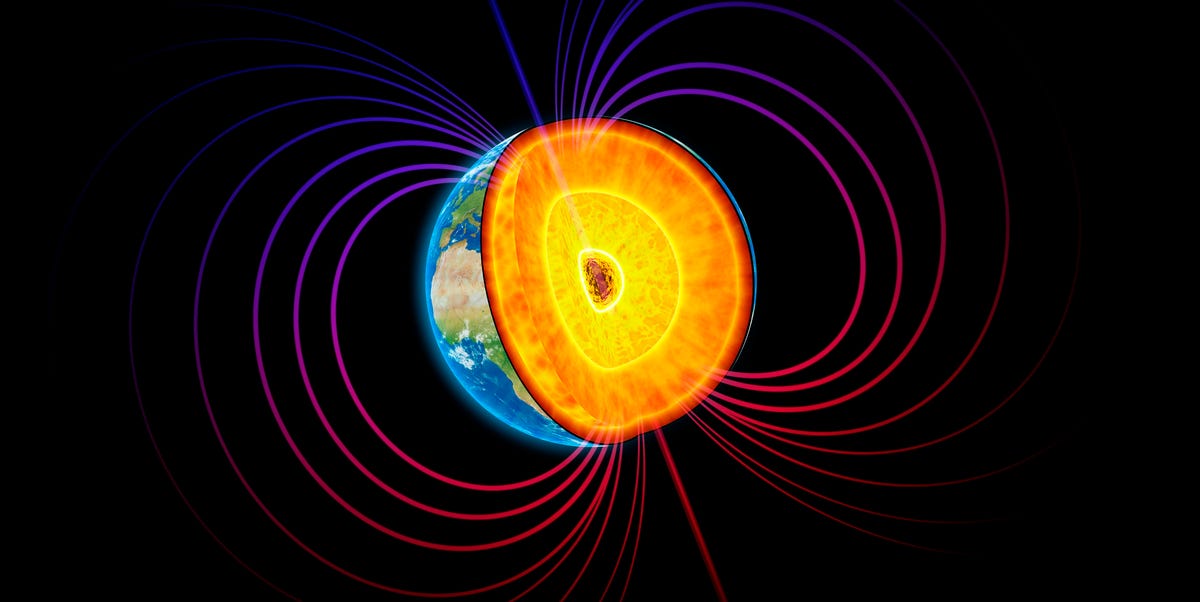
If Earth were a person, it would be the kind of person who looks perfectly calm in public while secretly doing something extremely weird in private. From the sidewalk, our planet seems steady, dependable, and not at all interested in drama. But deep below your shoes, beyond the crust, beneath the mantle, and inside a churning ocean of molten metal, Earth’s inner core may be performing a tiny, rhythmic wobble roughly every 8.5 years.
That sentence sounds like the setup for a science-fiction movie, but it comes from real geophysical research. The finding has stirred up excitement because it suggests the very center of our planet is not just sitting there like a frozen bowling ball. Instead, it may be slightly misaligned with the mantle and moving in a subtle pattern that shows up in two very precise measurements: polar motion and the length of the day.
Before anybody starts panic-buying compasses, let’s clear something up: this is not a catastrophic wobble, and it does not mean Earth is about to wobble off its orbit like a shopping cart with one bad wheel. The effect is tiny. But in geophysics, tiny is where the fun begins. A minuscule shift can reveal enormous truths about how the planet formed, how its magnetic field behaves, and how its deep interior exchanges energy and momentum.
So why does the Earth’s core mysteriously wobble every 8.5 years? The honest answer is that scientists now have a strong hypothesis, not a final courtroom verdict. The short version is that the wobble may be caused by a small tilt between the inner core and the mantle, combined with gravitational and fluid interactions in the planet’s deep interior. The longer version is much more interesting, and thankfully, much less boring than a middle-school cross-section diagram ever made it look.
First, What Exactly Is “Wobbling”?
When people hear “Earth’s core wobble,” they often imagine the whole center of the planet sloshing around like soup in a thermos. That is not what researchers mean. The proposed wobble involves the solid inner core, a dense iron-rich sphere surrounded by the liquid outer core. The outer core is in motion, and that motion helps generate Earth’s magnetic field. The inner core, meanwhile, is not totally isolated from the rest of the planet. It can rotate, shift very slightly, and interact with the mantle through gravitational and electromagnetic coupling.
The 8.5-year wobble refers to a repeating signal that scientists found in measurements of Earth’s rotation. Think of it less like a wild dance move and more like the tiniest possible off-center spin of a top. If you have ever watched a spinning top lean just a bit while still staying upright, you already have the basic visual. Earth, it turns out, may be doing a geophysical version of that trick at its center.
How Scientists Detected Something They Cannot Visit
Geophysicists have one major workplace inconvenience: they cannot pop down to the core with a flashlight and a clipboard. The deepest humans have ever drilled is nowhere close to the mantle, let alone the core. So scientists study Earth’s interior indirectly, using tools like seismic waves, geomagnetic observations, and ultra-precise measurements of rotation.
Polar Motion: Earth’s Spin Axis Has a Wandering Habit
One of the big clues comes from polar motion, which tracks how Earth’s spin axis shifts relative to the crust. This is a known phenomenon. Earth’s axis does not stay perfectly fixed; it meanders over time. Some of that motion comes from surface processes, including changes in the atmosphere, oceans, ice sheets, and groundwater. In other words, the planet’s balance changes when mass moves around near the surface.
But researchers studying long-term records noticed a signal that did not neatly match those familiar causes. Buried in the data was a pattern with a period of about 8.5 years. That was odd enough to get attention, because deep-Earth processes can also influence polar motion. If the inner core is slightly tilted or wobbling relative to the mantle, that motion can exchange angular momentum with the rest of the planet and leave a faint fingerprint in Earth’s rotational behavior.
Length of Day: Yes, Even Day Length Wiggles a Little
The second clue came from length-of-day variations. No, your smartphone is not wrong and the day is not suddenly 26 hours long. But Earth’s rotation is not perfectly uniform, so the exact length of a day can change by tiny amounts over time. Scientists track these changes with remarkable precision.
In the recent research, the same approximately 8.5-year signal appeared not only in polar motion but also in length-of-day records. That matters because it suggests the effect is not random noise. When two separate types of Earth-rotation data hum the same tune, researchers start listening very carefully.
Why 8.5 Years? The Leading Explanation
The leading explanation is that the inner core is slightly tilted relative to the mantle. The estimated tilt is tiny, around 0.17 degrees, which is geophysically meaningful but visually underwhelming. If you are hoping for a dramatic cinematic lean, I regret to inform you that the core remains committed to subtlety.
Still, a tiny tilt can matter. If the inner core’s axis is not perfectly aligned with the mantle’s rotation axis, then the inner core can wobble around that tilted position. Because the inner core is surrounded by the liquid outer core and influenced by gravitational forces from the mantle, its motion is not independent. Those interactions can create a repeating oscillation, which then shows up in Earth’s rotation records.
Researchers have also suggested that the observed 8.5-year period may reveal something about the density jump at the inner-core boundary, the transition between the solid inner core and the molten outer core. In other words, this wobble is not just an odd rhythm. It could be a clue about the physical structure of one of the least accessible regions on Earth.
Why Scientists Still Call It a Mystery
Because Earth’s interior likes to keep several secrets at once.
The wobble explanation is persuasive, but the deep Earth is a wildly difficult system to untangle. Polar motion can be influenced by climate-related mass redistribution, ocean circulation, atmospheric motion, hydrology, and internal geodynamics. Researchers work hard to subtract those known effects, but deep-Earth signals are faint, and the planet is not exactly cooperating by staying simple.
That is why careful scientists do not say, “Case closed, the core did it.” They say something more like, “This interpretation is strongly supported by the available data, but further observations and modeling are needed.” Which is science-speak for, “We are onto something big, but Earth is still being annoyingly mysterious.”
The Core Is Not Just Wobbling. It May Also Be Changing Speed and Shape.
The 8.5-year wobble is not the only strange behavior scientists have linked to the inner core. Other studies have suggested the inner core’s rotation rate changes over time. One line of research found evidence for a roughly six-year oscillation in which the inner core alternates between slightly faster and slightly slower motion relative to the rest of the planet. More recent work has suggested the inner core slowed relative to Earth’s surface around 2010.
If that were not enough to make textbooks nervous, newer research has also raised the possibility that the near-surface part of the inner core may be deforming. That means Earth’s deep center may not be a perfectly rigid metallic marble. Instead, it could be a dynamic structure whose rotation, shape, and interaction with the outer core all evolve over time.
This broader context matters because it tells us the 8.5-year wobble is not some isolated curiosity. It fits into a growing picture of the inner core as active, coupled, and surprisingly complicated.
What Does This Have to Do With Earth’s Magnetic Field?
Quite a lot, potentially. Earth’s magnetic field is generated by motion in the liquid outer core, a process often called the geodynamo. The swirling conductive metal there creates electric currents, which in turn generate the magnetic field that helps protect our planet from harmful charged particles from space.
If the inner core is slightly tilted, wobbling, changing speed, or deforming, that could influence the shape and motion of the outer core’s fluid over long timescales. Scientists are interested in that because even subtle changes in core dynamics may help explain certain geomagnetic variations. This does not mean the 8.5-year wobble will flip the magnetic poles next Tuesday. It means the wobble may offer one more clue to how the deep engine of the planet behaves.
That is one reason this topic fascinates researchers. A tiny rhythm hidden in Earth’s rotational data might connect to enormous planetary processes, including the long-term evolution of the magnetic field.
What This Discovery Does Not Mean
Let’s take a moment to rescue this story from internet exaggeration.
The 8.5-year wobble does not mean Earth is unstable. It does not mean the planet is about to tip over, stop spinning, or fling your coffee sideways every eight and a half years. It does not mean geophysicists have discovered an underground monster with a metronome.
What it means is that Earth’s deepest interior appears to have a subtle, measurable rhythm. The signal is small, the interpretation is sophisticated, and the implications are scientific rather than apocalyptic. In other words, it is exactly the kind of discovery the internet is capable of turning into nonsense if left unsupervised.
Why the 8.5-Year Core Wobble Matters
This research matters because the core is not just another layer in a geology diagram. It is central to how Earth works as a planet. The inner and outer core influence the magnetic field, the planet’s rotational behavior, and the long-term evolution of the deep interior. Understanding the core is part of understanding why Earth is habitable, why its magnetic shield exists, and how rocky planets develop over billions of years.
It also matters methodologically. The idea that scientists can infer motion in the inner core by analyzing tiny changes in day length and polar motion is a triumph of precision Earth science. We cannot travel to the core, but with enough data, enough mathematics, and enough patience, we can still catch the planet whispering about what is happening down there.
And that may be the most delightful part of the whole story. The Earth is not only alive with motion at the surface, where winds blow and oceans churn. It is also active at the center, where iron, gravity, heat, and rotation are engaged in a slow-motion argument that has been going on for billions of years.
So, Why Does the Earth’s Core Mysteriously Wobble Every 8.5 Years?
The best answer right now is this: Earth’s inner core probably wobbles because it is slightly misaligned with the mantle, and that small tilt interacts with gravitational forces, rotational dynamics, and the liquid outer core to produce a repeating oscillation. Scientists infer that rhythm from matching signals in polar motion and length-of-day records. The exact mechanism is still being refined, but the mystery has shifted from “Is there really a signal?” to “What deep-Earth physics creates it so reliably?”
That is real progress. The mystery is no longer a foggy rumor in the data. It is becoming a measurable feature of the planet’s internal life.
Earth, in classic Earth fashion, has managed to be both more understandable and more astonishing at the same time.
Human Experience: What It Feels Like to Live on a Planet With a Wobbling Core
There is something wonderfully humbling about learning that the center of Earth may wobble every 8.5 years and realizing that absolutely nobody notices it while waiting at a crosswalk. Cars stop. Birds land on wires. A kid drops a backpack. Someone reheats leftover pizza. Meanwhile, nearly 3,000 miles below the surface, the most inaccessible part of the planet may be shifting in a rhythm so small and so deep that only years of data can reveal it.
That contrast is part of what makes this topic feel so strange in a human way. We live on the crust, which encourages the illusion that the world is stable and finished. But the deeper science goes, the more Earth starts to feel less like a rock and more like a system of ongoing negotiations. The atmosphere negotiates with the oceans. The ice sheets negotiate with climate. The mantle negotiates with tectonic plates. And the core, apparently, has been conducting its own quiet business this whole time.
For students, readers, and anyone who has ever fallen into a late-night science rabbit hole, this discovery creates a very specific emotional effect: awe mixed with mild betrayal. Awe, because it is amazing that human beings can detect a faint 8.5-year rhythm in the heart of the planet. Betrayal, because school diagrams made the core look so simple. You were shown neat layers in cheerful colors. Nobody said the center might be wobbling, changing speed, and possibly deforming like a highly pressurized metallic mystery bean.
There is also a quiet beauty in how scientists experience discoveries like this. Nobody hears the core directly. No one gets front-row seats. Instead, researchers spend years with seismograms, rotational data, equations, models, and arguments over whether a signal is meaningful or just noise in a badly behaved planet. The experience of discovery is not a dramatic explosion of revelation. It is more like watching a blurry image slowly sharpen until a pattern you suspected becomes impossible to ignore.
For the rest of us, the emotional experience is different but no less real. Once you know the core may wobble, daily life changes just a little. The ground feels less like a platform and more like a temporary agreement. Mountains stop looking eternal. “Solid earth” starts sounding like a legal term rather than a physical description. Even a calm day can feel more alive, because calm at the surface no longer means stillness below.
That may be the real gift of this story. It reminds us that mystery is not the opposite of knowledge. Mystery is what knowledge looks like when the universe still has more to say. The 8.5-year wobble does not make Earth scarier. It makes Earth richer. It gives the planet character. It turns the world beneath our feet into something dynamic, layered, and gloriously unfinished.
And maybe that is why people love stories like this. They do not just explain a mechanism. They restore wonder. They remind us that even now, with satellites in orbit and supercomputers on command, the planet can still surprise us. Earth is not done revealing itself. It is still sending out tiny clues from impossible depths, and every once in a while, we are clever enough to hear them.
Conclusion
The idea that Earth’s inner core may wobble every 8.5 years sounds bizarre at first, but it is rooted in serious science. Researchers have traced this subtle rhythm through polar motion and length-of-day data, leading to the hypothesis that a tiny tilt between the inner core and mantle is driving the motion. The effect is small, but the implications are enormous. It suggests that Earth’s center is not static but dynamic, and that even the deepest parts of the planet participate in the slow choreography of rotation, gravity, and magnetism.
In the end, the mystery is not just why the core wobbles. The bigger mystery is how much more is happening inside Earth that we have not yet learned to detect. If the planet’s deepest layer can whisper in 8.5-year rhythms, it is a good bet that the center of Earth still has a few secrets left to share.