Someone narrows their eyes across the room, and your brain immediately opens a detective agency. Are they suspicious? Annoyed? Trying to remember your name? Or did the overhead light attack them like a tiny artificial sun?
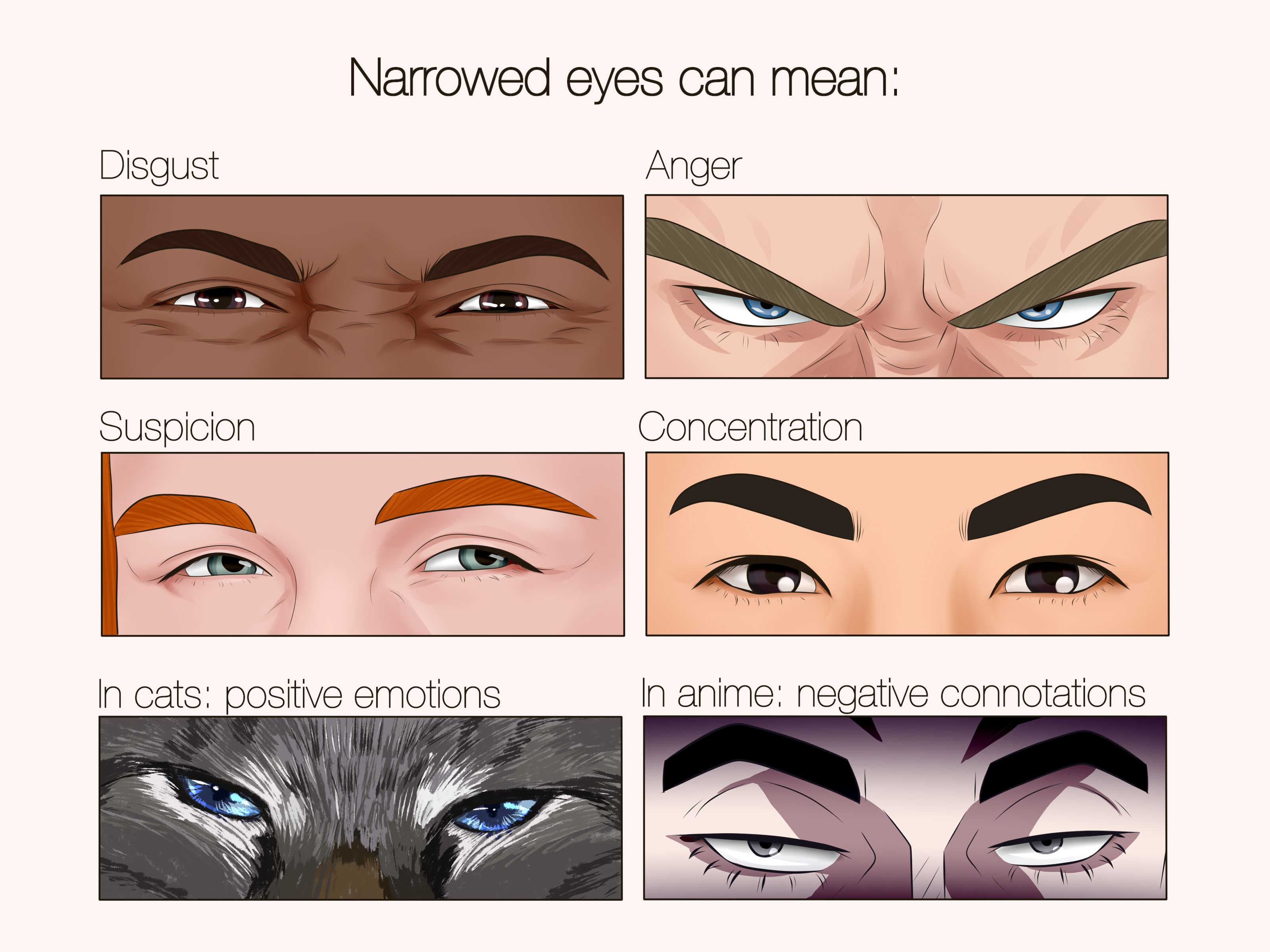
Narrowed eyes are noticeable, but they do not have one fixed translation. The expression can reflect suspicion, concentration, anger, disgust, amusement, blurry vision, fatigue, pain, or sensitivity to light. Its meaning depends on the conversation, the rest of the person’s face and body, and what is normal for that individual.
Eye narrowing is therefore a cluenot a signed confession. Reading it accurately requires context and a pattern of supporting signals.
The Quick Meaning of Narrowed Eyes
When someone narrows their eyes, they partially close their eyelids and reduce how much of the eyes is visible. Socially, this often suggests increased scrutiny. The person may be examining what they see, evaluating what they hear, or reacting to something unpleasant.
- Suspicion or skepticism: They are not convinced yet.
- Concentration: They are thinking or focusing closely.
- Anger or irritation: Tension may be building.
- Disgust or disapproval: Something feels objectionable.
- Amusement: A broad smile naturally compresses the eye area.
- Physical discomfort: Bright light, blurry vision, dryness, or pain may cause squinting.
The important word is may. One facial movement is rarely enough to identify a person’s exact emotion or intention.
Why Do People Narrow Their Eyes?
Eye narrowing has both visual and social functions. Reducing the opening between the eyelids can limit incoming light and briefly improve the perception of detail. Research comparing eye movements has found that widening the eyes supports broader detection, while narrowing them can support finer discrimination. Wide eyes ask, “What is happening?” Narrow eyes ask, “What exactly is that?”
Research support:
These useful physical movements also became social signals. People commonly associate narrowed eyes with evaluation, suspicion, or disgust. However, facial expressions are flexible. Human beings are not emoji characters with one permanent emotion assigned to each face.
Research support:
Common Meanings When Someone Narrows Their Eyes
1. Suspicion or Distrust
This is the classic interpretation. The eyebrows may lower, the head may tilt, and the person may hold steady eye contact. Together, those cues can suggest that they are testing whether a claim makes sense.
Imagine telling a coworker, “The spreadsheet deleted itself.” If their eyes narrow while their lips press together, they may be evaluating your story rather than admiring your technical vocabulary. Still, suspicion can be mild; the person may simply need more information.
2. Skepticism or Critical Evaluation
Skepticism is often less personal than distrust. Someone may narrow their eyes during a sales pitch, proposal, or ambitious prediction because they are analyzing the evidence. A raised eyebrow, backward lean, or detailed question strengthens this interpretation.
In this setting, the expression may mean, “Show me how you reached that conclusion,” not, “I dislike you and everything you represent.”
3. Concentration and Mental Effort
People narrow their eyes while solving problems, recalling memories, reading small text, or focusing on distant objects. The expression may have nothing to do with you. Their brain is using extra processing power, and their face has accidentally switched into advanced settings.
Concentration often comes with still posture, reduced blinking, a forward lean, or attention directed at an object instead of another person.
4. Anger or Irritation
Narrowed eyes can appear in anger, especially with lowered brows, a clenched jaw, flared nostrils, rigid posture, or a sharp voice. A brief squint may show annoyance; a prolonged stare with tense muscles may signal stronger hostility.
Do not judge intensity from the eyes alone. Tone, words, movement, personal distance, and the surrounding conflict matter much more.
5. Disgust or Disapproval
Disgust may combine narrowed eyes with a wrinkled nose, raised upper lip, turned head, or physical withdrawal. The trigger can be sensory, such as a bad smell, or social, such as an offensive remark.
Disapproval is often subtler. A parent watching a child decorate the wall with permanent marker may narrow their eyes in a look that says, “We are about to discuss your artistic career.”
6. Genuine Amusement or Warmth
Narrowed eyes are not automatically negative. During a strong smile, the cheeks rise and the muscles around the eyes contract, producing smaller eye openings and creases at the outer corners.
Relaxed brows, laughter, open posture, and raised cheeks point toward pleasure. The same eye shape paired with compressed lips and a rigid stare means something very different.
Research support:
7. Bright Light or Irritation
Sometimes the explanation is wonderfully boring: the room is too bright. Sunlight, glare, flashes, wind, smoke, dust, or harsh office lighting can cause squinting. Environmental narrowing often affects both eyes and improves when the person moves away from the trigger.
Before creating an emotional subplot, check whether they are facing a window at noon.
8. Blurry Vision, Eye Strain, or Pain
Squinting can temporarily make blurred objects appear clearer. Nearsightedness, astigmatism, or other focusing problems may cause frequent narrowing when a person reads signs, watches a presentation, or looks into the distance.
Research support:
Screen-related eye strain may also cause tired or dry eyes, headaches, blurry vision, and trouble focusing. Painful light sensitivity can occur with migraine, irritation, inflammation, infection, injury, and other medical conditions. Redness, watering, discharge, nausea, or vision changes suggest discomfort rather than attitude.
Research support:
How to Read Narrowed Eyes More Accurately
Start With Context
Ask what happened immediately before the expression. Did you make a surprising claim? Did the person walk into sunlight? Are they reading tiny text? Did someone say something insulting? Context eliminates many bad interpretations before they start a neighborhood rumor.
Look for a Cluster of Signals
Narrowed eyes plus a relaxed smile differ from narrowed eyes plus a clenched fist. Watch the eyebrows, mouth, head, posture, gestures, voice, and distance. Seek two or three supporting cues before forming even a tentative conclusion.
Compare With the Person’s Baseline
Some people naturally keep their eyelids partly lowered. Others squint when thinking, remove their glasses, become tired, or enter bright rooms. A change from someone’s usual behavior is more informative than the behavior alone.
Cultural and individual differences matter too. People vary in their use of eye contact and emotional display, so no facial configuration has an identical meaning for everyone.
Research support:
Notice Timing and Listen to Words
A split-second narrowing may be reflexive; a sustained expression may indicate ongoing focus, discomfort, or tension. Spoken language remains the clearest guide. If someone says, “I cannot see the numbers,” do not decide they secretly dislike your shoes unless the shoes are listed in the report.
What Narrowed Eyes May Mean in Different Situations
At Work
In meetings, narrowed eyes may indicate analysis, confusion, concern, or difficulty seeing a screen. Pause, clarify the point, enlarge the text, or invite questions rather than challenging the expression.
During Dating
A soft squint paired with a warm smile, comfortable eye contact, relaxed shoulders, and engaged conversation may feel playful or affectionate. It does not prove attraction. Consistent interest and direct communication are more reliable than decoding one eyelid movement like an ancient prophecy.
During Conflict
In an argument, narrowed eyes may signal anger, disbelief, or defensive attention. Lower the intensity and ask what concerns the person. If behavior becomes threatening, prioritize safety instead of attempting a detailed facial analysis.
With Children or on Video Calls
A child who repeatedly squints, rubs the eyes, closes one eye, sits close to screens, or reports headaches may need an eye exam. On video calls, screen glare, tiny windows, camera quality, and visual fatigue can produce the same expression. Ask, “Can you see this clearly?” before assuming disagreement.
Research support:
Does Narrowing the Eyes Mean Someone Is Lying?
No dependable rule connects narrowed eyes with deception. Truthful and dishonest people may both squint, stare, blink, smile, or look away. Nervousness, confusion, fatigue, discomfort, and fear of being disbelieved can produce similar behaviors.
Facial movements are not reliable lie detectors. Evaluate evidence, consistency, details, and behavior over time rather than treating one expression as proof.
Research support:
When Frequent Eye Narrowing May Need Medical Attention
Occasional squinting in bright light is normal. Arrange an eye examination when frequent narrowing interferes with reading, computer use, driving, schoolwork, or distance vision.
Seek prompt medical care for sudden vision changes, moderate or severe eye pain, marked redness, injury, strong light sensitivity, new flashes or floaters, discharge, swelling, or difficulty opening the eye. Sudden one-sided narrowing with facial weakness, drooping, speech difficulty, confusion, or severe headache requires emergency evaluation.
Research support:
How Should You Respond?
Use curiosity instead of mind reading. You might ask, “Does that make sense?” “Which part should I clarify?” “Is the light bothering you?” or “Did that comment make you uncomfortable?”
These questions let the person explain without having an emotion forced onto them. They also prevent the classic disaster in which one person squints at the sun and the other begins defending a decision nobody questioned.
Real-World Experiences: Narrowed Eyes in Practice
The following composite scenarios show how the same expression can have very different meanings. They are illustrations, not diagnoses or guaranteed translations.
Experience 1: The “Suspicious” Client
During a project presentation, a client narrowed her eyes whenever the budget slide appeared. The presenter assumed she disliked the pricing and began defending every expense at high speed. The client became more confused. Afterward, she explained that the pale numbers were difficult to read on the bright screen.
When the slide was redesigned with larger text and stronger contrast, the expression disappeared. What looked like financial distrust was actually a typography emergency wearing a serious face. The presenter’s mistake was not considering the simplest physical explanation first.
Experience 2: The Friend Who “Didn’t Believe” the Story
A man told friends that he had unexpectedly met a famous athlete at an airport. One friend narrowed his eyes, leaned forward, and asked detailed questions. The storyteller interpreted the look as disbelief and became defensive. In reality, the friend was fascinated and mentally picturing the scene.
The narrowed eyes did reflect scrutiny, but scrutiny is not always rejection. People closely examine stories when they are curious or surprised. The enthusiastic questions and laughter offered better evidence than the eye movement alone.
Experience 3: The Quiet Argument
During a family discussion, one person narrowed his eyes, tightened his jaw, and folded his arms after a dismissive comment. Several signals pointed toward controlled irritation. Instead of demanding, “What is that look supposed to mean?” another person said, “That sounded disrespectful. Let’s slow down.”
The response worked because it addressed the likely trigger without pretending to know his exact thoughts. In conflict, facial expressions can open a conversation, but they should not conduct the entire trial.
Experience 4: The Smiling Squint
At a reunion, two old friends spotted each other across the room. Both smiled broadly, their cheeks rose, and their eyes narrowed into warm creases. Someone isolating the eye shape might call it suspicion, but the complete expression clearly communicated joy.
The mouth, cheeks, eyebrows, posture, and movement transformed the meaning. Eye narrowing inside a relaxed smile differs fundamentally from eye narrowing paired with compressed lips and a rigid stare. The face works as a coordinated system, not a collection of independent subtitles.
Experience 5: The Habit Nobody Questioned
A student regularly narrowed one eye while looking at the classroom board. Teachers assumed it was a concentration habit because he performed well and never complained. Eventually, headaches and blurry distance vision led to an eye exam, which identified a focusing problem. The correct prescription improved both symptoms.
Repeated behavior deserves more attention than a momentary expression. When narrowing appears during particular visual tasksespecially with headaches, eye rubbing, closing one eye, or moving closerconsider eyesight before personality.
Conclusion
When someone narrows their eyes, they are often focusing more closely. They may be evaluating, doubting, concentrating, reacting to discomfort, or expressing anger or disgust. In a broad smile, the same movement can communicate genuine warmth.
The best interpretation combines context, supporting body-language cues, baseline behavior, timing, and direct communication. Do not treat narrowed eyes as proof of lying, attraction, or hostility. Sometimes the person is skeptical. Sometimes they are delighted. Sometimes they simply cannot read your 10-point font.
Note: This article offers general communication and health information. Persistent squinting, eye pain, redness, light sensitivity, or vision changes should be assessed by a qualified eye-care or medical professional.