Editorial note: This article is based on publicly available U.S. Navy, Department of Defense, congressional oversight, shipbuilder, and defense-industry information. Modernization schedules and fleet availability can change as testing and shipyard work continue.
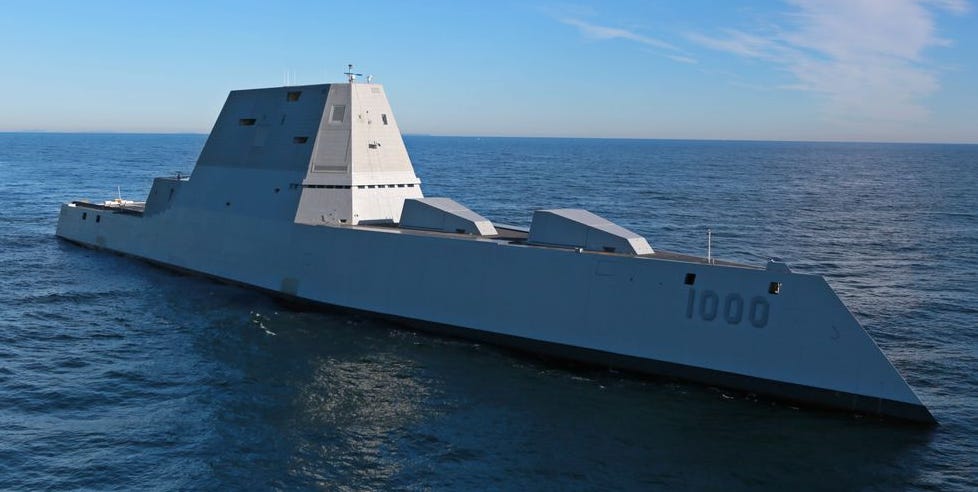
The USS Zumwalt class destroyers look less like traditional warships and more like somebody asked a science-fiction concept artist to design a naval vessel after three cups of coffee. With sharply angled sides, a strange-looking deckhouse, and a hull that seems determined to avoid every familiar destroyer shape, the Zumwalt class has always attracted attention.
But the story of the USS Zumwalt class destroyers is far more interesting than their futuristic silhouette. These ships represent one of the U.S. Navy’s boldest experiments in stealth, automation, electric propulsion, digital systems, and long-range strike capability. They are also a reminder that even the most advanced military programs can collide with changing budgets, shifting priorities, expensive ammunition, and the eternal naval question: “This is impressive, but how many can we actually afford?”
Only three Zumwalt-class destroyers were built: USS Zumwalt (DDG-1000), USS Michael Monsoor (DDG-1001), and USS Lyndon B. Johnson (DDG-1002). Originally envisioned as part of a much larger fleet, the class was reduced dramatically as costs rose and the Navy adjusted its strategy. Today, the ships are being repositioned for a new era of naval competition, with a growing focus on long-range conventional strike and advanced missile integration.
What Makes the USS Zumwalt Class Destroyers Different?
Calling the Zumwalt class “just another destroyer” is a little like calling a space shuttle “just another airplane.” Technically, the label works. Practically, it misses the point.
Zumwalt-class ships are among the largest destroyers ever operated by the U.S. Navy. They are roughly 600 feet long, displace around 15,000 tons, and are substantially larger than many traditional guided-missile destroyers. Their size gives them room for advanced sensors, computing systems, electrical infrastructure, aviation facilities, and future upgrades.
The class was designed around several major ideas:
- Reduced radar visibility through stealth shaping and careful external design.
- Integrated electric propulsion instead of a more conventional mechanical drive arrangement.
- Extensive automation to reduce crew requirements.
- Flexible missile-launch capacity for multiple mission types.
- Digital command-and-control systems that connect engineering, sensors, weapons, and ship operations.
The result is a destroyer that looks unusual because it was built around unusual requirements. Its hull uses a tumblehome shape, meaning the sides angle inward above the waterline rather than flaring outward like many traditional warships. This helps reduce radar reflections. In simple terms, instead of shouting “I AM A HUGE WARSHIP” to radar systems, the ship tries to mumble.
Stealth Design: More Than a Cool-Looking Hull
The most visible feature of the USS Zumwalt class destroyers is stealth. The ships were designed to reduce their radar signature through their hull shape, enclosed equipment, angled surfaces, deckhouse construction, and careful placement of external systems.
Stealth at sea is not the same as invisibility. A destroyer cannot simply sail past an opponent while wearing a wizard cloak. Radar, infrared sensors, satellites, electronic surveillance, aircraft, submarines, and human observation all matter. Still, reducing radar visibility can complicate an opponent’s ability to identify, track, and classify a ship at long distances.
The Zumwalt’s stealth approach was especially important because the class was originally intended to operate closer to shore than many earlier large surface combatants. Near coastlines, a ship must deal with crowded radar environments, land clutter, commercial traffic, coastal defenses, and all the visual chaos that comes with operating near busy shorelines.
A Ship Designed to Be Harder to Read
The Zumwalt class does not rely on a single stealth trick. It combines hull geometry, reduced external clutter, integrated sensors, and a distinctive deckhouse. The ship’s design attempts to make it more difficult for radar systems to interpret what they are seeing.
That matters because confusion can create time, and time matters at sea. A delayed identification, uncertain radar picture, or unclear target classification can make decision-making more difficult for any adversary.
Of course, that sophisticated design also came with engineering challenges. Innovative ships often create innovative maintenance questions. The Navy was not merely building a new destroyer; it was building a test case for technologies that had not been combined at this scale before.
Integrated Electric Propulsion and High-Tech Automation
One of the most important features of the Zumwalt-class destroyers is their integrated electric propulsion system. Instead of treating propulsion and shipboard electrical needs as largely separate systems, the Zumwalt class was designed to generate power for propulsion, sensors, computing, mission equipment, and future systems through a highly integrated architecture.
This design gives the ships significant electrical flexibility. In theory, that makes them better suited for future upgrades, especially as naval warfare becomes more dependent on sensors, digital networks, electronic warfare systems, and energy-hungry equipment.
Electric propulsion also supports the class’s broader philosophy: build a ship that can evolve. The Navy did not want a destroyer locked into one mission forever. It wanted a platform that could accept new capabilities as technology changed.
Automation is another major part of that philosophy. Zumwalt-class ships require smaller crews than many older destroyers of similar size. Automated machinery controls, digital monitoring, distributed computing systems, and integrated damage-control technologies reduce the need for large numbers of sailors to operate every mechanical function manually.
That does not mean the ships run themselves while everyone plays cards in the mess hall. A smaller crew can create its own challenges. Fewer people means fewer backups, fewer spare hands during demanding maintenance periods, and less margin when the ship faces multiple tasks at once. Automation can reduce workload, but it also raises the importance of training, software reliability, and technical expertise.
Why the Zumwalt Program Shrunk From a Big Idea to Three Ships
The Zumwalt story is not just about technology. It is also about economics, strategy, and the occasional reality check delivered by a budget spreadsheet.
Early plans envisioned a much larger fleet of next-generation destroyers. Over time, projected production numbers dropped as the cost of the ships rose and the Navy reassessed what it needed most. The class eventually went from a planned force measured in dozens of ships to only three completed vessels.
Several factors drove that change. First, the ships were expensive because they introduced multiple advanced technologies at once. New hull forms, new power systems, new computing architecture, new stealth features, and new weapons concepts all added complexity. Building three highly specialized ships also meant the development costs were spread across a tiny production run rather than a large fleet.
Second, the Navy’s priorities changed. The original Zumwalt concept placed heavy emphasis on supporting operations near shore, including naval gunfire support for forces ashore. But as strategic attention shifted toward major-power competition, long-range missile defense, and open-ocean operations, the Navy continued building more Arleigh Burke-class destroyers because they offered proven capability, established logistics, and stronger compatibility with existing fleet systems.
Third, the Advanced Gun System became a major problem. The Zumwalt class was built with two 155mm guns intended to fire specialized long-range ammunition. That ammunition became extremely expensive because the number of ships carrying the guns fell so sharply. With only three destroyers in the class, the cost per round became difficult to justify.
It was one of the strangest outcomes in modern naval procurement: a futuristic destroyer was built with giant advanced guns, but the ammunition plan became too costly to sustain. The guns were impressive. The economics were less impressed.
The Program’s Hard Lesson
The Zumwalt class demonstrates why military programs are often judged not only by what they can do, but also by whether they can be built, maintained, upgraded, and deployed at meaningful scale. A ship can be technologically brilliant and still struggle if the fleet cannot afford enough copies to create broad operational impact.
Government oversight reports have repeatedly pointed to the Zumwalt program as an example of the risks involved when ambitious requirements, immature technology, and uncertain cost assumptions arrive at the same meeting wearing name tags.
What Can the USS Zumwalt Class Destroyers Do Today?
Despite criticism of the program, the Zumwalt class is not a museum piece or a floating science project. The ships are active U.S. Navy guided-missile destroyers built for multiple missions.
The Navy has described the class as capable of supporting long-range precision strike, anti-air warfare, anti-surface warfare, anti-submarine warfare, and broader fleet operations. Zumwalt-class ships can operate independently or alongside carrier strike groups, surface action groups, and expeditionary forces.
The lead ship, USS Zumwalt, has conducted missile testing and live-fire exercises involving its vertical launch system and air-defense weapons. These events were important because they demonstrated that the ship’s combat systems, sensors, launch systems, and structural design could support real naval operations rather than remaining limited to trials and demonstrations.
The class also offers the Navy a valuable opportunity to learn. Since there are only three ships, the Zumwalts are not meant to replace the large Arleigh Burke fleet. Instead, they can serve as specialized platforms for testing advanced systems, refining tactics, and proving whether new technologies can eventually move into broader naval service.
That is not a small role. Many military breakthroughs begin with a few expensive, awkward, highly scrutinized platforms that teach the service what works, what does not, and what should never again be approved during a meeting that includes the phrase “revolutionary capability.”
The Hypersonic Pivot: A New Mission for an Unusual Ship
The most important recent development for the USS Zumwalt class destroyers is the shift toward long-range conventional strike. The Navy has been modernizing the ships to support the Conventional Prompt Strike program, a major effort involving advanced conventional hypersonic weapon technology.
This modernization changes the story of the class. Instead of remaining closely tied to the original land-attack gun concept, the Zumwalt class is being repositioned as part of the Navy’s future long-range strike architecture.
For USS Zumwalt, the modernization work has involved major shipyard changes, including replacing the original gun-system space with equipment intended to support the new strike mission. Public Navy statements have described the work as an important step toward bringing advanced conventional strike capability to the surface fleet.
The modernization is significant for several reasons. First, it gives the Navy a way to use the large, power-rich Zumwalt hull for a mission that better matches current strategic priorities. Second, it provides a bridge between surface-ship modernization and the Navy’s wider effort to develop future strike capabilities. Third, it gives the service a real-world platform for testing integration, maintenance, crew training, and operational concepts.
The schedule has moved over time, which is not unusual for complex military integration work. The key point is that the class is no longer defined only by its original gun mission. It is increasingly defined by its potential role in long-range conventional deterrence and advanced naval strike operations.
Are the Zumwalt Destroyers a Failure or a Success?
The honest answer is: both labels are too simple.
As a mass-production destroyer program, the Zumwalt class did not achieve its original vision. The Navy did not receive dozens of ships. The Advanced Gun System lost its ammunition path. Costs rose, schedules stretched, and the fleet ultimately relied much more heavily on the Arleigh Burke class for everyday destroyer missions.
But as a technology platform, the Zumwalt class has created value. Its stealth design, power architecture, automation, computing environment, integrated systems, and modernization potential have given the Navy a living laboratory for future surface warfare concepts.
It may be more accurate to think of the Zumwalt class as a naval prototype that escaped the prototype phase. The ships are fully operational combatants, but they also carry the burden of being experiments large enough to deploy and expensive enough to trigger arguments in Congress, shipyards, defense journals, and probably more than one Navy conference room.
The class’s future will depend on how effectively the Navy completes modernization, trains crews, sustains the ships, and integrates them into broader operations. If the long-range strike conversion works as intended, the Zumwalt destroyers may be remembered less as expensive oddities and more as early examples of a new kind of surface combatant.
Experiences Related to the USS Zumwalt Class Destroyers
For sailors, shipbuilders, naval engineers, defense analysts, and visitors who have followed the Zumwalt class, the experience is often defined by contrast. The ships look futuristic, but they still depend on the same fundamentals as every other warship: trained people, dependable maintenance, logistics, clear leadership, and enough spare parts to keep equipment working when the ocean decides to be difficult.
From the outside, seeing a Zumwalt-class destroyer can be striking. Traditional warships tend to communicate their purpose immediately. Their masts, radars, antennas, weapons, and superstructures are visible like a row of tools in a mechanic’s garage. The Zumwalt looks different. Its surfaces are cleaner, its shape is more angular, and its silhouette feels almost too smooth for a vessel of its size. Many observers describe the ship as futuristic because it seems to reject the visual language of older destroyers.
For the crew, however, the experience is likely much less about futuristic styling and much more about systems management. A highly automated ship can reduce repetitive workload, but it also demands sailors who understand complicated digital, electrical, mechanical, and combat-system relationships. On a conventional ship, a sailor may spend more time directly operating equipment. On a ship like Zumwalt, a sailor may spend more time monitoring integrated systems, diagnosing software-related issues, managing automated processes, and making decisions based on information flowing through multiple networks.
That creates a different kind of pressure. The job is not necessarily easier; it is simply more technical. When a ship relies heavily on integrated computing and electrical systems, troubleshooting can feel less like turning a wrench and more like solving a puzzle while standing on a moving platform in the middle of the Pacific Ocean.
Shipyard workers and engineers experience the class differently. For them, the Zumwalt destroyers are reminders that naval modernization is often harder than naval construction. Building a new ship is complicated, but modifying a completed ship can be even more demanding. Engineers must work around existing systems, preserve safety margins, update software, integrate new hardware, test equipment, train crews, and make sure every change functions as part of the wider ship.
The conversion work associated with the Zumwalt class also highlights how military technology evolves. A ship may be designed in one strategic era and upgraded for another. The original Zumwalt mission emphasized land attack and naval gunfire support. Its current modernization path reflects a different strategic environment, one shaped by long-range precision strike, distributed naval operations, and competition across the Pacific.
For defense analysts, the Zumwalt class offers a useful case study in ambition. It shows the promise of taking technological risks, but it also shows the cost of trying to introduce too many major innovations at once. Analysts often debate whether the class was ahead of its time, poorly managed, misunderstood, or simply built for a mission that changed before the ships could fully mature. The answer probably includes pieces of all four.
For the broader public, the Zumwalt class is a reminder that military hardware is rarely a simple success-or-failure story. These destroyers were criticized for their cost, their small production run, and the loss of their original ammunition plan. Yet they continue to evolve. That evolution is perhaps the most interesting experience of all: watching a controversial program try to turn its most unusual features into strengths.
The Zumwalt ships may never become common sights across the U.S. Navy. There are only three of them, and their limited numbers make them unique. But their influence may extend beyond their hull count. Lessons from their power systems, digital architecture, stealth concepts, automation, and modernization challenges could shape future surface ships long after the three destroyers themselves leave service.
Conclusion: The Zumwalt Class Is Still Writing Its Story
The USS Zumwalt class destroyers remain some of the most recognizable warships in the world. Their radical shape, advanced technology, troubled procurement history, and ongoing modernization make them far more than ordinary naval vessels.
They are cautionary tales about cost and complexity, but they are also examples of how military organizations adapt. The Zumwalt class began as a stealthy land-attack destroyer built around advanced naval guns. It is now being reshaped for a future centered on long-range conventional strike and advanced fleet integration.
Whether history ultimately calls the class a brilliant experiment, an expensive lesson, or an unexpected comeback story, one thing is certain: the Zumwalt destroyers are not boring. And for naval history, that alone is a pretty impressive achievement.