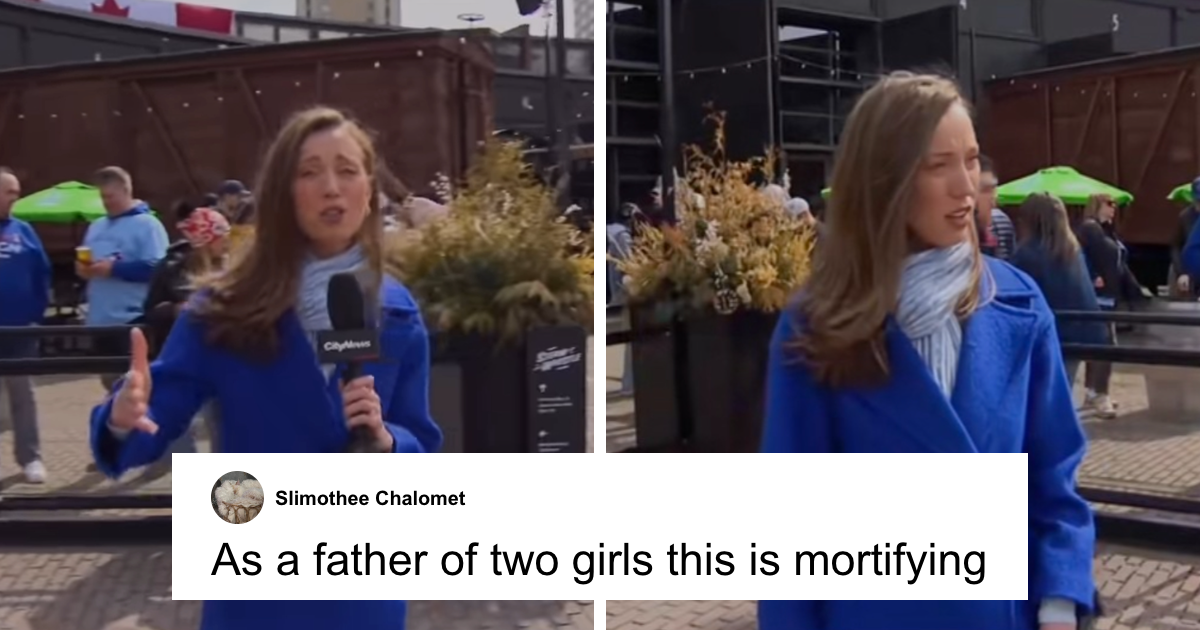
It takes a lot to rattle a TV reporter. Rain? Fine. Wind turning a hairstyle into modern art? Normal. A random sports fan yelling nonsense behind the camera? Practically a job requirement. But when CityNews Toronto reporter Michelle Mackey was filming outside Rogers Centre and a boy believed to be around 8 or 9 shouted a sexually explicit, misogynistic phrase at her, the moment landed differently. It was not just another live-coverage interruption. It was a small scene with a very large shadow.
The incident quickly went viral after Mackey shared the clip online, explaining that the child was accompanied by an adult man who appeared to laugh instead of intervene. Her reaction was immediate and human: shock, anger, and disbelief. The phrase itself came from an old internet meme that has been used for years to harass journalists, especially women, during live broadcasts. But the fact that it came from a child made the moment feel less like a throwback joke and more like a cultural warning light flashing red.
This story is not really about one child being crude in public. Children repeat things. Anyone who has spent five minutes near a second-grade lunch table knows kids can act like tiny parrots with snack privileges. The real issue is what adults model, what online culture rewards, and how misogyny can become so casual that even a child can perform it like a punchline.
What Happened During the Live Coverage?
Mackey was reporting near Rogers Centre in Toronto during coverage connected to the Blue Jays’ home opener atmosphere. As she was recording, a young boy walked past and shouted a vulgar phrase historically aimed at humiliating female reporters. According to Mackey, the adult with him laughed and continued walking away with the child.
In her social media post, Mackey said the moment was one of the most alarming things she had witnessed as a news reporter. She also blurred the faces of the boy and the adult, saying she did so out of respect for the child. That detail matters. Her criticism was not framed as a public shaming of a minor. It was a criticism of the environment that made the behavior possible and, apparently, funny to the adult beside him.
Mackey later explained that she did not primarily blame the boy because of his age. Instead, she placed responsibility on the adult who failed to correct the behavior. That distinction is important. A 9-year-old may not fully understand sexualized language, harassment, or gendered intimidation. An adult should.
Why the Comment Was More Than “Just a Joke”
Whenever incidents like this go viral, the internet immediately divides itself into two exhausted armies: “It was only a joke” versus “No, it was harassment.” Then everyone grabs a digital folding chair and the comment section becomes a town hall meeting held inside a blender.
But the “joke” defense collapses when you look at the target, the setting, and the history of the phrase. This was not a private joke between friends. It was shouted at a working journalist while she was doing her job in public. It interrupted a professional broadcast. It used sexualized language to embarrass, shock, and degrade. And it belongs to a long-running pattern in which reporters, particularly women, are harassed on camera for entertainment.
Humor is not automatically harmless because someone laughs. People laugh at cruelty, humiliation, and power plays all the time. The question is not, “Did someone think it was funny?” The better question is, “Who was expected to absorb the discomfort so someone else could feel clever?” In this case, the answer was a reporter doing her job.
The Ugly History Behind the Viral Phrase
The phrase shouted at Mackey did not appear out of thin air. It became widely known around 2014 through staged viral videos and later spread as a real-world prank. People began yelling it during live news shots, often at female reporters, hoping to get on camera. Like many internet trends, it had the life cycle of a housefly but somehow refused to die politely.
Years ago, several high-profile cases showed how damaging the “prank” could be. Reporters were forced to handle sexualized heckling while staying calm on air. Some media organizations and sports venues responded by condemning the behavior. In one widely discussed Canadian case, a reporter confronted men who had shouted the phrase during sports coverage, sparking broader debate about workplace harassment, misogyny, and public accountability.
That background is why Mackey’s reaction resonated. The phrase is not merely old internet junk. It has a history of being used to turn women journalists into props for public humiliation. Bringing it back through the mouth of a child made the moment feel especially disturbing.
How Children Learn Misogyny Before They Understand It
Children often learn social behavior by watching adults and copying what gets rewarded. If a child sees an adult laugh at a cruel remark, that laugh becomes a lesson. It says, “This gets attention. This is approved. This is how you perform confidence.” That lesson can stick even when the child does not understand the full meaning of the words.
This is where the adult’s response becomes the heart of the story. If the man with the boy had stopped, apologized, and explained that the comment was unacceptable, the moment could have become a correction. Instead, according to Mackey’s account, laughter turned it into approval. That is unchecked misogyny in its simplest form: not always a speech, a manifesto, or a villain twirling a mustache, but a shrug, a laugh, and a child learning the wrong lesson.
The scary part is that kids do not need a formal “How to Be Sexist 101” curriculum. Misogyny can be absorbed from memes, gaming chats, social media feeds, music lyrics, relatives, sports crowds, influencers, and casual comments at home. When nobody challenges it, it starts to feel normal.
Online Culture, Meme Culture, and the New Classroom
For today’s kids, the internet is not just entertainment. It is a classroom with no substitute teacher, no hallway monitor, and an algorithm that sometimes behaves like it was raised by raccoons. Children and teens can encounter sexist jokes, harassment campaigns, “manosphere” content, and influencer clips long before they have the emotional maturity to evaluate them.
That does not mean every child online is doomed to become a tiny internet goblin. Plenty of kids use digital spaces to learn, create, connect, and laugh at harmless nonsense. The problem is that harmful content often arrives disguised as comedy, confidence, or rebellion. A boy may repeat a misogynistic phrase not because he has a fully developed worldview, but because he has learned that shocking people produces attention.
This is why media literacy matters. Kids need adults to explain not only what certain words mean, but what they do. A phrase can embarrass someone. A joke can reinforce a stereotype. A meme can carry a history of harassment. A viral trend can make cruelty look like courage.
The Pressure on Women Journalists
Women in journalism already face a disproportionate amount of gendered harassment. The job often requires public visibility, quick thinking, and emotional control under pressure. For field reporters, that pressure can include strangers interrupting live shots, yelling comments, invading personal space, or trying to turn serious coverage into a personal performance.
When the harassment is sexualized, it sends a message: “You may be here as a professional, but I am going to reduce you to your body.” That is not edgy. That is not clever. That is the conversational equivalent of tracking mud through someone’s living room and declaring yourself an interior designer.
Mackey’s response made clear that the harm was not only in the words themselves, but in the normalization. When people dismiss this kind of language as harmless, they ask the target to carry the emotional cost while the offender keeps the punchline. Over time, that creates a hostile environment for women in public-facing roles, from reporters and teachers to athletes, streamers, politicians, and service workers.
Why Parental Responsibility Matters Here
Parenting is not about producing perfect children. Perfect children do not exist. Even the sweetest kid can say something horrifying at the exact moment your boss, pastor, or local news camera walks by. Parenting is about what happens next.
A responsible adult response might sound simple: “That was disrespectful. We do not talk to people that way. Apologize.” No TED Talk required. No 47-slide PowerPoint titled “The Socio-Cultural Implications of Your Bad Joke, Kevin.” Just a clear boundary, delivered quickly and consistently.
Adults teach values through reaction. Laughing teaches. Silence teaches. Eye-rolling teaches. So does apology. When a child crosses a line and an adult corrects it, the child learns that attention is not the same as approval. When the adult laughs, the child learns that humiliation can be entertainment.
What Schools, Parents, and Communities Can Do
1. Talk About Sexist Language Before It Shows Up
Waiting until a child repeats something offensive is like waiting until the kitchen is on fire to learn where the extinguisher is. Parents and educators should talk early about respectful language, consent, gender stereotypes, and online cruelty in age-appropriate ways.
2. Teach Kids to Question “It’s Just a Joke”
A useful question for children is: “Would the person hearing it feel respected?” If the answer is no, the joke probably needs retirement. Preferably somewhere remote. With no Wi-Fi.
3. Watch the Media Diet
Adults do not need to spy on every click, but they should know the general neighborhoods their kids visit online. What influencers do they quote? What games do they play? What videos make them laugh? If a child keeps repeating hostile or sexist language, that is a clue worth following.
4. Model Public Respect
Children notice how adults talk about women, workers, strangers, partners, and people on TV. If adults mock women’s voices, bodies, intelligence, or authority, children learn that contempt is socially acceptable.
5. Correct Without Turning the Child Into the Villain
The goal is not to label a child as bad forever. The goal is to interrupt harmful behavior before it hardens into identity. A child can learn, apologize, and grow. But growth requires adults who care enough to set limits.
Experiences and Everyday Lessons Related to Unchecked Misogyny
What happened to Mackey may have gone viral because it involved a camera, a reporter, and a child, but the basic pattern is familiar to many women and girls. It happens in classrooms when a boy repeats a sexist phrase from a video and everyone waits to see whether the teacher will challenge it. It happens in sports spaces when girls are told they “throw like girls” as though girls have been secretly throwing objects with their elbows since birth. It happens at family gatherings when an uncle makes a tired joke about women drivers and the room laughs because confronting him feels more exhausting than surviving the joke.
One common experience is the uncomfortable silence after a sexist comment. The person targeted often has to decide, in real time, whether to respond, laugh it off, walk away, or risk being labeled “too sensitive.” That split-second calculation is draining. It asks the person who was disrespected to also manage the comfort of everyone nearby. In Mackey’s case, viewers saw that calculation on her face. She was working, processing, reacting, and staying professional all at once. That is a lot to ask of someone who simply showed up to report the news.
Teachers often describe similar moments. A student repeats something from TikTok, YouTube, a gaming server, or an older sibling. The class laughs. The teacher has to decide whether to stop the lesson and address it. If the teacher ignores it, the comment becomes part of the room’s culture. If the teacher responds, some students may complain that it was “just a meme.” But those small corrections matter. They teach students that viral does not mean acceptable, and funny does not mean free from consequences.
Parents also face the challenge at home. A child may repeat an offensive phrase without understanding it. That moment can feel embarrassing, especially in public, but it is also an opportunity. The best response is calm, clear, and immediate: “That language is disrespectful. We do not use it. Let’s talk about where you heard it.” The follow-up conversation matters more than the initial shock. Children need help connecting words to impact.
For girls, unchecked misogyny often becomes background noise. They hear comments about their clothes, bodies, ambition, voices, sports ability, or intelligence. Over time, they may learn to shrink, laugh things off, or avoid certain spaces. That is why incidents like Mackey’s deserve attention. They remind us that misogyny does not begin when someone becomes an adult. It can start as imitation, become a joke, turn into a habit, and eventually shape how people treat women in classrooms, workplaces, relationships, and public life.
The encouraging part is that culture can be corrected the same way it is learned: through repetition. Every adult who refuses to laugh at harassment, every teacher who names sexist language, every parent who checks a cruel joke, and every peer who says “not cool” helps rewrite the script. No single correction fixes everything. But silence teaches too. So does courage.
Conclusion: A Viral Moment With a Bigger Message
The incident involving Michelle Mackey was shocking because of the age of the child, but it was revealing because of the adult response. A misogynistic comment shouted during live coverage is not just a bad joke with dusty internet origins. It is a reminder that children are always learning from the world around them, especially from adults who laugh, approve, or look away.
Unchecked misogyny survives in small permissions. It survives when harassment is called humor, when public humiliation is called tradition, and when adults treat disrespect as entertainment. The solution does not require moral panic. It requires attention, correction, and better modeling. Children do not need adults who are perfect. They need adults who are awake.
Note: This article synthesizes publicly reported information about the Michelle Mackey incident and broader research on journalist harassment, youth media exposure, online hate, social learning, and bullying prevention. No source-link elements or citation artifacts have been included so the HTML can be copied cleanly for web publishing.