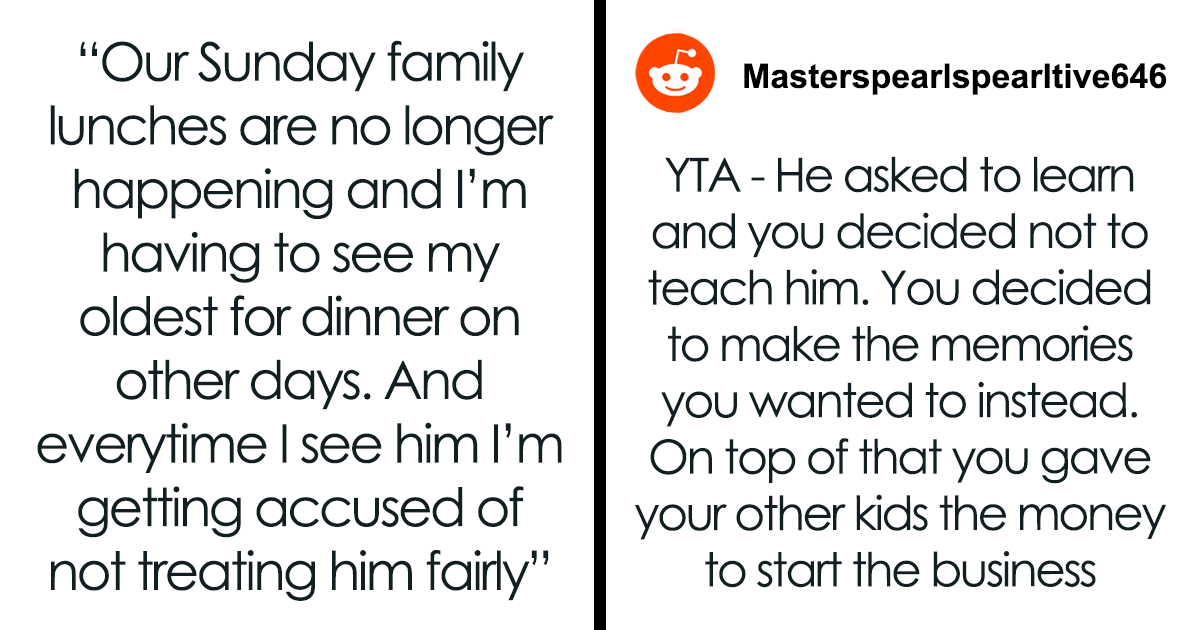
Family businesses sound charming until someone starts counting who got the tools, who got the training, who got the startup money, and who got stuck with a job they hate. In one complicated family story, twin brothers turned their dad’s old-school craft skills into a profitable business, while their eldest half-brother felt left behind, rejected, and understandably furious. Suddenly, what looked like a feel-good tale about handmade work became a full-blown case study in parenting guilt, sibling rivalry, missed opportunities, and the emotional price of success.
The basic conflict is simple enough to fit on a napkin: a father had three sons, one older son from a previous marriage and younger twin sons from a later relationship. The dad had rare, hands-on skills involving traditional materials like stone, wood, and metal. Because of distance, custody arrangements, and family hardship, the twins received far more practical training than the eldest son. Years later, the twins used those skills to build a thriving craft business. The eldest son, who disliked his own job and earned less, asked to join the business. The twins said no. Cue emotional fireworks, awkward dinners, and enough family tension to power a small sawmill.
Why This Story Hit Such A Nerve
This story is not just about money. If it were only about money, everyone could sit down with a spreadsheet, argue about equity percentages, and pretend Excel has healing powers. The deeper issue is that the eldest son saw the business as proof that his dad had given his younger half-brothers something he never got: access, attention, mentorship, and a path toward independence.
That is why stories like this spread so quickly online. They touch three very sensitive nerves at once: family favoritism, inherited opportunity, and the uncomfortable truth that love is not always distributed in ways children experience as fair. Parents may say, “I did the best I could,” while children hear, “Someone else got the version of you I needed.” Both can be true, which is exactly why the situation is so messy.
The Craft Was Old-School, But The Business Opportunity Was Very Modern
Traditional craft skills have become surprisingly valuable in a world full of mass-produced objects. Handmade furniture, custom metalwork, carved decor, restored wood pieces, stone accents, heirloom-quality home goods, and personalized art all appeal to buyers who want something that does not look like it came from aisle seven of a warehouse store.
The twins were not just lucky because they learned a niche craft. They were lucky because they learned it at a time when handmade commerce has real digital infrastructure behind it. A pair of motivated young makers can now build a brand through online marketplaces, social media, short videos, local markets, custom commissions, and direct-to-consumer websites. In other words, Dad’s dusty old workshop can become a surprisingly stylish business headquarters, assuming nobody trips over a clamp while filming a reel.
Platforms like Etsy helped normalize the idea that small sellers and independent makers can reach large audiences. Buyers increasingly care about origin stories, craftsmanship, customization, and human connection. A handmade product is not just an object; it is a story you can put on a shelf, wear, gift, or brag about at brunch.
Why The Eldest Half-Brother Felt Rejected
From the eldest son’s point of view, the rejection probably felt bigger than a business decision. He was not simply asking for a job. He was asking for a place in a family legacy that he believed should have included him from the beginning.
That does not automatically mean he was entitled to ownership. Businesses require work, risk, skill, consistency, and trust. The twins may have spent years practicing, making mistakes, learning suppliers, handling customers, building systems, and developing a reputation. Giving someone an instant stake because he is family can feel unfair to the people who actually built the company.
Still, emotional fairness and business fairness are not the same thing. The twins may have been right to protect their company, but the eldest son may also have been right to feel hurt. That is the part families hate: sometimes nobody is completely wrong, yet everyone still manages to feel wounded.
Was The Father To Blame?
The father sits at the center of this emotional traffic jam. He wanted to teach all his sons, but life got in the way. The eldest son lived farther away, the custody arrangement limited time, and later the family faced serious illness. Those are real obstacles. Teaching a demanding craft is not like teaching someone to make toast. You need repeated practice, tools, supervision, patience, and enough time to fail safely.
However, the father’s explanation does not erase the eldest son’s experience. A missed promise can still hurt even when the reason is understandable. If the dad promised to teach him later and never followed through, that broken expectation may have become a symbol of every time the eldest son felt like an outsider.
Parents in blended families often underestimate how loudly unequal opportunity speaks. One child may receive daily lessons, access to equipment, startup capital, and emotional encouragement. Another child may receive occasional visits, good intentions, and “we’ll do it someday.” Unfortunately, “someday” has a nasty habit of turning into “too late.”
The Twins’ Side: Why They Said No
The twins’ refusal may sound cold at first, but from a business perspective, it makes sense. They built something valuable. They likely invested time, labor, creativity, and possibly their own financial risk. If their half-brother entered as an owner without comparable contribution, resentment could poison the company from the inside.
Family businesses can collapse when roles are vague. “He’s my brother” is not a job description. “He feels bad” is not an equity structure. “Dad thinks we should include him” is definitely not a business plan. Before any relative joins a company, the family needs to answer practical questions: What will this person do? What skills do they bring? How will they be paid? Will they earn equity over time? Who makes final decisions? What happens if it does not work?
The twins were not required to hand over part of their company simply to soothe family guilt. But they could have handled the moment with more compassion. A hard no can protect a business, but a thoughtful alternative can protect a relationship.
A Better Solution: Apprenticeship Before Ownership
The fairest compromise would be an apprenticeship or trial role, not immediate partnership. The eldest son could learn the craft, contribute to operations, or help with finance and administration under clear terms. If he proves useful and committed, he could earn a larger role later.
This approach respects everyone. It recognizes the eldest son’s pain without pretending pain equals ownership. It respects the twins’ labor without treating the business like a family apology coupon. It also gives the father a constructive way to repair what he missed: helping his eldest son access training, mentorship, tools, or a different path into the craft.
For example, the dad could fund professional training, connect him with another master craftsperson, or pay him during a structured learning period. If the family wants to be especially careful, they could put everything in writing. Yes, paperwork sounds unromantic, but so does Thanksgiving dinner where everyone communicates through mashed potatoes.
What This Story Reveals About Family Business Succession
Family businesses often struggle because the family part and the business part operate by different rules. Families run on feelings, history, loyalty, memory, guilt, and who ruined whose birthday in 2009. Businesses run on cash flow, skill, contracts, customer satisfaction, and whether someone remembered to pay sales tax.
When a family business grows, informal arrangements stop working. The twins may have begun as two brothers using their dad’s skills, but once the business became profitable, it needed adult systems: ownership agreements, defined responsibilities, compensation plans, conflict procedures, and succession planning. Without those systems, every emotional disagreement becomes a business emergency.
The father also needs to clarify his own role. Did he give the twins startup capital as a gift, a loan, or an investment? Does he own a stake? If so, does he have the right to transfer that stake? Could he give part of his own ownership to the eldest son without forcing the twins to dilute theirs? These questions matter because vague generosity can become tomorrow’s lawsuit wearing a family sweater.
Why Handmade Businesses Can Make Serious Cash
It may surprise some readers that an old-school craft could create real income. But handmade businesses can succeed when they combine skill with branding, pricing, storytelling, and consistency. A beautifully made object is only the beginning. The maker also needs product photography, customer service, shipping systems, inventory control, social proof, and pricing that does not accidentally turn every order into charity.
One of the biggest mistakes new makers make is underpricing. They count materials but forget labor, overhead, tool wear, packaging, platform fees, taxes, design time, failed prototypes, and the emotional cost of answering “Can you make this cheaper?” for the 400th time. Serious handmade businesses treat time as valuable. They do not price a custom table like a lemonade stand with splinters.
The twins’ success likely came from a rare combination: technical skill from their father, enough time to practice, some financial support, and a market hungry for authentic handmade goods. That combination is powerful. It also explains why the eldest brother saw the business not merely as income, but as a door that had been opened for others and closed for him.
The Real Conflict: Equity Versus Belonging
At the heart of this story is one painful misunderstanding: the eldest son wanted belonging, but he asked for equity. The twins heard a business request. He may have meant, “I want to matter here too.”
That does not mean the twins should have given him ownership. It means the family needed a conversation deeper than profit shares. The father should have acknowledged the missed mentorship directly. Not with excuses, not with defensive timelines, and definitely not with “Well, your mother moved away,” even if custody made things difficult. A useful apology would sound more like: “I wanted to teach you, I failed to make it happen, and I understand why it hurts to see your brothers succeed with what I gave them.”
That kind of honesty does not fix everything, but it stops the eldest son from having to fight just to prove his pain exists.
How The Family Could Move Forward
1. Separate the emotional apology from the business negotiation
The father should repair the relationship with his eldest son without using the twins’ business as the only medicine. Emotional damage should not automatically become a demand for company shares.
2. Create a skills pathway
If the eldest son truly wants the craft, the family can help him learn it through classes, apprenticeships, paid training, or supervised work. If he only wants the money, that will become clear quickly.
3. Offer a role, not instant ownership
The twins could consider a defined position: bookkeeping help, customer service, marketing support, shop assistant, or apprentice. Compensation should be fair, but equity should be earned over time.
4. Put agreements in writing
Every family business needs written terms. Clear agreements are not a sign of distrust. They are a way to keep future arguments from turning into emotional escape rooms.
5. Stop treating silence as peace
Families often avoid hard conversations because they want to “keep the peace.” But avoided resentment does not disappear. It simply waits, lifts weights, and returns stronger.
Lessons For Parents In Blended Families
This story offers a clear warning for parents: children remember patterns. They remember who got time, who got training, who got patience, and who got “maybe later.” Even when circumstances are unfair to the parent, the child still lives with the result.
In blended families, parents should be especially careful about opportunity. Equal love is important, but equal access matters too. If one child cannot receive the same training or support because of distance, the parent can still create alternatives: summer workshops, remote lessons, saved funds for later education, scheduled mentorship, or connections to other teachers.
The goal is not perfect equality. Perfect equality is impossible unless all children have identical personalities, schedules, interests, and shoe sizes. The goal is visible effort. Children can often accept differences when they can see that a parent tried seriously, consistently, and honestly.
Lessons For Siblings Building A Business Together
For siblings, the lesson is equally practical: do not let family pressure decide business ownership. If a relative wants in, evaluate the request like a business decision while speaking like a human being. That means being kind but clear.
A better response from the twins might have been: “We understand why this hurts, and we are not rejecting you as a brother. We cannot give away ownership in a company we built, but we are open to discussing a paid role, training path, or future equity if you contribute over time.”
That answer protects the company while leaving the door open. It also prevents the rejected sibling from hearing, “You do not belong.” In family conflict, wording matters. A careless sentence can do more damage than a bad quarter.
Experiences Related To This Topic: What Real Families And Makers Can Learn
Many families have a version of this story, even if it does not involve stone, wood, metal, or twins with suspiciously good timing. Sometimes one child learns the family restaurant recipes while another moves away. Sometimes a daughter helps run the farm while a son returns years later expecting equal control. Sometimes one sibling spends weekends in the garage learning repairs from Dad, while another only realizes later that those “boring Saturdays” were actually a free vocational education.
The first experience many families recognize is the feeling of invisible inheritance. Not every inheritance is a house, bank account, or antique clock that nobody wants but everyone pretends is priceless. Skills are inheritance too. A parent who teaches one child carpentry, bookkeeping, sales, cooking, coding, farming, or negotiation is giving that child a powerful advantage. It may not look like money at first, but it can become money later.
The second experience is the danger of assuming that interest equals commitment. The eldest son may have wanted the craft, but did he want the years of practice? Handmade work can look romantic from the outside. People see the finished product, the proud Instagram post, and the satisfying “sold” notification. They do not see the ruined materials, sore hands, late nights, customer complaints, shipping disasters, and the special kind of despair that comes from measuring once and cutting wrong anyway.
The third experience is that parents often underestimate how deeply adult children compare childhoods. A parent may think, “I visited when I could.” The child may think, “My brothers got a daily father, and I got scheduled appearances.” Neither memory is automatically false. Families heal better when they stop debating whose version is the only valid one and start asking what can be repaired now.
The fourth experience is that money makes old wounds louder. Before the twins made serious cash, the unequal training may have felt sad but manageable. Once the skill became a profitable business, the old wound gained a dollar sign. That is common. A family recipe becoming a restaurant, a hobby becoming a brand, or a workshop becoming a company can turn emotional inequality into financial inequality almost overnight.
The fifth experience is that “joining the business” should never be vague. Anyone entering a family company should begin with a written role, a trial period, and measurable expectations. For example, the eldest brother could spend six months learning production basics, another six months managing invoicing or customer communication, and then be evaluated for a permanent role. If equity is possible, it should vest over time based on contribution. This protects the business and gives the newcomer a fair chance to prove he is not just chasing the smell of fresh profits.
The sixth experience is that repair may require creativity. The father cannot go back and teach the eldest son during childhood. Time travel remains unavailable, despite what certain family members seem to expect during arguments. But he can pay for training, mentor him now, introduce him to craftspeople, help him change careers, or offer part of his own stake if he has one. Repair does not have to be perfect to be meaningful.
The final experience is that families should talk about legacy before legacy turns profitable. When skills, tools, recipes, land, intellectual property, or business opportunities are involved, parents should be transparent. Who is being trained? Who wants in? Who will inherit tools? Who owns designs? Who gets paid? Who gets a say? These conversations may feel awkward, but they are far less awkward than three sons, one guilty dad, and a family group chat that now requires protective equipment.
Conclusion
The story of the twins who turned their dad’s old-school craft into serious cash is not simply about a successful handmade business. It is about how opportunity travels through families, how missed promises harden into resentment, and how money can expose emotional gaps that were already there. The twins had every right to protect the company they built, but the eldest half-brother’s hurt did not come from nowhere. He saw his brothers benefit from a fatherly investment he never fully received.
The best answer is not instant ownership, forced guilt, or permanent rejection. The best answer is honesty, structure, and a real path forward: an apology from the father, clear business boundaries from the twins, and a chance for the eldest son to earn a role if he genuinely wants the craft and not just the cash. Family legacy should not be a prize tossed to whoever happened to be closest to the workshop. It should be handled with care, clarity, and enough paperwork to keep Thanksgiving from becoming a courtroom drama with pie.