Breakfast cereal is supposed to be dependable. You buy a box, pour a bowl, add milk, and begin the day while pretending the cartoon mascot is not judging your pajama choices. Yet some cereals disappear almost overnight, leaving behind nothing but faded commercials, collectible boxes, and adults insisting that a particular marshmallow tasted better in 1987.
The most memorable discontinued breakfast cereals were rarely just food. They were miniature entertainment franchises. Boxes contained games, masks, stickers, trading cards, and prizes that immediately sank to the bottom of the bag. Television characters invaded the cereal aisle, video games became edible, and companies occasionally decided that children needed breakfast shaped like clowns, robots, barrels, or the letter T.
This ranking celebrates ten popular cereals that are no longer part of regular U.S. production. The order reflects cultural impact, originality, longevity, and the amount of nostalgia each cereal still generatesnot verified lifetime sales. Keep your spoon ready. We are entering the crunchy breakfast graveyard.
Why Do Discontinued Breakfast Cereals Remain So Memorable?
Cereal nostalgia is unusually powerful because breakfast products become part of a daily routine. A child might watch the same commercial dozens of times, study the box during breakfast, negotiate with siblings over the prize, and recognize the mascot more quickly than certain distant relatives.
Many vanished cereals were also tied to short-lived trends. A cereal based on a popular movie, television program, or arcade game could become an instant hit, but its future depended on the licensed property remaining fashionable. Other products disappeared because of declining sales, limited distribution, production costs, changing nutritional expectations, or a manufacturer’s need to make shelf space for newer brands.
Occasionally, a discontinued cereal returns after fans make enough noise. However, the ten cereals below remain unavailable as permanent nationwide products in the United States as of this writing.
10. Donkey Kong Cereal
Released by Ralston in 1982, Donkey Kong Cereal arrived when the original arcade game had become a cultural phenomenon. The cereal transformed the game’s famous obstacles into sweetened corn pieces shaped like tiny barrels. Unfortunately, eating them did not improve anyone’s ability to jump over actual barrels.
The box featured Donkey Kong, ladders, platforms, and the early version of the character later known as Mario. Commercials emphasized the cereal’s crunch, while promotions connected breakfast directly to the excitement of the arcade. For young players, it was a rare opportunity to continue the game before school without inserting another quarter.
Donkey Kong Cereal disappeared in 1984, giving it a brief but influential run. Ralston later produced Donkey Kong Jr. Cereal, but neither version survived. Original boxes are now valuable collectibles, especially when they still contain promotional materials. The cereal itself is best remembered as one of the earliest major attempts to turn a video game into an edible brand.
9. Hidden Treasures
General Mills introduced Hidden Treasures in 1993 with a wonderfully chaotic concept: every sweetened corn square looked similar, but some contained fruity filling and others were empty. Breakfast became a treasure hunt in which the treasure was frosting and the disappointment was an ordinary piece of cereal.
The filled pieces reportedly came in cherry, orange, and grape flavors. Children could search for them one spoonful at a time, although observant eaters eventually learned that differences in the seams sometimes revealed which filling was hiding inside. Apparently, even breakfast cereal can be reverse-engineered when enough sugar is at stake.
Hidden Treasures vanished by the middle of the 1990s. Its disappearance may have been partly practical: producing filled cereal pieces was more complicated than making standard flakes or puffs. Whatever the reason, the cereal’s combination of mystery, fruit flavor, and mild breakfast gambling has kept it alive in online nostalgia discussions.
8. Sprinkle Spangles
Sprinkle Spangles answered a question no responsible nutritionist had asked: What if sugar cookies became breakfast cereal and then received additional sprinkles?
General Mills launched the cereal in 1993. It featured star-shaped pieces with a sugar-cookie flavor and a coating of colorful sprinkles. Its mascot, the Sprinkle Genie, appeared whenever children wished for a more exciting breakfast. His magic was remarkably specialized, but nobody complained.
Sprinkle Spangles lasted only a few years, yet it became one of the most frequently requested General Mills cereals for a possible comeback. The cereal benefited from perfect early-1990s timing. Bright colors, exaggerated mascots, dessert-inspired flavors, and loud packaging were practically mandatory in the children’s cereal aisle.
Unlike many old products remembered more fondly than accurately, Sprinkle Spangles had a genuinely distinctive flavor. Modern cereals offer birthday-cake and confetti-cake varieties, but fans still argue that none completely reproduce its crunchy sugar-cookie personality.
7. Smurf Berry Crunch
Post introduced Smurf Berry Crunch in 1983 during the enormous popularity of The Smurfs animated television series. The cereal featured brightly colored, fruit-flavored pieces and packaging crowded with familiar blue characters. It looked less like a balanced breakfast and more like a small village had fallen into a bowl of milk.
Its advertising became nearly as memorable as the cereal. Commercials used cheerful music, animated Smurfs, and repeated references to “smurfberries,” a fictional fruit marketed with enough enthusiasm to make children wonder why their local grocery store did not sell it separately.
The original cereal was followed by Smurf Magic Berries in the late 1980s, but the product line eventually disappeared. Although other limited-edition Smurfs cereals have appeared over the years, they were not permanent returns of the original recipe.
Smurf Berry Crunch remains popular with collectors because it represents the peak of cartoon-driven cereal marketing: colorful characters, invented fruit, catchy advertising, and absolutely no concern that the word “smurf” was being used as a noun, verb, adjective, and breakfast strategy.
6. Mr. T Cereal
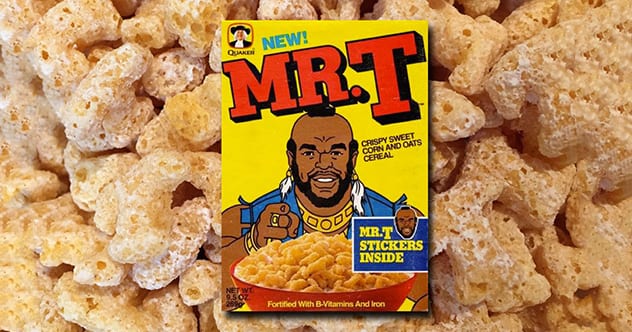
Mr. T Cereal debuted in 1984, when the star of The A-Team and Rocky III was one of America’s most recognizable celebrities. Quaker produced the cereal from corn and oats, shaped every piece like the letter T, and placed an animated version of Mr. T on the box.
The cereal was often compared with Cap’n Crunch because of its sweet flavor and dense crunch. Advertising naturally borrowed Mr. T’s famous tough-guy personality, including variations of his “I pity the fool” catchphrase. A breakfast mascot had never seemed so capable of bench-pressing the kitchen table.
Mr. T Cereal also earned a permanent place in pop culture through its appearance in the 1985 film Pee-wee’s Big Adventure. In one scene, Pee-wee Herman pours the cereal while imitating Mr. T, turning an ordinary product placement into a memorable movie moment.
The cereal remained available into the early 1990s before disappearing. Today, sealed boxes command high prices from collectors, although anyone considering eating thirty-year-old cereal should instead enjoy the box visually and make peace with an ordinary fresh breakfast.
5. C-3PO’s
Kellogg’s released C-3PO’s in the United States and Canada in 1984, making it the first breakfast cereal officially branded around the Star Wars universe. The product arrived one year after Return of the Jedi, when fans believed the original trilogy might be the last major visit to that galaxy far, far away.
The cereal combined oats, wheat, and corn in unusual twin-ring shapes resembling two connected letter O’s. Marketing called attention to the “double crunch,” proving that even advanced protocol droids can be converted into a texture-based selling point.
Boxes offered collectible promotions such as character masks, sticker cards, and a cardboard Rebel Rocket that children could assemble. The prizes helped turn C-3PO’s into more than breakfast; each package was also a piece of Star Wars merchandise.
The cereal had a relatively short life, but its historical importance has grown. Modern supermarkets regularly carry cereals tied to major movies and television franchises. C-3PO’s helped demonstrate how effectively a blockbuster entertainment property could conquer the breakfast aisle without firing a single laser.
4. Nintendo Cereal System
Few cereal boxes have contained an idea as clever as the Nintendo Cereal System. Released by Ralston in 1988, the box held two separate bags. One side contained fruit-flavored Super Mario Bros. cereal, while the other offered berry-flavored pieces inspired by The Legend of Zelda.
The divided package imitated the two-game format of Nintendo entertainment products. Mario pieces included characters and items such as mushrooms and Goombas, while the Zelda side included shapes such as hearts, keys, shields, and Link. Children could eat one side at a time or mix both together and create the breakfast equivalent of a crossover game.
Boxes also included Nintendo-themed promotions, stickers, and collectible cards. The product lasted only from 1988 to 1989, but that short lifespan increased its appeal among collectors. Surviving boxes have sold for impressive prices, especially when unopened or accompanied by intact promotional items.
Nintendo has released other cereals since then, but none has duplicated the original split-bag “system.” It was unnecessarily elaborate, visually brilliant, and therefore exactly what an iconic 1980s cereal should be.
3. Pac-Man Cereal
General Mills launched Pac-Man Cereal in 1983, transforming one of the world’s most famous arcade games into a sweetened corn cereal with marshmallows. Early versions featured marshmallow shapes representing Pac-Man and the four ghosts: Blinky, Pinky, Inky, and Clyde.
Later versions expanded the lineup with larger Super Pac-Man pieces and shapes inspired by Ms. Pac-Man. The cereal therefore received updates in roughly the same way a video game receives downloadable content today, except the update arrived in a cardboard box beside the milk.
Pac-Man Cereal was supported by animated television commercials, promotional offers, and the game character’s extraordinary popularity. It remained on shelves until 1988. As the original arcade craze cooled and new entertainment properties competed for children’s attention, the cereal lost the cultural momentum that had made it possible.
Its appeal remains easy to understand. The cereal combined two activities that children were rarely encouraged to enjoy without limits: eating sugar and playing video games. It also offered the deeply satisfying experience of eating the ghosts after spending years watching them chase Pac-Man through a maze.
2. Kaboom
General Mills introduced Kaboom in 1969, and the cereal remained available in some form until 2010. That long run makes it one of the most enduring discontinued breakfast cereals on this list.
Kaboom featured sweetened oat pieces shaped like smiling clown faces, along with colorful marshmallows. Later versions added circus-animal marshmallow shapes, including bears, lions, and elephants. Its mascot was a cheerful clown, which probably delighted children and quietly terrified a measurable percentage of their parents.
The cereal was heavily fortified with vitamins and minerals, allowing its advertising to combine nutrition claims with a bowl that looked like a circus had exploded. Kaboom became especially familiar during the 1970s and 1980s, although distribution reportedly became more limited during its later years.
Its appearance in Quentin Tarantino’s film Kill Bill: Volume 1 gave the cereal an unexpected adult pop-culture moment. By the time General Mills discontinued it in 2010, Kaboom had accumulated several generations of fans. Its unusually long history and instantly recognizable clown-face pieces earn it a place near the top of the cereal graveyard.
1. Product 19
Product 19 did not feature a cartoon mascot, video-game character, magical genie, or imaginary fruit. Its packaging looked serious enough to contain tax forms. Nevertheless, it developed one of the most devoted followings in breakfast-cereal history.
Kellogg’s introduced Product 19 in 1967 as a competitor to General Mills’ Total. The lightly sweetened cereal combined flakes made from corn, oats, wheat, and rice and was promoted for its vitamin and mineral content. Its unusual name may have referred to the nineteenth formula tested during development or to its place among products being developed by Kellogg’s.
Product 19 appealed primarily to adults who wanted a crisp, restrained cereal rather than a bowl filled with neon marshmallows. It survived for almost five decades, but distribution gradually narrowed. Loyal customers began having trouble finding it, leading to online complaints, petitions, and rumors about its status.
In November 2016, Kellogg’s confirmed that Product 19 had been discontinued. Fans responded with genuine grief, partly because no current cereal offered exactly the same combination of texture, flavor, and heavy fortification. Its quiet disappearance proved that a cereal did not need a cartoon celebrity to become part of someone’s daily life. Sometimes a plain red-and-white box can inspire more loyalty than an entire army of breakfast mascots.
What These Lost Cereals Reveal About American Breakfast Culture
Cereal Boxes Once Functioned Like Entertainment Centers
Before smartphones and streaming video followed everyone to the breakfast table, cereal boxes provided games, jokes, mazes, stories, and collectible prizes. Children read the same panels repeatedly, sometimes memorizing promotional instructions while waiting for the cereal to become soggy.
The food itself was only one part of the experience. A child might choose Nintendo Cereal System because of Mario, C-3PO’s because of Star Wars, or Mr. T Cereal because the box implied that refusing breakfast was an act of personal foolishness. Packaging transformed routine grocery purchases into miniature media events.
Licensed Cereals Usually Had Built-In Expiration Dates
A cereal connected to a celebrity or entertainment franchise could launch with enormous publicity. However, it also faced a problem: popularity changes quickly. When a television series ended, an arcade game lost players, or a new character captured children’s attention, the corresponding cereal could suddenly feel outdated.
That helps explain why many licensed cereals had shorter lives than independent brands such as Cheerios or Corn Flakes. The cereal might still taste perfectly acceptable, but the cultural moment supporting it had moved on.
Nostalgia Can Be Stronger Than the Original Flavor
People often remember discontinued cereals as being extraordinarily delicious. Some probably were. Others benefited from childhood memories, exciting commercials, and the fact that human beings tend to improve vanished products in their imagination.
A recreated cereal can match the ingredients and still feel wrong because it cannot reproduce the original context. The Saturday-morning cartoons are missing. The kitchen looks different. The prize is no longer buried in the bag. Most importantly, the person eating it is now expected to answer emails.
The Experience of Remembering Breakfast Cereals That Disappeared
For many cereal fans, the strongest memory begins in the supermarket aisle. As a child, choosing a cereal could feel like making a major financial investment, despite contributing none of the money. You examined the characters, compared box prizes, checked whether the back panel contained a decent game, and developed an extremely selective interest in nutrition whenever it supported your preferred choice.
The negotiation with a parent followed a predictable pattern. You pointed to the vitamins printed on the front. The parent pointed to the sugar in the nutrition panel. You explained that the cereal contained “eight essential vitamins,” as though you had recently completed medical school. Eventually, the box entered the cart, either through persuasive skill or because the adult wanted to finish shopping before sunset.
Opening a new cereal at home was a ceremony. The cardboard tabs had to be separated without tearing the box because the back contained a maze, mask, or collectible panel. Next came the interior bag, which was apparently designed to split down the side and scatter cereal across the counter. Somewhere near the bottom was a prize. Official instructions usually suggested waiting until the prize naturally appeared. No child in recorded history followed those instructions.
The first bowl established the rules of the product. Some cereals remained crunchy for a respectable amount of time. Others surrendered to milk almost immediately. Marshmallows floated, dense pieces sank, and certain brightly colored cereals transformed the milk into a liquid that looked scientifically ambitious.
Discontinued cereals also created shared experiences at school. Children compared prizes, repeated commercial catchphrases, and debated which character-shaped piece tasted best even when every shape used the same recipe. A promotional sticker could become temporary social currency. An especially good cereal-box toy might earn admiration until someone arrived with a new action figure and destroyed the entire economic system.
Years later, discovering that a favorite cereal had disappeared could be strangely disappointing. There was rarely a formal farewell. No mascot announced retirement. The product simply became harder to find until an online search confirmed that production had ended years earlier.
That discovery often inspires a hunt. Fans search auction sites for empty boxes, watch old commercials, join online discussions, and attempt homemade recreations. A person who once refused to eat the cereal after it became slightly soggy may now consider paying a surprising amount for a sealed thirty-year-old box. Nostalgia has excellent marketing skills and very weak food-safety instincts.
Trying a revived cereal can be equally emotional. The box may look familiar, but the flavor, ingredients, or texture may have changed. Even a faithful recreation competes with an impossible standard: the remembered bowl. Childhood cereal was eaten before school, during cartoons, or on quiet weekend mornings. The modern version is consumed while checking notifications and wondering why the electricity bill has increased.
Ultimately, the experience surrounding discontinued breakfast cereals is not only about food. It is about rituals, advertising, family kitchens, popular culture, and the excitement of finding a plastic prize under several pounds of corn puffs. The cereal disappeared, but the routine remained stored in memory. One photograph of an old box can bring back the sound of a commercial, the taste of sweetened milk, and the serious childhood responsibility of deciding whether to eat the marshmallows first or save them until the end.
Could Any of These Discontinued Cereals Return?
A comeback is always possible. Cereal manufacturers regularly use nostalgia to revive old recipes, shapes, and brand names. Consumer requests can influence those decisions, particularly when an existing product can be manufactured without expensive licensing agreements or specialized equipment.
Sprinkle Spangles and Hidden Treasures continue to attract fan requests. Product 19 still has devoted supporters, while Nintendo and Star Wars remain powerful brands capable of supporting new breakfast products. However, a new licensed cereal would probably use updated characters and recipes instead of recreating the original product exactly.
Fans should also distinguish permanent relaunches from limited editions. A cereal may reappear for several months and then vanish again. Breakfast nostalgia can be profitable, but manufacturers love the phrase “while supplies last” almost as much as collectors hate it.
Conclusion
The most popular discontinued breakfast cereals succeeded because they offered more than something to pour into milk. Donkey Kong Cereal brought an arcade game to the table. Hidden Treasures turned breakfast into a guessing game. Nintendo Cereal System placed two adventures in one box, while Kaboom survived for decades with clown faces, circus marshmallows, and impressive confidence.
Product 19 proved that nostalgia is not limited to children’s brands. Its loyal adult audience mourned a straightforward multigrain cereal just as passionately as other fans remembered Pac-Man marshmallows or Sprinkle Spangles stars.
Some of these cereals may eventually return, but even a perfect recreation cannot completely restore the original experience. The real secret ingredient was not sugar, artificial fruit flavor, or vitamin fortification. It was opening a colorful box on an ordinary morning and believing that breakfast could contain an entire adventure.