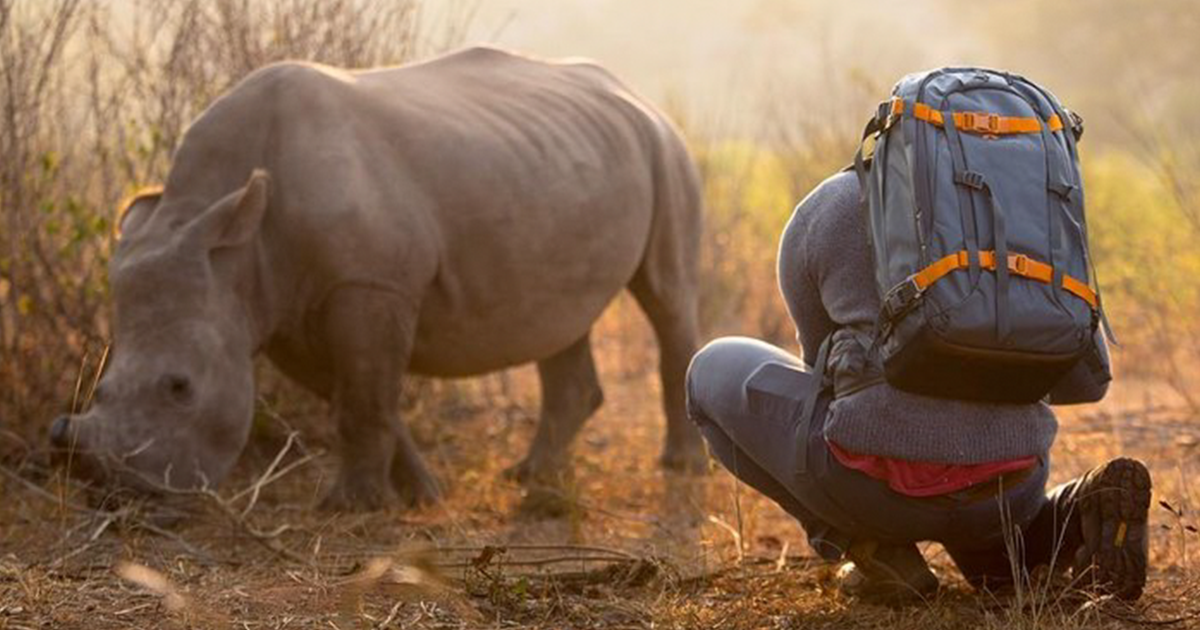
Most wildlife photographers hope for a close encounter. They dream about perfect light, a cooperative animal, and maybe a once-in-a-career moment when nature decides to pose instead of disappearing behind a bush. What they generally do not expect is a rhinoceros strolling over like an oversized house cat and apparently requesting personal spa services.
Yet that is essentially what happened to South African wildlife filmmaker Garth de Bruno Austin while he was working in the field. Austin was filming material connected with rhino conservation when a wild rhino he had known and filmed for years approached him. Instead of charging, retreating, or ignoring the cameraman, the enormous animal moved close enough to receive what looked very much like a belly rub. The brief encounter was captured on video and quickly became an internet favorite.
It was funny, touching, and slightly terrifying. It was also an unusual interaction that should not be mistaken for proof that wild rhinos are simply 5,000-pound puppies with horns.
The Viral Rhino Belly Rub That Nobody Expected
The footage lasts only seconds, but it contains almost everything required for a viral wildlife video: an enormous animal, a remarkably calm human, an unexpected display of trust, and enough potential danger to make viewers wonder whether the cameraman had temporarily misplaced his survival instincts.
Austin, however, was not dealing with a completely unfamiliar animal. According to accounts of the encounter, he had spent years filming this particular rhino and had developed a degree of familiarity with her. Importantly, he did not walk toward the rhino and attempt to touch her. She entered his space voluntarily. Austin later emphasized that people should absolutely not try to reproduce the encounter with an unfamiliar wild rhino.
That distinction changes the story considerably.
This was not a tourist hopping out of a safari vehicle because a rhino looked adorable. It was a wildlife professional experiencing an extraordinary interaction after repeated exposure to one individual animal.
And even Austin seemed aware of how absurd the situation looked. The rhino was enormous enough to rearrange both cameraman and camera equipment without needing a second attempt. Fortunately, she seemed more interested in scratching than smashing.
Who Is Garth de Bruno Austin?
The cameraman behind the viral encounter was not simply someone wandering around South Africa with a camera and an impressive tolerance for danger. Garth de Bruno Austin is a filmmaker and cinematographer with extensive experience documenting wildlife and conservation.
He later co-directed The Last Horns of Africa, a feature documentary examining the rhino-poaching crisis and the people attempting to protect the animals. The American Conservation Film Festival describes the production as providing unusually intimate access to conservationists, anti-poaching efforts, and the struggle to save African rhinos.
That background provides useful context. Spending long periods around wildlife can give filmmakers opportunities that casual visitors simply do not have. They learn individual animals, landscapes, routines, warning signs, and subtle changes in behavior.
It still does not make a rhinoceros harmless.
Think of professional wildlife filmmaking as the difference between watching somebody repair a high-voltage electrical line and deciding that electricity must therefore enjoy being hugged. Expertise changes risk management. It does not eliminate the risk.
Did the Rhino Really “Demand” a Belly Rub?
Probably not in the human sense of marching over and thinking, “Excuse me, camera person. Lower left side, please.”
The phrase is a charming interpretation of what viewers see in the video. We cannot know precisely what the animal intended. Scientists are appropriately cautious about assigning complex human motivations to wildlife based solely on a short clip.
What we can say is that the rhino voluntarily approached a familiar person, tolerated physical contact, and appeared comfortable enough for the encounter to continue briefly.
There is also a biological reason scratching might feel rather pleasant to a rhinoceros.
Rhino Skin Is Tough but Surprisingly Sensitive
Rhinos look as if evolution fitted them with industrial-grade body armor. Their thick, folded skin certainly provides protection, but it is not immune to irritation.
The San Diego Zoo Wildlife Alliance notes that rhinoceros skin can be sensitive to sun and biting insects. Rhinos regularly wallow in mud because the coating helps protect their skin from insects and sunlight while also assisting with cooling.
Rhinos also rub against natural objects. So although nobody should assume the animal was consciously requesting a conventional “belly rub,” enjoying scratching or rubbing is perfectly compatible with normal rhino behavior.
In other words, the rhino may not have been asking to become somebody’s pet. She may simply have discovered that the strange two-legged camera operator possessed surprisingly effective scratching equipment: hands.
Rhinos Are More Complicated Than Their Tank-Like Reputation
Popular culture tends to give rhinoceroses one personality setting: CHARGE.
Reality is more interesting.
There are five surviving rhino species, and behavior varies by species, sex, age, individual temperament, social circumstances, and environment. The International Rhino Foundation estimates that roughly 27,000 rhinos remain across all five species, making every surviving population important to global conservation.
White rhinos, for example, can be more social than black rhinos. National Geographic describes white rhinos as animals that may gather in groups, while African Wildlife Foundation material similarly notes that white rhinos generally show more social behavior than the often more solitary black rhinoceros.
They Rely Heavily on Smell and Hearing
Rhinos do not have especially impressive eyesight. Their hearing and sense of smell, however, are far more useful.
Research summarized by the University of Michigan’s Animal Diversity Web describes black rhinos as relying strongly on scent, while National Geographic similarly notes the importance of hearing and smell to rhino communication and awareness.
That sensory profile helps explain why surprising a rhino is such a spectacularly bad addition to anybody’s vacation itinerary.
An animal that weighs thousands of pounds does not need malicious intentions to be dangerous. Fear, confusion, territorial behavior, protection of a calf, or simply feeling cornered can create a serious situation extremely quickly.
And Yes, They Can Move Fast
The word “rhinoceros” may summon an image of a slow prehistoric bulldozer wandering through the grass.
Do not rely on that image during an emergency.
San Diego Zoo Wildlife Alliance reports that black rhinos can reach surprisingly high running speeds despite their enormous size, while the International Rhino Foundation notes that some rhinos can weigh several thousand pounds.
This creates an important wildlife equation:
Several thousand pounds + much faster than you expected = stay respectfully far away.
Why Familiarity Matters in the Cameraman’s Encounter
One of the most important parts of the viral rhino story is also the easiest to lose when the clip is reposted without context.
Austin had encountered and filmed this particular animal repeatedly.
That does not mean the rhino had become domesticated. A wild animal can become familiar with an individual person without becoming tame in the way a domestic dog or cat is tame.
Repeated nonthreatening encounters may affect how an animal responds to a particular person. The rhino apparently tolerated Austin’s presence because he was already part of her familiar environment rather than a stranger suddenly rushing into her personal space.
For everyone else, the correct lesson is not “rhinos enjoy belly rubs.”
The lesson is that relationships between individual wild animals and long-term observers can occasionally produce remarkable behavior that should not be generalized.
Why You Should Never Try This Yourself
This deserves its own section because the internet has repeatedly demonstrated that some people interpret “do not attempt” as “challenge accepted.”
Do not walk toward a wild rhino hoping to recreate this video.
Do not wave at one.
Do not extend your hand and announce that you are “good with animals.”
And definitely do not leave a vehicle because you have watched three wildlife documentaries and therefore consider yourself spiritually qualified.
General wildlife-viewing guidance from the U.S. National Park Service emphasizes that apparently calm wildlife remains unpredictable. Visitors are advised to keep their distance, use binoculars or telephoto lenses, and move away if an animal approaches rather than remaining close for photographs.
The exact safe distance and procedures around African rhinos depend on the reserve, guides, circumstances, and local regulations, but the broader principle is universal: wildlife gets the right of way.
The Sweet Video Has a Much Darker Conservation Background
The belly-rub footage feels wonderfully lighthearted, yet the project Austin was working on concerned one of the darkest realities facing rhinoceroses: poaching.
Rhino horn consists primarily of keratin, the structural protein also found in human hair and fingernails. Despite this decidedly unmagical composition, illegal demand for rhino horn has fueled organized wildlife trafficking and the killing of thousands of animals.
Poaching is particularly destructive because rhinoceroses reproduce slowly. Gestation can last around 15 to 16 months, and females usually produce one calf at a time. Rebuilding a population therefore requires years of protection and careful management.
Conservation Requires More Than Guarding Individual Animals
Modern rhino conservation includes anti-poaching patrols, habitat protection, veterinary medicine, genetic research, wildlife crime investigations, translocation, community programs, and international cooperation.
The U.S. Fish and Wildlife Service’s Rhinoceros and Tiger Conservation Fund supports programs ranging from habitat management and protected areas to anti-poaching initiatives and community conservation. Smithsonian researchers and conservation partners have also worked on veterinary medicine and genetic tools designed to improve rhino protection and management.
Those efforts matter because rhinos are not simply charismatic attractions for safari brochures. As giant herbivores, they influence vegetation, seed movement, nutrient cycling, and the structure of the landscapes they inhabit. The U.S. Fish and Wildlife Service describes rhinos as megaherbivores capable of shaping ecosystems through their feeding behavior.
Saving rhinos can therefore help protect far more than rhinos.
Why the Video Became So Popular
The obvious answer is that an armored herbivore apparently requesting a tummy scratch is objectively excellent internet material.
But there is probably another reason.
Most people encounter rhinos through dramatic images: horns, charges, safari vehicles, poaching statistics, armed rangers, and conservation emergencies. Those images are important, but they can flatten an animal into a symbol.
The belly-rub video does the opposite.
For several seconds, the rhinoceros stops looking like a conservation statistic and becomes an individual animal making an individual choice.
That emotional connection has tremendous value. People are often more motivated to care about wildlife when they can see behavior rather than merely population numbers.
The challenge is enjoying that connection without turning wildlife into cartoon characters. The rhino can be endearing and dangerous. She can appear gentle in one situation while still being an enormously powerful wild animal. Both things can be true simultaneously.
What Wildlife Photography Should Look Like
The best wildlife photography minimizes interference.
A photographer should ideally capture animals behaving naturally rather than manufacturing an encounter. Long lenses, patient observation, knowledge of behavior, professional guides, and respect for an animal’s escape routes generally produce safer and more authentic results.
The National Park Service specifically recommends binoculars and zoom lenses as tools for observing animals without getting physically close. It also stresses that if your presence changes an animal’s behavior, you are probably too close.
A viral close-up may earn millions of views. A stressed animal is not worth the engagement statistics.
The Bigger Message Behind One Tiny Video
The strange beauty of Austin’s encounter is the contrast contained within it.
Here is an animal capable of tremendous physical power behaving with remarkable calm around one familiar person. Here is a cameraman documenting a species threatened by human greed while simultaneously experiencing an extraordinary moment of apparent trust from that same species.
It is difficult to invent a better metaphor for wildlife conservation.
Humans have the capacity to destroy rhinos, but we also have the capacity to protect them.
The choice matters considerably more than whether we ever get to rub one.
Experience-Based Lessons From the Rhino Belly-Rub Encounter
For photographers, safari travelers, and wildlife enthusiasts, the most useful way to experience this story is not to imagine reproducing the physical interaction. Instead, imagine everything that happened before those famous seconds.
Wildlife work contains enormous amounts of waiting. A photographer may spend hours watching an animal feed, rest, walk away, disappear behind vegetation, reappear in terrible light, and finally stand perfectly still just as the camera battery announces that it has reconsidered its career choices.
That patience creates something valuable: knowledge.
Experience Teaches You to Watch Before You Shoot
A beginner often sees an animal and immediately thinks about the photograph.
An experienced wildlife observer first thinks about the animal.
Where is it looking? Is it feeding? Does it have a calf nearby? Is it aware of the vehicle? Is it relaxed or alert? Does it have a clear path to leave? Has its posture changed?
Understanding those details improves both safety and photography. An animal that is comfortable enough to continue natural behavior often produces better photographs than one staring directly at a human because it feels threatened.
The Best Close-Up May Be Taken From Far Away
Modern telephoto equipment can produce incredibly intimate wildlife photographs without forcing intimate physical distances.
Imagine two photographers seeing the same rhino.
The first approaches repeatedly because the animal looks calm. Eventually the rhino raises its head, turns toward the photographer, and becomes visibly alert. The resulting photograph may look dramatic, but the photographer has changed the behavior being documented.
The second photographer remains farther away. The rhino continues grazing, flicking its ears, walking through the grass, visiting a mud wallow, and interacting naturally with its surroundings.
The second photographer may return with a richer story.
Trust Is Not Permission for Everyone
Austin’s experience also demonstrates why context matters when wildlife clips spread online.
Someone watching 15 seconds sees a man touching a rhino.
Someone who knows the background sees years of repeated observation condensed into 15 seconds.
That distinction applies broadly to wildlife professionals. Rangers, veterinarians, researchers, rehabilitators, and filmmakers sometimes appear remarkably close to dangerous animals because their jobs require specialized procedures or because they understand specific individuals.
Their footage should not automatically become an instruction manual for tourists.
Sometimes the Greatest Experience Is Simply Being Accepted
There is another, quieter lesson in the encounter.
Wildlife photography is often framed as conquest: capture the shot, bag the image, find the animal, get closer.
A more rewarding approach is observation without ownership.
When a wild animal behaves normally despite your distant presence, that alone can feel extraordinary. You are temporarily allowed to witness a life operating according to its own priorities.
The animal owes you nothing. It does not need to pose, approach, perform, or become social-media content.
That perspective makes Austin’s rhino encounter even more remarkable. The special element was not simply that he touched the animal. It was that the rhino apparently felt comfortable enough to choose the interaction herself.
That choice is what separates an extraordinary wildlife moment from a forced encounter.
Conclusion
The famous footage of a wild rhino approaching Garth de Bruno Austin for what appeared to be a belly rub remains delightful because it reveals an unexpected side of an animal most people associate with raw power.
But the best version of the story includes its context. Austin had spent years filming the individual rhino. She approached him rather than the other way around. He specifically warned people not to repeat the interaction with unfamiliar wildlife. And behind the funny footage was serious conservation work involving animals still threatened by poaching, habitat loss, and fragmented populations.
So enjoy the video. Laugh at the idea of a rhinoceros ordering a belly rub like a gigantic armored golden retriever. Appreciate the extraordinary relationship between a filmmaker and an animal he had observed for years.
Just keep one rule firmly in mind if you ever meet a rhino yourself:
Bring the camera. Bring the telephoto lens. Leave the belly rubs to the professionalsand preferably to the rhino’s own decision.
Note: Describing the rhino as “demanding a belly rub” is a humorous interpretation of the viral footage, not a scientific claim about the animal’s exact mental intention. Wild rhinos are powerful, unpredictable animals and should never be approached or touched by visitors.