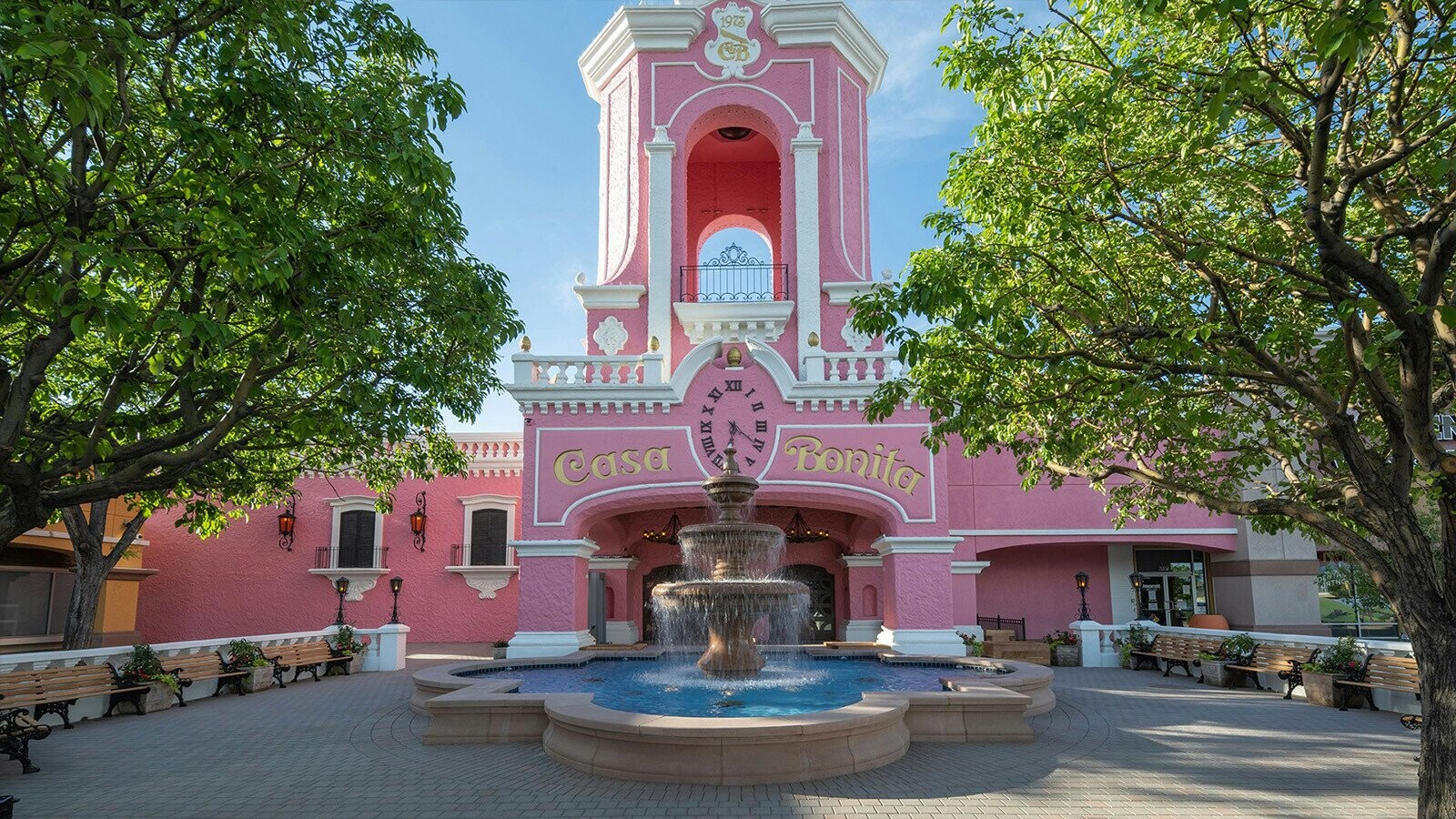
Most renovation stories begin with stained carpet, ugly cabinets, and an extremely confident person saying, “We can probably knock out this wall.” ¡Casa Bonita Mi Amor! begins with something more alarming: Trey Parker and Matt Stone realizing they may have purchased a giant pink building held together by nostalgia, deteriorating infrastructure, and mechanical systems that belonged in an episode of Kitchen Nightmares: Building Inspector Edition.
The documentary follows the South Park creators as they attempt to rescue Casa Bonita, the famously eccentric Lakewood, Colorado, restaurant that combines Mexican food, cliff diving, puppet shows, caves, waterfalls, arcade games, roaming performers, and enough childhood memories to overpower normal financial judgment.
Directed by Arthur Bradford, the film turns a celebrity passion project into a tense, funny, and unexpectedly heartfelt story about preservation, perfectionism, construction chaos, and the brutal difference between loving a place and becoming responsible for it.
A Childhood Dream With a Terrifying Inspection Report
Parker and Stone did not buy Casa Bonita because a spreadsheet identified an exciting growth opportunity. They bought it because they grew up in Colorado, loved the restaurant as children, and had already immortalized it in a beloved 2003 episode of South Park.
In that episode, Cartman goes to morally catastrophic lengths to secure an invitation to Kyle’s birthday celebration at Casa Bonita. Years later, the show’s creators effectively followed Cartman’s logic: Casa Bonita mattered, so ordinary limits involving money, time, and common sense were apparently negotiable.
After the restaurant closed during the COVID-19 pandemic and entered bankruptcy proceedings, Parker and Stone agreed to purchase it in 2021. The reported sale price was approximately $3.1 million. At first, the rescue might have sounded manageable: repair the building, improve the menu, freshen the attractions, reopen the doors, and accept grateful hugs from Colorado.
Then the experts started looking behind things.
The documentary trailer captures the shift from childhood wonder to construction-site dread with ruthless efficiency. Viewers see dirty air ducts, rapidly growing estimates, unfinished spaces, shrinking deadlines, and an expert delivering the unforgettable verdict: “It’s the most dangerous thing I’ve ever seen in my whole life.”
The line is funny for approximately half a second. Then you remember this is a building where live performers jump from artificial cliffs into an indoor pool.
Why ¡Casa Bonita Mi Amor! Looks More Stressful Than a Normal Makeover Show
The Building Was Not Merely “Dated”
Casa Bonita was never a simple restaurant. It was an enormous theatrical environment containing themed dining rooms, underground-style passages, kitchens, performance spaces, water features, mechanical equipment, and a towering indoor waterfall. Renovating it meant solving the problems of a restaurant, theater, amusement attraction, historic landmark, and fever dream at the same time.
That distinction matters. Replacing worn carpet is annoying. Discovering that performers might have been working near serious electrical hazards is the sort of revelation that causes a project manager to age visibly between camera cuts.
Local reporting about the documentary described cliff divers potentially facing electrocution risks before the renovation. The old building also presented structural, ventilation, accessibility, kitchen, and safety challenges. This was not a makeover in which somebody selected a warmer shade of beige. It was a rescue operation with sopapillas.
The Budget Began Behaving Like a Cartoon Villain
The renovation cost quickly became one of the project’s defining stories. Early expectations reportedly began in the single-digit millions. As crews uncovered more problems, the estimate expanded dramatically.
By the time the revived Casa Bonita was preparing to welcome guests, Parker and Stone had reportedly spent more than $40 million on the restoration. The $3.1 million purchase price, once the headline number, started looking like a modest appetizer before an entrée that arrives accompanied by a banker and a defibrillator.
The documentary’s tension comes partly from watching wealthy, successful entertainers encounter a universal renovation experience: every opened wall contains a fresh invoice. Four million dollars for heating, ventilation, and air conditioning does not land like a charming design surprise. It lands like a piano dropped from a tenth-floor window.
Trey Parker Could Not Settle for “Good Enough”
Parker’s creative intensity appears to be both the project’s greatest advantage and its most reliable stress generator. Casa Bonita was not supposed to reopen as a sanitized corporate tribute with a gift shop, a few framed photographs, and an employee dressed as nostalgia.
The goal was to preserve the experience while improving nearly everything that had become unsafe, inaccessible, inefficient, or famously disappointing. That meant protecting the waterfall, divers, caves, puppet shows, Black Bart mythology, theatrical weirdness, and childlike sense of discovery.
At the same time, the team had to create a functioning modern restaurant with stronger safety systems, better food, improved accessibility, and operations capable of serving large crowds. Executive chef Dana Rodriguez described the owners’ philosophy as changing nothing while improving everything.
It is a beautiful creative principle. It is also an excellent way to make contractors develop nervous facial tics.
The Documentary Is Also a Surprisingly Sincere Love Story
Parker and Stone built their careers by attacking sacred cows, mocking sentimentality, and identifying the ridiculous nerve ending in nearly every American institution. That history makes ¡Casa Bonita Mi Amor! unexpectedly affecting.
Here, the joke is not that caring is foolish. The joke is that caring this much can empty your bank account, destroy your sleep schedule, and trap you in an emergency meeting about air ducts.
Beneath the construction disasters is a story about two famously cynical comedians trying to preserve a place that helped shape their imaginations. Casa Bonita was not beloved because it provided conventional luxury. It was beloved because, to a child, it felt impossible: a pink palace hidden in a shopping center where dinner could lead to caves, pirates, puppet shows, gorillas, waterfalls, and divers flying through the air.
Reviews of the film highlighted this emotional sincerity. Rather than hiding the mounting costs or presenting every decision as commercially brilliant, the documentary acknowledges that the project is irrational. It then asks a more interesting question: What happens when people with enough resources to save a cultural landmark are stubborn enough to keep trying?
Arthur Bradford Was the Right Director for the Chaos
Director Arthur Bradford had already filmed Parker and Stone under extreme creative pressure in 6 Days to Air, the acclaimed documentary about the punishing production schedule behind South Park.
That familiarity matters. Bradford understands how the pair work, how quickly humor becomes a coping mechanism, and how to capture panic without transforming every setback into manufactured reality-TV melodrama.
His access allows ¡Casa Bonita Mi Amor! to feel intimate rather than promotional. The film watches its subjects absorb bad news, debate creative choices, stare at expanding budgets, and consider the possibility that the restaurant may never open.
The documentary premiered at the 2024 Tribeca Festival and won an audience award before receiving a limited theatrical release and arriving on Paramount+. Its appeal is easy to understand: the film combines construction suspense, Colorado nostalgia, celebrity access, food-world ambition, and the deeply relatable spectacle of a project becoming far larger than anyone promised.
Casa Bonita Had to Improve Without Becoming Normal
One of the smartest decisions in the revival was hiring acclaimed Denver chef Dana Rodriguez to overhaul the food. Casa Bonita’s entertainment had traditionally been the main attraction. The meal was often treated as the price of admission, something families endured before obtaining sopapillas and running toward the caves.
Parker and Stone wanted the revived restaurant to preserve the spectacle while serving food that did not require affectionate excuses. Rodriguez’s involvement reflected the project’s larger philosophy: modernization could not mean erasing Casa Bonita’s personality.
The menu, kitchen, accessibility, ventilation, safety systems, and physical structure all needed major upgrades, but the oddball experience had to survive. A polished dining room without cliff divers would not be Casa Bonita. It would simply be a large Mexican restaurant wondering where its gorilla went.
The reopening process was deliberately gradual. Casa Bonita operated through an extended soft-opening period and controlled ticketing before moving toward broader public reservations. Demand remained enormous. When reservations became more widely available, local reports documented tens of thousands of people attempting to secure tables.
After years of uncertainty, the main question changed from “Will this ever open?” to “How many people can enter the pink palace without breaking the reservation system?”
Why the Casa Bonita Documentary Trailer Works So Well
The trailer is edited like a disaster movie in which the monster is deferred maintenance.
It begins with childhood wonder. People describe Casa Bonita as a kind of Mexican Disneyland. Parker remembers dreaming that he might own it someday. Familiar attractions flash across the screen, including cliff divers, caves, performers, and the restaurant’s unmistakable pink exterior.
Then the tone pivots. Filthy ducts appear. Contractors name frightening prices. Deadlines shrink. Someone raises the possibility that the restaurant might never open. Parker jokes that he had better start making more television shows.
That joke summarizes the project beautifully. Parker and Stone have produced a long-running animated series, movies, video games, television specials, and a blockbuster Broadway musical. Yet Casa Bonita intimidates them in a completely different way.
Comedy can be rewritten. Animation can be redrawn. A failing mechanical system beneath an indoor waterfall is less interested in artistic feedback.
The documentary therefore promises more than behind-the-scenes trivia for South Park fans. It offers a real-world test of the duo’s creative instincts. Can the obsessive energy that powers television and theater revive a massive hospitality business? Can nostalgia be reconstructed without becoming artificial? Can an aging institution be made safer without sanding away the delightful nonsense that made people love it?
The Casa Bonita Experience: Wonder, Anxiety, and the Smell of Sopapillas
Watching ¡Casa Bonita Mi Amor! produces a peculiar emotional cocktail: amusement, dread, admiration, secondhand financial panic, and a sudden desire for fried dough.
The film invites viewers to experience the project from two perspectives at once. One belongs to the child who sees waterfalls, secret passages, divers, puppets, glowing rooms, and costumed performers. The other belongs to the adult who notices emergency exits, payroll, insurance, food safety, water filtration, accessibility, ventilation, and the ominous expression a contractor makes before saying, “We found another problem.”
That split perspective makes the documentary relatable even for people who have never visited Colorado. Many adults understand the desire to rescue something connected to childhood: a family house, an old car, a neighborhood theater, a summer camp, or a box of toys that has somehow survived six moves.
We imagine that restoring the object will restore the feeling. Then reality hands us a repair estimate and politely asks whether the feeling accepts credit cards.
For longtime Casa Bonita visitors, the documentary carries a more personal charge. Families remember raising a small flag to request more food, exploring Black Bart’s Cave, watching cliff divers, hearing puppet-show music, and ending the meal with warm sopapillas and honey.
The revived restaurant had to honor those memories without preserving the dangerous systems, poor accessibility, or culinary weaknesses of the past. That is far harder than creating a replica. A replica copies surfaces. A successful revival must identify the soul.
For a first-time visitor, the renovated Casa Bonita experience is designed to unfold like live theater. The enormous building does not reveal itself all at once. Guests travel through different spaces, encounter performers, hear rushing water, discover visual jokes, and gradually understand that dinner is only one component of the attraction.
The documentary can enrich that visit because every polished area carries an invisible before-and-after story. Clean ventilation is not exciting until viewers see what it replaced. The cliff dive becomes more impressive after learning what had to be repaired to make it safer. An accessibility ramp becomes meaningful when contrasted with the maze of stairs in the original layout.
The movie also creates a special form of anxiety for anyone who has managed a large project. Opening dates approach while essential work remains unfinished. Creative ambition collides with practical limits. Teams become exhausted. Costs keep rising. The owners must decide which details are sacred and which compromises are survivable.
Viewers may laugh at the scale, but the emotions are familiar: fear of disappointing people, embarrassment over missed deadlines, and the stubborn belief that one more push will finally make everything work.
Perhaps the most memorable experience is seeing Parker and Stone without their usual emotional armor. Their humor remains, but it cannot entirely conceal how much Casa Bonita matters to them. When a project is purely commercial, failure is a business problem. When it represents childhood, home, and creative identity, failure becomes personal.
By the end, Casa Bonita feels less like a restaurant and more like a physical argument for taking silly things seriously. Not everything meaningful needs to be elegant or solemn. Sometimes preserving joy requires engineers, chefs, electricians, performers, millions of dollars, and two comedians repeatedly asking themselves why they did not buy a normal building.
Conclusion: A Beautiful House Built From Bad Decisions and Good Intentions
¡Casa Bonita Mi Amor! looks stressful as hell because its stakes are real. Parker and Stone are not participating in a television renovation that must reach a tidy reveal before the closing credits. They are reviving a massive, deteriorating entertainment complex while protecting the memories that made it worth saving.
Every dangerous discovery threatens the schedule. Every improvement threatens the budget. Every practical compromise risks removing some of the weirdness that gave Casa Bonita its identity.
That conflict is why the documentary works. It is funny without treating the project as a joke, sincere without becoming syrupy, and inspiring without pretending that passion automatically creates a sensible business plan.
Casa Bonita survives because an army of specialistsand two exceptionally stubborn ownerskept solving one ridiculous problem after another. The result is not simply a restored restaurant. It is proof that a place can be absurd, beloved, financially terrifying, and culturally valuable at the same time.
Research note: This article synthesizes official film information, festival records, interviews, reviews, entertainment reporting, and local Colorado coverage of the purchase, renovation, documentary, and reopening of Casa Bonita.