Aerobatic flying looks like a pilot took the laws of physics, folded them into a paper airplane, and launched them straight into a tornado. Airplanes loop, roll, dive, climb, hang upside down, and sometimes trace shapes in the sky so precise they look drawn with a ruler by someone who had too much coffee. But the magic is not magic at all. It is physics: lift, drag, thrust, weight, angle of attack, load factor, momentum, airflow, and a very serious respect for safety.
In ordinary flight, an airplane’s job is fairly polite: stay upright, go from Point A to Point B, and avoid making passengers reconsider every life choice that led them to seat 14A. Aerobatic flight is different. It pushes an aircraft through unusual attitudes and rapid changes in acceleration, turning the sky into a three-dimensional physics classroom. The “hair-raising” part comes from how quickly familiar forces stop feeling familiar. Gravity does not disappear during a loop; it simply teams up with acceleration and asks your body, “So, how attached are you to your breakfast?”
This article explores the physics of aerobatic flying in clear American English, with real aviation science, practical examples, and just enough humor to keep the equations from wearing a tiny lab coat and lecturing you.
What Is Aerobatic Flying?
Aerobatic flying is a form of precision flight in which an aircraft intentionally performs unusual attitudes, rapid changes in direction, or abnormal acceleration. That includes familiar airshow figures such as loops, rolls, spins, hammerhead-style vertical turns, Cuban eights, and other sky-writing-without-the-pen maneuvers. In competition aerobatics, pilots fly inside a defined airspace area and are judged on geometry, smoothness, accuracy, and control.
The key word is precision. Aerobatics is not random stunt flying. A well-flown routine is closer to figure skating than chaos: every line, radius, roll rate, and heading matters. The airplane may look like it is escaping a blender, but the pilot is working from trained habits, energy awareness, aircraft limitations, and strict safety rules.
From a physics point of view, aerobatics is the art of changing the direction and magnitude of forces acting on an aircraft. The airplane still obeys the same four basic forces of flight: lift, weight, thrust, and drag. The difference is that those forces are constantly being re-aimed, increased, reduced, or briefly rearranged in ways that make the cockpit feel like a carnival ride designed by an aerospace engineer.
The Four Forces Still Run the Show
Every airplane in flight deals with four main forces. Lift is produced by airflow over the wings and acts generally perpendicular to the relative wind. Weight pulls the aircraft toward Earth. Thrust moves the airplane forward, usually from a propeller or jet engine. Drag resists motion through the air.
During straight-and-level flight, these forces are balanced in a fairly calm relationship. Lift roughly balances weight, and thrust roughly balances drag. Aerobatic flying breaks that polite dinner-table arrangement. In a loop, lift may point backward, upward, downward, or somewhere that makes your inner ear file a complaint. In a roll, the lift vector rotates around the aircraft. During a vertical climb, thrust and momentum become especially important because the wings are no longer doing the same job they do in level flight.
The physics is not about defeating gravity. Nobody defeats gravity; gravity has been undefeated since the universe opened for business. Aerobatic pilots manage gravity by controlling speed, attitude, lift, and acceleration. When done properly in the right aircraft with proper training, these forces can be shaped into elegant figures. When misunderstood, they can exceed aircraft or human limits, which is why aerobatics belongs in a disciplined training environment, not in the “hold my soda” department.
Angle of Attack: The Wing’s Mood Ring
One of the most important ideas in aerobatic flying is angle of attack, often shortened to AOA. It is the angle between the wing’s chord line and the relative wind. In simple terms, it describes how aggressively the wing meets the airflow.
Increase angle of attack and, up to a point, lift increases. That is why raising the nose can help a wing produce more lift. But there is a limit. Beyond the critical angle of attack, airflow begins separating from the wing, lift becomes less reliable, drag rises sharply, and the wing stalls. A stall is not simply “going too slow.” It is exceeding the critical angle of attack. That distinction matters enormously in aerobatics because an airplane can stall at different speeds depending on load factor, aircraft weight, configuration, and how hard the pilot is pulling.
Imagine holding your hand flat out a car window. Tilt it slightly and it wants to rise. Tilt it too much and the airflow becomes messy, the force changes, and your arm starts flapping around like it has joined a roadside inflatable tube man union. A wing behaves with more sophistication, thankfully, but the principle is similar: airflow must remain attached enough to produce controlled lift.
G-Forces: When Your Body Learns Multiplication
The “G” in G-force refers to acceleration relative to normal Earth gravity. Sitting still in your chair, you feel about 1G. In aerobatic flight, the load factor may rise above 1G during a pull-up or turn, fall toward 0G during a push-over or ballistic-feeling segment, or become negative when the aircraft accelerates in a way that makes the pilot feel lifted against the straps.
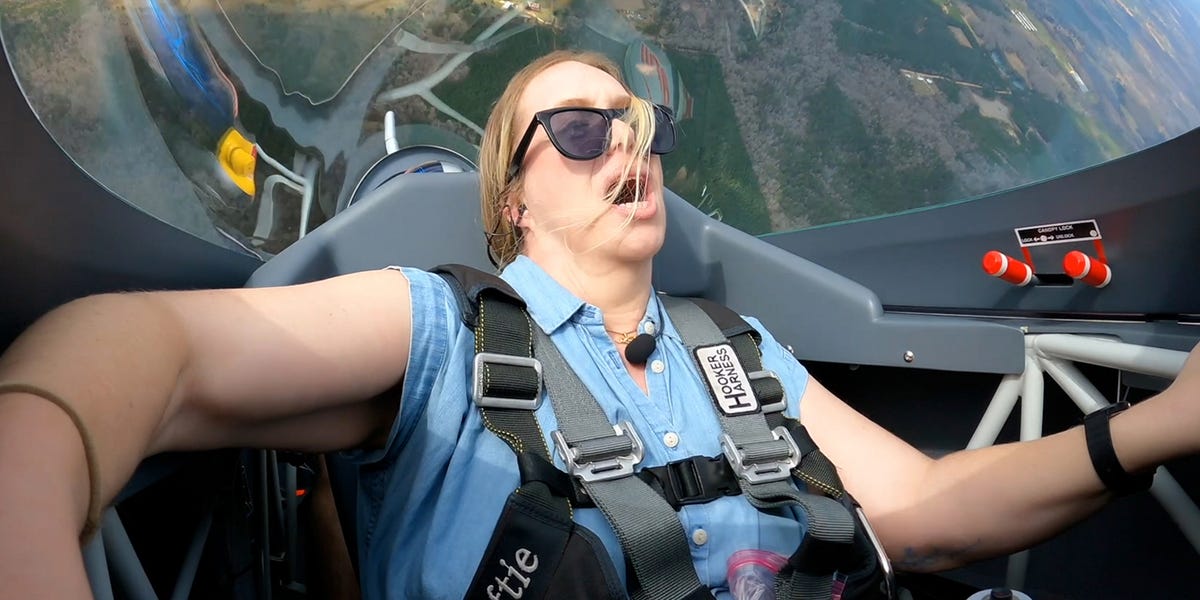
Positive G generally pushes the pilot downward into the seat. At higher levels, arms feel heavy, the head feels heavier, and the body has to work harder to maintain blood flow to the brain. Negative G can feel strange in the opposite direction, pressing the body upward against the harness. Aerobatic training treats these forces seriously because the human body is part of the flight system, not just a passenger with opinions.
Load factor also affects the aircraft. If an airplane is pulling 4G, its wings and structure are effectively supporting four times the aircraft’s weight. That does not mean the airplane got heavier in a bathroom-scale sense; it means acceleration has increased the aerodynamic load. Aerobatic aircraft are built and certified to handle higher positive and negative loads than ordinary training airplanes, but even they have limits. Physics gives no bonus points for confidence.
Why Loops Are Not Just “Flying in a Circle”
A loop may look simple from the ground: the airplane goes up, over, down, and back to level flight. Easy, right? Also, a violin is just a wooden box with strings, and somehow that does not make everyone Mozart.
In a loop, the airplane continuously changes direction in the vertical plane. At the bottom, the aircraft needs enough speed and lift to curve upward. As it climbs, kinetic energy becomes potential energy; speed decreases while altitude increases. Near the top, the aircraft may be slower, inverted, and still following a curved path. Then gravity helps accelerate it downward on the backside of the loop.
The loop is a beautiful example of energy management. Too little energy and the aircraft may not complete the shape properly. Too much force and the airplane or pilot may experience unnecessary load. The goal is not brute strength; it is timing, smoothness, and respecting the aircraft’s performance envelope.
From a physics standpoint, the loop shows how lift can act as a centripetal force, continuously changing the airplane’s direction. The airplane is not simply “pointing up.” It is being curved through space by aerodynamic force, engine power, momentum, and gravity all taking turns in the spotlight.
Rolls: Rotating Around the Long Axis
A roll is rotation around the airplane’s longitudinal axis, the imaginary line running from nose to tail. The primary control surfaces involved are the ailerons, which change the lift distribution between the wings. One wing produces more lift, the other less, and the aircraft rotates.
Not all rolls are the same. An aileron roll, slow roll, barrel roll, and snap roll differ in shape, control demands, and aerodynamic behavior. Some are smooth rotations; others combine rolling with pitching or involve stalled-wing dynamics. In competition aerobatics, different figures are judged very specifically, and what looks like “the plane spun around” to a casual observer may represent a carefully defined maneuver.
The physics of a roll includes torque, angular momentum, lift vector rotation, and yaw-roll coupling. As the airplane rolls, the lift vector no longer points straight upward. If lift tilts sideways, the airplane may begin to turn or descend unless the pilot manages pitch, yaw, and energy precisely. This is why aerobatic flying is not merely about moving a stick. It is about understanding how the aircraft responds in three dimensions.
Inverted Flight: Upside Down, Still Obeying the Rules
One of the most visually dramatic parts of aerobatic flying is inverted flight. Seeing an airplane upside down can make non-pilots wonder whether the wing has temporarily forgotten its job. But wings can produce lift in more than one attitude as long as the angle of attack and airflow support it.
Many aerobatic aircraft use symmetrical or nearly symmetrical airfoils, meaning the top and bottom of the wing are shaped more similarly than on many general aviation aircraft. This helps the wing behave more predictably when upright or inverted. In inverted flight, the aircraft must still create a lifting force relative to its flight path, but the pilot achieves that with a different pitch attitude and control input than in upright flight.
It is not “anti-gravity.” It is geometry, airflow, and enough engine power to keep the situation from becoming a very expensive lawn dart demonstration.
Drag: The Invisible Handbrake
Drag is the resistance an aircraft experiences as it moves through air. In aerobatic flying, drag changes constantly because the airplane’s speed, angle of attack, orientation, and control surface positions change constantly. High angle of attack can increase drag dramatically. Rapid control inputs can also add drag because deflected surfaces disturb the airflow.
There is also induced drag, sometimes called drag due to lift. When wings generate lift, wingtip vortices and downwash form as part of the three-dimensional airflow around the aircraft. The harder a wing works to produce lift, especially at higher load factors, the more induced drag becomes a concern. Aerobatic pilots must think about this because drag is an energy thief. It steals airspeed, reduces climb performance, and can turn a graceful figure into a droopy sky noodle.
Good aerobatic design reduces unnecessary drag while preserving control authority. That is one reason aerobatic airplanes often have clean shapes, powerful control surfaces, strong structures, and engines with enough power to rebuild lost energy quickly.
Spins, Snaps, and Stalled-Wing Physics
Some aerobatic figures involve stalled or partially stalled airflow. A spin, for example, involves stalled-wing aerodynamics combined with rotation. A snap roll involves a rapid autorotative motion associated with abrupt aerodynamic changes. These maneuvers are advanced and should only be discussed here from a physics and safety standpoint, not as a do-it-yourself checklist.
The important concept is that stalls and spins are not mysterious monsters hiding in the clouds. They are aerodynamic states. When a wing exceeds its critical angle of attack and the airplane has yaw or uneven lift between wings, rotation can develop. Aerobatic pilots train to understand these states in approved aircraft, with qualified instruction, altitude, and a safety plan. That training can improve awareness of aircraft behavior and make unusual attitudes less surprising.
In other words, the goal is not to “beat” the stall. The goal is to understand what the wing is telling you before it starts speaking fluent chaos.
The Flight Envelope: The Airplane’s Rulebook
Every aircraft has limits. These include maximum speeds, structural load limits, approved maneuvers, center-of-gravity range, and operating restrictions. A common way to visualize structural and aerodynamic limits is the V-n diagram, also called the velocity-load factor diagram. It shows how much load factor the aircraft can safely handle at different speeds.
This matters because speed and G-force are connected. At higher speeds, control inputs can create larger aerodynamic loads. At lower speeds, the wing may stall before it can produce a high load factor. Aerobatic pilots must understand where the airplane sits inside this performance envelope at all times. It is like dancing on a stage with invisible edges. The better you know the boundaries, the more graceful the performance looks.
Why Aerobatic Airplanes Look Different
Aerobatic airplanes are built for a very different job than a commuter aircraft or a basic trainer. They often have strong structures, responsive controls, high power-to-weight ratios, and airfoils that handle upright and inverted flight more evenly. Many are compact and lightweight, which helps them change direction quickly. Some have short wings for fast roll rates; others use biplane layouts or specialized designs for competition or airshow performance.
The tail, rudder, elevator, and ailerons are especially important. Aerobatic flight needs authority around all three axes: pitch, roll, and yaw. The airplane must respond crisply but predictably. Too little control authority and the aircraft cannot shape the figure accurately. Too much sensitivity without discipline and the pilot may overcontrol. The best aerobatic aircraft feel like precision instruments, not flying shopping carts with wings.
Safety: The Serious Side of Sky Acrobatics
Aerobatics may look playful, but safe aerobatic flying is built on rules, training, inspection, weather judgment, altitude discipline, and respect for human limits. In the United States, aerobatic flight is restricted in certain areas and conditions, including over congested areas, over open-air assemblies of people, in some controlled airspace areas, near federal airways, below certain altitudes, or when visibility is too low. These rules exist because aerobatics needs room, planning, and separation from people on the ground.
Training matters just as much as aircraft capability. A pilot does not become ready for aerobatics by watching videos and deciding the sky needs more drama. Qualified instruction teaches energy management, aircraft limitations, G-awareness, unusual attitude recognition, and recovery principles. It also teaches humility, which may be the most aerodynamic virtue of all.
Why Aerobatic Flying Fascinates Us
Aerobatic flying fascinates people because it reveals the airplane as something more than transportation. In normal travel, the aircraft is a bus with wings. In aerobatics, it becomes a brush, a compass, a pendulum, and a physics experiment with a propeller.
Watching a skilled aerobatic pilot fly a clean loop or roll is satisfying because the motion is both wild and controlled. The airplane seems free, yet every movement is constrained by physics. It cannot ignore lift, drag, gravity, or structural limits. The beauty comes from working with those limits so well that the result looks effortless.
That is the real secret: aerobatic flight is not a rebellion against physics. It is a partnership with physics, and physics is a partner that insists on reading the contract.
Experience: What the Physics Feels Like From the Human Side
To understand aerobatic flying more deeply, it helps to imagine the experience not as a passenger seeking thrills, but as someone observing how the body and mind react to a moving physics lesson. The first surprise is that the airplane does not feel like it is floating in empty space. It feels connected to the air. Every change in pitch, roll, and speed produces a response: pressure in the seat, lightness in the shoulders, a tug from the harness, a change in sound, a shift in the horizon.
During a smooth pull into a climbing arc, the body feels heavier. This is positive G in a very personal form. Your arms may feel as if someone secretly filled your sleeves with library books. The seat presses upward; the world outside the canopy slides downward. At the same time, the engine note and airflow provide clues about energy. The airplane is trading speed for height, and even without staring at instruments, the body senses that exchange.
Near the top of a vertical or looping figure, the mood changes. The aircraft may feel lighter, quieter, and more delicate. The horizon may rotate into a position that your brain labels “not normal,” as if the Earth has decided to redecorate. This is where aerobatic flying becomes mentally fascinating. Your eyes, inner ear, and expectations may disagree. Training teaches pilots to rely on disciplined visual references, instrument awareness when appropriate, and practiced control rather than raw instinct.
In a roll, the sensation is different. Instead of simply feeling heavier or lighter, the world rotates. The horizon swings around like a giant steering wheel. A well-flown roll can feel surprisingly smooth because the aircraft is rotating around its long axis, but the changing lift vector still matters. The pilot must understand how the airplane’s path, nose position, and energy are changing during the rotation. To an observer, it may look like a quick twist. To the pilot, it is a sequence of aerodynamic events happening very quickly.
The most memorable part of aerobatic physics is often not fear, but respect. The forces are invisible, yet they become obvious through sensation. Drag shows up as lost speed. Lift shows up as pressure. Gravity shows up everywhere, like a strict teacher walking around the classroom. Momentum carries the airplane through graceful arcs. Control surfaces translate small cockpit movements into big changes in attitude. The aircraft feels alive, but not in a mystical way; it feels alive because the air is constantly pushing, resisting, separating, reattaching, and flowing around it.
Aerobatic experience also reveals why smoothness matters. Jerky control inputs waste energy, increase loads, and make the airplane look untidy. Smooth inputs preserve energy and create cleaner shapes. The best flying feels deliberate. Nothing is rushed, even when the aircraft is moving fast. That calm precision is part of the appeal. Aerobatics looks dramatic, but the highest skill is often quiet: knowing when to pull, when to relax, when to let speed build, and when to stop asking the airplane for more.
For spectators, the experience is visual: smoke trails, engine noise, sunlight flashing off wings, and the collective gasp when an airplane draws a perfect vertical line. For pilots, the experience is physical and analytical at once. It is math you can feel in your ribs. It is geometry with a soundtrack. It is a reminder that the sky is not empty; it is a moving fluid, and an airplane is at its best when the pilot understands how to carve through it with care.
Conclusion
The hair-raising physics of aerobatic flying comes from the way ordinary flight principles become extraordinary when an aircraft changes attitude, speed, and acceleration rapidly. Lift still depends on airflow and angle of attack. Drag still steals energy. Gravity still pulls. G-forces still affect both aircraft and pilot. What makes aerobatics spectacular is not the abandonment of these rules, but the disciplined use of them.
Aerobatic flying is a powerful example of applied physics. It turns equations into loops, airflow into rolls, and energy management into art. The result is thrilling, but the foundation is serious: training, aircraft design, regulatory limits, and respect for the forces involved. The sky may look like a playground, but in aerobatics, physics is always the referee.