Every generation gets at least one financial mania that makes otherwise normal people stare at a price chart and whisper, “This time is different.” Sometimes it is tulip bulbs. Sometimes it is railroads, Florida land, internet stocks, houses, crypto tokens, artificial intelligence companies, or whatever shiny object Wall Street has decided to wrap in a prospectus and sell with dramatic lighting.
But what qualifies as the biggest asset bubble in history? Is it the one with the most ridiculous prices? The widest public participation? The largest dollar value? The greatest damage after it bursts? The answer depends on the measuring stick. Tulip Mania wins for comedy. Japan’s late-1980s bubble wins for breathtaking real estate absurdity. The 2000 dot-com bubble wins for sock-puppet confidence. The 2008 housing bubble wins for systemic destruction. Yet by scale, reach, and the number of assets lifted at the same time, the strongest modern candidate is what many analysts call the Everything Bubble: the long post-2008 era of inflated stocks, bonds, real estate, private equity, venture capital, crypto, and speculative technology valuations.
This was not merely one market getting overexcited. It was a global financial party where nearly every asset class showed up wearing a crown.
What Is an Asset Bubble?
An asset bubble happens when the price of an asset rises far beyond what its underlying income, utility, scarcity, or long-term fundamentals can reasonably justify. In plain English: people stop buying because something is worth that price and start buying because they believe someone else will pay even more later. That “someone else” is the famous greater fool, the unofficial mascot of every bubble since humans discovered both money and overconfidence.
Bubbles usually have a familiar recipe. Start with a real innovation or powerful story. Add cheap credit. Sprinkle in rising prices. Pour in public enthusiasm. Let leverage simmer. Finish with denial, panic, and a documentary series.
Why the Biggest Bubble May Be the “Everything Bubble”
The phrase Everything Bubble describes the broad inflation of asset prices after the global financial crisis, especially during the years of ultra-low interest rates, quantitative easing, and pandemic-era stimulus. Stocks climbed. Bonds became expensive. Home prices surged. Venture capital valuations ballooned. Crypto exploded. Meme stocks turned message boards into trading floors. Collectibles, luxury watches, private companies, and digital images of cartoon animals all found eager buyers.
The key word is “everything.” Earlier bubbles often centered on one area: railroads, Florida land, Japanese property, internet stocks, or American housing. The Everything Bubble was different because it linked multiple markets through the same financial fuel: cheap money, abundant liquidity, investor fear of missing out, and the belief that central banks would rescue markets whenever gravity became rude.
The Fuel: Cheap Money and the Search for Yield
After the 2008 financial crisis, central banks cut interest rates aggressively to support the economy. The Federal Reserve also used quantitative easing, buying large amounts of securities to push down long-term interest rates and stabilize financial markets. These policies helped prevent deeper economic damage, but they also changed investor behavior.
When safe assets yield almost nothing, investors go hunting. Pension funds, hedge funds, retirees, institutions, and ordinary savers all face the same uncomfortable question: “How do I earn a return when cash pays crumbs?” The answer, increasingly, was to move further out on the risk curve. Buy stocks. Buy longer bonds. Buy rental property. Buy private funds. Buy startups. Buy anything that might rise faster than inflation.
This created a powerful feedback loop. Higher asset prices made investors feel wealthier. Wealthier investors took more risk. More risk-taking pushed prices higher. Eventually, valuation discipline started to feel old-fashioned, like using a paper map or paying for ringtones.
Historical Bubble Contest: The Other Heavyweights
Tulip Mania: The Original Financial Punchline
In 17th-century Holland, rare tulip bulbs became speculative trophies. Prices rose wildly before collapsing. Tulip Mania is often remembered as the first famous bubble, though historians debate how widespread and economically damaging it truly was. Still, it remains useful because it captures the psychology of bubbles perfectly: beauty, scarcity, bragging rights, and the dangerous assumption that tomorrow’s buyer will be even more excited than today’s.
The South Sea Bubble: Financial Engineering Before Spreadsheets
The South Sea Bubble of 1720 involved shares of the South Sea Company, which promised wealth through trade and government debt restructuring. Investors rushed in, prices soared, and then confidence collapsed. The episode showed that a bubble does not need modern technology. It only needs a persuasive story, official credibility, and enough people willing to confuse complexity with safety.
The 1929 Stock Market Bubble: Leverage Meets Optimism
The late 1920s stock market boom had many classic bubble ingredients: technological progress, consumer optimism, easy access to margin debt, and the belief that prosperity had become permanent. Investors bought stocks with borrowed money, sometimes putting down only a fraction of the purchase price. When prices fell, forced selling turned fear into a landslide. The crash of 1929 did not single-handedly cause the Great Depression, but it helped destroy confidence and exposed deep financial fragility.
Japan’s 1980s Bubble: When Land Became a Fantasy Asset
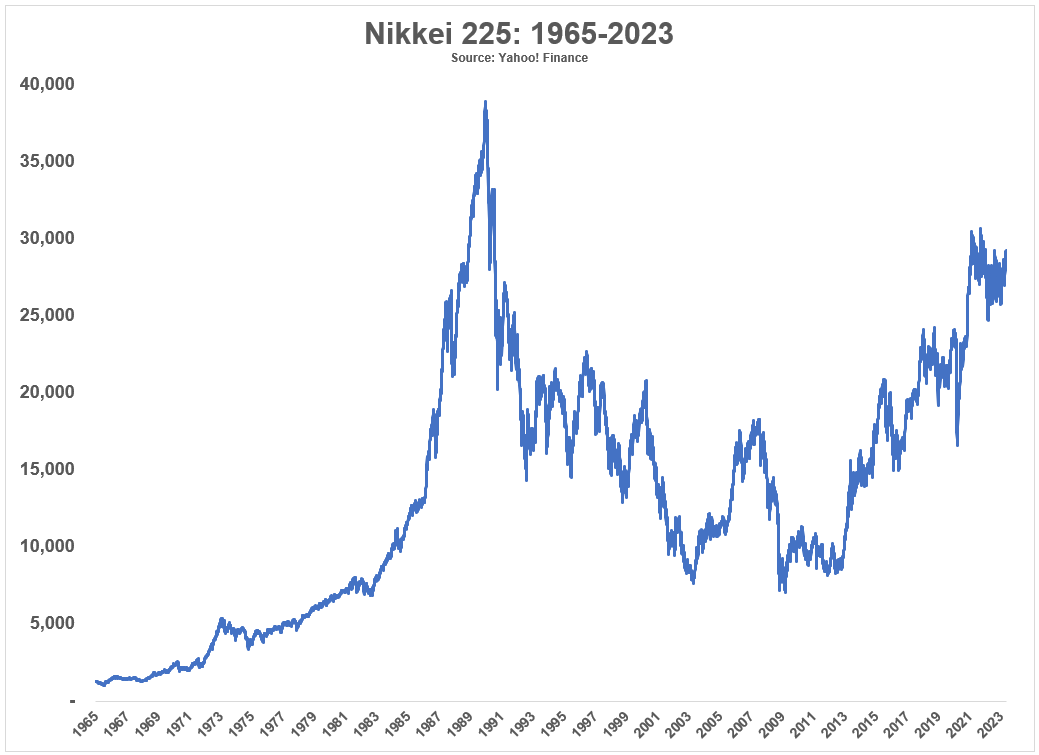
Japan’s late-1980s asset bubble was one of the most extreme valuation events ever recorded. Stock prices and urban land values surged to astonishing levels. At the peak, stories circulated that the land beneath Tokyo’s Imperial Palace was worth more than all the real estate in California. Whether used as precise math or market folklore, the message was clear: valuations had drifted into the financial stratosphere. When the bubble burst, Japan entered a long period of stagnation often called the Lost Decades.
The Dot-Com Bubble: “Profits Are Optional, Eyeballs Are Everything”
The late-1990s internet boom began with a genuinely revolutionary technology. The internet did change the world. The problem was that investors started treating every company with “.com” in its name as if it had already conquered the future. Many firms had no profits, weak business models, and marketing budgets that looked like someone had spilled coffee on a calculator. The Nasdaq collapsed after the mania peaked in 2000, wiping out trillions in paper wealth.
The U.S. Housing Bubble: The Bubble That Entered the Living Room
The 2000s housing bubble was especially dangerous because it involved homes, mortgages, banks, insurers, securitization, household wealth, and global credit markets. Home prices rose sharply, lending standards weakened, and mortgage-backed securities spread risk through the financial system. When housing prices fell, the damage moved from neighborhoods to balance sheets to the global economy. The 2008 financial crisis proved that a bubble in a basic asset like housing can become a national emergency.
Why the Everything Bubble Was So Large
The Everything Bubble was not necessarily the most dramatic bubble in percentage terms. A small cryptocurrency can rise 10,000 percent and still be tiny compared with the U.S. bond market. The Everything Bubble’s claim to the throne comes from breadth and dollar scale. It touched public stocks, private companies, housing, bonds, speculative technology, digital assets, and alternative investments at the same time.
Low interest rates also changed valuation math. When discount rates fall, future cash flows appear more valuable today. That can justify higher prices up to a point. But when investors stretch that logic too far, they begin pricing companies as if growth will continue smoothly forever, competition will remain polite, profit margins will stay heroic, and recessions have been permanently deleted from the economic calendar.
The Role of Stories in Financial Manias
No bubble survives on numbers alone. It needs a story. The story may be true, partly true, or emotionally irresistible. In the dot-com bubble, the story was that the internet would transform commerce. It did. In the housing bubble, the story was that home prices rarely fall nationwide. They did. In the Everything Bubble, the story was that low rates made high valuations reasonable and that technology would keep expanding profits. Parts of that story were valid. The danger came when a reasonable idea became a universal excuse.
During the AI boom, for example, investors had good reasons to be excited. Artificial intelligence may reshape productivity, software, chips, data centers, healthcare, education, and nearly every office job that currently involves too many tabs open. But even transformative technologies can produce bubbles when investors pay any price for exposure. Railroads changed the world too. So did electricity. So did the internet. Plenty of investors still lost money buying wonderful stories at terrible prices.
How to Spot the Biggest Asset Bubble Before It Bursts
Spotting a bubble in real time is difficult because bubbles often contain truth. Prices may be high for good reasons before they become silly for bad reasons. However, several warning signs appear again and again.
1. Valuations Detach From Fundamentals
When prices rise much faster than earnings, rents, cash flows, wages, or productivity, caution is wise. A stock can be expensive for years, but when investors stop caring about whether a business can ever produce durable profits, the market has wandered into the fog.
2. Leverage Becomes Normal
Borrowed money makes bubbles larger and crashes uglier. Margin loans, adjustable-rate mortgages, private credit, derivatives, and aggressive corporate debt can all magnify gains during the boom and losses during the bust.
3. Skeptics Are Mocked
Every bubble develops its own social etiquette: cheer loudly, question nothing, and accuse cautious people of “not getting it.” When basic risk management becomes socially embarrassing, the market is no longer investing. It is auditioning for a Greek tragedy with better graphics.
4. Everyone Becomes an Expert
Taxi drivers, dentists, cousins, celebrities, influencers, and anonymous accounts with laser-eye profile pictures suddenly offer confident market analysis. Public participation is not bad by itself, but when enthusiasm replaces education, danger rises.
5. Liquidity Is Mistaken for Genius
In easy-money environments, many strategies work. Rising tides lift boats, yachts, pool floats, and occasionally a refrigerator. The mistake is assuming the floating happened because the refrigerator was a brilliant sailor.
What Happens When a Bubble Bursts?
Bubble collapses rarely move in a straight line. First, prices wobble. Then dip buyers arrive. Then the narrative adjusts: “This is healthy.” Then losses spread. Credit tightens. Weak balance sheets crack. Investors who thought they had long-term conviction discover they actually had short-term tolerance. Finally, the phrase “I’m in it for the long run” becomes either wisdom or a coping mechanism, depending on the asset.
The damage depends on where the bubble lives. A bubble in a narrow speculative corner may hurt traders but leave the economy mostly intact. A bubble in housing or credit can be much worse because it affects banks, consumers, employment, construction, and household wealth. That is why the 2008 crisis was so severe: the bubble was tied to debt and the financial plumbing of the global economy.
Is Today Another Bubble?
As of the mid-2020s, the debate is alive and caffeinated. Some investors argue that high valuations are justified by strong corporate earnings, artificial intelligence, resilient consumers, and the dominance of highly profitable technology companies. Others worry that concentrated market leadership, expensive valuation measures, heavy debt loads, and speculative enthusiasm resemble earlier late-cycle environments.
The honest answer is that “bubble” is easier to confirm afterward. Nobody rings a bell at the top. Usually, someone rings a podcast microphone, three newsletters, and a conference panel, but not a bell. Markets can stay expensive for years, and some expensive assets grow into their valuations. Still, history suggests that investors should be careful when perfection is already priced in.
Lessons From the Biggest Asset Bubble in History
The first lesson is that bubbles are not caused by stupidity. They are caused by human nature under favorable financial conditions. Intelligent people can participate in bubbles because the early stages often reward risk. The problem is that rising prices become evidence, evidence becomes belief, and belief becomes identity.
The second lesson is that innovation and overvaluation can coexist. The internet was real. Housing is useful. Artificial intelligence is powerful. Electric vehicles, cloud computing, and biotechnology may all reshape society. But a great technology does not automatically make every investment in that technology great.
The third lesson is that debt matters. A bad investment bought with cash is painful. A bad investment bought with borrowed money can become a personal financial horror movie.
The fourth lesson is diversification. When everything rises together, diversification may look boring. When everything falls together, diversification suddenly looks like the adult in the room.
The fifth lesson is humility. The market is very good at humiliating people who confuse luck with skill, momentum with value, and confidence with knowledge.
Personal Experiences and Practical Reflections on Asset Bubbles
Anyone who has watched a bubble from the inside knows the emotional pressure can be intense. The hardest part is not understanding valuation theory. The hardest part is watching other people make money faster than you while you sit there with your sensible allocation, your emergency fund, and your deeply uncool spreadsheet. During bubbles, prudence feels like failure. Your neighbor flips a house. Your friend buys a tech stock that triples. A stranger online posts screenshots of gains large enough to make your savings account look like a decorative coin jar.
This is where many investors make their biggest mistakes. They do not enter near the beginning, when prices are low and risk is disliked. They enter near the end, when the story is obvious, the gains are public, and the fear of missing out has become unbearable. The emotional sequence is familiar: skepticism, curiosity, envy, participation, overconfidence, panic, regret, and finally a solemn promise to “never do that again,” which usually lasts until the next exciting chart appears.
A practical way to survive bubble environments is to separate admiration from allocation. You can admire artificial intelligence without putting your entire net worth into one AI stock. You can believe in housing without buying a rental property with numbers that only work if rent rises forever and repairs are performed by magical elves. You can respect Bitcoin, venture capital, or high-growth technology without pretending volatility is a personality trait.
Another useful habit is writing down the reason for an investment before buying it. Not a vague reason like “it’s going up,” but a real one: expected cash flows, competitive advantage, valuation, time horizon, risk limits, and what would prove the thesis wrong. This simple exercise is wonderfully annoying because it forces honesty. If the investment case sounds silly in writing, it may also be silly in real life.
Investors should also decide in advance how much loss they can tolerate. Bubbles make risk feel theoretical. Busts make it personal. A 50 percent decline is not just a number on a chart; it is a test of sleep, patience, liquidity, and whether you still enjoy opening your brokerage app. If an investment can fall by half and still not threaten your financial life, you can think clearly. If a decline would force you to sell, borrow, or panic, the position is too large.
The biggest asset bubble in history teaches a surprisingly old-fashioned lesson: wealth is built by surviving. The investors who last are not always the ones who capture every thrilling rally. They are the ones who avoid catastrophic mistakes, keep enough liquidity to stay calm, and remember that markets are not vending machines. They are more like weather systems: useful, powerful, sometimes beautiful, and occasionally determined to throw patio furniture into the neighbor’s yard.
In the end, the smartest response to a bubble is not permanent fear. It is disciplined curiosity. Study the story, respect the momentum, measure the valuation, manage the risk, and never forget that price and value are dating, not married.
Conclusion: The Bubble Is the Mirror
The biggest asset bubble in history is not just a financial event. It is a mirror reflecting how humans behave when money is easy, stories are exciting, and prices keep rising. The Everything Bubble deserves serious consideration as the largest because it stretched across so many assets at once and was powered by a historic era of low rates, liquidity, and speculation.
Yet the deeper lesson is timeless. Every bubble begins with a believable idea and ends with the discovery that price still matters. Investors do not need to predict every crash. They need to avoid becoming dependent on impossible assumptions. In markets, as in life, anything that requires perfection to work is already fragile.
Note: This article is for educational and editorial purposes only. It is not personalized investment, legal, tax, or financial advice.