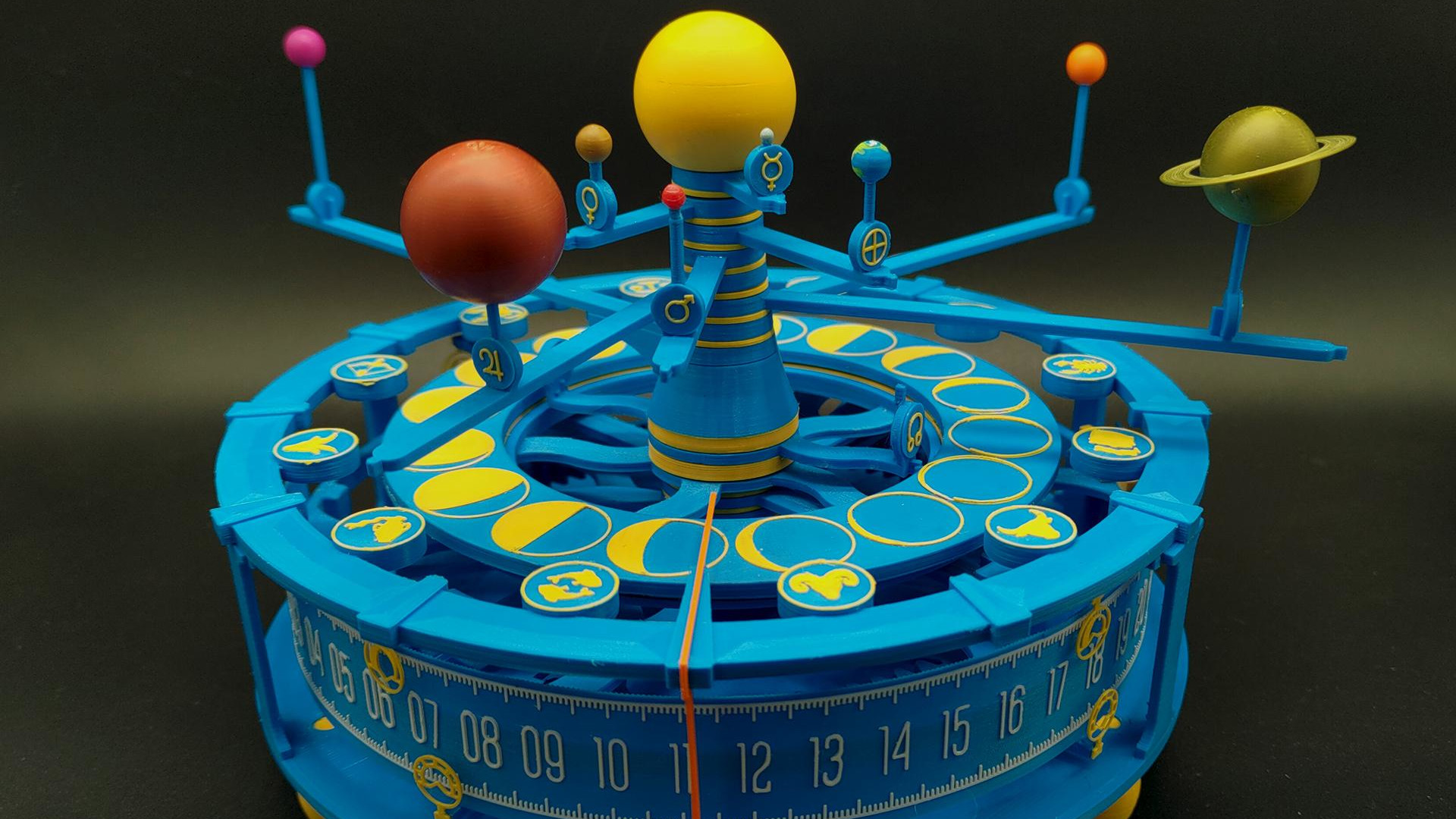
Some clocks politely tell you it is 3:17 p.m. and then go back to being wall decor. This astronomical timepiece is not that kind of clock. It tells time, tracks the Sun, follows the Moon, points toward planets, hints at sunrise and sunset, and even predicts solar and lunar eclipses. In other words, it is the rare clock that looks at your kitchen wall and says, “Nice place. Shall we also model the cosmos?”
The project that inspired this discussion is a modern maker-built astronomical clock: part clock, part orrery, part astrolabe, part mechanical theater. It combines 3D-printed parts, movable rings, a stepper motor, and an ESP32-C3 microcontroller to translate astronomical data into physical motion. The result is not merely a time display; it is a small, clever model of how humans have always measured life: by the turning of Earth, the glow of the Moon, and the slow choreography of planets overhead.
That may sound like something stolen from a wizard’s observatory, but the idea is deeply practical. Before phones, satellites, and weather apps that notify you about drizzle with the urgency of a national emergency, people used the sky as their calendar, compass, clock, and cosmic reminder that laundry could probably wait.
What Is an Astronomical Timepiece?
An astronomical timepiece is a clock or mechanical display that shows more than civil time. Instead of stopping at hours, minutes, and seconds, it connects time to celestial motion. A traditional astronomical clock may show the position of the Sun, the phase of the Moon, the zodiac, sunrise and sunset, or planetary locations. A modern version can use digital calculations and motorized parts to make those relationships visible.
The magic is not that the clock “knows” the heavens. The magic is that the heavens are predictable enough to be modeled. Earth rotates, the Moon repeats its phases roughly every 29.5 days, planets travel in measurable paths, and eclipses happen when the Sun, Moon, and Earth line up under the right orbital conditions. Put those cycles into a good mechanism, and suddenly a clock becomes a tiny lecture on astronomy.
More Than a Clock, Less Than a Planetarium
A planetarium fills a dome with stars. An astronomical clock compresses that ambition into gears, rings, disks, pointers, or digital controls. The best ones do not merely display numbers; they make relationships visible. You see that noon is not just “12.” It is the Sun crossing the sky. You see that the Moon is not randomly changing shape like a moody nightlight, but moving through a cycle. You see that eclipses are not supernatural plot twists, but geometry with excellent timing.
How This Modern Astronomical Clock Works
The standout feature of this build is its mechanical restraint. Many people assume an astronomical clock needs a glorious jungle of brass gears, each one waiting to pinch a finger and destroy a weekend. This project takes a different route. Instead of relying on a pile of custom gear trains, it uses movable rings with small tabs that interact with one another. Those tabs help position elements for planets, lunar phases, sunrise, sunset, and eclipse indicators.
That design choice is important. It proves a wonderful principle of engineering: complexity in the result does not always require complexity in the mechanism. A well-designed tab, ring, and stop can do the job of what might otherwise become an intimidating gearbox. It is the mechanical equivalent of using one perfectly timed raised eyebrow instead of a 40-slide presentation.
The Role of the ESP32-C3
At the heart of the clock’s modern side is an ESP32-C3 microcontroller. This small chip handles the calculations and control logic. It can determine what each display element should show for the current date and location, then direct the mechanism accordingly. The clock uses a stepper motor to move the physical parts, and the electronics update the display on a regular schedule.
This marriage of old and new is what makes the project charming. The visible face feels like an heir to astrolabes and orreries, while the invisible brain belongs to the age of microcontrollers, code, and late-night debugging sessions that begin with confidence and end with someone whispering, “Why is Saturn upside down?”
Why a Single Motor Is So Clever
Using one main motor keeps the design elegant. Every extra motor adds cost, wiring, calibration, power demands, and new opportunities for mechanical drama. A single-motor system requires the physical design to carry more intelligence. The tabs and rings become a kind of mechanical program. They guide the motion, constrain the possibilities, and let one controlled movement produce several meaningful positions.
That is exactly the kind of design that maker culture celebrates. It is not just “Can we make it move?” It is “Can we make it move beautifully, reliably, and with fewer parts than expected?” When a clock can track celestial events without turning into a mechanical spaghetti bowl, the builder deserves applause and possibly a snack.
The Ancient Roots: Astrolabes, Orreries, and Cosmic Calculators
This modern astronomical timepiece belongs to a long family of devices that tried to put the sky into human hands. The astrolabe, widely used for centuries in Islamic and European cultures, could help users determine time, identify star positions, and solve astronomical problems. It was portable, sophisticated, and flexible. In today’s language, it was an analog app store made of metal.
Then there were orreries: mechanical models showing the movements of planets around the Sun. These devices turned orbital motion into visible motion, usually through gears. They were educational tools, scientific demonstrations, and status objects for people who wanted their living room to say, “I enjoy Newtonian mechanics, but tastefully.”
The most famous ancient ancestor is the Antikythera mechanism, a Greek device recovered from a shipwreck and studied as an early astronomical calculating machine. Research shows that it could model cycles and predict eclipses using a complex arrangement of gears and dials. It reminds us that the desire to predict the heavens is not new. Humans have been trying to automate awe for a very long time.
Why Moon Phases Matter in a Clock
Moon phase displays are among the most beloved features of astronomical clocks. They are beautiful, useful, and easy to understand at a glance. NASA describes the familiar eight-phase cycle: new Moon, waxing crescent, first quarter, waxing gibbous, full Moon, waning gibbous, third quarter, and waning crescent. The cycle repeats about once a month, because the amount of sunlight we see on the Moon changes as it orbits Earth.
For most of modern life, moon phases are decorative. But historically, they mattered for travel, agriculture, tides, religious calendars, and night work. A full Moon could make a road or field easier to navigate. A new Moon meant darker skies for stargazing. Even today, a moon phase display gives a clock emotional depth. It says, “Yes, you have a meeting at 9, but also the Moon is waxing gibbous, so please remain humble.”
Predicting Eclipses: The Sky’s Most Dramatic Appointment
Eclipse prediction is where an astronomical timepiece becomes especially impressive. A solar eclipse occurs when the Moon passes between Earth and the Sun, casting a shadow on Earth. A lunar eclipse occurs when Earth moves between the Sun and Moon, casting its shadow on the Moon. These events do not happen every month because the Moon’s orbit is tilted relative to Earth’s orbit around the Sun.
That orbital tilt is the key. If everything orbited in one perfectly flat plane, eclipses would be monthly events and much less dramatic. Instead, the Moon usually passes above or below the Sun from our point of view. Only when the alignment happens near the orbital crossing points do we get the grand shadow show.
The Saros Cycle and Ancient Prediction
Ancient astronomers recognized that eclipses repeat in patterns. One of the most important is the Saros cycle, approximately 223 lunar months. The Antikythera mechanism used this kind of cycle to predict eclipses. That achievement is astonishing because it combined observation, mathematics, and craftsmanship into a physical machine.
A modern astronomical clock does not need to use ancient gearing to reach similar conclusions. It can rely on programmed astronomical algorithms and microcontroller control. But the philosophical result is the same: the device turns rare celestial events into something visible, expected, and understandable.
Sunrise, Sunset, and the Human Side of Time
Sunrise and sunset displays may sound simple, but they connect clock time to lived time. Civil time says 6:30 p.m. Sunset says the day is closing. One is a number; the other is a mood. Astronomical clocks that show sunrise and sunset remind us that time is not only mechanical. It is seasonal, local, and tied to the tilt of Earth.
Sunrise and sunset change with latitude, longitude, date, and time zone. The same clock display that makes sense in New York will not automatically match Seattle, Miami, or Anchorage without location-aware calculations. That is why modern astronomical timepieces benefit from microcontrollers: they can adjust for place and date in a way that traditional fixed mechanisms often cannot.
Design Lessons From This Astronomical Timepiece
This clock is more than a novelty. It offers useful design lessons for makers, educators, engineers, and anyone who has ever opened a drawer full of spare parts and thought, “Surely this is almost a telescope.”
1. Make Complexity Visible, Not Confusing
A good astronomical clock does not dump data on the viewer. It organizes it. Planet positions, Moon phase, solar timing, and eclipses can easily become a visual traffic jam. The challenge is to design a display that feels rich without becoming a dashboard from a submarine.
2. Let Mechanics Do Some Thinking
The movable-ring and tab system shows how physical geometry can simplify control. Instead of asking software to micromanage every motion independently, the mechanism can guide and limit motion. This is an old idea with modern value: smart parts reduce the burden on electronics.
3. Build for Wonder
Not every project needs to solve an urgent problem. Some projects earn their place because they make people stop, look, and ask better questions. An astronomical timepiece is useful, but its deeper job is to create curiosity. It turns timekeeping into a doorway.
Why Astronomical Clocks Still Matter
In a world where a phone can display eclipse maps, moonrise times, planetary positions, and your cousin’s lunch in three swipes, why build a physical astronomical clock at all? Because physical objects teach differently. A screen gives answers. A mechanism invites attention.
When a pointer moves, when a ring advances, when a Moon indicator changes phase, time becomes tactile. You can watch the slow logic of the sky unfold in your room. That experience is difficult to replace with an app notification, especially one wedged between a grocery coupon and a reminder that your cloud storage is emotionally disappointed in you.
Astronomical clocks also preserve an important idea: timekeeping began with astronomy. Long before atomic clocks and standardized time zones, people measured days by the Sun, months by the Moon, and seasons by the changing sky. Modern precision is wonderful, but it can hide the source. Astronomical timepieces bring the source back into view.
Practical Uses for a Modern Astronomical Timepiece
A device like this can serve many roles. In a classroom, it can teach lunar phases, planetary motion, eclipses, and Earth’s rotation in a way students can see. In a maker space, it can demonstrate mechanical design, microcontroller programming, stepper motor control, and 3D printing. In a home, it can become functional art: a clock that starts conversations without needing to shout across the room.
It can also help amateur astronomers plan observations. Knowing the Moon phase matters when choosing a night for deep-sky viewing. Seeing sunset and sunrise times helps plan outdoor sessions. Planet indicators can encourage casual skywatching. If Jupiter is prominent, why not step outside and look? The clock becomes a polite nudge toward the real sky.
Experience Section: Living With a Clock That Thinks Bigger Than the Wall
The experience of using an astronomical timepiece is very different from checking a normal clock. A normal clock answers a narrow question: “What time is it?” An astronomical clock answers that question and then adds, “Also, here is what the Moon is doing, here is where the planets are, and by the way, the Sun has plans.” It changes the way a room feels. Instead of being just another object on a shelf, it becomes a quiet performance that updates with the day.
Imagine walking past it in the morning. The large dial gives you the ordinary time, but your eye drifts to the sunrise marker. Suddenly the morning is not just a block of hours before school, work, errands, or coffee number two. It is part of a larger rhythm. The Sun has risen at a specific angle because Earth is tilted, orbiting, and spinning. That is a lot of cosmic activity before breakfast.
At night, the Moon phase display becomes the star of the show. A waxing crescent feels hopeful. A full Moon feels theatrical, as if the sky has installed overhead lighting for dramatic effect. A waning Moon feels quieter. These impressions are not scientific measurements, of course, but they are part of why astronomical clocks are emotionally satisfying. They let people notice changes that modern schedules often flatten into identical calendar squares.
For makers, the experience is even richer. Building or studying a clock like this forces you to move between disciplines. One moment you are thinking about astronomy. The next, you are considering tolerances, motor torque, friction, backlash, power supply behavior, firmware timing, and whether a plastic ring is slightly warped or simply judging you. The project becomes a conversation between code and matter. Software can calculate a planet’s position instantly, but the mechanism still has to move there cleanly.
That is where patience enters. Astronomical devices reward slow thinking. You cannot rush the Moon, and you should probably not rush a delicate ring mechanism either. Calibration becomes part of the ritual. You check whether the pointers align, whether the display updates correctly, whether the clock remains readable, and whether the whole thing still feels like an object rather than a science fair panic attack.
The greatest experience, however, is sharing it with someone who has never seen one before. People understand normal clocks instantly, but astronomical clocks make them lean in. They ask what the rings mean. They ask why eclipses are predictable. They ask why the Moon does not eclipse the Sun every month. That moment is the real success of the timepiece. It turns passive timekeeping into active curiosity.
In that sense, this astronomical clock is not only a device for telling time. It is a reminder that time is not floating numbers. Time is sunrise, shadow, orbit, phase, season, and alignment. It is the daily spin of Earth and the monthly dance of the Moon. It is engineering with a poetic streak. And yes, it is also a fantastic way to make an ordinary wall look like it went to graduate school.
Conclusion
“Tell Time And Predict The Heavens With This Astronomical Timepiece” is more than a catchy title. It describes a project that reconnects modern making with ancient curiosity. By combining microcontroller control, mechanical rings, stepper-driven motion, and astronomical logic, this clock turns celestial cycles into a readable, physical display.
Its appeal is not only technical. It reminds us that the sky has always been humanity’s first clock. Every sunrise, every Moon phase, every eclipse, and every planetary wandering helped shape how people understood days, seasons, calendars, and navigation. A modern astronomical timepiece brings that heritage into the present with plastic, code, motors, and a healthy dose of wonder.
Note: This article is original, rewritten for publication, and based on verified information about astronomical clocks, moon phases, eclipse geometry, astrolabes, the Antikythera mechanism, and modern maker-built celestial timepieces.