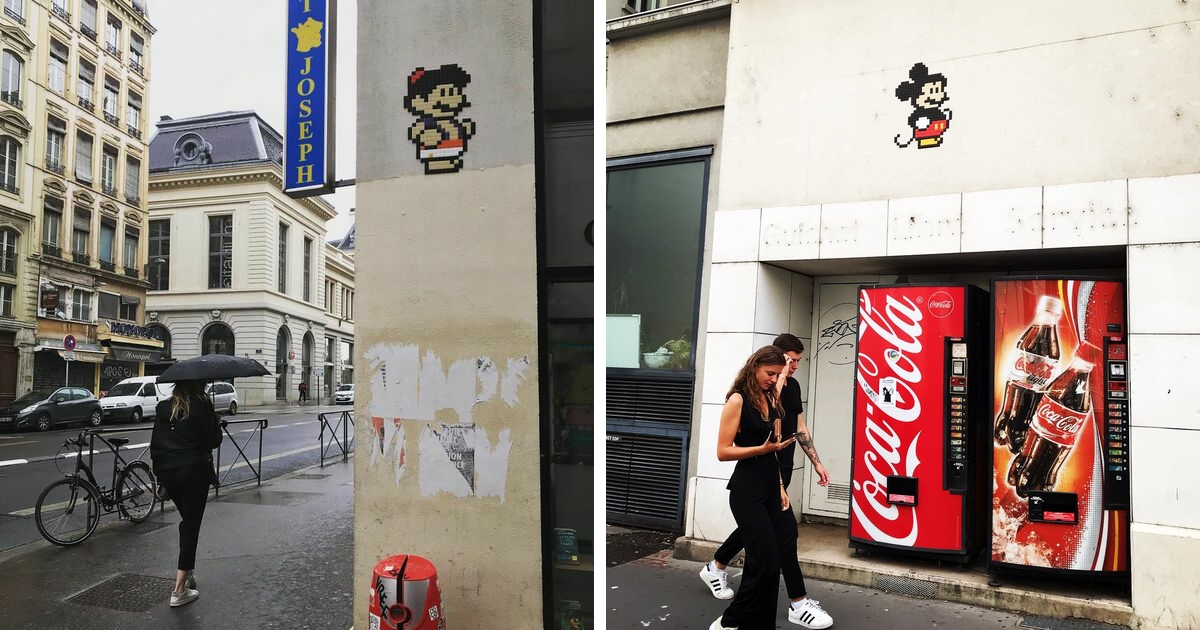
Street art often announces itself with a giant wall, a cloud of spray paint, or lettering visible from another postal code. The mosaic creations of French artist IN THE WOUP take the opposite route. They are compact, pixelated, and easy to missuntil a familiar red cap, superhero mask, anime hairstyle, or cartoon silhouette suddenly appears and turns an ordinary walk into a pop-culture treasure hunt.
Installed in Lyon and neighboring Villeurbanne in France, as well as on the Croatian island of Korčula, this 30-piece collection belongs to the artist’s ongoing MARIO WORLDZ project. Its playful concept blends classic video-game imagery with characters from movies, comics, manga, animation, and television. The result is a globe-trotting family of hybrid heroes: Mario meets Pikachu, Gandalf, Sonic, Iron Man, Snow White, Batman, and more. It is fan art with grout, or perhaps a crossover event hosted by a brick wall.
From Digital Pixels to Physical Tesserae
A mosaic is assembled from small pieces of stone, glass, ceramic, or other colored material, traditionally called tesserae. Long before screens existed, artists understood that tiny units could combine into faces, landscapes, symbols, and monumental scenes. Pixel art works on a remarkably similar principle: a limited grid of colored squares becomes an image once the viewer steps back.
That shared structure makes mosaic a natural physical language for video-game imagery. Early game characters were designed under strict technical limits, so every block mattered. A hat might occupy only a few pixels. A mustache had to be readable without the luxury of individual hairs. Recreated in ceramic squares, these characters seem to escape the screen without losing their original visual DNA.
IN THE WOUP treats Mario as a flexible template rather than a fixed portrait. The recognizable body becomes a stage for other fictional identities. A pointed hat, mask, cape, hairstyle, weapon, or color scheme can transform the plumber while leaving enough of him visible to make the joke land instantly.
Why the Mashups Work
Visual humor depends on quick recognition. Mario x Pikachu succeeds because yellow ears and electric energy collide with an unmistakable gaming silhouette. Mario x Gandalf borrows the wizard’s hat and beard, while Mario x Iron Man replaces overalls with armored confidence. Mario x Sonic is especially mischievous because it merges two longtime video-game icons whose rivalry practically comes with its own soundtrack.
The pieces also reward different generations. A child may identify a Pokémon character. A longtime gamer notices the pixel construction. A movie fan spots Loki or The Mask. Someone else simply enjoys the possibility that Batman has reconsidered his career and entered the plumbing trade. Every crossover acts as a tiny test of cultural memory.
Lyon: A City Built for Small Discoveries
Lyon is an ideal setting for street art that prefers discovery over domination. Its layered architecture, riverfront streets, passageways, courtyards, and dense neighborhoods place centuries of design within the same walk. A small mosaic can settle comfortably into that complexity. It does not need to defeat the building around it; it behaves like a witty footnote in the city’s margin.
The contrast is part of the pleasure. Ceramic pixels associated with arcade screens appear on stone, concrete, brick, or plaster. Digital nostalgia becomes materially solid. Rain changes the shine, sunlight brings out the glaze, and a weathered wall makes the clean grid look even more deliberate.
Lyon also has a wider connection to mosaic-based urban interventions. Artists in the city have used ceramic pieces to repair cracks, decorate overlooked surfaces, and introduce color into pedestrian spaces. That context helps mosaic street art feel like more than a novelty. It is durable enough to resemble architecture, yet small enough to remain intimate.
The Joy of Scale
Large murals tell pedestrians where to look. Small mosaics ask pedestrians to pay attention. Finding one feels personal and accidental, even when its placement has been carefully planned. A character near a doorway may seem to guard the entrance. One installed low on a wall recalls a side-scrolling game, where the hero runs close to the ground while surprises wait ahead.
Villeurbanne: Everyday Streets Become a Gallery
Villeurbanne borders Lyon but has its own streetscape and rhythm. Moving the same artistic language across the municipal boundary demonstrates how public art responds to place. A mosaic does not exist in a vacuum; its background includes traffic, storefronts, apartment blocks, construction scars, signage, and the routines of people who pass it every day.
In a museum, a work receives lighting, a label, and a respectful bubble of empty space. On a Villeurbanne street, it may compete with a drainpipe, delivery scooter, poster, or suspiciously confident pigeon. That competition is not a flaw. It is the medium. Street art enters daily life rather than asking daily life to step aside.
The MARIO WORLDZ characters fit this environment because they resemble game sprites, stickers, and collectible icons. Each installation stands alone, but together they form a distributed gallery. The walls become exhibition rooms, the walk becomes the hallway, and closing time is whenever your phone battery dies.
Korčula: Pixel Art Meets Adriatic Stone
Korčula offers a dramatically different visual setting. The Croatian island is associated with coastal light, stone architecture, narrow streets, historic townscapes, and the blues of the Adriatic. In that environment, a bright ceramic character becomes a conversation between old masonry and modern global fandom.
The island also has a meaningful relationship with mosaic culture. In Vela Luka, on Korčula’s western side, a long-running community project has transformed part of the waterfront with mosaic contributions. That local presence makes the medium feel less like an imported trick and more like a material already capable of belonging to the island’s public spaces.
Location changes the emotional tone. In Lyon, a Mario crossover may feel like a clever city glitch. On Korčula, surrounded by sunlit stone and sea air, it can resemble an artifact from a fictional civilization that worshipped game cartridges. The humor remains, but the contrast becomes more cinematic.
Traveling Art Without Losing Its Identity
Pixel-based mosaic art travels well because the grid provides consistency while each installation surface supplies local character. Weather, architecture, neighborhood culture, and pedestrian behavior all reshape the work. A photograph records the design, but the physical location completes it.
Highlights From the 30-Picture Collection
The collection’s strongest images are built around instantly readable transformations. Mario x Aladdin introduces storybook adventure. Mario x Charmander and Mario x Squirtle bring Pokémon energy into the Mushroom Kingdom. Mario x Mickey Mouse creates a meeting between two entertainment icons, roughly the pop-culture equivalent of two mayors accidentally wearing the same suit.
Superhero and comic-inspired pieces add another layer. Mario x Iron Man delivers armored swagger, while Mario x Batman turns the cap-and-mustache formula toward Gotham. Mario x Loki suggests magical mischief, and Mario x Joker leans into theatrical chaos. Each design selects a few decisive features rather than overcrowding the small format.
Anime, games, and animation produce equally effective combinations. Mario x Son Goku merges two characters famous for impossible jumps and questionable relationships with gravity. Mario x Chun-Li and Mario x Blanka draw from fighting-game history. Mario x Mega Man feels natural because both heroes come from classic side-scrolling worlds. Mario x Sonic looks like a forbidden laboratory experiment conducted by the entire 1990s.
Film and television references widen the audience. Mario x The Mask uses the green-faced character’s exaggerated expression. Mario x Woody borrows cowboy details, while Mario x Rick introduces science-fiction chaos. Mario x Snow White, Mario x Lucky Luke, and Mario x the Smurfs bring fairy tales, comics, and European animation into the pixel grid.
As the gallery progresses, viewers begin predicting the design logic. Which feature will carry the crossovercolor, headgear, hair, clothing, or an accessory? Each image becomes a visual riddle with an answer that seems obvious once revealed. That is the strength of the concept: simple enough to understand, flexible enough to keep producing surprises.
Why Mosaic Street Art Feels Different From Paint
Paint can move quickly, stretch across huge surfaces, and create soft gradients. Mosaic is slower and more stubborn. The artist must plan the grid, select materials, build the image, and install a physical object with thickness and weight. Curves become stair-stepped edges, and details must survive simplification.
Those limits give the finished work authority. Tiles catch light differently from paint. Grout creates a visible network between the pieces. The object casts tiny shadows and may remain legible as the surrounding wall ages. It feels manufactured and handmade at onceprecise like a sprite, imperfect like a human decision.
Outdoor durability depends on installation quality, climate, substrate movement, moisture, and maintenance. Conservation specialists pay close attention to mortar, adhesion, cracking, salts, water, and material compatibility. A street mosaic may look carefree, but gravity and weather are ruthless art critics.
Public Art, Permission, and Respect for Place
Street art raises questions about ownership and permission. A charming image does not automatically erase concerns about private property, heritage surfaces, or conservation. Historic stone and fragile façades require particular care. Responsible practice considers who owns the surface, whether an installation can be removed, and whether its materials may cause damage.
These questions connect street art to civic life. Public art can strengthen identity, encourage walking, and create shared neighborhood landmarks. It can also become unwelcome when artists treat a place as an empty backdrop. Thoughtful work behaves less like a flag planted in foreign territory and more like a guest who notices the furniture.
Viewers have responsibilities too. Do not touch, scrape, climb on, or add marks to a mosaic. Avoid blocking doorways and traffic while taking photographs. Credit the artist when known, and remember that a residential wall is not a movie set simply because a tiny superhero lives there.
Experience Notes: Following Mosaic Characters Through Three Places
The most rewarding way to experience small street mosaics is to stop treating the city as a route between appointments. They demand slower eyes. On an ordinary walk, people scan for traffic lights, addresses, menus, and the heroic arrival of an empty café table. Mosaic hunting changes that priority. Doorframes, corners, low walls, utility structures, and repaired masonry become possible hiding places.
In Lyon, the experience resembles exploring a layered game map. Slopes, river districts, historic passages, and mixed architectural surfaces create natural levels. A bright character discovered on a muted wall delivers the same small reward as finding a hidden item in a platform game. The art does not shout “destination.” It makes the journey more alert and playful.
Villeurbanne offers a more everyday encounter. Commuters, residents, students, and shopkeepers may pass the same piece repeatedly. Over time, a character becomes a neighborhood marker: turn after the mosaic, meet near the pixel hero, look for the wall with the strange Mario. Public art earns familiarity through repetition.
Korčula changes the pace again. Island light sharpens color, and stone streets carry a strong sense of age. A pop-culture mosaic in that setting creates a delightful time collision. The subject belongs to games, movies, or animation, but the material connects to a much older decorative tradition. Ceramic pieces can feel unexpectedly at home, even when they depict a superhero, wizard, or electric cartoon creature.
Time of day can completely change an encounter. Morning light may reveal the mosaic clearly while the street is quiet. Afternoon sun can create sharp reflections on glazed tiles. Evening shadows may hide part of the design and make the discovery feel more secretive. Returning to the same piece under different conditions often produces photographs that look like entirely different artworks.
Photography adds another layer. A close-up records the tile arrangement and grout lines; a wider frame explains why the location matters. Changing position may reveal how glazed pieces reflect light. At one angle, colors appear flat and graphic. At another, individual tiles flash like tiny screens.
Recognition also creates social moments. One person spots Mario; another identifies the crossover. Someone explains the reference to a friend. A child names Pikachu before the adults finish pretending they knew all along. Street art starts brief conversations because it offers a shared puzzle with no admission fee.
The search must remain flexible. Outdoor artwork can be removed, damaged, relocated, covered, or changed by construction. That impermanence is part of the form. A photograph may outlive an installation while a neighborhood gains new work elsewhere. Cities are not vending machines, and street art is not obliged to remain in slot B7.
Ultimately, the goal is not checking every piece off a list. It is learning to see ordinary surfaces differently. After spending time with mosaic street art, a blank wall looks less blank, a crack resembles a possible frame, and a handful of colored squares seems capable of opening a portal between Lyon, Villeurbanne, Korčula, and the fictional worlds people carry with them.
Conclusion: A Small Artwork Can Make a City Feel Bigger
IN THE WOUP’s mosaic creations combine a clear artistic system with endless cultural possibilities. The MARIO WORLDZ project translates digital nostalgia into physical objects, then lets architecture and location finish the composition. Lyon supplies layered urban texture, Villeurbanne adds neighborhood energy, and Korčula contributes coastal stone and historical contrast.
The 30 pictures are funny at first glance, clever on the second, and surprisingly revealing after that. They show how an ancient technique can speak fluent pixel art and how tiny installations can change the way people move through public space. A wall does not need to be enormous to hold a world. Sometimes it only needs a few colored tiles, a good idea, and a plumber wearing the wrong costume.