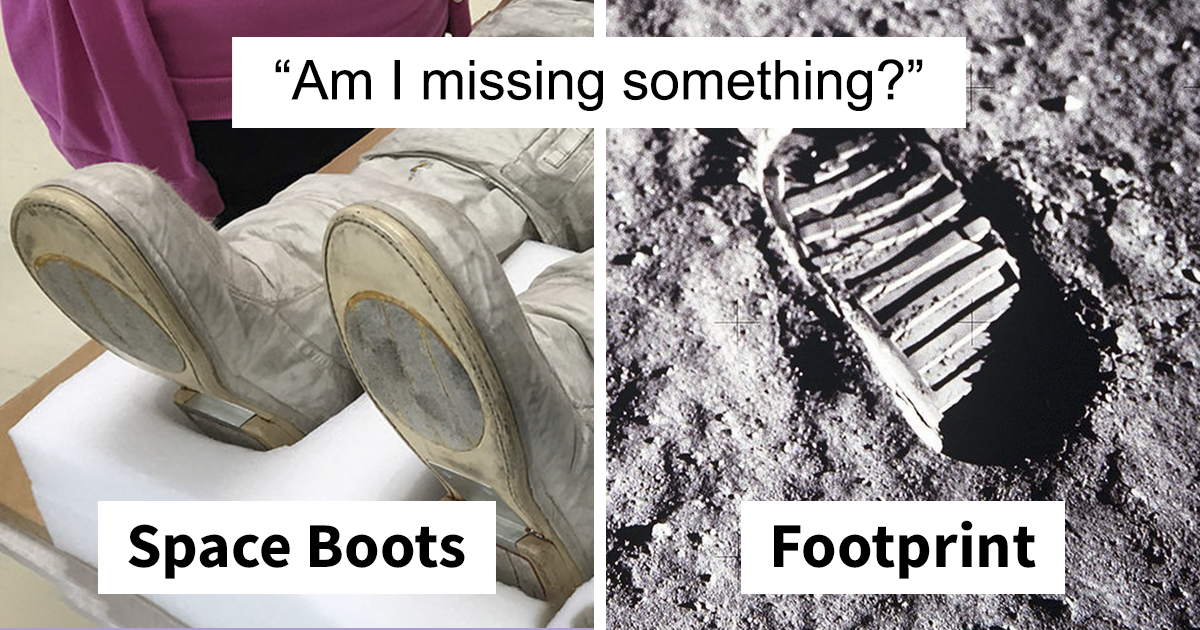
At first glance, it looks like the kind of discovery that could launch a thousand conspiracy videos before breakfast. Someone puts two images side by side: on the left, Neil Armstrong’s preserved Apollo 11 spacesuit with a relatively smooth-looking boot sole; on the right, one of those famous Moon footprints with deep horizontal grooves. The tread patterns clearly do not match.
Case closed? Did NASA forget to coordinate the footwear department with the fake-Moon-set department?
Not quite. The mismatch itself is real. The conclusion drawn from it is not.
The explanation is surprisingly simple: Apollo astronauts wore removable lunar overshoes over the boots built into their spacesuits. Those protective overshoes had the distinctive ribbed silicone soles responsible for the famous Apollo boot prints. The Apollo 11 overshoes were later discarded on the Moon, which is why Neil Armstrong’s preserved spacesuit does not display the tread seen in lunar photographs. The Smithsonian specifically addresses this frequently repeated question, while Reuters, AFP, PBS, and Snopes have independently examined versions of the same viral claim.
That little missing piece of equipment turns an apparently suspicious photograph into something much more interesting: a lesson in Apollo engineering, lunar geology, historical context, and why two pictures on social media rarely constitute a complete investigation.
Why the Moon Boot Print Looks Different From Armstrong’s Spacesuit Boot
The viral comparison normally shows the bottom of a boot permanently integrated into an Apollo spacesuit. That boot was part of the pressure garment assembly and served important purposes inside the spacecraft and during other stages of the mission.
But walking across another world required more protection.
Before Neil Armstrong and Buzz Aldrin left the Lunar Module Eagle, they added specialized extravehicular equipment. Among that equipment were lunar overshoes, sometimes described informally as Moon boots or lunar galoshes.
The Apollo astronauts were essentially wearing two layers of footwear
Think of the arrangement like wearing rugged waterproof boots over another pair of shoes, except your backyard is the Moon, the temperature range is brutal, the dirt is made from billions of years of pulverized rock, and calling roadside assistance is not an option.
The inner boots were incorporated into the pressure suit. The lunar overshoes slipped over them for surface activity. Smithsonian documentation explains that the overshoes featured silicone soles along with protective materials including woven stainless-steel Chromel-R and insulating layers. They were designed to provide traction, thermal protection, and resistance to sharp lunar material.
Most importantly for our mystery, those silicone soles carried the horizontal tread pattern visible in Apollo footprints.
So comparing the preserved inner boot with the footprint is like comparing someone’s socks with the tracks made by their hiking shoes and announcing that Big Footwear has some explaining to do.
The Famous Apollo 11 Footprint Has Another Commonly Missed Detail
There’s another twist that frequently gets lost when the photograph circulates online.
The iconic close-up image commonly used in discussions of the Apollo 11 boot print is associated with Buzz Aldrin, not simply a photograph of Neil Armstrong’s historic first step.
NASA’s Apollo photographic records identify a sequence of imagesAS11-40-5876 through AS11-40-5880documenting Aldrin’s lunar surface boot imprint. The photographs were connected to observations of how the soil behaved when compressed by a boot. National Geographic likewise identifies Aldrin as the astronaut who photographed the famous footprint during Apollo 11.
This distinction matters because viral posts often combine several ideas into one dramatic claim: Armstrong’s suit, Armstrong’s boot, Armstrong’s first step, and the famous close-up photograph. In reality, those are not necessarily photographs of the same object or moment.
Once again, context is doing most of the heavy lifting.
Why Aren’t Armstrong’s Lunar Overshoes in the Museum?
This is where the conspiracy theory occasionally gains a second wind.
If the astronauts really wore grooved overshoes, skeptics ask, why can’t we simply inspect Armstrong’s pair today?
Because Apollo crews left a surprising amount of equipment behind.
Every pound mattered when the Lunar Module’s ascent stage needed to lift astronauts and samples from the Moon and rendezvous with the Command Module. Before departure, Apollo crews discarded equipment that was no longer necessary. For Apollo 11, that included the Portable Life Support System backpacks and lunar overshoes.
In other words, the most useful exhibit for answering the boot-print question stayed approximately 238,000 miles away.
The Smithsonian states that Armstrong’s lunar overshoes and life-support equipment were left on the lunar surface. Reuters reached the same conclusion when examining the viral footwear comparison: photographs of Armstrong’s preserved suit do not include the external boots responsible for the striped tread.
But We Actually Do Have Apollo Lunar Overshoes
Fortunately, history eventually provided something close to the perfect demonstration.
During Apollo 17 in December 1972, Commander Eugene Cernan and Lunar Module Pilot Harrison Schmitt broke with the earlier practice and brought their lunar overshoes home. Cernan’s flown overshoes are now preserved by the Smithsonian’s National Air and Space Museum.
And yesthe soles have the familiar horizontal tread.
The Smithsonian describes Cernan’s Apollo 17 boots as external EV equipment worn over the integrated spacesuit boots. They feature silicone soles and protective Chromel-R uppers. These surviving artifacts provide a remarkably straightforward physical answer to the supposed Apollo boot-print mystery.
It is difficult to ask for a better historical receipt.
Why Lunar Soil Produced Such Sharp Boot Prints
Once the footwear mystery is explained, another question often arrives right behind it: How could dry Moon dust hold such a crisp footprint?
People naturally associate sharply defined footprints with wet sand. The Moon obviously does not have a beach underneath Eagle where Aldrin could dip his toes between experiments.
The answer lies in the unusual characteristics of lunar regolith.
Lunar soil is not ordinary Earth sand
The Moon’s surface has been bombarded by micrometeorites and other impactors for immense periods of time. With no substantial atmosphere or normal weathering system to soften particles the way erosion does on Earth, lunar grains can be extremely irregular and abrasive.
Armstrong described the surface near Eagle as extremely fine-grained and powder-like. NASA’s Apollo 11 mission summary notes that when he stepped onto the surface, his boot sank slightly and produced a sharply defined impression.
Fine lunar particles also display cohesive behavior. Their irregular shapes can mechanically interlock, helping compressed soil retain surprisingly detailed impressions without requiring liquid water.
That is why photographs can show distinct ridges from a boot sole rather than a shapeless crater where somebody’s foot happened to land.
The Footprint Photograph Was Science, Not Just a Cool Vacation Picture
Apollo 11 photography was not simply about collecting heroic images for magazine covers.
The astronauts documented the behavior of the lunar surface. Close-up boot impressions helped scientists examine penetration, compression, cohesion, and other soil properties.
The Apollo Lunar Surface Journal identifies Aldrin’s footprint photographs as part of a boot-print penetration sequence connected with soil-mechanics observations. NASA’s photogrammetric reconstruction also discusses the footprint photographs while mapping the astronauts’ activities around Eagle.
So the image that eventually became ammunition for a conspiracy claim was originally created partly because scientists actually wanted to study what a boot did to lunar soil.
History has a sense of humor.
Why the “Mismatch” Became Such a Successful Internet Claim
The Moon boot print story survives because it uses an extremely effective form of visual persuasion.
You don’t need to understand spacecraft engineering. You don’t need to read an Apollo mission report. You barely need to read anything.
You just look at two photographs.
Boot A has one sole. Print B has another pattern. Therefore, something is wrong.
That argument feels powerful because our brains are excellent at spotting inconsistencies but not automatically good at asking whether two images depict equivalent things.
What the viral comparison removes
It usually does not explain that the spacesuit had an integrated pressure boot. It does not show the removable overshoe. It does not mention that Apollo 11’s lunar overshoes were discarded. It may incorrectly imply that the famous close-up image shows Armstrong’s literal first footprint. And it rarely directs viewers to museum records showing surviving Apollo lunar overshoes with the correct tread.
Remove enough context, and an ordinary equipment configuration begins to look like a smoking gun.
Does Explaining the Boots Prove Every Apollo Claim?
Noand it does not need to.
A good investigation evaluates a specific claim using evidence relevant to that claim. The question here is whether the difference between a preserved Apollo spacesuit boot and a lunar footprint indicates that the photographs are fraudulent.
The available evidence gives a direct explanation: they are different pieces of footwear.
That conclusion also fits the much larger Apollo record, including mission photographs, surface transcripts, returned lunar samples, scientific experiments, spacecraft hardware, tracking data, and artifacts preserved in museums. Apollo 11 was followed by five additional successful crewed lunar landings, bringing the total number of people who walked on the Moon to 12 between 1969 and 1972.
You certainly do not have to treat NASA as incapable of making mistakes. No large technical organization deserves that kind of magical immunity. But skepticism works best when it examines the complete evidence rather than stopping at the first visually surprising image.
A Better Way to Investigate Viral Space Claims
The boot-print mystery provides a useful checklist for almost any historical claim built around photographs.
- Identify exactly what each photograph shows. A spacesuit boot and a removable EVA overshoe are not interchangeable objects.
- Check dates and mission context. Apollo hardware changed over time, and equipment used outside the spacecraft was not necessarily returned to Earth.
- Find the original image record. NASA’s image numbers, mission journals, transcripts, and museum catalogs provide far more information than reposted memes.
- Look for surviving hardware. Apollo 17’s returned lunar overshoes are especially valuable because they let researchers examine the real construction and tread.
- Separate the observation from the conclusion. “These soles look different” is an observation. “Therefore the Moon landing was staged” is a conclusion requiring substantially more evidence.
That final distinction may be the most important one. Sometimes a mystery begins with a perfectly accurate observation. The mistake happens in the leap that follows.
What Happened to Footprints Left on the Moon?
Without rain, rivers, vegetation, or ordinary wind erosion, Apollo footprints can survive far longer than footprints on Earth. That does not mean they are literally eternal. Micrometeorite impacts and other processes slowly disturb and redistribute lunar material over extremely long periods.
Still, the tracks surrounding the Apollo landing sites remain extraordinary archaeological features: marks produced by human beings walking on another celestial body.
The Library of Congress preserves materials showing how quickly those footprints became cultural symbols after Apollo 11, while National Geographic’s Apollo photography collections continue to highlight Aldrin’s footprint as one of the mission’s defining images.
Perhaps that explains why the boot-print meme remains so irresistible. The footprint is more than dirt pressed into dirt. It represents one of humanity’s most famous technological achievements, which makes anything apparently unusual about it instantly fascinating.
Conclusion: The Moon Boot Mystery Is Really an Equipment Mystery
Yes, someone noticed that the boots displayed with Neil Armstrong’s Apollo spacesuit do not appear to match the grooved footprints photographed on the Moon.
That observation is correct.
What it leaves out is the removable footwear astronauts wore during lunar excursions.
Armstrong and Aldrin slipped specialized lunar overshoes over their integrated suit boots before walking outside Eagle. Those overshoes had grooved silicone soles. Their Apollo 11 pairs were discarded before leaving the Moon, which is why Armstrong’s museum suit appears to have the “wrong” footwear. Later Apollo 17 astronauts brought examples home, and the surviving overshoes preserved by the Smithsonian show exactly the kind of tread expected from lunar photographs.
The mismatch therefore reveals something fascinatingbut not what conspiracy posts suggest. It reveals how specialized Apollo equipment was, how much hardware had to be discarded to save mass, and how easily a photograph can lose its meaning when separated from its original context.
Sometimes the mystery is not hidden in a secret government warehouse. Sometimes it’s an overshoe.
Experience: Following the Moon Boot Print Mystery From Meme to Evidence
For many readers, the most interesting part of the Moon boot controversy is the experience of investigating it. Imagine encountering the comparison for the first time without knowing anything about Apollo spacesuit construction. The two pictures look persuasive. One sole appears smooth or differently patterned; the lunar footprint contains bold horizontal ridges. Your brain immediately recognizes the mismatch, and a tiny detective wearing imaginary sunglasses whispers, “Well, that’s suspicious.”
The productive next move is not to accept the conspiracy claim or dismiss it because it sounds ridiculous. It is to follow the objects.
Start with Armstrong’s preserved suit. Museum photographs make it possible to inspect the integrated boots closely. Then look up how astronauts prepared for an EVA. Suddenly another piece of footwear appears in the documentation: the lunar overshoe.
That changes the entire experience of viewing the original meme. What appeared to be one pair of boots becomes a layered equipment system.
Next comes the particularly satisfying part: finding photographs and catalog records for Gene Cernan’s Apollo 17 lunar overshoes. The horizontal tread is sitting there in plain sight. You can mentally place the overshoe over the integrated spacesuit boot, and the mystery collapses without requiring an elaborate technical argument.
Then examine NASA’s Apollo 11 photographic sequence. Another assumption disappears. The familiar close-up print is connected to Buzz Aldrin’s documentation of the lunar surface rather than simply being a snapshot of Armstrong’s legendary first step. Suddenly the meme has lost two important pieces of context instead of only one.
The investigation gets even more interesting when you move from footwear to geology. Looking closely at lunar photographs, you can see how sharply the regolith records equipment marks and footsteps. Reading Armstrong’s descriptions of fine, powder-like material makes those images feel less abstract. Lunar dust was not merely scenery; it affected traction, contaminated equipment, coated suits, and became an engineering problem astronauts had to manage.
This is the kind of research experience that makes historical spaceflight unusually rewarding. Almost every famous Apollo photograph sits on top of layers of engineering documentation, transcripts, museum artifacts, scientific observations, and technical decisions.
It also teaches a useful internet survival skill. When a viral image says, “Explain this,” take the invitation seriouslybut expand the question. What exactly am I seeing? Are the objects really equivalent? Who took the photograph? When? Was equipment added or removed? Does a museum catalog describe the hardware? Are there surviving examples?
Following those questions does not make the story less exciting. In this case it makes the story better. Instead of ending with “the soles don’t match,” you end up learning why Moon walkers needed protective overshoes, what those boots were made from, why Apollo crews threw equipment onto the lunar surface, how scientists studied boot penetration in regolith, and why at least one later astronaut decided those dusty overshoes were worth bringing home.
That’s a much richer rabbit hole than the meme promisedand nobody even had to build a movie studio on the Moon.
Note: This article synthesizes historical and technical information from NASA mission archives, the National Air and Space Museum, Smithsonian Magazine, Reuters Fact Check, AFP Fact Check, PBS, Snopes, National Geographic, Space.com, History, the Library of Congress, and related Apollo documentation. The well-known Apollo 11 close-up footprint is associated with Buzz Aldrin’s soil-documentation sequence and should not automatically be described as a photograph of Neil Armstrong’s first footprint.