Restaurant servers possess a rare professional talent: smiling warmly while their internal monologue is throwing furniture.
During a single shift, a server may memorize complicated orders, explain the difference between medium and medium-well, carry dangerously hot plates, refill six beverages, locate someone’s missing ranch dressing, and somehow remain responsible for weather conditions, menu prices, kitchen delays, and the customer’s decision to skip lunch.
Most diners are perfectly reasonable. They order, eat, pay, tip, and leave without attempting to renegotiate the social contract. Then there are the entitled customersthe people who treat a neighborhood restaurant like a private resort where every employee has been assigned exclusively to them.
Editor’s note: The incidents below are original, condensed retellings inspired by recurring experiences shared publicly by restaurant workers. Details have been generalized to protect privacy and avoid reproducing any individual post.
Why Entitled Customers Make Server Life So Difficult
Waiting tables involves much more than carrying food. According to the U.S. Bureau of Labor Statistics, servers spend much of their shifts standing, walking, carrying trays, coordinating with kitchen employees, entering orders, processing payments, and responding to customer requests in a fast-paced environment. About 2.3 million Americans worked as waiters and waitresses in 2024, and the occupation’s reported median hourly wage of $16.23 included tips.
Tips remain especially important because federal law still allows qualifying employers to pay tipped employees as little as $2.13 per hour in direct wages, provided wages and tips together reach the applicable minimum wage. Many states require higher amounts, but the system still means that a customer’s generosityor lack of itcan affect a server’s earnings that night.
Americans generally understand that expectation. Pew Research Center found that 92% of U.S. adults who visit sit-down restaurants say they always or often tip. However, disagreements about service quality, suggested gratuities, digital payment screens, and what counts as “good service” continue to produce tension.
Against that background, server communities have become digital break rooms. Restaurant workers share bad tips, bizarre complaints, insulting receipt messages, impossible requests, and moments when a manager actually defended the staff. The stories are funny, frustrating, and occasionally proof that some adults should not be released into public without a responsible chaperone.
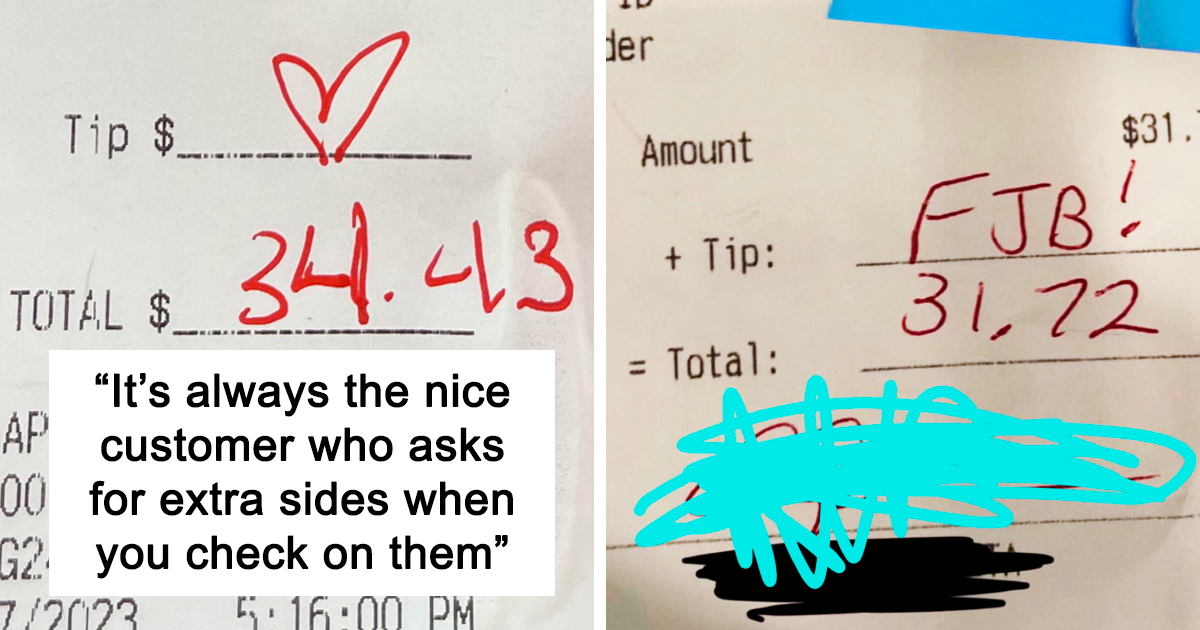
30 Entitled Customers Servers Will Never Forget
-
1. The Fake-Money Philanthropist
A customer praised the server’s work, promised an “early Christmas present,” and left what appeared to be a generous bill. It was fake money containing a promotional message. Nothing says holiday spirit quite like briefly convincing someone they can afford groceries.
-
2. The Parent Who Outsourced Parenting
A child began throwing sugar packets at nearby guests. When the server politely asked the family to stop the miniature condiment rebellion, the parent complained. Apparently, protecting other diners was less important than preserving little Brayden’s artistic freedom.
-
3. The Guest Who Wanted a Table That Did Not Exist
A group arrived without a reservation during the dinner rush and demanded immediate seating for twelve. They rejected every available arrangement because they wanted one large tablepreferably one created through advanced carpentry while they waited.
-
4. The Luxury Drinker With a Budget Emergency
A customer ordered multiple rounds of premium tequila shots at an upscale bar, then complained that the bill was unfair. The server had neither distilled the tequila nor established its price, but somehow became the defendant in a surprise financial trial.
-
5. The Customer Who Tipped in Compliments
This diner requested sauces, substitutions, extra sides, separate containers, and several refills. At the end, they announced that the server was “amazing” and left almost nothing. Unfortunately, landlords remain stubbornly unwilling to accept verbal appreciation as rent.
-
6. The Religious Pamphlet Tip
Instead of money, a customer left a tract explaining how the server could achieve spiritual riches. The message may have been sincere, but spiritual wealth does not pay the electric bill, especially after someone has occupied a booth for two hours.
-
7. The Receipt-Side Beauty Critic
A guest avoided eye contact throughout the meal, ignored every check-in, and later wrote an insulting comment about the server’s appearance on the receipt. The restaurant had been mistaken for a fashion competition, and apparently everyone else missed the auditions.
-
8. The Fifteen-Person Dollar Tip
Two servers handled a party of fifteen, coordinated separate requests, cleared mountains of dishes, and split the work for the entire evening. The group left one dollar. Divided between two people, it became less of a tip and more of a coin-flavored insult.
-
9. The Political Receipt Manifesto
Rather than simply paying and leaving, one customer transformed the receipt into a political billboard. The server received a lecture instead of a reasonable gratuity, despite having no visible role in Congress, campaign management, or national economic policy.
-
10. The Pocket-Change Archaeological Dig
A customer left a collection of tiny coins jammed beneath a table fixture, forcing the server to pry them out individually. Technically, money had been left. Practically, the diner had invented an escape room with a prize worth less than a soda.
-
11. The Bill-Rounding Warrior
One customer adjusted the tip so the final total would land on a visually satisfying number, regardless of the service provided. Servers quickly learn that some diners care deeply about round numbers and significantly less about the people running their food.
-
12. The Amateur Accountant
A guest altered figures on the receipt, disputed clearly listed charges, and accused the server of manipulating the total. After a manager recalculated everything, the original bill was correct. The customer remained angry, because mathematics had failed to respect their feelings.
-
13. The “I Know the Owner” Celebrity
A diner announced that they knew the owner and therefore expected free appetizers, priority seating, and unauthorized substitutions. Curiously, people who genuinely know restaurant owners rarely deliver a ten-minute speech about it before ordering mozzarella sticks.
-
14. The Kitchen-Timing Conspiracy Theorist
A customer blamed the server because a well-done steak took longer than a salad. The explanation that different dishes require different preparation times was rejected. Clearly, the server had hidden the steak in a vault as part of a personal vendetta.
-
15. The Entire-Meal Refund Hunter
A diner finished every bite, praised the food when checked on, and then demanded the meal be removed from the bill because it had been “terrible.” The empty plate apparently served as evidence that the customer had bravely destroyed the offending entrée.
-
16. The Last Table of the Night
A party entered minutes before closing, promised to be quick, ordered in stages, and continued chatting long after the dining room had been cleaned. “We’ll only be a minute” is restaurant language for “Cancel whatever plans you had after work.”
-
17. The Tip With a Political Condition
Another guest withheld part of the gratuity because of a political disagreement that the server had never actually discussed. Apparently, carrying soup now requires a complete ideological profile, voter history, and televised debate before dessert.
-
18. The Decimal-Point Disaster
A customer apparently attempted to leave a percentage-based tip but misplaced a decimal point, producing an amount so tiny that the server joked about selling an organ. Whether it was bad math or deliberate stinginess, the result looked equally painful.
-
19. The Human Drink-Shaker
Instead of saying “Excuse me,” a customer snapped their fingers and rattled an empty glass in the air. This ancient royal technique communicates two things: the diner wants a refill, and they have never considered how unpleasant they are at parties.
-
20. The Birthday Ruination Committee
A family accused the server of ruining their mother’s birthday because the restaurant could not provide an unavailable menu item. The server apologized, offered alternatives, and involved a manager. Nothing worked because the desired resolution was apparently time travel.
-
21. The Marathon Table With the Microscopic Tip
A guest repeatedly sent the server across the restaurant for one item at a time, occupied the table for more than an hour, and left pocket change. Requesting everything together would have required planning, a skill mysteriously absent from the evening.
-
22. The Damaged-Bill Artist
A customer left a torn, marked, or otherwise questionable bill as a gratuity. The server then had to determine whether it could be accepted or exchanged. The diner saved money while generously donating a new administrative task.
-
23. The Menu Reconstruction Specialist
One diner removed nearly every ingredient from a dish, added items from several other entrées, and became angry when the result cost more. They had not ordered dinner so much as commissioned a custom engineering project from a busy kitchen.
-
24. The Management-Punishment Tipper
A customer disliked a restaurant policy established by management and punished the server by withholding the tip. This is similar to protesting airline baggage fees by taking money from the flight attendant’s wallet. Bold strategy, questionable target.
-
25. The “I Cannot Afford a Tip” Gourmet
After ordering drinks, appetizers, entrées, and dessert, a diner wrote that money was tight and therefore no tip was possible. Financial hardship is real, but the revelation arrived suspiciously latejust after the cheesecake and before the signature.
-
26. The Automatic-Gratuity Revolutionary
A large party became furious about an automatic gratuity clearly printed on the menu and restaurant website. They wrote an angry note as if they had uncovered an international banking scandal rather than a policy designed for demanding groups.
-
27. The Serial Date Critic
A regular customer arrived with different companions and repeatedly made demeaning comments about the staff to impress them. The employees eventually stopped wondering who the new date was and started wondering how long it would take the date to escape.
-
28. The Adult Kids’-Menu Protest
Several adults were told that a discounted children’s meal was restricted by restaurant policy. They responded with insults on the receipt. The portion may have been designed for children, but the tantrum certainly met the age requirement.
-
29. The Tip Percentage Prosecutor
A customer treated the gratuity line as an opportunity to grade the server’s entire personality. Every minor delay resulted in another imagined deduction, including problems caused by the kitchen, bar, host stand, weather, and possibly planetary alignment.
-
30. The “We’ll Take Care of You” Razzle-Dazzle
Experienced servers recognize this phrase immediately. A guest repeatedly promises an enormous tip while making endless demands. When the check arrives, the promised treasure becomes a few dollars and a handwritten smiley face with unsettling confidence.
What These Entitled Customer Stories Reveal
Complaining about a genuine restaurant problem is not entitlement. Food can arrive cold, orders can be entered incorrectly, and service can occasionally be poor. A reasonable customer identifies the problem early, explains it calmly, and gives the restaurant an opportunity to fix it. Restaurant professionals generally want constructive feedback because it allows them to replace a dish, correct a bill, or improve the experience.
Entitlement begins when a customer demands special treatment, insults employees, blames a server for decisions outside their control, or uses the tip as leverage for obedience. Snapping fingers, arriving immediately before closing, allowing children to run through service areas, occupying a table long after paying, and demanding off-menu creations can disrupt both employees and other diners.
The consequences are not limited to hurt feelings. Research summarized by Harvard Business Review indicates that customer incivility can affect frontline employees emotionally, physically, and cognitively. Restaurant workers may also encounter threats, intimidation, discriminatory comments, or sexual harassment. OSHA identifies public interaction, money handling, late-night work, and alcohol service as potential workplace-violence risk factors, while the EEOC notes that unlawful workplace harassment can be committed by customers and clientsnot only supervisors or coworkers.
Behind the Apron: A Composite Server-Life Experience
The following scene is a composite narrative based on recurring experiences described by restaurant employees. It illustrates why one rude table can affect an entire shift.
The dinner rush begins at 6:15 p.m., which is restaurant time for “Everyone has arrived simultaneously and would like water immediately.” The server has five tables, two birthday celebrations, one allergy discussion, and a couple who have been “ready to order” three separate times without opening their menus.
At 6:22, a six-person party is seated. One guest immediately announces that they are in a hurry. This usually means they will spend fifteen minutes asking questions before requesting a heavily modified entrée that requires approval from three departments and perhaps the local zoning board.
The server takes the drink order. When the drinks arrive, one customer asks for lemon. The server brings lemon. Another customer then requests extra ice. The server brings extra ice. A third person wants a straw. A fourth says they also need a straw but does not want the type of straw currently available.
Meanwhile, food is ready for another table. A child is standing in the aisle. Someone at the bar needs a check. The kitchen is asking whether Table 12’s allergy is medically serious or simply a strong dislike. The answer matters considerably when nuts are involved.
The rushed party finally orders. One guest requests a burger with no bun, no cheese, no onions, no tomato, sauce on the side, fries replaced by vegetables, and vegetables replaced by another side that is not included. When informed about an added charge, the customer sighs as though the server has personally invented capitalism.
Twenty minutes later, the food arrives. One guest says the plate looks smaller than it did during their previous visit. Another claims they ordered something different. Three relatives confirm that they did not. The server offers to replace the dish anyway.
During the remake, the party asks to speak with a manager because “everything is taking forever.” The manager apologizes and removes an appetizer from the bill. The customers accept the discount, finish the meal, order dessert, and remain for another hour.
When the check comes, they request six separate payments. Two people switch seats. One card declines. Another guest disputes the automatic gratuity, despite the policy being printed on both the menu and receipt. The server explains it politely. The guest announces that they understand the policy but disagree with it, as though disagreement automatically edits the restaurant’s software.
Finally, the group leaves. On the receipt is a note: “Service was okay, but smile more.”
The server clears the table, resets it, checks on four other groups, and apologizes to a patient couple whose dessert was delayed during the chaos. That couple says, “No problem. We could see you were busy.” They leave a generous tip and write, “Thank you for taking care of us.”
That small act does not erase the difficult table, but it changes the emotional temperature of the shift. Servers often remember cruelty, yet they also remember kindness with surprising clarity. A guest who listens, uses basic manners, and recognizes that a restaurant is a coordinated workplacenot a personal servant factorycan rescue an exhausting evening without doing anything extraordinary.
Conclusion: Hospitality Should Work Both Ways
Great restaurant service requires patience, organization, physical stamina, product knowledge, emotional control, and the ability to solve problems without letting the mashed potatoes slide onto the floor. It should not require tolerating humiliation.
Customers are entitled to receive what they reasonably ordered, ask questions, report mistakes, and expect respectful treatment. Servers deserve the same respect in return. They do not control every price, policy, cooking time, reservation, staffing decision, or ingredient shortage.
The easiest way to avoid becoming a legendary server-life story is beautifully simple: communicate clearly, treat employees like human beings, control your children, mention problems before eating the entire meal, and tip appropriately under the restaurant’s local system.
In other words, enjoy dinner without becoming the reason the staff holds an emergency meeting beside the walk-in refrigerator.