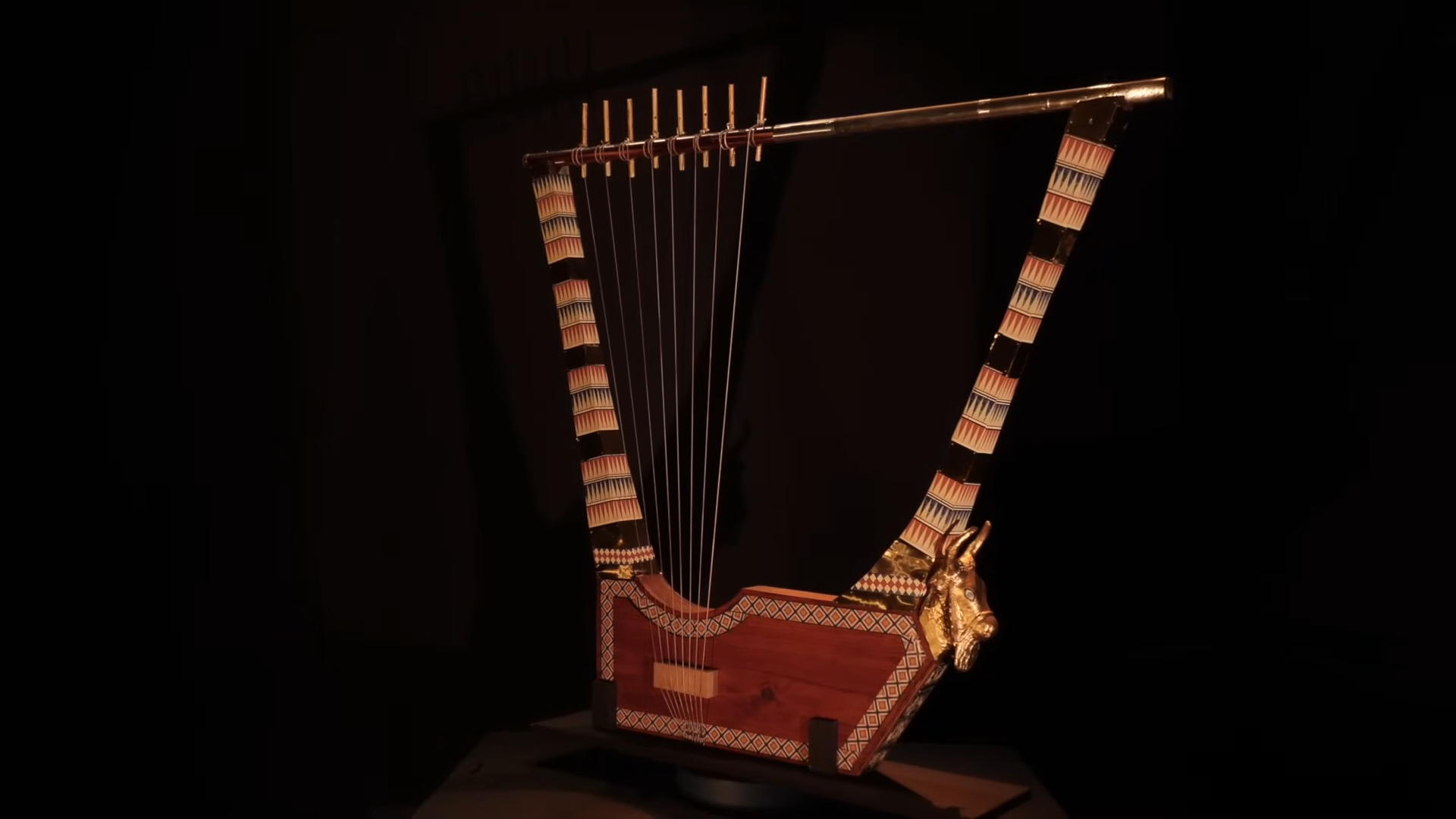
If you’ve ever tried to assemble IKEA furniture without the instructions, you already understand the vibe of rebuilding an ancient instrument from four-and-a-half millennia ago. Except here the missing “Step 7” is: “attach the gold bull head without angering any sun gods.”
The “world’s oldest stringed instrument” headline usually points to the Lyres of Uriconic Mesopotamian lyres discovered in the Royal Cemetery at Ur and dated to roughly the mid–third millennium BCE. Replicating one isn’t just a craft project. It’s experimental archaeology, acoustic detective work, museum-grade conservation respect, and a reminder that humans have always been the kind of species that hears silence and thinks, “We should fix that with strings.”
So What Counts as the “World’s Oldest Stringed Instrument”?
“Oldest” is a tricky word in archaeology: the earliest depictions of stringed instruments can predate the oldest surviving physical examples. What we can point to with the most confidence are the surviving (or survivable) remains: the famous Lyres of Ur, found in fragmentary condition and carefully restored and reconstructed in the modern era.
Among them, the star of the show (and the marketing department’s dream) is the bull-headed lyre tradition: a lyre with a bovine head attached to the sound box, often adorned with precious materials like gold and lapis lazuli. These objects weren’t just instrumentsthey were status, symbolism, and ceremony, with decorative panels that tell stories as loudly as any chord.
The headline instrument: a bull-headed lyre
The best-known examples feature a bold mix of materials: gold sheet, lapis lazuli, shell, and bitumen, sometimes with reconstructed woodwork where time did what time does. Museums document pieces like bull heads and inlay panels, while the original wooden structure often had to be inferred and rebuilt because organic materials don’t love spending 4,500 years underground.
Why Replicating It Is Harder Than “Measure Twice, Cut Once”
Recreating an ancient lyre isn’t like copying a modern guitar where you can buy a blueprint and argue online about tonewood for three straight days. With the Lyres of Ur, the hardest parts are the parts that didn’t survivethe wood, the exact joinery, the bridge and stringing geometry, the soundboard thickness, and the tiny decisions that shape sound.
The “wood is gone” problem
Wood decays. Metal and stone hang around. So what survives is often the glamorous jewelry of the instrument (gold, lapis, shell inlay), while the functional acoustic engine (the wooden body) becomes a ghost. Replication begins by reconstructing that ghost: its dimensions, angles, internal volume, and how it held tension without turning into ancient confetti.
The “music is also gone” problem
Even if you rebuild the object, you still have to answer: How was it played? Fingers? A plectrum? What tuning? What scales? What performance context? Replicas force you to move from “it looks like this” to “it behaves like this,” and that’s where the fun (and the arguments) start.
The Evidence Toolkit: How Builders Turn Artifacts Into a Playable Replica
The best reconstructions don’t rely on a single cluethey triangulate from many kinds of evidence. Think of it as building an instrument with three toolboxes open at once: archaeology, museum conservation, and musicology.
1) Museum documentation and conservation notes
Museum collection records help anchor the replica in reality: materials, provenance, surviving parts, and past restoration choices. In some cases, records explicitly note reconstructed elements (like sound boxes and strings) versus original components (like the bull head and decorative panels). This matters because a replica can either mirror the ancient objector mirror a modern restoration. Those are not always identical twins.
2) Photographs, drawings, and measured comparisons
Builders study high-resolution photos, exhibition shots, and published measurements where available. They also compare the Lyres of Ur to other Mesopotamian depictions of lyres, because artistswhile not always to scaleoften preserve consistent structural ideas: arm height, crossbar placement, and the general geometry needed for tensioned strings.
3) Iconography and “instrument relatives”
The Met notes that bovine-headed lyres appear at multiple Mesopotamian sites, not just Urmeaning the Ur examples likely belong to a broader instrument family. That helps replication because you can infer “typical” features even when a specific piece is incomplete.
4) Texts and musicological reconstruction
Ancient Mesopotamian music theory and tuning systems are studied through cuneiform sources and scholarly interpretation. You don’t get a neat modern chord chart, but you do get clues about scales, intervals, and tuning procedures. Replicas become the testing ground: if a proposed tuning is physically awkward or acoustically implausible, the build pushes scholars back to the evidence with better questions.
Building the Replica: A Practical Walkthrough (With Fewer Sun Gods Than You’d Think)
While each replica differs, many builds follow a similar sequence. Here’s a realistic path a luthier or experimental archaeologist might take when recreating a bull-headed lyre inspired by the Ur finds.
Step 1: Pick your “reference lyre”
“Lyre of Ur” isn’t one single object. There are multiple instruments associated with the Ur discoveries, with different sizes and materials. A builder must decide: are you replicating a specific museum-held example, or creating a “type replica” that reflects the broader Ur tradition?
Step 2: Decide what “authentic” means for your project
Authenticity can mean at least four things:
- Visual authenticity: it looks right in a photo next to the artifact.
- Material authenticity: it uses historically plausible woods, glues, and string materials.
- Acoustic authenticity: it produces a sound consistent with what the instrument likely could produce.
- Process authenticity: it’s built using methods consistent with ancient tool capabilities.
You rarely get all four at maximum strength without compromises. A museum education replica might prioritize durability and safety. A research replica might prioritize acoustic behavior even if the decorative materials are simplified.
Step 3: Reconstruct the sound box geometry
The sound box is the instrument’s lungs. Its volume, shape, and stiffness set the baseline resonance. Some reconstructions use a trapezoidal or rectangular sound box with a soundboard, while others adjust thickness and bracing to prevent warping under string tension. A replica that collapses under tension is a fun sculpture but a terrible instrument.
Step 4: Build arms and crossbar that can take tension
Lyres are structurally simple but mechanically demanding: strings pull hard on the crossbar and arms. Joinery matters. The arms must resist bending, the crossbar must resist rotation, and the whole frame must stay stable enough for tuning without turning your performance into a live woodworking demo.
Step 5: Add the bridge, tail attachment, and string path
The string path determines playability and tone. Even small changes in break angle over the bridge can alter volume and sustain. Builders often test multiple bridge shapes and placements, listening for changes and watching how the soundboard responds over time.
Step 6: Stringsbecause “just use fishing line” is how you get haunted
Historically plausible strings could include animal gut or plant fibers (depending on region and period), though modern replicas sometimes use safer, more stable substitutes to survive travel, humidity shifts, and frequent handling. The Penn Museum’s discussions of replicas and reconstructions show how modern makers balance “plausible” with “playable.”
Step 7: Decorative elements (optional for sound, mandatory for swagger)
The Ur lyres aren’t subtle. Bull heads, inlay panels, and precious materials communicate power and meaning. Many replicas treat decoration as a second phase after the acoustic build is stable. This is sensible: it’s easier to tweak soundboard thickness before you’ve attached intricate inlays that you really don’t want to remove.
Tuning and Playing: Making Ancient Strings Behave in a Modern Room
Once you can tune a replica without fear, the next question is: tune it to what? Replicas are where scholarship becomes audible. They let researchers explore tunings and performance techniques proposed from texts and iconography.
How many strings? What range?
Reconstructions often discuss lyres with a set number of strings (commonly around 11 in modern summaries of the Ur finds), but even when the count is suggested, the exact pitch system is another puzzle. A lyre can be tuned diatonically, pentatonically, or in other interval schemes depending on the interpretive model.
Fingerstyle vs. plectrum
Playing technique shapes tone. Plucking with fingers can produce warmer, rounder attacks; a plectrum can create brighter, sharper articulation. Some replicas are tested with both, especially when the goal is educational demonstration: letting listeners hear how technique changes the “voice” of the same instrument.
Buzz, rattle, and “imperfections” that might be features
Ancient instruments often sound different from modern concert instruments because modern design tends to chase consistent sustain and clean resonance. In older traditions, percussive attack, buzzing textures, or quick decay may be perfectly desirableespecially in ensemble settings with singers, drums, or pipes. Replication helps us stop judging ancient instruments by modern “hi-fi” expectations.
Real-World Replication Efforts: What Modern Builds Have Taught Us
Several documented efforts show how replication sits at the intersection of scholarship and craft.
Playable replicas made for research and demonstration
Penn Museum materials discuss playable replicas (including work associated with academic builders) used to explore performance and construction questions. Some published references point to multiple replicas created for study and demonstration, emphasizing that replication is iterative: you build, you test, you adjust, and you learn.
The “Gold Lyre” replication as cultural bridge-building
Modern projects have also framed replication as cultural preservationespecially after well-publicized damage and looting of Iraqi cultural heritage. In that context, a replica isn’t a replacement; it’s a way to keep sound, story, and public attention alive while original artifacts are protected.
What changes when you build the thing
Books and museum publications on Ur lyres emphasize conservation histories and reconservationreminding us that even museum-held objects have “life stories” shaped by excavation, restoration, storage, and display. A replica must decide which chapter it’s copying: the ancient original, the excavated remains, or the conserved museum form.
What Replicas Reveal (That Photos Never Will)
Replication isn’t just about getting a cool-looking object you can pluck at dinner parties. It creates testable hypotheses.
1) Structural plausibility
If a proposed reconstruction can’t hold tension, it’s probably wrongor at least incomplete. Replicas expose hidden engineering requirements: wood thickness, joinery strength, crossbar diameter, and how the instrument distributes force.
2) Acoustic behavior and performance context
The replica’s sound helps answer: would this instrument project outdoors? Would it blend with voices? Would it support rhythmic patterns? These aren’t abstract questions; they connect directly to how ancient music might have functioned in ceremonies, court life, or communal events.
3) Human ergonomics
Your hands are data. The moment you try to play a replica, you learn what’s comfortable, what’s awkward, and what technique naturally emerges. That feedback loopobject to body to soundis one of the strongest arguments for replication as a research method.
If You Want to Replicate One Today: A Responsible Maker’s Checklist
The internet can make any project feel like a weekend craft. This is not that. Here’s how to approach it thoughtfully.
Start with open museum records and reputable publications
Use museum collection entries, peer-reviewed research, and established educational sources. The goal is to ground your build in documented reality, not in the loudest comment thread.
Be explicit about what you’re replicating
Label your project clearly: “visual replica inspired by Ur lyres,” “acoustic research replica,” or “educational demonstration model.” Honesty about intent prevents confusion and respects the original.
Don’t feed the looting economy
Replication should never encourage the market for unprovenanced antiquities. Respect cultural heritage: study artifacts through museums, legitimate archives, and scholarshipthen build your own, from scratch, with documentation.