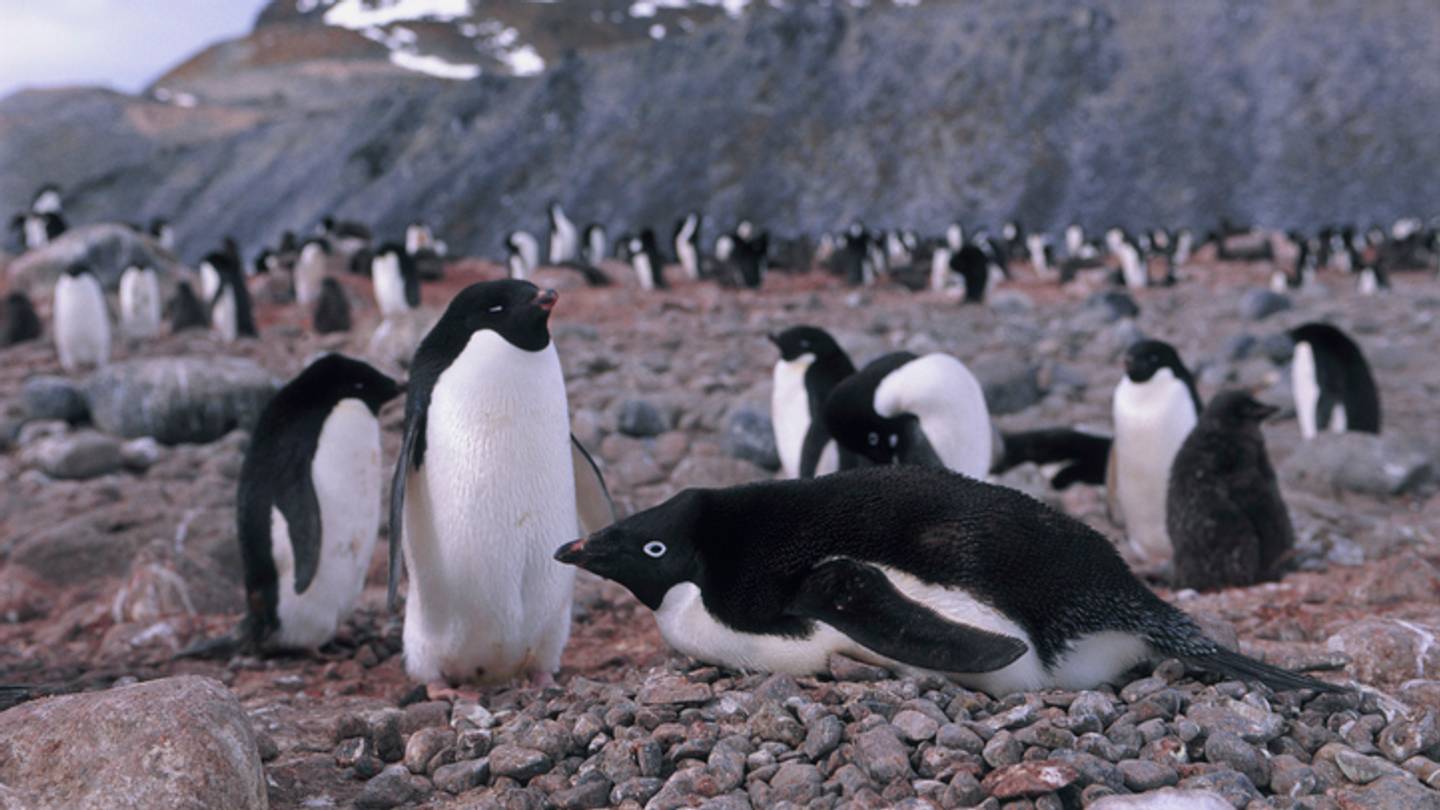
Penguin poop is not the kind of phrase most people expect to find in a serious climate science conversation. It sounds like the setup to a middle-school joke, the sort of headline that makes editors grin and scientists sigh. Yet in Antarctica, those messy pinkish-brown stains left behind by penguins are turning out to be more than biological graffiti. They may help scientists understand cloud formation, regional cooling, wildlife health, and the complicated feedback loops that shape Earth’s climate.
Recent research suggests that penguin guano releases ammonia into the Antarctic atmosphere. That ammonia can combine with sulfur-containing gases from marine life, helping tiny aerosol particles form. Those particles may grow into cloud condensation nuclei, the little airborne “seeds” around which water vapor gathers to become fog and clouds. In plain English: penguin poop can help make clouds. And in a place where sunlight, ice, ocean, and atmosphere constantly negotiate the planet’s thermostat, clouds matter.
Before anyone starts pitching “Adopt a Penguin, Cool the Planet” bumper stickers, let’s be clear: penguins are not a substitute for cutting fossil fuel emissions. They are not waddling carbon-capture machines with tuxedos and tiny briefcases. But their guano reveals something powerful: living ecosystems can influence climate in ways that models must understand better. The latest climate tool may not be a machine at all. It may be a colony of Adélie penguins doing what penguins do best: eating seafood, socializing loudly, and redecorating the ice.
Why Penguin Poop Matters in Climate Science
Antarctica is often imagined as a frozen blank space, a white continent where not much happens except wind, ice, and the occasional dramatic documentary soundtrack. In reality, it is a living, changing system. The Southern Ocean feeds microscopic phytoplankton. Krill graze on those blooms. Penguins eat krill and fish. Penguins then produce guano, a nitrogen-rich waste that does not politely disappear. In dense breeding colonies, it piles up, stains snow and rock, and releases gases into the air.
One of those gases is ammonia. In many parts of the world, ammonia is associated with agriculture, fertilizer, livestock, and industrial emissions. Antarctica has little of that human-made ammonia. That makes it a rare natural laboratory where scientists can observe how wildlife affects the atmosphere without the usual background noise of cities, highways, and farms.
The big discovery is not simply that penguin colonies smell memorable. Anyone standing downwind of 60,000 seabirds could have guessed that without a grant proposal. The exciting part is that ammonia from guano appears to help trigger new particle formation, a key atmospheric process. New particles can grow large enough to affect clouds, and clouds can influence how much sunlight is reflected back into space or how much heat remains near the surface.
The Science: From Guano to Clouds
The climate connection begins with chemistry. Penguin guano contains nitrogen. As it breaks down, it releases ammonia gas. Meanwhile, the surrounding ocean produces sulfur compounds, partly linked to marine phytoplankton. When ammonia meets sulfuric acid and related compounds in cold Antarctic air, the combination can encourage the birth of tiny aerosol particles.
These particles are extremely small at first, far too tiny to impress anyone outside an atmospheric chemistry lab. But size is not everything. If conditions are right, they grow. Once they reach a useful size, they can become cloud condensation nuclei. Water vapor condenses onto them, forming droplets. Enough droplets together create fog or clouds.
A Penguin Colony as an Atmospheric Engine
Measurements near Marambio Base on the Antarctic Peninsula showed striking ammonia spikes when winds blew from the direction of a large Adélie penguin colony several miles away. Researchers found that ammonia levels could rise dramatically above background values, even after penguins had left the area for the season. The leftover guano continued to emit ammonia, like a smelly climate-relevant afterparty.
That matters because clouds over Antarctica can alter the surface energy balance. Bright clouds can reflect incoming sunlight, which may cool the surface. In other situations, clouds can trap heat, especially over already-bright ice where sunlight is naturally reflected. The Antarctic cloud story is not simple, which is exactly why scientists care. The guano-cloud link gives researchers a better way to understand natural aerosol sources in a region where small atmospheric changes can have large consequences.
Penguins Are Not “Solving” Climate ChangeBut They Are Teaching Us
The phrase penguin poop fights climate change is catchy, and yes, it deserves a place in the headline hall of fame. But the real story is more nuanced. Penguin guano may help create clouds that influence local cooling in parts of Antarctica. That does not mean penguins can offset global greenhouse gas emissions. A penguin colony cannot neutralize a coal plant, an oil field, or millions of gas-powered cars. Penguins are good at swimming, not international climate policy.
Still, the finding is important because climate models need accurate natural baselines. To predict future warming, scientists must understand how the atmosphere behaved before heavy human influence and how natural systems are changing now. If seabirds and penguins contribute meaningfully to aerosol formation, then their population shifts could alter regional cloud patterns. Fewer penguins may mean less guano, less ammonia, fewer particles, and potentially different clouds. More penguins in a region could have the opposite effect.
This is a classic climate feedback loop. Wildlife affects the atmosphere. The atmosphere affects ice and ocean. Ice and ocean affect wildlife. The loop keeps looping, while scientists try to measure it without freezing their eyebrows off.
Why Antarctica Is So Sensitive
Antarctica plays an oversized role in the global climate system. Its ice sheets store enormous amounts of frozen freshwater. Its surrounding sea ice helps regulate ocean temperature, sunlight reflection, and marine ecosystems. Its cold waters help drive global circulation patterns. When Antarctica changes, the effects do not stay politely below the 60th parallel.
Antarctic sea ice has shown worrying behavior in recent years, including record-low or near-record-low extents. Unlike the Arctic, where long-term sea-ice decline has been obvious for decades, Antarctic sea ice was once more variable and harder to categorize. Recently, however, scientists have become increasingly concerned that the system may be shifting. Less sea ice affects penguins directly, especially emperor penguins that rely on stable fast ice for breeding, chick rearing, and molting.
Penguins as Climate Sentinels
Penguins are often described as sentinel species. That means their health reflects broader environmental conditions. If penguin colonies are thriving, it may suggest that food webs, sea ice, and local habitats are functioning well. If colonies fail, relocate, or decline, something larger may be wrong.
For emperor penguins, early sea-ice breakup can be catastrophic. Chicks need stable ice until they develop waterproof feathers. If the ice collapses too soon, chicks may drown or freeze. For Adélie penguins, changes in sea ice, food availability, snowfall, and nesting conditions can also reshape colony success. The irony is sharp: penguins may help maintain climate-relevant cloud processes, while climate change threatens the penguins themselves.
How Scientists Track Penguin Poop from Space
One of the strangest and most useful tools in penguin science is satellite imagery. Penguins gather in large colonies and leave visible guano stains on snow, ice, and rock. These stains can be detected from space. That means satellites can help locate colonies, estimate population changes, and monitor remote areas that would be difficult, expensive, or dangerous to survey on foot.
NASA-related research and other satellite-based studies have shown that guano marks can reveal the presence of penguin colonies. In some cases, scientists discovered previously unknown colonies because the birds had, with admirable consistency, left behind a signature visible from orbit. It is wildlife tracking by bathroom evidence, and it works surprisingly well.
Remote sensing is especially valuable in Antarctica because fieldwork is hard. Weather can turn ugly fast. Sea ice can block access. Colonies can be spread across huge distances. A satellite does not complain about frostbite, seasickness, or the smell. It simply looks down and records the stains.
The Role of Krill, Fish, and the Southern Ocean
Penguin guano starts with penguin food. Adélie penguins and other species feed heavily on krill and fish. Krill, in turn, depend on sea ice and phytoplankton. When the ocean warms or sea ice patterns shift, krill availability can change. That affects penguin diets, breeding success, and colony size.
This food-web connection matters for the guano-climate story. A healthy penguin colony produces plenty of guano. A struggling colony produces less. If climate change reduces krill availability or destabilizes breeding habitat, penguin populations may decline. That would not only be a biodiversity loss; it could also reduce a natural source of ammonia that helps shape Antarctic aerosol chemistry.
Again, this does not mean penguin poop is a magical thermostat. But it does mean wildlife, food webs, and atmospheric chemistry are linked. Climate change is not just about carbon dioxide molecules floating around in isolation. It is about entire systems responding to pressure.
Could Penguin Poop Cool Antarctica?
The short answer is: possibly, in specific regional ways. The longer answer is: atmospheric science enjoys ruining simple headlines, but in a useful way.
Clouds can cool Earth by reflecting sunlight. This is why a cloudy day often feels cooler than a bright one. In Antarctica, however, the surface is already highly reflective because of snow and ice. A cloud over a dark ocean surface may produce a different effect than a cloud over a gleaming ice sheet. Clouds can also trap outgoing heat, especially during darker seasons. So the net effect depends on cloud type, altitude, season, surface conditions, and local weather.
What makes penguin guano important is not that it guarantees cooling everywhere. It is that it contributes to cloud-forming particles in a place where natural aerosol sources are limited and climate sensitivity is high. This helps scientists refine climate models, especially for polar regions where clouds remain a major uncertainty.
What This Means for Climate Models
Climate models are only as good as the processes they include. If a model underestimates natural aerosol formation in coastal Antarctica, it may misrepresent cloud behavior. If it ignores biological ammonia from penguins and seabirds, it may miss an important source of cloud condensation nuclei.
Adding penguin-driven ammonia emissions to climate thinking could improve regional predictions. It may help answer questions such as: How cloudy should certain Antarctic coastlines be? How do bird colonies affect local atmospheric chemistry? What happens if penguin populations decline or move? How might changing sea ice alter the relationship between wildlife and clouds?
These questions matter because climate change is not evenly distributed. Some regions warm faster than others. Some feedbacks amplify warming. Others may buffer it temporarily. Understanding these details improves the accuracy of projections and helps policymakers make better conservation decisions.
Conservation: Protecting the Birds That Help Explain the Climate
The penguin guano discovery adds another reason to protect Antarctic ecosystems. Penguins already matter because they are remarkable animals, central predators, and cultural icons. They also support scientific understanding. Their colony locations, breeding success, diets, and guano emissions all provide information about the state of the Southern Ocean and the atmosphere above it.
Conservation actions can include stronger protection for breeding areas, careful management of krill fisheries, limits on disturbance from tourism and research, and rapid reductions in greenhouse gas emissions. The last point is the big one. No amount of admiration for penguins will save them if warming continues to erase the ice they need.
Protecting penguins is not sentimental fluff. It is practical climate science, ecosystem management, and biodiversity protection wearing a tuxedo.
What Everyday Readers Can Take Away
The penguin poop story is funny, but it is also a reminder that nature is full of hidden connections. A seabird colony can influence the air. A microscopic particle can help form a cloud. A cloud can affect ice. Ice can determine whether chicks survive. The entire chain sounds improbable until scientists measure it.
For readers, the lesson is not to wait for penguins to rescue the planet. The lesson is to respect how finely tuned Earth’s systems are. Climate change disrupts more than temperatures. It changes relationships: between birds and ice, ocean and atmosphere, plankton and clouds, chemistry and life.
Experiences and Reflections: What Penguin Poop Teaches Us About Seeing Climate Change Differently
Imagine standing near an Antarctic research station on a cold, sharp morning. The air feels clean enough to bottle and sell at an extremely unreasonable price. In the distance, a penguin colony chatters like a crowded lunchroom. The birds waddle, dive, argue, parent, molt, and occasionally look as if they have just remembered an important appointment. Around them, the snow is marked with guano stains that look messy, ordinary, and easy to dismiss.
That is the experience this topic creates for many people: surprise. Climate change is often discussed through giant numbersgigatons of carbon dioxide, degrees of warming, square miles of ice loss, sea-level projections. Those numbers are necessary, but they can feel distant. Penguin poop brings the issue down to Earth, or more accurately, down to ice. It shows that climate science is not only about smokestacks and satellites. It is also about animals, ecosystems, and small chemical reactions happening in remote places.
For educators, this story is gold. Students who might tune out during a standard lesson on aerosols suddenly pay attention when penguins enter the chat. The humor opens the door; the science keeps it open. A teacher can begin with the silly question“Can penguin poop make clouds?”and end with serious concepts such as nitrogen cycling, atmospheric chemistry, albedo, sea ice decline, and ecological feedbacks. That is good science communication: start with curiosity, then build toward understanding.
For travelers and nature lovers, the story offers a humbling reminder. Antarctica may look empty from a distance, but it is alive with processes that humans are still learning to decode. Every colony is part of a wider network. The penguins are not just adorable postcard celebrities. They are predators, nutrient movers, atmospheric influencers, and climate witnesses. Their droppings may be funny, but their role is not trivial.
For policymakers, the experience should be sobering. If something as overlooked as guano can influence cloud formation, then damaging ecosystems may have consequences we do not fully anticipate. Conservation is not just about saving attractive species; it is about preserving relationships that support planetary stability. Protecting penguins means protecting breeding grounds, food webs, and the environmental conditions that allow these natural processes to continue.
For everyday people, the story is a useful antidote to climate despair. It does not say nature will fix everything for us. It says nature is active, creative, and interconnected. The planet has systems that buffer, respond, and adaptbut those systems have limits. Human action still matters most. Cutting emissions, supporting science, reducing waste, protecting oceans, and voting for climate-aware policies remain far more powerful than cheering for penguins from the couch. Although, to be fair, cheering for penguins is still emotionally healthy.
The biggest experience this topic offers is a shift in perspective. Climate change is not a single villain in a single story. It is a pressure that moves through air, ice, water, animals, and chemistry. Penguin poop makes that visible in the weirdest possible way. It reminds us that the world is stranger, funnier, and more connected than we think. And sometimes, the latest tool for understanding climate change arrives not with a shiny logo or a billionaire launch event, but with a waddling bird and a stain on the snow.
Conclusion
Penguin poop may sound like comic relief, but the science behind it is serious. Ammonia from penguin guano can help form aerosol particles, which may grow into cloud-forming nuclei over coastal Antarctica. Those clouds may influence local climate conditions, making penguins part of a natural feedback system that connects wildlife, ocean biology, atmospheric chemistry, and sea ice.
The discovery does not mean penguins can save us from climate change. They cannot out-poop fossil fuel emissions, and frankly, we should not ask them to try. But they can help scientists understand how Antarctic ecosystems shape the atmosphereand how climate change might disrupt those relationships. In a warming world, even the messiest clues matter.
Note: This article is original, web-ready, written in standard American English, and prepared without source-link placeholders or citation artifacts inside the publishable body content.