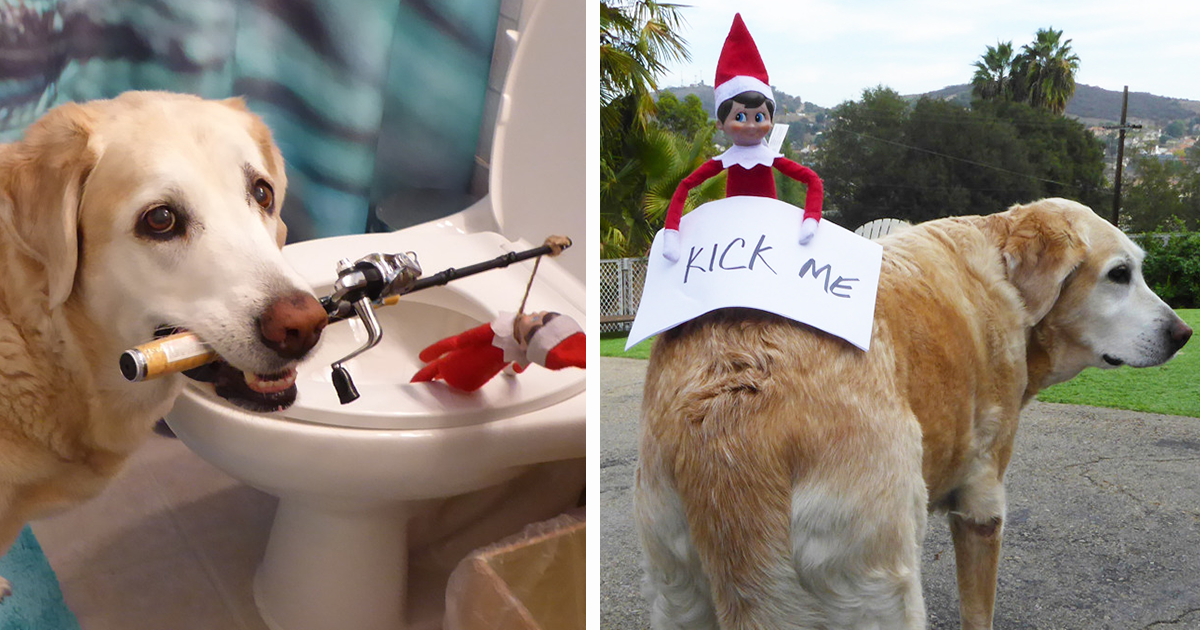
Every December, a tiny red-suited visitor arrives in our house with a permanent smile, suspiciously perfect posture, and abeillance contractor.
My dogs call him the enemy.
At first, I assumed they would ignore him. After all, our dogs regularly sleep through delivery trucks, vacuum cleaners, and family arguments about the correct way to load a dishwasher. Surely a twelve-inch fabric elf would not disturb their peace.
I was wrong. The moment the Elf on the Shelf appeared above the fireplace, both dogs stared at him as though he had entered the house without passing a background check. By the end of the week, what began as canine curiosity had developed into a full-scale holiday revenge campaign.
This is the story of how my dogs declared war on Elf on the Shelfand how we kept their Christmas rebellion funny, creative, and safe.
The Elf Arrived, and the Dogs Immediately Had Questions
The official Elf on the Shelf tradition involves a Scout Elf visiting a family during the Christmas season. The elf moves to a new location each day, supposedly after traveling to the North Pole to report the household’s activities to Santa.
Children generally accept this explanation without requesting flight records. Dogs are less trusting.
On the elf’s first morning, I placed him on a bookshelf. My older dog, Max, noticed him during breakfast. He stopped chewing, slowly raised his head, and stared at the shelf. Then he looked at me. Then he looked back at the elf.
His expression clearly said, “You see this too, right?”
Our younger dog, Daisy, approached the situation differently. She stood beneath the shelf, sniffed the air, tilted her head, and released one quiet bark. It was not her excited squirrel bark or her dramatic “someone closed the bathroom door” bark. It was a controlled warning intended for suspicious holiday personnel.
The elf had been in our home for less than ten minutes, and he was already under investigation.
Why Dogs May Become Obsessed With Elf on the Shelf
Although it is entertaining to imagine dogs plotting revenge, their reaction usually has a practical explanation. Dogs investigate their surroundings through scent, movement, sound, and visual changes. A new object that appears in a different location every morning is naturally interesting.
The Elf Smells Unfamiliar
Dogs experience the household largely through their noses. A new doll may carry scents from its packaging, a storage box, a store, or the hands of the person who positioned it. To us, the elf looks like a harmless decoration. To a dog, it may smell like cardboard, attic dust, human hands, and mystery.
The Elf Keeps Invading New Territory
One morning the elf is on a shelf. The next morning he is sitting beside the cereal. Later, he appears near the dog treats wearing a paper crown.
From the dogs’ perspective, this newcomer is not simply visiting. He is expanding operations.
Dogs often notice changes in familiar environments. Moving furniture, adding decorations, hosting guests, and changing daily routines can make the holiday season feel unpredictable. A grinning doll that teleports overnight does not exactly restore order.
The Humans Keep Giving Him Attention
Every morning, the family searches for the elf. People laugh, take pictures, and discuss his latest activity. Meanwhile, the dogswho have devoted their lives to monitoring the householdreceive far less recognition for finding him first.
Jealousy may be too human a label, but dogs certainly notice where attention goes. If everyone gathers around the elf while the dogs are ignored, the dogs may try to join the activity. Unfortunately, a dog’s idea of participation often includes sniffing, grabbing, licking, or carrying the guest away by his pointy red hat.
The Canine Revenge Campaign Begins
The first incident occurred on a Tuesday morning.
I had positioned the elf on the arm of the couch with a tiny handwritten sign that said, “Be good!” When I entered the living room, the sign was on the floor, the elf was facedown under a cushion, and Max was sitting nearby with the peaceful expression of a dog who had recently completed important work.
There were no witnesses. Daisy refused to cooperate with investigators.
Phase One: Intimidation
The dogs began sitting beneath the elf and staring upward for long periods. They did not bark or jump. They simply watched him.
The elf was supposed to observe the household, but now the household was observing him. The balance of power had shifted.
One evening, Max placed his favorite rubber chicken directly below the shelf. I cannot prove it was a threat, but the message seemed clear: “This squeaks now. You could be next.”
Phase Two: Strategic Relocation
A few days later, the elf disappeared from the bottom branch of the Christmas tree. After searching the room, we found him in the dog bed beneath a blanket.
Daisy was lying on the opposite side of the room, pretending to be deeply interested in her own foot.
The elf was unharmed, but the dogs had demonstrated that our security system had weaknesses. From then on, we kept him well above nose level and never left him where the dogs could reach him unsupervised.
Phase Three: Snack-Based Sabotage
The conflict escalated when I created a scene featuring the elf beside a bowl of dog treats. This was a tactical error.
To the children, the setup looked like the elf was handing out presents to the pets. To the dogs, it looked like a small intruder had gained unauthorized access to strategic snack reserves.
Max sat beneath the counter for nearly an hour. Daisy attempted several negotiation tactics, including whining, spinning, and presenting me with a tennis ball.
That was the last time the elf appeared near edible props.
When a Funny Christmas Story Becomes a Safety Issue
A dog stealing the elf may produce a hilarious photo, but the situation stops being funny if the doll is chewed or swallowed. Fabric, plastic pieces, stuffing, tags, wire, and accessories are not dog toys. Swallowed foreign objects can cause choking or intestinal blockage, potentially requiring emergency veterinary care.
Holiday scenes may also contain decorations that are more dangerous than the elf himself. Ribbons, string, tinsel, batteries, electrical cords, glass ornaments, candles, artificial snow, and small plastic props should never be placed where a curious dog can reach them.
Food-based scenes require extra caution. Chocolate, raisins, grapes, alcohol, onions, garlic, macadamia nuts, cooked bones, and products containing xylitol can be dangerous to dogs. Even foods that are not toxic may cause digestive trouble when they are fatty, heavily seasoned, or consumed in large amounts.
The safest rule is simple: if a display contains anything your dog might chew, swallow, pull, or knock over, place it behind a barrier or completely out of reach.
How We Made Elf on the Shelf Dog-Friendly
Canceling the tradition was unnecessary. We simply adjusted it so the children could enjoy the elf without turning December into a series of veterinary emergencies.
We Moved the Elf Higher
Our elf now spends most mornings on high shelves, curtain rods, cabinets, and other locations the dogs cannot access. We avoid unstable surfaces where he or his accessories could fall.
Height alone is not always enough. Athletic dogs can jump onto furniture, while determined dogs may climb or knock things down. We consider the entire route to the display, not just its final location.
We Stopped Using Dangerous Accessories
Many popular Elf on the Shelf ideas involve string, candy, miniature ornaments, balloons, flour, marshmallows, or gift-wrapping supplies. These can create unnecessary risks in a home with pets.
We replaced loose accessories with large paper signs, washable containers, digital backgrounds, and other items that remain inaccessible to the dogs. We also avoid lit candles, exposed wires, breakable decorations, and anything with button batteries.
We Practiced “Leave It” and “Drop It”
A reliable “leave it” cue helps stop a dog before it grabs something inappropriate. A calm “drop it” cue can help when the object is already in the dog’s mouth.
We practiced with ordinary toys rather than waiting for an emergency. The dogs learned that releasing an object earned praise and a better reward. Chasing them around the house would have turned stealing into a thrilling game, so we focused on calm exchanges.
When a dog grabs something potentially dangerous, it is important not to force your hands into the dog’s mouth or create a confrontation. A veterinarian or qualified trainer can help with dogs that guard objects, growl, or refuse to release them.
We Gave the Dogs Their Own Holiday Activity
The dogs were much less interested in disrupting the elf after receiving their own puzzle toys, sniffing games, walks, and dog-safe treats. Appropriate enrichment gave them something better to do than conduct surveillance beneath the bookshelf.
Maintaining normal meal, exercise, and rest schedules also helped. Holiday celebrations can be exciting for people but overwhelming for animals. A quiet room or comfortable bed gives a dog somewhere to retreat when decorations, visitors, music, and family activity become too much.
Funny Dog-Friendly Elf on the Shelf Ideas
Once we accepted that the dogs were part of the story, the tradition became more entertaining. Instead of placing the elf where the dogs could physically interact with him, we created safe scenes suggesting that the rivalry continued after everyone went to sleep.
The Canine Courtroom
We placed the elf high on a cabinet behind a paper sign reading, “Charged with stealing dog treats.” Below him, we arranged framed photos of Max and Daisy as the judge and prosecutor.
The evidence consisted of an empty treat bag that had been thoroughly cleaned and placed beyond the dogs’ reach. The elf was found guilty on all counts.
The Holiday Mugshot
We printed a picture of the elf holding a tiny identification board. The listed charges included unlawful relocation, suspicious smiling, and impersonating a North Pole official.
The dogs posed beside the printed photograph. Max looked serious. Daisy attempted to eat the corner of the paper, so the photo session was brief.
The Peace Treaty
One morning, the elf appeared on a high shelf with a large paper treaty promising not to touch the dog treats. In exchange, the dogs agreed not to remove his hat.
We placed two paw-print stamps on the document using washable, pet-safe ink and immediately cleaned the dogs’ paws afterward. The agreement lasted approximately three days.
The Elf’s Security Detail
We photographed the dogs sitting several feet from the elf and added a caption claiming they had been hired as his bodyguards.
This was especially funny because their expressions suggested they were waiting for management to leave so they could renegotiate the contract.
The Dog Detective Scene
We placed cardboard clues around the room while keeping the elf safely above reach. The children followed paw-print cutouts to discover him. The dogs joined the search and received treats for sitting calmly near each clue.
This transformed the tradition into a supervised family game rather than an opportunity for the pets to steal decorations.
What the Great Elf Feud Taught Me About My Dogs
The experience reminded me that dogs do not understand holiday traditions simply because humans find them charming. They see a familiar home suddenly filled with new smells, objects, foods, visitors, and rules.
Max was not truly plotting revenge. He was monitoring an unusual change in his environment. Daisy was not attempting to destroy Christmas. She was exploring a new object that smelled interesting and attracted everyone’s attention.
Interpreting their behavior with humor made the season more enjoyable, but understanding the practical reasons behind it helped us manage the situation responsibly.
It also taught me not to stage a photograph before thinking through what could happen next. A scene may look harmless for five seconds but become risky when the photographer turns away. Safe setups should remain safe even if a dog behaves like a dogwhich, despite our careful household negotiations, dogs continue to do.
Signs That Your Dog May Have Swallowed Something
If an elf, accessory, or holiday decoration is damaged, check whether any pieces are missing. Contact a veterinarian promptly if you suspect your dog swallowed part of an object. Do not wait for severe symptoms or attempt to induce vomiting unless a veterinary professional specifically instructs you to do so.
Possible warning signs include repeated vomiting, loss of appetite, unusual tiredness, abdominal discomfort, drooling, diarrhea, difficulty passing stool, gagging, restlessness, or changes in behavior. Choking, breathing difficulty, collapse, severe weakness, or repeated unproductive retching should be treated as emergencies.
Keep your veterinarian’s number and the nearest emergency veterinary hospital’s information available during the holidays. Fast professional guidance is far more useful than searching the living room while repeatedly asking a dog, “What did you eat?”
Conclusion: The Dogs May Have Won Christmas
My dogs are getting revenge on Elf on the Shelf, but the conflict is now conducted under strict safety regulations. The elf stays high, the dangerous props remain packed away, and the dog treats are protected by security measures more advanced than those used for our important documents.
The children still wake up excited to discover the elf’s newest location. The dogs still inspect him every morning. Max remains suspicious, while Daisy appears willing to negotiate if snacks are involved.
That is what makes the tradition memorable. It is not the perfectly staged photographs or elaborate miniature scenes. It is the family story that develops around themincluding the moment your dogs decide that Santa’s smallest employee has become their greatest seasonal rival.
The elf may report to Santa, but in this house, he answers to the dogs.
My Experience: Twelve Days of Dogs Versus Elf on the Shelf
Our most memorable Elf on the Shelf season began when I made the mistake of placing the elf on the floor beside a miniature cardboard sled. I wanted to photograph the display before the children woke up, so I stepped away for what I believed was ten seconds.
Ten seconds is a surprisingly long time when a Labrador mix has discovered an unsupervised object.
When I returned, the sled was upside down, the elf was missing, and Max was walking toward the hallway with four red felt legs hanging from his mouth. He was not chewing. He was carrying the elf carefully, like a security officer escorting an unregistered visitor from the premises.
I traded him a dog treat for the elf and inspected the doll for damage. Fortunately, nothing was missing or torn. That lucky outcome convinced me to stop creating displays within reach, even temporarily.
The next morning, I placed the elf safely on top of the refrigerator. Daisy discovered him within minutes. She sat beneath the refrigerator and barked once every thirty seconds. Her consistency was impressive. She seemed to believe that if she filed enough formal complaints, management would respond.
On the third day, the elf held a sign saying, “Dogs are on the nice list.” Max looked at the sign, sneezed, and walked away. Daisy remained nearby because I had made the sign beside the treat cabinet. She understands real estate.
By day five, we began incorporating the dogs into the story without giving them access to the doll. The elf appeared with printed “case files” about mysterious missing biscuits. The dogs posed beside the evidence while I held treats behind the camera. The resulting photograph made them look like experienced detectives, although Daisy’s investigation consisted mainly of trying to identify where I was hiding the snacks.
Our funniest scene happened on day eight. I created a peace conference on the kitchen counter. The elf sat behind a paper nameplate while photographs of the dogs represented the opposing delegation. The official agenda covered treat access, couch territory, and the elf’s unauthorized use of the dogs’ water bowl in an earlier display.
That evening, Max carried his blanket into the kitchen and dropped it below the counter. I decided this was either a generous peace offering or an attempt to encourage the elf to sleep somewhere else.
On day ten, the dogs received holiday puzzle toys while the children searched for the elf. For the first time that month, Max and Daisy showed almost no interest in his location. This taught me a valuable lesson: a mysterious Christmas visitor is much less fascinating when a toy is dispensing chicken-flavored treats nearby.
By Christmas Eve, the rivalry had become a family tradition of its own. The children wrote a farewell letter from the dogs. It informed the elf that he had been granted permission to return next year, provided he respected snack boundaries and submitted all shelf locations for advance approval.
The elf departed for the North Pole. Max watched me remove him but said nothing. Daisy sniffed the empty shelf the next morning and looked slightly disappointed.
I realized the dogs had never hated the elf. They had simply wanted a role in the excitement. Once we gave them safe activities, attention, and their own place in the story, the household feud became something everyone could enjoy.
Editorial note: This humorous personal-style story is fictionalized, while its pet-safety recommendations are informed by established guidance from U.S. veterinary and animal-welfare organizations. Contact a veterinarian promptly whenever a dog may have swallowed a decoration, toy component, toxic food, or other foreign object.