Christmas is supposed to be the season of warm lights, cozy sweaters, cinnamon-scented kitchens, and pretending that untangling last year’s string lights is “part of the fun.” But for one daughter-in-law, the holiday spirit took a sharp turn when her sentimental Christmas decorations allegedly vanished from her own collectiononly to make a dramatic guest appearance on her mother-in-law’s tree.
The story, which circulated online through a family-advice discussion, touched a nerve because it was not simply about ornaments. It was about ownership, memory, trust, boundaries, and that very specific in-law tension that can turn a peaceful Christmas visit into a courtroom drama with tinsel. The decorations in question were not expensive designer pieces or rare antique collectibles guarded by elves in white gloves. They were childhood ornaments with emotional value: the kind of small items that carry years of family memories, photos, traditions, and nostalgia.
That is why the situation felt bigger than “just decorations.” When someone takes or keeps something sentimental without permission, the price tag becomes almost irrelevant. A $5 ornament can feel priceless if it reminds someone of childhood Christmas mornings, a parent’s home, or a tradition that survived moves, adulthood, and the mysterious black hole inside every storage closet.
The Viral Christmas Decoration Drama: What Allegedly Happened?
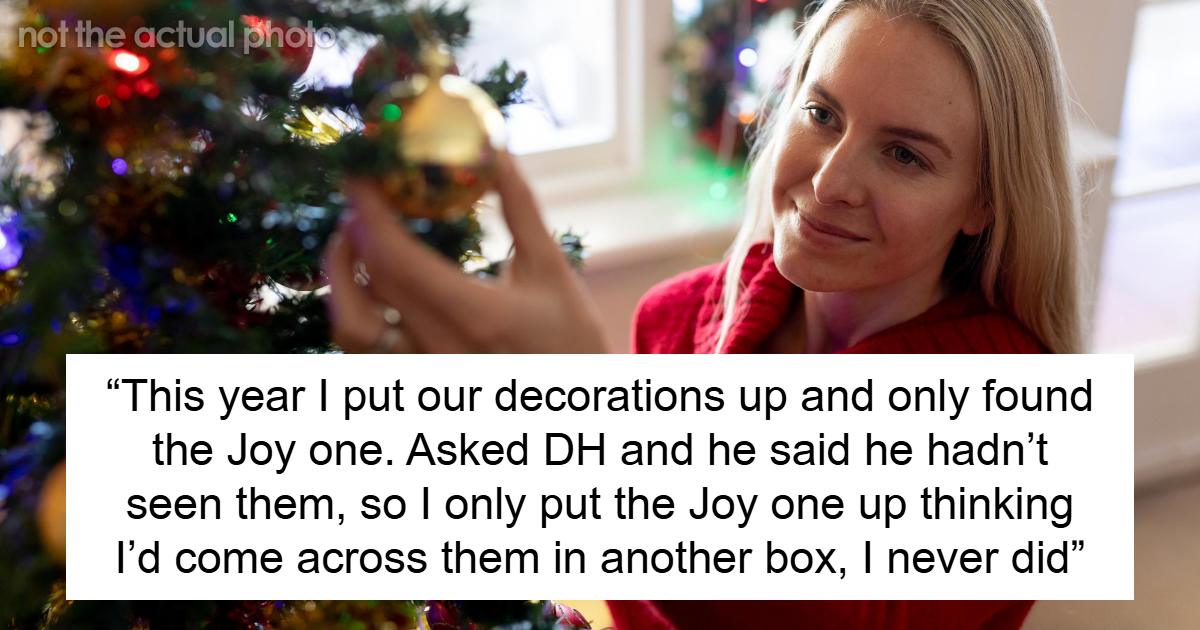
According to the story, the daughter-in-law had three beloved Christmas decorations from her childhood. They were simple festive pieces with cheerful holiday words and designsthe sort of ornaments that may not impress a professional decorator but can make a family tree feel personal and alive. While preparing her own home for Christmas, she discovered that two of the three decorations were missing.
She searched her house, checked her boxes, and likely performed the traditional holiday ritual of opening the same storage bin four times, hoping the missing items would magically reappear between the garland and the broken candy cane ornament from 2011. No luck.
Then came the twist worthy of a holiday soap opera. During a visit to her mother-in-law’s home, she allegedly noticed the missing decorations hanging on MIL’s Christmas tree. Her husband reportedly did not remember giving them to his mother, and the daughter-in-law was left wondering whether she was looking at her own keepsakes or an uncanny decorative coincidence.
Now, before anyone grabs a ladder, a tote bag, and a detective hat, there is one important word in the title: allegedly. Family stories often come wrapped in emotion, confusion, and missing context. Maybe the ornaments were borrowed and never returned. Maybe the husband accidentally passed them along. Maybe MIL had similar decorations. Maybe someone thought, “These are just Christmas things,” not realizing they were emotional heirlooms. Or maybe, yes, someone helped themselves to a little unauthorized holiday sparkle.
Why Sentimental Christmas Decorations Matter So Much
To outsiders, ornaments may look like clutter with hooks. To the owner, they can be tiny memory capsules. A handmade ornament from second grade, a ceramic Santa from a late grandparent, a “Baby’s First Christmas” keepsake, or a silly wooden reindeer with one missing antler can hold more emotional weight than an entire cart of brand-new decorations.
This is why the daughter-in-law’s shock makes sense. When sentimental Christmas decorations disappear, the loss can feel personal. It is not like misplacing a roll of wrapping paper. It feels like a piece of one’s history has been lifted, relocated, and displayed without permissionalmost like seeing your childhood diary used as a coffee table book.
Holiday decor also has a unique emotional role in American homes. Families often reuse the same pieces year after year, building tradition through repetition. The act of unpacking Christmas ornaments can become a yearly reunion with the past. Every object says, “Remember this?” That is beautifuluntil the answer becomes, “Yes, and why is it on your tree, Linda?”
The Real Issue: It Is Not About the Tree
At the center of this story is not a battle over red-and-green accessories. The real issue is respect. In healthy family relationships, people understand that “family” does not mean “free access to everyone’s belongings.” A daughter-in-law’s home, memories, decorations, and traditions are still hers. Marriage does not turn personal items into a community lending library.
This is especially important in in-law relationships, where boundaries can already be delicate. A mother-in-law may feel emotionally attached to her adult child’s household. A daughter-in-law may feel judged, watched, or compared. A son or husband may try to avoid conflict and accidentally become a human throw pillow: soft, present, and not especially helpful under pressure.
When an item appears to have been taken or transferred without permission, the relationship damage can be larger than the object itself. The person affected may wonder: Was this intentional? Did my spouse know? Has this happened before? Will I be believed? And why does Christmas suddenly feel like a mystery episode with pine needles?
Should She Confront Her Mother-in-Law?
A direct confrontation may feel satisfying in the imagination. Many people picture themselves walking up to the tree, pointing dramatically, and saying, “Aha!” while the room gasps and someone drops a gingerbread cookie. In real life, though, holiday conflicts are best handled with calm precision.
The daughter-in-law should first confirm as much as possible. Are the decorations truly identical? Do they have unique marks, scratches, handwriting, repairs, or personal details? Are there old photos showing them on her childhood tree? Did she ever lend them? Did her husband move or pack the decorations during a previous holiday?
Once she feels reasonably confident, she can ask in a non-accusatory way. For example: “I noticed those Noel and Ho Ho Ho decorations on your tree. I have the matching Joy one at home, and I’ve been missing the other two from my childhood set. Do you remember where you got yours?”
That sentence works because it does three things. It states the observation. It explains the emotional connection. And it gives the mother-in-law room to answer without immediately turning the living room into a holiday battlefield.
What If MIL Denies It?
If MIL denies taking the ornaments, the daughter-in-law has a choice. She can escalate, or she can protect the relationship while still protecting her belongings moving forward. The best next step depends on the evidence, the family history, and whether this is a one-time weirdness or part of a larger pattern.
If the ornaments are clearly hers and she can prove it, she might say, “I understand you may not have realized they were mine, but those are very sentimental to me. I’d like to take them home after Christmas.” Calm, firm, and boring is often the best tone. Drama feeds drama. Boring boundaries are surprisingly powerful.
If she is not fully sure, she can avoid making a theft accusation and instead say, “They look exactly like the ones I lost, so I wanted to ask.” This keeps the conversation honest without burning down the family gingerbread house.
What she should not do is secretly take them back from the tree, even if the internet’s chaotic little shoulder angel says, “Do it.” Taking items without discussion may create a second conflict and make it easier for others to paint her as the unreasonable one. The goal is to recover the ornaments and preserve dignitynot to start the Great Ornament War of Christmas.
Where the Husband Fits Into the Christmas Ornament Conflict
The husband has an important role here. If the decorations belonged to his wife, and they appeared on his mother’s tree, he should not shrug and vanish into the eggnog. He does not need to attack his mother, but he should support his wife in getting clarity.
A strong approach might be: “Mom, we noticed those two decorations match the set from my wife’s childhood. She’s been looking for them. Do you remember how they ended up here?”
That wording matters because it presents the issue as a shared concern, not a daughter-in-law versus mother-in-law cage match. In-law conflicts often become worse when the spouse acts like a neutral bystander. In marriage, neutrality can feel like abandonment. Support does not mean blindly accusing someone; it means helping handle the issue respectfully.
Why In-Law Boundaries Get Messy During the Holidays
The holiday season has a magical talent for magnifying family patterns. If someone tends to overstep, Christmas gives them glitter-covered opportunities. If someone avoids conflict, Christmas hands them a mug of cocoa and says, “Good luck with that.”
Families often carry unspoken expectations about traditions, decorations, hosting, meals, gifts, visits, and who gets to decide what “real Christmas” looks like. A mother-in-law may feel that certain decorations, recipes, or rituals belong to the larger family. A daughter-in-law may be trying to build her own household traditions. Neither desire is automatically wrong, but problems begin when one person’s nostalgia bulldozes another person’s ownership.
Healthy boundaries are not rude. They are the instructions that help relationships function without resentment. “Please ask before taking things from our house” is not an insult. It is basic respect wearing a Santa hat.
How to Handle Missing Sentimental Items in a Family Setting
1. Start With Facts, Not Fury
Before confronting anyone, gather details. Check storage bins, old photos, messages, and any memory of lending or gifting the item. Emotional certainty is powerful, but factual certainty is more useful.
2. Use “I” Statements
Instead of saying, “You stole my ornaments,” try, “I’m upset because those decorations look like the missing pieces from my childhood set.” This opens a conversation rather than launching a missile.
3. Ask a Clear Question
Do not dance around the issue forever. A simple question such as “Do you remember where you got them?” can reveal a lot. People often explain more than expected when asked calmly.
4. Make the Request Specific
If the items are yours, say exactly what you want: “I’d like to take them home today,” or “Please return them after Christmas.” Vague discomfort rarely solves practical problems.
5. Protect Future Keepsakes
For sentimental decorations, consider labeling storage boxes, photographing special ornaments, writing initials discreetly on the back, or keeping heirloom pieces in a separate container. This is not paranoia. This is adulthood with better inventory management.
What This Story Teaches About Holiday Etiquette
Good holiday etiquette is not just about using the right fork or pretending to enjoy fruitcake. It is about thoughtfulness. If you admire someone’s decoration, compliment it. If you want to borrow it, ask. If you accidentally take it, return it. If someone says an object matters to them, believe them.
This applies to Christmas ornaments, serving dishes, family recipes, baby clothes, tools, books, and that one cozy blanket everyone mysteriously “forgets” to give back. Borrowing without permission is not borrowing. It is taking with better public relations.
In families, people sometimes excuse bad behavior by saying, “But we’re family.” A healthier version is: “Because we’re family, we should be more careful with each other’s feelings and belongings.” Familiarity should raise the standard, not lower it.
Could This Have Been a Misunderstanding?
Absolutely. That is why the word “allegedly” matters. Holiday decorations are often mass-produced, passed around, donated, inherited, thrifted, and bought in matching sets. Two homes can easily own similar ornaments, especially if the items came from a common store or popular seasonal collection.
There is also the possibility of accidental transfer. During moves, family visits, shared storage, or group decorating, items can end up in the wrong box. Many households have at least one mystery ornament that nobody remembers buying but everyone accepts as part of the family now. It is the Christmas version of a stray cat.
Still, even if the situation was accidental, the daughter-in-law’s feelings remain valid. The right response to a possible misunderstanding is not mockery. It is curiosity, kindness, and a willingness to fix the problem.
When the Pattern Matters More Than the Ornament
If this is the first awkward incident, a calm conversation may solve it. But if the mother-in-law has a history of taking items, dismissing boundaries, entering the couple’s home without permission, rearranging belongings, or treating the daughter-in-law’s possessions as available for family use, then the ornaments may be part of a larger issue.
In that case, the couple should set broader boundaries. They may need to limit unsupervised access to their home, keep sentimental items stored separately, and agree as a couple on how to respond when lines are crossed. Boundaries work best when they are consistent. A rule that only appears after the tenth incident is less effective than one calmly stated early.
The conversation might sound like this: “We love sharing the holidays with family, but personal belongings need to stay where they belong. Please ask before taking anything from our home.” Simple. Direct. No dramatic soundtrack required.
Experience Section: Lessons From Real-Life Holiday Decoration Disputes
Many families have a version of this story, even if the missing item is not a Christmas ornament. One person loses a serving platter, another spots it at Thanksgiving. Someone lends a wreath “just for the party,” and it somehow becomes a permanent resident on another person’s front door. A box of heirloom ornaments gets mixed with a relative’s decorations after a shared holiday gathering, and suddenly everyone is squinting at old photos like detectives in matching pajamas.
The biggest lesson from these experiences is that sentimental items need special handling. Families often treat holiday decorations casually because they come out once a year and are packed away in big mixed bins. But the emotional value of certain items is not casual at all. A child’s handmade ornament, a decoration from a late parent, or a piece from someone’s first apartment deserves the same care as jewelry, photos, or important documents.
One practical habit is to create a “sentimental Christmas box.” This box should be separate from general decorations and clearly labeled. Inside, each item can be wrapped, photographed, and even listed on a simple note. That may sound extra, but future-you will be grateful when you are not digging through six bins while muttering, “Where is the tiny Santa with the weird eyebrow?”
Another useful experience-based rule is to avoid lending sentimental decorations unless you are truly comfortable never seeing them again. That may sound cynical, but it is realistic. Things get lost, broken, forgotten, or absorbed into other households. If an item would hurt to lose, do not lend it casually. Offer a similar item instead, or say, “That one is special to me, so I keep it at home.” No long courtroom defense necessary.
Families also benefit from making borrowing explicit. “Can I use this for my party?” should be followed by “Yes, please return it by Sunday.” If the item is valuable or sentimental, send a friendly text so both people remember. Written clarity prevents awkward memory battles later. Nobody enjoys arguing over whether “borrow” meant “borrow” or “quietly adopt forever.”
In in-law relationships, the emotional temperature can rise quickly because the issue is rarely isolated. A missing ornament may symbolize feeling dismissed, replaced, judged, or disrespected. That is why couples should talk privately before confronting relatives. The spouse connected by blood should often take the lead, especially if their parent is the one involved. This prevents the daughter-in-law or son-in-law from being unfairly framed as “starting drama.”
At the same time, the affected person should be allowed to speak for themselves. Support does not mean taking over. A balanced approach is for the couple to stand together: one person explains the concern, the other confirms it matters. That united front can keep the conversation from becoming a tug-of-war.
Finally, the best holiday conflict resolution is calm but firm. People sometimes think they must choose between being “nice” and being honest. Not true. You can be polite and still say, “That belongs to me.” You can protect peace without swallowing resentment like a stale sugar cookie. The goal is not to punish the other person; it is to restore respect and prevent the same problem from returning next Christmas wearing a bow.
Final Thoughts
The story of a lady allegedly pocketing her daughter-in-law’s Christmas decorations became compelling because it captured a familiar family truth: small objects can carry big feelings. A missing ornament is not always just a missing ornament. Sometimes it represents childhood, trust, tradition, and the need for boundaries inside families that love each other but occasionally behave like unsupervised raccoons in a gift shop.
The smartest response is not instant accusation or secret revenge. It is careful confirmation, calm conversation, and clear boundaries. If the ornaments truly belong to the daughter-in-law, she has every right to ask for them back. If it was a misunderstanding, the family has a chance to fix it gracefully. Either way, the lesson is simple: ask before taking, return what you borrow, and never underestimate the emotional power of a tiny Christmas decoration with a slightly crooked Santa face.
Note: This article is an original, publication-ready synthesis based on real online family-discussion themes, holiday etiquette principles, household organization practices, and common guidance on boundaries, sentimental belongings, and family conflict resolution.