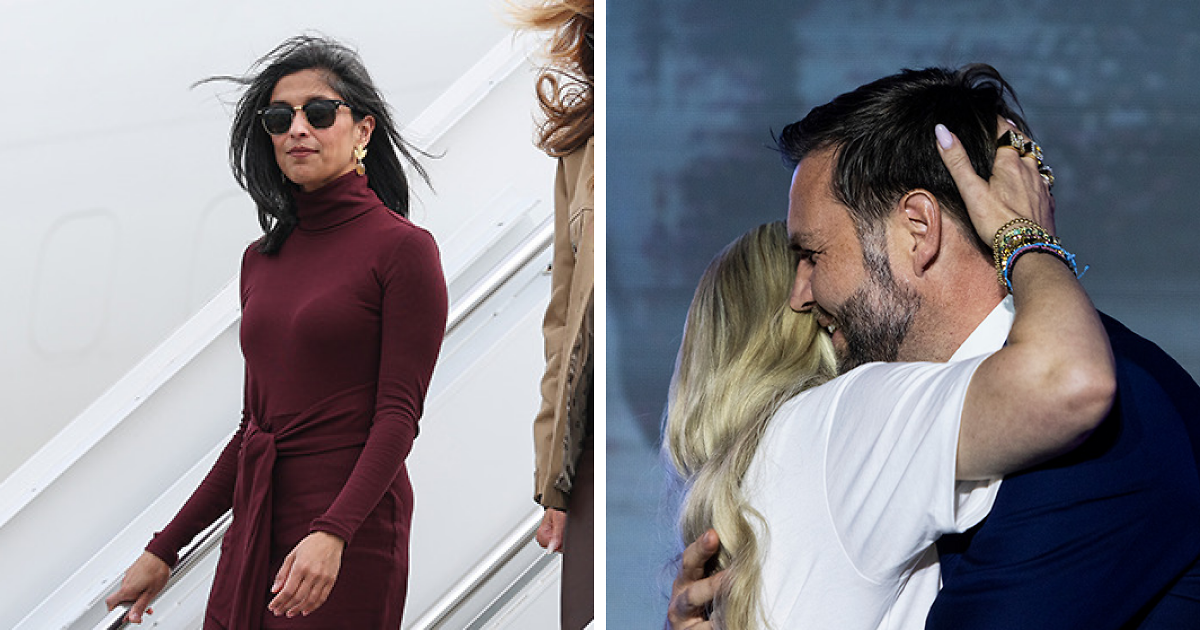
There are ordinary celebrity rumors, there are political rumors, and then there are internet rumors the kind that begin with a single photo, skip all available context, chug three iced coffees, and end up declaring a marriage dead before lunch. That is more or less what happened when Usha Vance appeared in public without her wedding ring, prompting a wave of online chatter about whether she and Vice President JD Vance were headed for a breakup.
The problem with viral speculation, of course, is that it tends to sprint faster than reality. One missing ring became a full-blown marriage autopsy online, complete with body-language analysis from strangers, instant courtroom verdicts from social media, and the usual digital confidence of people who have never once been wrong on the internet. But when Usha Vance finally addressed the gossip, the story looked much less like a political soap opera and much more like a classic case of the web turning a detail into a drama.
This story matters not just because it involves one of the most watched political couples in America, but because it says something bigger about how public life works now. A spouse’s expression, outfit, silence, or jewelry choice can become a mini-scandal all by itself. In an age of freeze-frames and doom-scrolling, even a bare ring finger can get treated like a press release.
The Photo That Lit the Match
The rumor cycle began after Usha Vance appeared without her wedding ring during a public outing alongside First Lady Melania Trump. That visual detail, small on its face and common in everyday life, quickly became a social media Rorschach test. To some users, it was just that a moment. To others, it was “proof” of a secret split, a political cover-up, or the beginning of some grand domestic unraveling.
And because this is the internet, the commentary did not stop at the ring. It escalated into the kind of gleeful overreading that now defines online celebrity gossip. Screenshots spread. Captions got snarkier. Threads multiplied. The usual crowd of amateur detectives stepped forward to interpret facial expressions, event photos, and public schedules as if they were decoding encrypted state secrets rather than discussing a married couple with children.
What made the reaction especially intense was timing. The Vances already lived in the glare of political attention, and public curiosity around the second lady had been rising for months. A private person entering a highly visible national role was always going to attract scrutiny. Add a ringless appearance, a hyperactive political internet, and a public already conditioned to expect scandal, and the rumor machine basically built itself.
What Usha Vance Actually Said
When Usha Vance finally addressed the swirl, her message landed with the force of a balloon quietly deflating in a crowded room. She did not hint at separation. She did not feed the speculation. She did not perform a dramatic rebuttal. Instead, the explanation was refreshingly mundane: she does not always wear the ring, and the internet had turned a routine detail into a headline circus.
That response was notable for its normalcy. In a media environment that rewards emotional overstatement, her tone was closer to, “Everybody please take a breath,” than “let me begin my statement with tears.” It also matched an earlier explanation from her camp that the missing ring reflected everyday life rather than relationship trouble. For people hoping for a palace-intrigue plotline, the answer was almost offensively practical.
And honestly, that practicality is what made it believable. Plenty of married people forget rings, remove them while traveling, skip them during busy workdays, or simply do not wear them every hour of every day. The internet, however, often treats a wedding band as a biometric device linked directly to the health of a relationship. No ring? Clearly the marriage has collapsed. Ring back on? Reconciliation arc unlocked. It is melodramatic, binary, and almost always too neat to be true.
Why the Rumor Took Off So Fast
The answer is simple: optics. Public figures are increasingly judged not only by what they say, but by what they seem to signal in photographs. In politics, spouses are often turned into symbolic characters in a larger national narrative. They are expected to communicate stability, relatability, warmth, loyalty, and polish all at once ideally while never appearing too rehearsed, too distant, too happy, too stiff, or too human. Easy, right?
Usha Vance occupies a particularly fascinating place in that ecosystem. She has long been described as highly accomplished, intensely private, and different in style from the louder, more theatrical corners of modern political culture. That contrast makes her compelling. It also makes her a magnet for projection. Supporters see steadiness. Critics see restraint and try to read it as discomfort. Casual observers see mystery and start filling in the blanks like they are writing fan fiction with polling data.
Once that dynamic is in place, a ringless photo does not remain a photo for long. It becomes a story template. Suddenly every old clip, every public appearance, and every quote gets yanked back into the conversation. The internet does not simply ask, “Was she wearing a ring?” It asks, “What does this mean for the marriage, the image, the base, the future, and perhaps the republic?” Which is a lot of pressure to place on one finger.
The Erika Kirk Factor and the Gossip Pile-On
The rumor frenzy also fed off another episode that had already attracted attention online: JD Vance’s viral public embrace with Erika Kirk. On social media, that moment got dragged into the ring discourse almost immediately, because the internet loves nothing more than stitching unrelated moments together into a theory board worthy of red string and insomnia.
But that leap ignored a lot of context. Public reporting around the event emphasized grief, political camaraderie, and support in a difficult moment, not romantic intrigue. Erika Kirk herself publicly praised both JD and Usha Vance for their support. In other words, the online storyline depended on shaving off the context until only the most clickable version remained.
This is one of the recurring flaws in modern rumor culture: emotionally charged visuals travel farther than full explanations. A hug becomes a scandal. A missing ring becomes a crisis. A quiet spouse becomes a mystery novel. The details that complicate the story grief, routine, travel, family life, exhaustion, humanity are much less viral because they are, frankly, less dramatic than chaos. Reality rarely trends as hard as suggestion.
Who Usha Vance Is Beyond the Gossip
One reason the split rumors felt especially flimsy is that they collided with the larger public record of who Usha Vance is. She is not famous merely as a spouse orbiting political power. She arrived in national view with an unusually strong résumé: Yale Law, major clerkships, high-level legal work, and a reputation for being both intellectually serious and personally reserved. Long before the ring headlines, she was already a figure of public interest because she did not fit neatly into the cartoon version of a modern campaign spouse.
That matters because online gossip often flattens accomplished women into props inside someone else’s storyline. One week they are treated as image-polishers. The next week they are cast as trapped bystanders. The week after that, they become symbols in somebody else’s culture-war thesis. Usha Vance has repeatedly been read through those lenses, even though her public profile suggests something more complicated: a disciplined professional who entered a brutally visible national role without ever seeming eager to become a permanent reality show character.
In that sense, the ring rumor says as much about the audience as it does about the subject. Americans remain obsessed with political spouses because spouses humanize power. They offer emotional clues, or at least the illusion of emotional clues. When the spouse is private, people become even more curious. Silence gets interpreted. Ordinary gestures get overvalued. The less a person narrates themselves publicly, the more the internet volunteers to do it for them often badly.
The Marriage Narrative vs. the Actual Evidence
Strip away the clicky framing, and the evidence for a dramatic split just was not there. The public explanation for the ring was straightforward. Later comments treated the speculation more like an internet sideshow than a real-life crisis. The broader record of the couple’s public life, family focus, and recent milestones also pushed against the idea that one photo had cracked open some hidden collapse.
That does not mean public figures are immune to real relationship strain; they are not. It means observers should resist turning weak evidence into definitive claims. Too often, the online habit is to begin with a suspicion and then shop for visuals that appear to confirm it. That is not reporting. That is mood boarding with an agenda.
There is also a weirdly moralizing quality to these rumors. People do not just speculate; they assign entire emotional narratives to strangers. If a wife looks serious, she must be miserable. If a husband hugs someone, he must be straying. If a ring disappears for a day, the marriage must be on life support. It is gossip disguised as deduction, and it thrives because it gives people the thrill of certainty without the burden of actual evidence.
What This Episode Reveals About Online Political Culture
The Usha Vance ring saga is a perfect little case study in the modern merger of politics, celebrity culture, and algorithmic chaos. Politicians are now covered like influencers. Influencers are analyzed like candidates. Their families are consumed like supporting cast members in an ongoing series that never really ends. Every image is content. Every absence is suspicious. Every minor deviation from routine can be inflated into a “what’s really going on?” event.
That environment rewards the hottest interpretation, not the most accurate one. It especially punishes women in public life, who are often required to look flawless, loyal, independent, maternal, composed, glamorous, and relatable at exactly the same time while also somehow signaling the proper emotional setting for the news cycle. Miss the jewelry once, and suddenly half the internet acts like it deserves discovery rights.
So the real takeaway here is not that the internet loves gossip. We knew that already. It is that the internet has become astonishingly comfortable confusing access with understanding. People see photos, short clips, or curated moments and believe they have insight into marriages they do not live in, families they do not know, and contexts they do not bother to learn.
Experience, Optics, and the Internet’s Favorite Hobby: Overreading Everything
To understand why this story hit such a nerve, it helps to step away from the Vances for a second and look at the much more ordinary experiences underneath the drama. Most married people know that rings are not magic. They are meaningful, yes, but they are also objects. People leave them on bathroom counters. They forget them when they are rushing out the door. They take them off while traveling, exercising, cooking, working, parenting, or simply dealing with the million tiny practical interruptions that make up adult life.
Now place that ordinary human habit under extraordinary public scrutiny. A person who is juggling appearances, travel, family life, staff coordination, security, scheduling, and public messaging does one completely normal thing forgets a ring and suddenly it is no longer normal. It becomes content. It becomes commentary. It becomes a supposed window into the soul of a marriage. That is not really about the ring. It is about how hungry the culture has become for symbols that feel easier to interpret than actual people.
There is also a universal experience here that has nothing to do with politics: anyone who has ever been misread in public understands the basic frustration. You are tired, and someone thinks you are furious. You are quiet, and someone thinks you are offended. You forget a ring, and someone thinks your life is falling apart. Public figures live inside that distortion constantly, but the mechanism is familiar to regular people too. One incomplete detail becomes a full personality profile in somebody else’s head.
Another experience tied to this story is the weird gap between private relationships and public expectations. Healthy marriages do not all look the same. Some couples are gushy in public. Some are dry and funny. Some are reserved. Some wear symbols constantly; some do not. Some hate attention. Some navigate religion, ambition, family, and career with a level of complexity that would never fit into a viral post. But the internet likes simple stories because simple stories are easier to share. Complicated marriages may be more realistic, but neat narratives travel better.
That is why episodes like this keep happening. The public wants emotional clarity from snapshots. It wants certainty from fragments. And in political life especially, people keep trying to decode spouses as if they are mood rings for power itself. But marriages are not memes, and one visible detail rarely tells the whole truth. In this case, the “evidence” looked huge online mostly because the internet had enlarged it. In real life, it appears to have been exactly what it looked like before everyone lost their minds: a person, at an event, without a ring, living her life while strangers wrote season finales around her.
Conclusion
The headline frenzy around Usha Vance’s ringless appearance says far more about the habits of modern media culture than it does about her marriage. Yes, the image sparked speculation. Yes, the chatter caught fire. But once her side addressed it, the story looked a lot less like scandal and a lot more like a familiar internet overreaction powered by projection, politics, and a deep national addiction to reading tea leaves in high resolution.
In the end, this was not a breakup bombshell. It was a reminder that online narratives are often built from fragments, then inflated by repetition until they feel bigger than the facts that started them. And in that sense, the ring discourse around Usha Vance was not really about a marriage at all. It was about how modern audiences consume public women: zoomed in, overconfident, and always one missing accessory away from declaring a crisis.