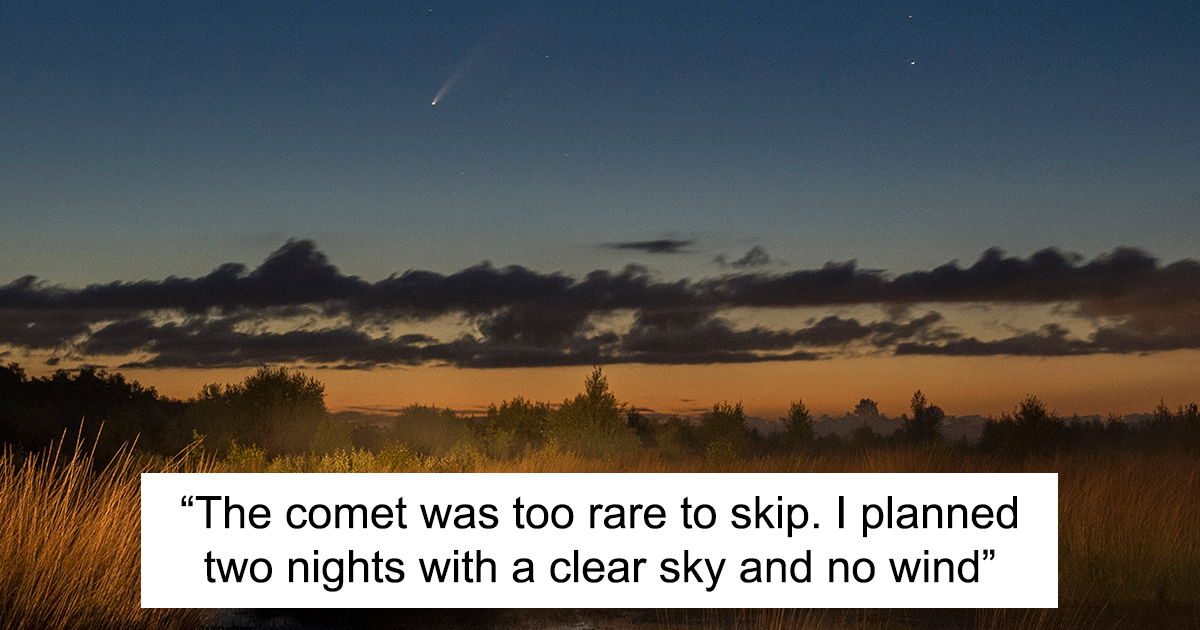
Some nights ask very little of you: close the laptop, make tea, pretend you are going to sleep at a reasonable hour. Other nights fling a cosmic snowball across the sky and whisper, “Grab your camera, human. You have about one chance every several thousand years.” That was Comet NEOWISE in July 2020a rare celestial visitor bright enough to pull people out of their homes, away from city lights, and into the awkward but magical business of staring upward with their mouths slightly open.
Officially named C/2020 F3 (NEOWISE), the comet was discovered on March 27, 2020, by NASA’s NEOWISE space telescope mission. It made its closest approach to the Sun on July 3, 2020, survived that fiery handshake, and then became visible to many Northern Hemisphere observers during July. For photographers, it was more than a sky event. It was a deadline, a treasure hunt, and a very dramatic reminder that the universe does not care about your battery percentage.
This article is a story about using a once-in-a-lifetime chance to capture the NEOWISE comet in 13 photos: the planning, the panic, the cold air, the failed test shots, the “is that it?” moments, and finally the gorgeous streak of dust and ice hanging over the horizon like the universe had signed its name in chalk.
Why Comet NEOWISE Felt Like a Once-in-a-Lifetime Event
Comets visit the inner solar system all the time, but most of them are shy little smudges that require telescopes, dark skies, patience, and the emotional resilience of a tax auditor. NEOWISE was different. It became one of the brightest comets visible from the Northern Hemisphere in decades, and under good conditions, it could be seen with the naked eye. That made it a public sky show, not just an astronomy-club whisper.
The “once-in-a-lifetime” part was not poetic exaggeration. NEOWISE follows a long, stretched-out orbit. After its 2020 appearance, it is expected to take roughly 6,800 years to return to the inner solar system. In other words, if you missed it, your next appointment is not “next summer.” It is “after several civilizations, fashion cycles, and probably twelve new versions of USB.”
The Science Behind the Spectacle
A comet is not a shooting star
NEOWISE was not a meteor, not a falling star, and not a glitch in someone’s drone footage. A comet is a frozen body made of dust, ice, and rocky material. When it approaches the Sun, heat causes some of that frozen material to vaporize. Gas and dust stream away from the nucleus, forming a glowing coma and tails that can stretch across the sky.
Why NEOWISE had more than one tail
One reason NEOWISE looked so photogenic was its tail structure. The brighter, broader dust tail reflected sunlight and curved gracefully because dust particles continued along slightly different paths. The fainter ion tail, shaped by solar wind and magnetic fields, appeared more bluish and straighter. Some observations also detected a sodium tail, a rarer feature that gave scientists another clue about what was happening on the comet’s surface as sunlight cooked off material.
Why it was visible from Earth
In early July 2020, NEOWISE emerged from solar glare after surviving its close pass by the Sun. For a while, observers could find it before dawn. Later in July, it shifted into the evening sky, appearing low in the northwest beneath the Big Dipper. That timing was perfect for photographers: dark enough to shoot, early enough that the adventure did not always require becoming a full-time nocturnal mammal.
The Plan: How I Prepared to Photograph NEOWISE
Capturing the NEOWISE comet started with equal parts research and weather-app betrayal. I checked visibility charts, watched the moon phase, studied maps for darker skies, and looked for a clear northwestern horizon. The comet was low in the sky, so a hill, field, lake, ridge, or open road could make the difference between “cosmic masterpiece” and “beautiful photo of trees blocking everything.”
The gear list was surprisingly simple. A DSLR or mirrorless camera, a sturdy tripod, a wide-angle or moderate telephoto lens, extra batteries, a remote shutter or timer, and warm clothing were enough to get started. A star tracker helped for longer exposures, but it was not mandatory. The biggest requirement was not expensive equipment. It was showing up while the comet was still bright enough to catch.
The 13 Pics: A Photo Journey Under the NEOWISE Sky
Pic 1: The scouting shot
The first image was not glamorous. It was a test frame of the horizon, taken before the sky was fully dark. The purpose was simple: find the Big Dipper, confirm the direction, and make sure the camera was not aimed at a very confident telephone pole.
Pic 2: The first faint smudge
In the second photo, NEOWISE appeared as a tiny blur above the horizon. To the naked eye, it was subtle. On camera, it had personality. That first detection felt like finding a secret message written in starlight.
Pic 3: The comet with landscape
This frame placed the comet above a dark foreground: trees, hills, or a quiet road. Including the land gave scale to the sky. Without it, NEOWISE was beautiful. With it, the comet felt like it had arrived over Earth specifically for the photo session.
Pic 4: A longer exposure
A longer exposure pulled more detail from the tail, but it also introduced the classic astrophotography problem: stars move. Technically, Earth moves, but blaming the stars is more emotionally satisfying. Keeping the shutter speed moderate helped preserve sharp points of light.
Pic 5: The dust tail begins to bloom
With better focus and a steadier tripod, the dust tail became more obvious. It looked like a soft brushstroke, wide and pale, spreading away from the comet’s bright head. This was the image that made the trip feel worth it.
Pic 6: NEOWISE near the Big Dipper
One of the most useful ways to frame NEOWISE was with recognizable stars nearby. The Big Dipper acted like a celestial road sign. It helped viewers understand where the comet sat in the sky and made the image more accessible to people who do not casually identify constellations at dinner parties.
Pic 7: The wide-angle sky
A wide-angle shot captured more of the night: stars, fading twilight, the horizon, and the comet as part of a larger scene. It was less dramatic than a close-up, but it told a better story. Sometimes the sky needs room to breathe.
Pic 8: The telephoto close-up
The telephoto frame brought out the comet’s structure. The head became brighter, the tail longer, and the whole thing looked less like a smudge and more like an ancient icy traveler with excellent branding.
Pic 9: The battle with light pollution
Not every image was taken under perfect dark skies. In one shot, light pollution created an orange glow near the horizon. It was annoying, but it also told the truth: modern skywatching often means negotiating with parking lots, porch lights, and cities that glow like someone left the oven on.
Pic 10: The stacked image
Stacking several exposures can reduce noise and bring out faint detail. This technique is common in astrophotography because one frame often contains both beauty and chaos. Combining multiple images helped NEOWISE look cleaner, sharper, and closer to what the eye hoped it was seeing.
Pic 11: The human-scale frame
Adding a person in silhouette changed the mood completely. Suddenly, the photo was not only about a comet. It was about being small in the best possible way. A lone figure under NEOWISE made the image feel like a postcard from the edge of wonder.
Pic 12: The almost-missed shot
This picture came near the end of the session, when the comet was lower, the air was cooler, and enthusiasm was fighting sleepiness in a parking-lot duel. It was imperfect, but it had energy. Sometimes the photo you nearly skip becomes the one with the most feeling.
Pic 13: The farewell frame
The final image was quieter. NEOWISE had begun to fade, slipping away from easy visibility. The photo felt less like a trophy and more like a goodbye. That is the strange power of comet photography: you are not capturing something that belongs to you. You are borrowing a moment before the solar system takes it back.
Photography Tips Learned From Chasing NEOWISE
Find dark skies, but do not wait for perfection
Dark skies make a huge difference, especially for faint tails and subtle detail. Still, waiting for perfect conditions can mean missing the event entirely. A decent location tonight is often better than a dream location after the comet has faded.
Use manual focus
Autofocus gets confused in the dark and may decide that infinity is somewhere behind a shrub. Switch to manual focus, use live view if available, zoom in on a bright star, and adjust until the star is as small and sharp as possible.
Keep exposures controlled
Long exposures gather more light, but they also reveal star trails if the camera is not tracking the sky. A common starting point is a shutter speed between 2 and 10 seconds, depending on focal length, aperture, and sensor. Take test shots and check sharpness instead of trusting optimism.
Shoot RAW
RAW files preserve more information than JPEGs, which is important when editing faint comet detail. The image may look flat at first, but careful adjustments to exposure, contrast, highlights, shadows, and color temperature can reveal a surprising amount of structure.
Bring extra batteries
Cold nights drain batteries faster, and long exposures are greedy. Nothing ruins cosmic inspiration like a blinking battery icon. Bring more power than you think you need, because the universe does not pause for charging breaks.
Why NEOWISE Mattered Beyond the Photos
NEOWISE arrived during a strange year, when many people were stuck indoors, anxious, isolated, or simply tired of refreshing news feeds. Then a comet appeared. It did not fix anything, but it gave people a reason to step outside, look up, and remember that Earth is part of a much larger story.
That may be why so many NEOWISE comet photos spread online. They were not just technically impressive. They were emotional. A comet above a barn, a comet over mountains, a comet reflected in water, a comet behind city hazeeach image said, “I was here when this happened.”
Astrophotography often looks like a gear-heavy hobby, but NEOWISE proved that wonder is still the main ingredient. Yes, sharp lenses help. Yes, dark skies help. Yes, learning exposure settings prevents heartbreak. But the real reason people chased NEOWISE was simpler: it was beautiful, temporary, and bigger than everyday noise.
Extended Experience: What It Felt Like to Chase a Comet
The most memorable part of photographing NEOWISE was not a camera setting. It was the feeling of leaving the normal world behind for a few hours. The drive out of town felt like sneaking away from adulthood. Streetlights thinned, buildings disappeared, and the sky slowly became less like a ceiling and more like an ocean. I remember parking, stepping out, and immediately realizing I had underestimated the wind. Astrophotography has a glamorous reputation online, but in real life it often involves shivering beside a tripod while your snack bag makes suspicious noises in the dark.
At first, I could not find the comet. I knew where it should be: low in the northwest, beneath the Big Dipper. That sounds simple until you are standing under an enormous sky trying to identify one pale smudge among thousands of glittering distractions. I took a test shot, checked the screen, saw nothing, adjusted the angle, tried again, and briefly considered that the comet had chosen not to attend. Then, on the next exposure, there it was: faint, slanted, unmistakable. The excitement was ridiculous. I had not created the comet. I had not even found it first. Still, seeing it appear on the camera screen felt like unlocking a secret level of Earth.
The session became a rhythm. Shoot, review, adjust, repeat. Raise the ISO, lower it again. Try a wider frame. Try a tighter frame. Refocus because doubt is apparently part of the workflow. Every few minutes, I stopped touching the camera and simply looked. That mattered. It is easy to become so obsessed with documenting a rare event that you forget to experience it. NEOWISE was dimmer to the eye than it looked in processed photos, but it had a quiet presence. It looked ancient because it was ancient, carrying material from the early solar system across a sky full of modern satellites and impatient humans.
There were failures, of course. Some shots were blurred by wind. Some were ruined by passing headlights. In a few frames, the stars looked like tiny commas because I pushed the exposure too far. One image featured what may be the least majestic foreground bush in astrophotography history. But even the flawed pictures became part of the memory. They showed the actual chase, not just the polished result.
By the time I packed up, NEOWISE had dipped lower and the sky had shifted. The final frames felt softer, almost private. I knew the comet would continue outward, fading night by night until binoculars, telescopes, and then only calculations could follow it. That knowledge gave the whole experience weight. A sunset comes back tomorrow. A full moon returns next month. NEOWISE will not be back for thousands of years. Photographing it was a reminder that some opportunities do not politely wait until life is convenient. Sometimes the sky opens a door, and you either walk outside with a camera or spend the next 6,800 years wishing you had.
Conclusion
Capturing the NEOWISE comet was more than an astrophotography project. It was a race against weather, fading brightness, low horizons, light pollution, battery life, and the simple human urge to stay comfortable indoors. The reward was a 13-picture record of a rare visitor from the outer solar system: a comet bright enough to inspire beginners, serious enough to excite astronomers, and beautiful enough to make everyone briefly forget how small their phone screen is compared with the sky.
NEOWISE reminded us that the best photographs are not always perfect. They are proof of attention. They say we noticed something extraordinary while it was here. And when the subject will not return for thousands of years, noticing becomes its own kind of art.
Note: This article is written for web publication and synthesizes verified astronomy facts with original narrative, practical photography guidance, and personal-experience-style storytelling.