Some objects tell time. Others tell everyone who enters the room that the owner has excellent taste, a sense of humor, and absolutely no fear of oversized accessories. The watch clock belongs firmly in the second category.
A watch clock is essentially a wristwatch that has been enlarged until wearing it would require the forearm strength of a professional wrestler. Instead of wrapping around a wrist, it hangs vertically on a wall, complete with an enormous case, buttons, dial, buckle, and dangling straps. Some models reproduce analog watches, while others imitate familiar digital designs.
These wonderfully unnecessary objects enjoyed plenty of attention during the colorful design culture of the 1980s. Then interiors became restrained, electronics became smaller, and clocks were increasingly replaced by phones. The giant wristwatch wall clock quietly disappeared into vintage stores, collectors’ rooms, and the occasional movie set.
That disappearance was a mistake. With retro design returning, people growing tired of glowing screens, and modern fabrication tools making custom objects easier to build, the oversized watch clock is ready for another moment in the spotlight.
What Exactly Is a Watch Clock?
In this context, “watch clock” does not refer to an old security device used by night watchmen. It means a functional wall clock designed to resemble an enlarged wristwatch. Picture a normal watch multiplied by 15 or 20, fastened to the wall instead of your arm, and suddenly capable of frightening a houseguest who was not prepared to see a seven-foot timepiece near the kitchen.
The basic formula is simple:
- A large watch-shaped case containing a working clock
- A dial or digital display that reproduces a recognizable watch face
- Decorative or functional side buttons
- Long straps extending above and below the case
- A buckle, keepers, printed markings, and other scaled-up details
The most famous commercial examples are the MAXI Swatch wall clocks. Swatch’s current American collection describes these pieces as approximately 83 inches tall, with clock cases around 11 inches in diameter. They are not merely clocks with watch-inspired graphics. They are enormous watches that happen to live on walls.
That distinction matters. A normal wall clock fills an empty area. A giant watch clock transforms the entire wall into a design feature.
Why Oversized Watch Clocks Made Sense in the 1980s
The 1980s were not famous for whispering. Fashion, graphics, furniture, music videos, and consumer electronics frequently competed to see which could attract attention first. Colors were brighter, shapes were louder, and restraint occasionally took a well-deserved vacation.
Postmodern and Memphis-influenced design rejected the idea that household objects had to be quiet, neutral, or strictly practical. Clocks became opportunities for geometric forms, contrasting colors, playful hands, and unusual materials. A clock could be functional and still behave like a piece of pop art.
The watch clock fit perfectly into that environment. It took a familiar personal object and changed its scale until it became architecture. The result was funny, decorative, and instantly understandable. Nobody needed an instruction manual to recognize a giant wristwatch, although getting it through a narrow doorway was another matter.
Swatch was particularly suited to the idea. Its watches treated the dial and strap as canvases for color and graphics, so enlarging them produced dramatic wall pieces without requiring a completely new visual language. Today, vintage MAXI Swatch clocks from the 1980s are collected as examples of postmodern design as well as watch memorabilia.
The Giant Casio F-91W That Proved the Idea Still Works
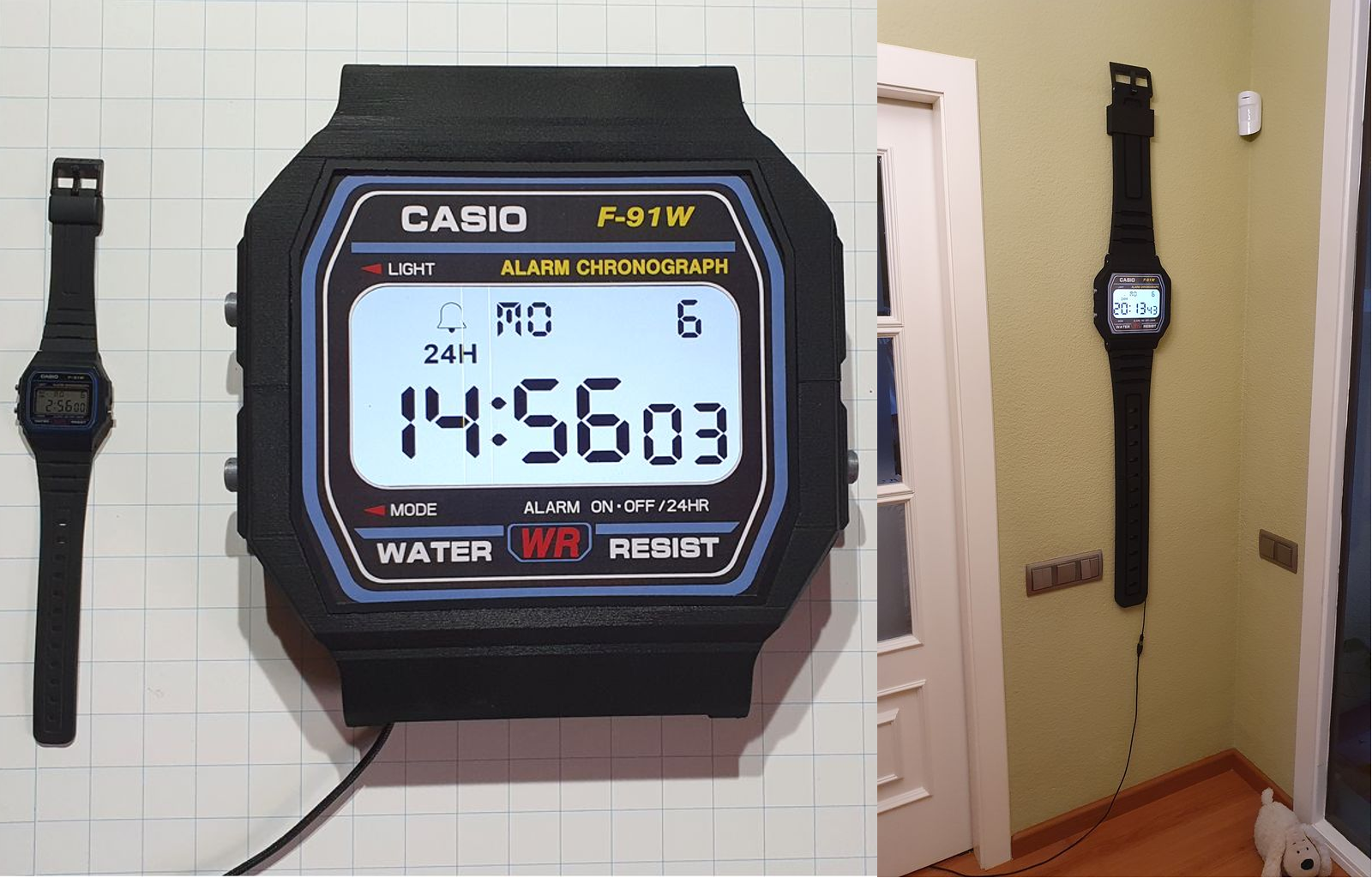
One of the strongest arguments for reviving watch clocks came from a maker known as Kothe, who built an enormous, working version of the Casio F-91W. The project was featured by Hackaday and Hackster because it did more than enlarge the appearance of the famous digital watch. It reproduced much of its functionality.
The original Casio F-91W is a remarkably modest object. Casio lists features including a daily alarm, an LED light, 12- and 24-hour time formats, and a stopwatch measuring hundredths of a second. The resin watch weighs about 21 grams and is powered by a battery with an estimated seven-year life.
Kothe’s wall-sized interpretation took that tiny, practical design and turned it into something gloriously theatrical. A seven-inch display showed the time, date, alarm information, and stopwatch functions. An Arduino Mega-class controller handled the logic, while a battery-backed real-time clock module maintained accurate timekeeping.
The case, buckle, and buttons were 3D printed. Because the straps were too large for the available printer bed, they were produced from laser-cut foam and engraved with the original details. Touch sensors hidden behind the controls allowed the enormous side buttons to behave like those on the real watch. Even the familiar electronic beeps were reproduced.
In other words, it was not simply wall art shaped like a Casio. It was a functional tribute that happened to be large enough for a small apartment to claim it as an additional tenant.
Why the Casio F-91W Was the Perfect Choice
The F-91W has one of the most recognizable digital-watch faces ever made. Its rectangular case, blue border, red accents, compact display, and labeled buttons remain visually connected to the late 1980s. Gear Patrol has described the model as an unusual icon whose affordability, reliability, and widespread availability helped make it ubiquitous.
Enlarging such a familiar object creates an immediate emotional response. People who owned one recognize it. People who never owned one have probably seen it. The design is simple enough to reproduce but detailed enough to reward close inspection.
A luxury watch enlarged to wall size might look like advertising for a jewelry store. A giant F-91W feels more democratic. It celebrates an everyday object rather than turning the living room into a private airport lounge.
Why Watch Clocks Are Ready for a Comeback
We Are Exhausted by Screens
Phones replaced wristwatches for many people, then smartwatches returned notifications to the wrist. Meanwhile, televisions became dashboards, refrigerators gained displays, and light bulbs began asking for software updates. Modern life offers many conveniences, but it also creates the strange possibility that checking the time will lead to answering three messages, reading bad news, and accidentally watching a video about a raccoon stealing cat food.
A wall clock provides the time without presenting a menu. It does not demand a password, recommend a subscription, or notify you that someone you met once has posted a new photograph.
Architectural Digest has documented growing interest in analog bedrooms and home controls that reduce visible technology. Designers increasingly hide sophisticated systems behind simple, tactile interfaces. A modern watch clock could follow the same philosophy: advanced components inside, straightforward interaction outside.
Retro Design Is No Longer Limited to Collectors
Digital watches, mechanical keyboards, cassette-inspired audio products, vintage cameras, and colorful postmodern furniture have all found enthusiastic new audiences. Younger buyers often approach these objects without the old debate about whether they are outdated. They simply see distinctive designs with personality.
A retro wall clock shaped like a watch offers nostalgia for older owners and discovery for younger ones. It can reference the past without requiring the room to look like a museum exhibit assembled in 1987.
Modern Homes Need Better Conversation Pieces
Many contemporary interiors rely on safe combinations of white walls, pale wood, neutral textiles, and one plant doing an unreasonable amount of decorative labor. These rooms can be calm and beautiful, but they sometimes need a focal point.
An oversized watch clock supplies one immediately. It offers color, scale, humor, and function in a single object. Unlike generic wall art, it changes throughout the day and invites interaction. Guests will ask about it before they ask about the sofa, which is impressive considering what the sofa probably cost.
Watch Clocks Can Work With More Than Retro Interiors
The obvious setting for a giant wristwatch wall clock is a playful 1980s-inspired room, but the concept is much more flexible.
Minimalist Rooms
A monochrome digital watch clock can provide contrast without introducing visual chaos. Imagine an oversized black Casio-style case on a white wall, with the straps arranged as strong vertical lines. The object becomes graphic rather than nostalgic.
Home Offices and Creative Studios
A large digital clock is easy to read across a room. Stopwatch and timer functions can support focused work sessions, exercise routines, photography, music practice, or workshops. In this environment, exaggerated scale has a practical advantage.
Children’s Rooms and Game Rooms
Bright colors and interactive buttons make watch clocks natural additions to playful spaces. A model based on a calculator watch, game-themed digital watch, or colorful analog design could introduce children to timekeeping without looking like school equipment.
Retail and Hospitality Spaces
Watch stores, cafés, hotels, barber shops, restaurants, and vintage clothing retailers could use oversized timepieces as recognizable landmarks. A custom watch clock can communicate a brand’s personality more effectively than another glowing logo mounted behind a counter.
How a Modern Watch Clock Could Improve on the Originals
The best revival would preserve the playful scale of vintage watch clocks while quietly adding modern convenience.
Automatic Time Synchronization
A Wi-Fi-connected clock could synchronize itself while keeping the network features invisible. It should behave like a normal clock after setup, not like an application that happens to know what time it is.
Configurable Displays
Digital models could offer optional date layouts, 12- or 24-hour formats, alarms, countdown timers, stopwatch modes, and adjustable brightness. An e-paper display could provide high contrast with low power consumption, although reproducing the authentic appearance of an LCD might require careful design.
Physical or Capacitive Controls
Capacitive touch systems allow large decorative buttons to trigger electronic controls without complicated mechanical linkages. Adafruit and SparkFun both demonstrate how conductive pads and touch controllers can be incorporated into custom interfaces. Traditional push buttons would provide more satisfying feedback, but touch controls simplify construction and reduce wear.
Modular Faces and Straps
Manufacturers could sell interchangeable dials and straps, allowing the clock to change with the room. This would also revive the collectible appeal that made colorful watches exciting in the first place.
Better Cable Management
Nothing damages the illusion of a giant wristwatch faster than a thin power cord wandering toward the nearest outlet like it has become separated from its family. Rechargeable batteries, hidden channels, removable battery packs, or carefully designed wall plates would create a cleaner installation.
Building a DIY Giant Wristwatch Wall Clock
A maker does not need to reproduce every feature of Kothe’s Casio project. A basic version can begin with a quartz clock movement, printed dial, lightweight case, and foam or fabric straps. More ambitious builders can add digital displays, alarms, touch controls, sound, and programmable functions.
The project naturally combines several useful skills:
- Computer-aided design for the case and buckle
- 3D printing for dimensional components
- Laser cutting or hand cutting for straps
- Graphic design for labels and dial markings
- Microcontroller programming for digital functions
- Basic wiring, soldering, and enclosure planning
Large parts often need to be divided into printable sections. Formlabs recommends using alignment features such as pins, slots, grooves, or lips when splitting oversized models. These features reduce the possibility of assembling a watch case that looks as though it lost an argument with gravity.
Lightweight materials are usually preferable to solid printed components. Foam board, EVA foam, thin plywood, acrylic, and hollow printed shells can reproduce scale without placing unnecessary stress on the wall. Builders should confirm that any material used in a laser cutter is compatible with the machine and properly ventilated.
What It Is Like to Build and Live With a Watch Clock
The first surprise in an oversized watch-clock project is that enlarging a familiar object does not make it simpler. Tiny imperfections also become enormous. A label that is one millimeter too low on a wristwatch may be invisible. Multiply the design several times, and the same mistake appears to be attempting an escape from the dial.
Planning the scale is therefore the most important early experience. It is tempting to make the clock as large as possible, but doorways, ceilings, electrical outlets, and furniture have opinions. Taping a full-size paper outline to the wall before cutting or printing anything prevents an ambitious design from becoming an expensive object stored diagonally in a garage.
Assembly brings another lesson: the straps create much of the illusion. A watch case without straps is simply an unusually shaped clock. Once the long bands and buckle are installed, the brain immediately understands the joke. The object stops looking like a technical project and starts looking like a wristwatch borrowed from a giant.
The display also changes the experience. A bright screen may look impressive in a workshop but become distracting in a dim living room. Adjustable brightness is worth adding. So is a silent mode. The authentic Casio beep may produce instant nostalgia during a demonstration, but an hourly signal at 3 a.m. can make historical accuracy feel less important.
Living with the finished clock is surprisingly practical. The time can be read from across the room, and checking it does not require reaching for a phone. In a home office, the stopwatch can support focused work intervals. In a kitchen, a countdown feature is useful. In a studio, the display provides a clear reference without interrupting creative work.
The social experience is even more noticeable. Visitors do not ignore a giant watch clock. Some recognize the design immediately and begin discussing the watches they owned as children. Others examine the buttons, ask how the display works, or wonder whether the buckle opens. At least one person will suggest wearing it as a necklace. This person believes the idea is original and should be allowed to enjoy the moment.
Maintenance is usually uncomplicated if the internal electronics remain accessible. A removable rear panel makes it easier to replace a power supply, adjust wiring, update software, or silence a buzzer that has developed a personal agenda. Mounting hardware should be selected according to the clock’s actual weight, not the optimistic weight imagined before the project was assembled.
The most rewarding part is the transformation from recognizable object to environmental feature. A normal F-91W nearly disappears on a wrist. Its wall-sized counterpart changes the mood of an entire room. It demonstrates how scale can turn ordinary industrial design into sculpture without eliminating function.
There may also be a period of adjustment. For the first few days, the clock feels enormous. After several weeks, it begins to seem perfectly reasonable. Eventually, a standard wall clock may look strangely timid, as though it would like to apologize for taking up space.
That is the real charm of the watch clock. It makes timekeeping visible again. Instead of hiding the time in a corner of a phone screen, it gives the act of checking the hour a physical place in the home.
Should You Buy One or Build One?
Buying is the easier path for anyone who wants a polished decorative object. Swatch continues to offer MAXI wall clocks, while vintage models appear through design dealers and collectors. Commercial products provide reliable movements, clean printing, and hardware intended for wall installation.
Building is better for people who want a particular watch design, unusual functions, or a personalized color scheme. It also allows the scale to match a specific wall. A DIY model can reproduce a favorite childhood watch, commemorate a family timepiece, or create a completely fictional model that never existed.
There is one important boundary: copying a recognizable commercial design for private experimentation is different from selling branded replicas. Anyone producing clocks commercially should create original artwork or obtain the necessary permissions.
Conclusion: Give the Wall Something Better Than Another Screen
Watch clocks deserve to return because they combine qualities modern products rarely attempt at the same time. They are useful but not boring, nostalgic but adaptable, humorous but visually powerful. They can be simple quartz clocks, programmable digital displays, collectible design objects, or satisfying maker projects.
The revival is already beginning. Swatch still offers enormous wall-mounted watches, retro digital timepieces remain popular, and contemporary interiors are showing renewed interest in tactile controls and screen-free objects. The technology required to build custom versions is also more accessible than it was during the original watch-clock era.
A phone may tell the time more efficiently, but efficiency is not the only reason to place something in a home. Sometimes an object should create delight, start conversations, and make an ordinary wall look as though it has developed a personality.
Bring back the giant straps. Bring back the absurd buckles. Bring back the buttons large enough to operate with an elbow. It is time for watch clocks to make a comebackand this time, they can be smarter on the inside while remaining gloriously ridiculous on the outside.
SEO Metadata
Note: This article synthesizes verified information from established horology, design, electronics, and maker references, including Casio, Swatch, Arduino, Adafruit, Hackaday, Hackster, MoMA, Architectural Digest, Gear Patrol, Formlabs, and SparkFun.