Galway has always been a city with excellent taste and absolutely no interest in behaving itself. It is bohemian, musical, walkable, and just unruly enough to make a good meal feel like part of the atmosphere instead of a break from it. That is exactly why Ard Bia at Nimmos, tucked by the Spanish Arch and the River Corrib, feels so at home there. The restaurant’s refresh did not erase its personality; it sharpened it, brightened it, and let the quirks breathe a little better. In a city known for its arts scene, medieval streets, and lively restaurant culture, that kind of update makes perfect sense.
The timing also fits Galway’s broader food story. U.S. travel and food publications have increasingly described Ireland’s culinary scene as a renaissance, shaped by local ingredients, a stronger sense of place, and chefs who are comfortable being both traditional and slightly rebellious. AFAR notes that Galway’s food culture has become a magnet for creative energy, while Smithsonian points to farm-fresh ingredients as a core reason Ireland’s dining scene feels newly exciting. Travel + Leisure has also highlighted Galway as a stop where music, local pubs, and the city’s bohemian atmosphere come together in a way that feels distinctly alive.
A restaurant that already knew who it was
Before the refresh, Ard Bia had already built its reputation on being gloriously hard to pin down. Remodelista described the original dining room as a tiny restaurant with plant-forward dishes and an offhand, collected feel: mismatched Thonet chairs, wax-dripped candlesticks, eclectic art on the walls, and a general sense that every object in the room had a story, even if it refused to tell it on cue. Another earlier feature on the same space emphasized the menu’s wide-ranging spirit, with Irish, New Zealander, and North African dishes, plus foraged elderflower cordial and a strong connection to local growers and artists. In other words, the room was already speaking fluent “eclectic.” The refresh simply taught it to speak a little more clearly.
That matters, because restaurant design can go wrong in two very familiar ways. The first is the museum problem: everything is beautiful, but nobody wants to touch anything. The second is the themed-restaurant problem: the room is full of symbols, but none of them are actually useful. Ard Bia dodged both traps by keeping the soulful clutter and adding structure, light, and warmth. The result is not a wipe-clean reset. It is a better version of the same idea, which is usually the hardest kind of renovation to pull off.
What the refresh actually changed
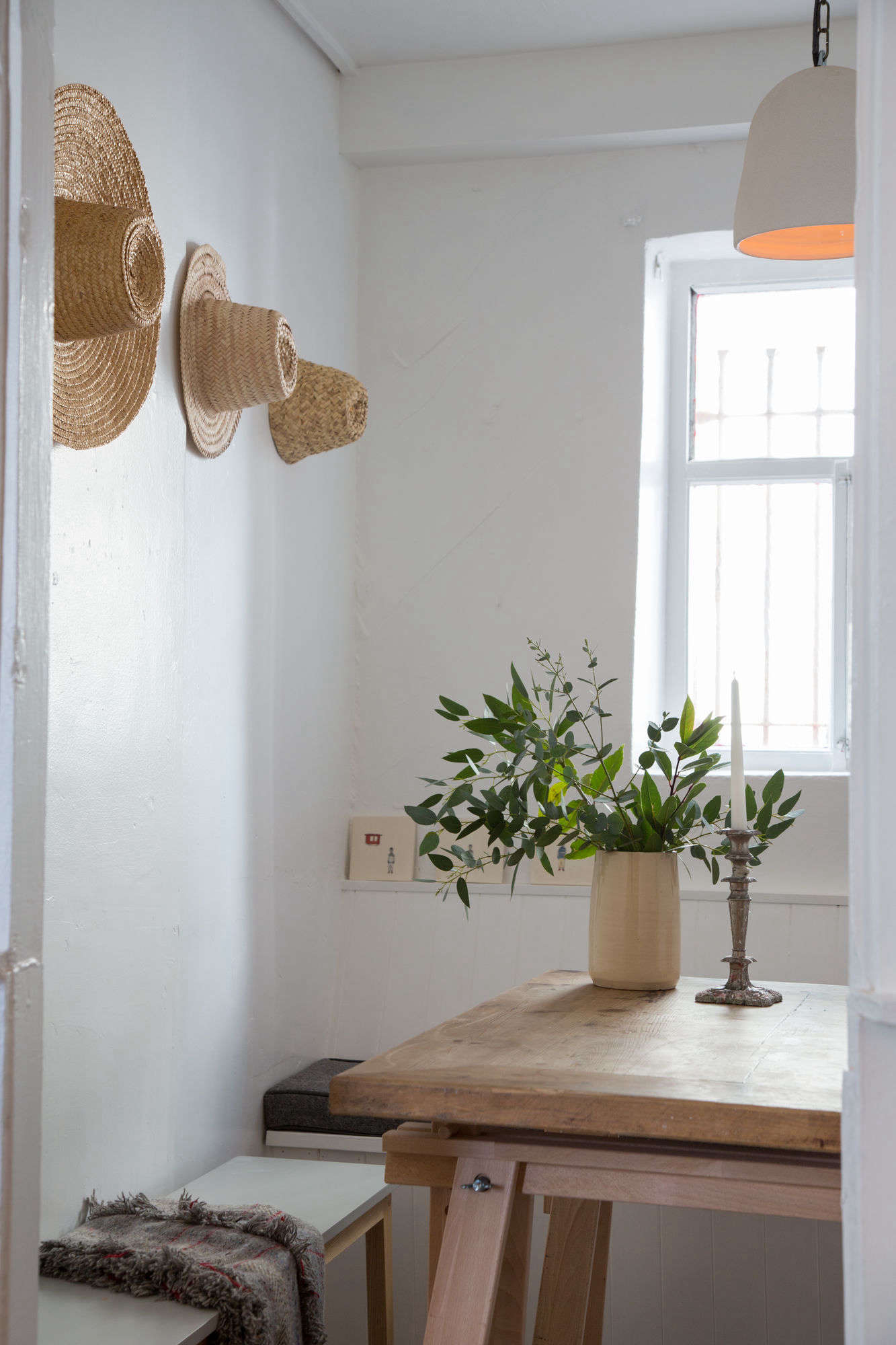
According to Remodelista’s reporting, the redesign centered on a brighter, more open look with a Nordic influence, while preserving the restaurant’s original personality. Local Galway artisans and craftspeople were brought into the project, and untreated local larch was used to panel a wall and add warmth. The stairwell was opened to make the bar area feel lighter, ceramic pendant lamps were handmade by a nearby potter, and cushions in gray Donegal tweed softened the banquettes. The restaurant also kept a rotating collection of local art on the walls, along with touches like straw hats as decor, built-in shelving, and original elements that were too good to lose.
There is a particularly smart lesson hidden in that list of details: the best refreshes do not “fix” personality out of a space; they give personality better posture. Interior design coverage from House Beautiful and Architectural Digest has made the same larger point in other settings, noting that great rooms often mix styles instead of obeying one rigid formula. House Beautiful describes maximalist and eclectic design as a balance of color, pattern, texture, and restraint, while Architectural Digest repeatedly shows that restaurants can feel lively when they blend old and new materials, art, and furniture without making the dining room feel busy. Ard Bia lands in that sweet spot. It is not sterile, and it is not chaotic. It is edited.
Why eclectic works so well in Galway
Galway is an easy city to over-romanticize, but the truth is simpler: it is a place where the street life already supplies most of the mood. Rick Steves describes medieval streets filled with colorful facades, pubs, musicians, and steaming eateries, while Travel + Leisure highlights the city’s traditional music, relaxed pace, cobbled lanes, and bohemian atmosphere. That environment rewards restaurants that do more than serve dinner. They need to join the conversation. Ard Bia does that by feeling less like a generic dining room and more like a gathering place that knows the town around it.
Even Galway’s food calendar supports that energy. Travel + Leisure notes that the city draws oyster lovers for the Galway International Oyster and Seafood Festival, and AFAR’s reporting shows how deeply local sourcing, market relationships, and scratch cooking have become part of the city’s culinary identity. That kind of ecosystem gives a restaurant room to be playful without feeling detached from place. It also makes “eclectic” feel less like a design adjective and more like a civic habit.
The menu matches the room’s attitude
Ard Bia’s food story has always been part of the design story. The restaurant has been described as serving Irish, New Zealander, and North African dishes, which already tells you this is not a kitchen that believes in a narrow passport. That range mirrors what the room does visually: it borrows, layers, and reinterprets rather than settling for one note. It is the culinary equivalent of a room where the tablecloth, the art, the lamps, and the chairs all look like they came from different decades and somehow decided to become friends.
And that is part of why the refresh feels credible. The team did not paste a shiny concept onto an old favorite. Instead, they made the dining room feel closer to the way the menu already behaved: sourced from different places, grounded in local ingredients, and comfortable with surprise. Smithsonian has described Ireland’s food scene as a gastronomic renaissance built on farm-fresh ingredients, and AFAR has pointed to the city’s growing reputation for inventive dining. Ard Bia’s room does the same thing visually. It quietly says: yes, we know exactly where we are, and yes, we are still going to put a little North Africa next to a lot of Galway.
What this refresh teaches other restaurants
There is a temptation in hospitality to think a renovation must be dramatic to matter. Tear out the old. Add a giant feature wall. Buy the lighting fixture that photographs beautifully and probably hurts to sit under. But the smartest restaurant refreshes often work in subtler ways. They improve flow, add warmth, make small spaces feel bigger, and let the operator’s point of view come through with more confidence. Ard Bia’s update is a good example of that philosophy. It did not start from zero. It started from character and then gave that character better tailoring.
That distinction matters because guests can feel it immediately, even if they cannot name it. A room with only style can feel distant. A room with only comfort can feel bland. A room like Ard Bia’s, by contrast, feels personal enough to remember and polished enough to revisit. The balance is what makes people stay longer, order another round, and take one more look around before they leave. It is the kind of interior that rewards slow attention, which is exactly what good restaurants and good cities both need.
What it feels like to sit down here
Imagine walking in from a Galway street where the weather changes its mind every thirty seconds. The first thing you notice is not perfection. It is texture. Wood. Tweed. Light on glass. A chair that has clearly lived a few lives. A wall that feels warm instead of overdesigned. That sensory layering is what makes an eclectic room memorable. It gives your eye something to do while your appetite catches up. In a good restaurant, the room should never be background wallpaper; it should work like a prelude. Ard Bia’s refresh seems built for exactly that kind of prelude, where the first course is atmosphere and the second is dinner.
There is also a social side to a room like this. The original and updated versions of Ard Bia both suggest a place that likes the idea of people lingering. The shelves above the banquettes hold wine, coffee, and cookbooks. The walls carry rotating art. Found objects and local crafts keep the mood from becoming precious. Even the rough edges help create a kind of hospitality that feels human rather than choreographed. That is not a small thing. In a city like Galway, where music, conversation, and late-night wandering are part of the fabric of daily life, a restaurant that welcomes loitering is doing real cultural work.
What makes that especially appealing is the way the refresh respects memory. Many renovations forget that returning guests do not just want novelty; they want recognition. They want the room to feel evolved, not erased. Ard Bia seems to understand that. The bright banquette, the handmade lighting, the warm wood, the local art, and the old mismatched chairs that remain in the story all tell the same tale: this is still your place, just clearer now. That is a rare and useful kind of hospitality.
For diners, that means the experience is likely to feel layered in the best way. You get the comfort of something familiar, but also the little frisson that comes from noticing a material you have not seen in this exact context, or a table setting that looks collected rather than purchased in a single afternoon. AD’s coverage of eclectic interiors in restaurants shows how powerfully reclaimed materials, vintage furnishings, and art can shape mood, while House Beautiful’s design guidance reminds us that the point of mixing styles is not excess for its own sake, but a space that feels uniquely itself. Ard Bia’s refresh lands on that principle with uncommon ease.
There is something deeply satisfying about a restaurant that behaves like a good host. It greets you without showing off. It has confidence, but not the exhausting kind. It knows the difference between atmosphere and gimmick. Ard Bia’s refreshed room seems to understand that the best design is often the kind that makes people talk a little softer, sit a little longer, and notice the food a little more carefully. That is not just a style win. It is a hospitality win. And in Galway, where the city’s creative spirit already gives diners plenty to look at, that kind of restraint is its own form of luxury.
Conclusion
Ard Bia at Nimmos did not get a makeover that tried to outshine Galway. It got a refresh that sounds like Galway: layered, local, artful, a little unconventional, and built with community in mind. The result is a restaurant that feels truer to itself after the update than before it. That may be the most Irish part of all. The village did not just help. It made the whole thing work.