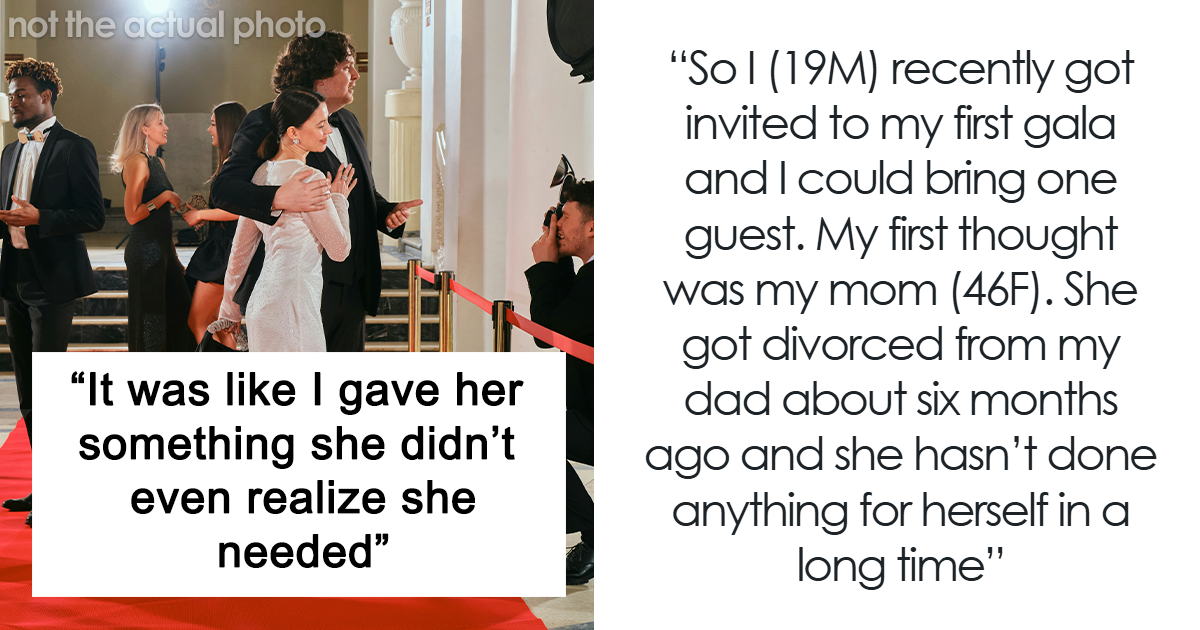
There are sweet mother-son moments, and then there are sweet mother-son moments that accidentally turn into a full-blown emotional detective episode. In one viral online story, a teen decided to take his recently divorced mom to a formal gala as his plus-one. His goal was simple: give her a beautiful night out, help her feel seen again, and remind her that life after divorce does not have to look like a sad movie montage with cold coffee and laundry baskets.
At first, the plan worked. His mom dressed up, enjoyed the attention, smiled more than she had in a long time, and seemed to come alive in the kind of room where chandeliers sparkle and everyone pretends they are not checking the dessert table. But then a man at the event began showing interest in her. Not just any man, according to the teen, but a well-known smooth talker with a reputation for flirting, chasing women, and leaving emotional confetti behind him.
That is where the story becomes more than gossip. It becomes a question many families quietly face after divorce: when a parent starts dating again, where does a child’s concern end and the parent’s independence begin?
The Gala Was Supposed To Be A Gift, Not A Warning Bell
The teen’s invitation came from a loving place. He noticed his mother had been struggling after the divorce. She was still handling responsibilities, still keeping the household moving, but her spark had dimmed. Taking her to a gala was his way of saying, “You still deserve joy.” Honestly, that is better than most teenage gifts, which often involve a half-used candle, a rushed card, or the legendary phrase, “I forgot, but I love you.”
At the gala, his mom received the kind of admiration she may not have felt in years. She looked elegant. She relaxed. She laughed. For a divorced parent who has spent months or years rebuilding identity after a marriage ends, that kind of evening can feel powerful. Divorce does not just split a couple; it can rearrange a person’s confidence, social life, routines, and sense of being desirable.
That is why the son’s gesture mattered. He was not trying to parent his mother. He was trying to celebrate her. But the mood shifted when he noticed a man with a questionable reputation becoming very interested in her. Suddenly, the son was no longer just a proud escort at a fancy event. He became a worried observer, watching someone he loved step into a social situation he did not trust.
Why The Teen Felt So Conflicted
The teen’s concern makes sense. On one hand, his mom is an adult. She can talk to whomever she wants, follow whomever she wants on social media, and decide for herself whether a charming man is a harmless flirt or a walking red flag wearing cologne. On the other hand, children of divorced parents often feel protective, especially when they have watched one parent suffer emotionally.
That protective instinct can be loving, but it can also be heavy. A teen should not have to become a bodyguard, therapist, private investigator, or relationship consultant for a parent. Still, emotions do not always read the family handbook. When someone has seen their mother cry, withdraw, or carry too much alone, they may feel responsible for preventing the next heartbreak.
This is the emotional trap in the story. The teen does not seem to want control over his mother’s life. He wants reassurance that she will not be hurt by someone who appears to treat romance like a hobby and women like collectibles. His concern is not irrational. But the way he handles it matters.
The Man At The Gala: Charming Or Concerning?
Charm is not automatically dangerous. Plenty of decent people are charming. Some can even make small talk without turning it into a hostage situation. The issue is pattern. If someone has a reputation for being manipulative, overly flirtatious, dishonest, or careless with other people’s feelings, that reputation deserves attention.
In situations like this, several warning signs are worth watching. Does the person move too quickly? Do they flood someone with compliments before they know them? Do they ignore boundaries, touch too casually, or pressure for private contact right away? Do they seem more interested in conquest than connection? Do they have a long trail of people describing the same bad behavior?
For someone recently divorced, attention can feel especially intoxicating. After months or years of feeling unseen, being admired can hit like emotional espresso. That does not mean divorced people are helpless or naive. It simply means a vulnerable season can make fast affection feel more meaningful than it really is.
Dating After Divorce Is Not A Simple “Move On” Story
Dating after divorce is complicated because it is not just about romance. It is about identity. A person may be asking, “Am I still attractive?” “Can I trust myself?” “Will anyone see me as more than someone’s ex?” “Do I even remember how flirting works, or do I just smile and hope for the best?”
For parents, the emotional math becomes even more complex. They are not only thinking about themselves. They are thinking about their children, family stability, privacy, judgment, and timing. A new romantic interest can feel exciting to the parent and alarming to the child at the exact same time.
Teenagers, in particular, may respond strongly to a parent dating again. They are old enough to understand romantic implications, but still young enough to feel shaken by family changes. A young child may ask, “Is he coming to dinner?” A teen may silently wonder, “Is this person going to change everything again?”
Why Children Sometimes Become Protective After Divorce
Divorce can push teenagers into emotional roles they were never meant to carry. Some become peacekeepers between parents. Some become emotional support for a grieving mom or dad. Some become hyper-aware of every new person entering the family orbit. They may not say, “I feel responsible for your happiness,” but their behavior says it loudly.
In this story, the son’s worry may come from love, but also from fear. He wanted one good night for his mom. Instead, he accidentally opened the door to a man he believes could hurt her. That can make a teen feel guilty, as if he handed trouble an engraved invitation.
But guilt is not the right frame. He did something kind. He gave his mother a night out. What happened afterward is not his fault. Adults make their own choices. The healthier question is not, “How do I stop this?” It is, “How do I share what I know without disrespecting her?”
Should The Teen Say Something?
Yes, but carefully. Silence may leave his mom without useful information. A dramatic confrontation, however, could make her feel judged, embarrassed, or treated like a child. The best approach is calm, respectful, and specific.
Instead of saying, “Do not talk to him, he is bad news,” the teen could say, “Mom, I’m glad you had fun at the gala. I also wanted to tell you something because I care about you. That man has a reputation for being disrespectful and manipulative with women. I’m not telling you what to do, but I thought you should know.”
That kind of message does three important things. It affirms her happiness, shares the concern, and preserves her autonomy. No adult wants to feel like their teenager has promoted himself to Chief Romance Officer of the household. But most parents would want to know if their child had credible concerns.
What The Mom Might Be Feeling
The mother’s perspective matters too. She may have spent years being responsible, tired, practical, and emotionally drained. Then, for one night, she felt glamorous. Someone noticed her. Someone flirted. Someone made her feel like a woman, not just an ex-wife, a parent, or the person who remembers whether the electric bill is due.
If her son rushes in with panic, she may feel humiliated. She may think, “Can I not enjoy one moment without being monitored?” That reaction would not mean she is foolish. It would mean she is human. Nobody enjoys being warned immediately after feeling desired.
That is why timing matters. The teen should not turn the conversation into an interrogation about Instagram follows, private messages, or whether the man used too many fire emojis. He should simply offer information, then step back.
The Difference Between Warning And Controlling
A warning gives someone information. Control tries to take away their choice. In family relationships, especially after divorce, that difference is everything.
A healthy warning sounds like: “I heard things about him that worry me.” A controlling statement sounds like: “You are not allowed to see him.” One invites judgment; the other starts a power struggle. And if there is one thing teenagers and divorced parents do not need more of, it is another power struggle sitting at the kitchen table like an unpaid bill.
The teen can be honest without becoming harsh. He can be protective without becoming possessive. He can love his mom without treating her as fragile glass. She survived a divorce. She can likely survive an awkward conversation.
How Families Can Handle New Dating After Divorce
Families do better when dating after divorce is handled with communication, patience, and boundaries. Parents do not need to reveal every detail of their romantic lives to their children. In fact, they should not. But when a new person may become important, children need stability and reassurance.
For parents, that means avoiding a revolving door of partners, not oversharing adult problems, and not asking children to approve or reject romantic interests. For teens, it means expressing feelings honestly while remembering that parents are allowed to have lives outside parenthood.
A divorced mom dating again is not betraying her children. A teen feeling uneasy is not automatically being selfish. Both things can be true. The family task is to create enough trust that concerns can be spoken without turning into accusations.
When A “Womanizer” Reputation Should Be Taken Seriously
The word “womanizer” can sometimes be thrown around carelessly. But when multiple people describe someone as manipulative, predatory, dishonest, or emotionally reckless, it is worth paying attention. Reputation alone is not proof, but repeated patterns are not meaningless either.
The biggest concern is not that the man flirted. Flirting at a gala is not exactly breaking news. The concern is whether he uses charm to push boundaries, create false intimacy, or target people who are emotionally vulnerable. A recently divorced person deserves fun and romance, but also respect and safety.
If the man begins asking for money, pushing secrecy, demanding constant attention, insulting the mother’s family, rushing commitment, or making her feel guilty for slowing down, those are serious warning signs. Healthy interest can handle patience. Manipulation hates patience because patience gives people time to think.
What The Teen Can Learn From This Situation
This story may feel like a crisis, but it can become a moment of growth. The teen can learn that loving a parent does not mean managing every risk in that parent’s life. He can learn to speak up respectfully. He can learn that adults sometimes make choices their children do not like, and that does not always mean disaster is coming.
He can also learn that his mother is more than the divorce. She is a person with loneliness, hope, curiosity, and maybe a slightly rusty flirting muscle. Seeing a parent as a full human being is strange for many teens. It is like discovering your teacher has a first name or that your dentist goes to concerts. Deeply unsettling, but technically allowed.
Most importantly, he can stop blaming himself. Taking his mom to the gala was generous. The night gave her confidence. Even if the man turns out to be bad news, the son did not cause that. He simply created an opportunity for joy, and joy sometimes arrives with complications wearing a nice suit.
Experiences And Lessons Related To This Story
Many families recognize some version of this situation. A parent finally begins stepping back into the world after divorce, and a child reacts with a mix of happiness, anxiety, protectiveness, and confusion. The child wants the parent to be happy, but not reckless. The parent wants support, but not supervision. Everyone is trying to be loving, and somehow everyone still manages to step on an emotional rake.
One common experience is the teen who becomes the “little adult” after divorce. This teen notices when Mom is sad, when Dad is angry, when money is tight, when the house feels too quiet, and when a new romantic interest changes the mood. Because teenagers are observant, they may see details adults underestimate. They notice tone, timing, body language, and inconsistencies. Sometimes they are wrong. Sometimes they are very right.
Another familiar experience is the divorced parent who underestimates how strange dating looks from the child’s side. To the parent, a new person may represent hope. To the teen, that same person may represent uncertainty. Will this person come to family events? Will they sleep over? Will they replace the other parent? Will they criticize family traditions? Will they make Mom act different? These questions may sound dramatic, but divorce already taught the teen that family life can change quickly.
There is also the experience of watching someone you love enjoy attention from someone you distrust. That feeling is uncomfortable because it mixes tenderness with alarm. The teen at the gala probably saw his mom smile and felt proud. Then he saw who was making her smile and felt his stomach drop. That emotional whiplash is real. It is possible to be happy for someone and worried about them at the same time.
Families can learn from this by building a culture of low-drama honesty. A teen should be able to say, “Something about that person makes me uncomfortable,” without being dismissed as jealous or immature. A parent should be able to say, “I hear you, but I need to make my own choices,” without being accused of not caring. The goal is not total agreement. The goal is respect.
For divorced parents, one useful practice is to keep early dating separate from family life until trust has developed. Children do not need to meet every charming stranger, dinner date, or person who says “we should grab coffee sometime.” Let a relationship prove itself before it enters the family system. This protects children from emotional churn and protects the parent from confusing excitement with commitment.
For teens, the lesson is to avoid becoming the relationship police. Share concerns once, clearly and kindly. If the situation becomes genuinely unsafe, involve another trusted adult. But if the concern is mostly discomfort, the teen may need to practice stepping back. That does not mean not caring. It means caring without carrying the whole emotional suitcase.
The gala story also reminds readers that divorce recovery is not linear. A person may look strong and still be lonely. A person may enjoy flirting and still be cautious. A parent may need both independence and support. A teen may need both reassurance and boundaries. Everyone in the story is trying to figure out what love looks like after the family map has changed.
In the end, the most powerful move is not panic. It is conversation. Not a courtroom-style cross-examination. Not a lecture. Just a sincere exchange between a son and his mother: “I love seeing you happy, and I also want you to be safe.” That sentence carries more wisdom than a hundred dramatic warnings. It respects her freedom while honoring his concern. And honestly, in a world full of messy relationships, that is a pretty elegant place to start.
Conclusion
The story of the teen who took his divorced mom to a gala is compelling because it is not really about one flashy event or one questionable man. It is about the delicate emotional territory families enter after divorce. Parents are rebuilding their identities. Teens are adjusting to new realities. Everyone wants happiness, but no one wants to watch someone they love get hurt.
The teen’s concern is understandable, but his best path is not control. It is honest, respectful communication. His mother deserves joy, romance, and independence. She also deserves information if someone around her has a troubling reputation. The healthiest response sits somewhere between silence and panic: speak kindly, share the concern, then trust her to make her own decision.
That may not feel easy. Love rarely does. But sometimes the most mature form of protection is not standing in front of someone. It is standing beside them, telling the truth, and letting them remain the author of their own life.