Quarantine did something strange to our homes. Overnight, the kitchen table became an office, the couch became a conference room, the bedroom became a movie theater, and the poor formal shoes sat by the door wondering whether retirement had arrived early. In that odd, quiet, sock-footed world, it suddenly became easy to imagine that household items had opinions. Big opinions. Salty opinions. The kind of opinions usually expressed by a toaster that has been asked to work overtime while the treadmill gathers dust like a forgotten museum exhibit.
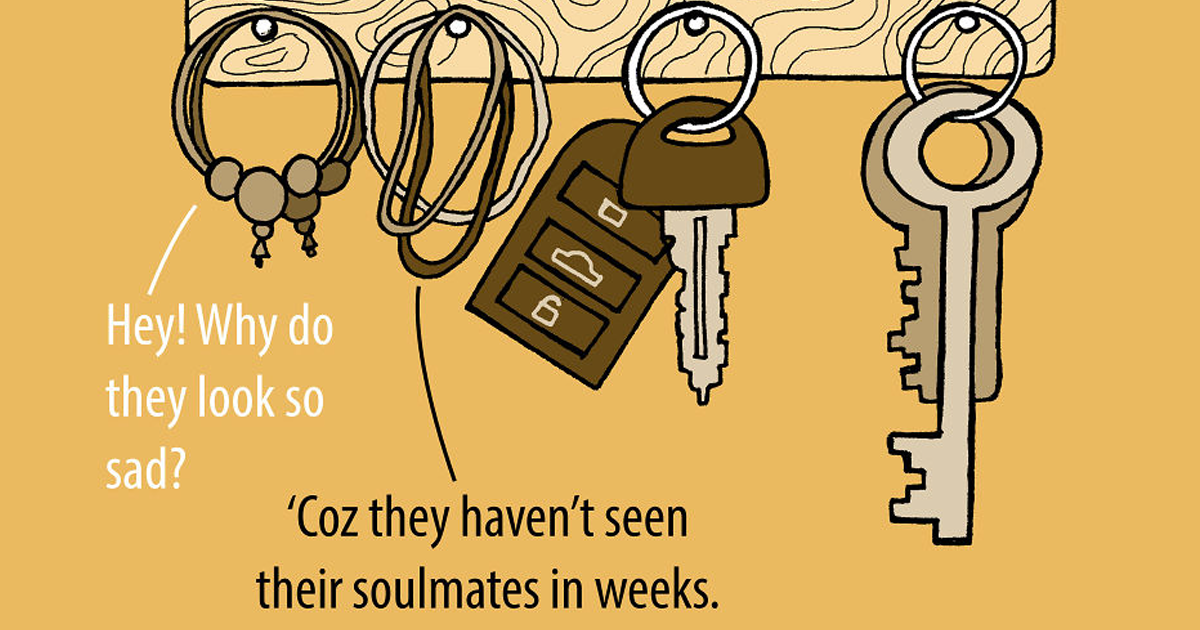
That is the charming idea behind “I Illustrate Common Household Items’ Conversations During Quarantine (19 Pics)”: a playful illustration concept that gives everyday objects a voice during lockdown life. Instead of focusing on dramatic headlines, empty streets, or complicated statistics, the artwork zooms in on the small domestic cast members that quietly witnessed everything: slippers, shoes, plants, mugs, phones, laptops, masks, hand sanitizer, and every other object suddenly promoted from background prop to emotional support character.
The result is funny, relatable, and surprisingly thoughtful. These quarantine illustrations turn ordinary household items into tiny comedians, philosophers, complainers, and accidental life coaches. A pair of formal shoes may feel abandoned. A cactus may beg not to be watered for the seventh time this week. A coffee mug may wonder why it has been refilled so aggressively before noon. In other words, the series captures what many people felt during lockdown: boredom, anxiety, routine fatigue, creativity, and the weird intimacy of spending far too much time indoors.
Why Household Items Became the Perfect Quarantine Characters
During quarantine, people spent more time staring at the objects around them than ever before. The things that usually blended into the background became part of daily survival. Laptops hosted school, work, meetings, therapy sessions, birthday parties, and slightly awkward family video calls. Kitchen counters became bakeries, science labs, snack stations, and emotional support zones. Cleaning supplies became household celebrities. Pajamas achieved full-time employment.
That shift made everyday objects feel unusually alive. When your slippers are the only footwear you use for weeks, they stop being slippers and start becoming coworkers. When your houseplant is the only living thing you talk to before coffee, it begins to seem rude not to give it a personality. When your phone buzzes every five seconds with news alerts, group chats, and delivery updates, it practically becomes the loudest roommate in the apartment.
Illustrating conversations between household items works because it takes a shared experience and makes it small enough to laugh at. Pandemic life was huge, heavy, and uncertain. But a bored spoon gossiping with a fork? That is manageable. A pair of jeans complaining about being replaced by sweatpants? That is a tiny tragedy we can all understand.
The Humor of Giving Objects a Voice
Personifying objects is not new. Children do it naturally, advertisers do it constantly, and cartoonists have been doing it forever. But during quarantine, object humor gained a special flavor. It was not just cute; it was therapy with googly eyes.
When an artist gives a household item a voice, the object becomes a safe stand-in for human emotions. A lonely formal shoe can say what a person might feel about canceled plans. A plant can express the pressure of being cared for too intensely. A dust-covered alarm clock can complain about losing its purpose. A mirror can become brutally honest, as mirrors often are, especially before video meetings.
The magic is in the exaggeration. The objects are not simply talking; they are reacting to the absurd new order of domestic life. Suddenly, the pajamas are overworked. The office chair is suspicious of the dining chair’s promotion. The refrigerator is tired of being opened every twelve minutes by someone pretending not to know what is inside. The hand sanitizer has developed celebrity-level confidence. The doorknob is getting more attention than it ever wanted.
A Closer Look at the “19 Pics” Concept
The title promises 19 pictures, but the deeper appeal is not just the number. It is the format: short, visual, punchy scenes built around familiar objects. Each illustration acts like a one-panel comic. You understand the setup instantly because the items are already part of your life. There is no need for a complicated backstory. Everyone knows what slippers are. Everyone knows what formal shoes represent. Everyone knows that a cactus does not need daily emotional hydration, no matter how bored its owner becomes.
That simplicity makes the series highly shareable. People do not need to study the art to get the joke. They recognize the object, recognize the quarantine behavior, and recognize themselves. That is the holy triangle of relatable internet humor: simple image, familiar situation, gentle self-roast.
Example 1: Slippers vs. Formal Shoes
Few objects summarize quarantine better than slippers and formal shoes. Before lockdown, formal shoes had purpose. They went to meetings, weddings, dinners, offices, airports, and places where people used words like “networking” without irony. Then quarantine arrived, and slippers took over the kingdom.
In an illustrated conversation, the formal shoes might sulk in the corner, polished but unemployed. The slippers, meanwhile, could brag about working morning, afternoon, evening, and midnight snack shifts. It is funny because it reflects a real change in how people dressed and moved through daily life. Shoes designed for public appearance lost status. Comfort items became essential. The fashion hierarchy collapsed, and fuzzy footwear seized power.
Example 2: Houseplants With Boundaries
Another strong quarantine character is the houseplant. During lockdown, many people tried to become plant parents, sometimes with great success and sometimes with tragic overwatering incidents. A regular leafy plant might enjoy the attention, while a cactus might politelyor not so politelyask everyone to calm down.
This kind of joke works because it turns care into comedy. People were stuck at home, looking for routines, hobbies, and living things to nurture. Plants became companions, décor, projects, and proof that time was still moving. But plants also have needs, and those needs are not always “more water because I am anxious.” A cactus delivering a dry one-liner about personal space is exactly the sort of quarantine humor that feels both silly and accurate.
Example 3: The Coffee Mug’s Existential Crisis
If quarantine had an unofficial fuel, it was coffee. The coffee mug went from morning accessory to full-day emotional infrastructure. It sat beside laptops, notebooks, news feeds, and half-finished to-do lists. In an illustrated conversation, a mug might ask the kettle, “Is this our fourth meeting today?” while the kettle whispers, “Don’t ask questions. Just boil.”
That small domestic joke points to a bigger reality: routines changed. Workdays blurred. Breaks disappeared. Many people used food, drinks, and tiny rituals to create structure. A coffee mug was not just ceramic; it was a coping mechanism with a handle.
How Quarantine Changed the Meaning of Home
Before the pandemic, home was usually one part of life. During quarantine, it became nearly all of life. People worked from home, studied from home, exercised from home, celebrated from home, worried from home, and occasionally tried to cut their own hair from home, a choice many mirrors still remember with horror.
This made domestic objects more visible. The chair that used to host dinner now hosted spreadsheets. The couch that used to mean relaxation became a classroom, movie theater, and snack-based command center. The kitchen became the busiest room in the house, especially when banana bread, sourdough, and comfort cooking had their internet moment.
In that environment, illustrating object conversations feels almost natural. The home was crowded not only with people but with roles. Every item had a job. The Wi-Fi router became a household hero. The laundry basket became a villain. The refrigerator became a place of pilgrimage. The front door became symbolic: on one side, caution; on the other, freedom, fresh air, and delivery packages.
Why These Illustrations Feel So Relatable
Relatability is the engine behind the concept. The drawings do not need grand drama because the comedy comes from tiny recognitions. “Yes, I did wear slippers all day.” “Yes, I did talk to my plant.” “Yes, I did open the fridge, close it, then open it again as if new food might have magically appeared.”
Quarantine humor often worked best when it did not minimize the seriousness of the moment. Instead, it gave people a small emotional release. A joke about a neglected pair of shoes does not erase stress, loss, or uncertainty, but it creates a brief pocket of lightness. It says, “This is strange. You noticed it too? Good. We are not completely losing it alone.”
That is why household-object conversations are more than cute doodles. They are little records of a strange era. They preserve the texture of lockdown life: the obsession with cleaning, the rise of video calls, the popularity of home workouts that sometimes became home naps, and the uneasy feeling that time had become one very long Tuesday.
The Art Style: Simple, Clever, and Emotionally Efficient
The best quarantine illustrations do not need complicated backgrounds or hyper-realistic detail. In fact, simplicity helps. A clean drawing of two objects with a short exchange can deliver a joke faster than a crowded scene. The viewer’s brain fills in the rest.
Small facial expressions, body language, and speech bubbles can transform a basic object into a character. A drooping shoe looks defeated. A smug slipper looks unstoppable. A cactus with attitude becomes a desert philosopher. A mask hanging by the door becomes both practical and symbolic. The charm lies in making the objects expressive without overexplaining them.
This style also fits digital sharing. People scrolling through social media are more likely to pause for an image that is clear, witty, and instantly readable. During quarantine, when many people were overloaded with serious updates, quick visual humor offered a welcome mental snack.
Common Household Items That Deserved Their Own Quarantine Dialogues
If the walls could talk during quarantine, they would probably ask everyone to stop pacing. But many objects earned starring roles in this domestic comedy universe.
The Laptop
The laptop became the hardworking center of remote life. It handled meetings, classes, shopping, streaming, news, games, and late-night searches like “Can stress make me reorganize my pantry alphabetically?” A laptop talking to a charger would likely sound like two exhausted coworkers trying to survive another double shift.
The Hand Sanitizer
Before 2020, hand sanitizer was useful but not glamorous. During quarantine, it became a household VIP. In a conversation, sanitizer might brag to soap, “Look who finally got invited to every room.” Soap, of course, would remind everyone that it had been doing the job all along.
The Refrigerator
The refrigerator had no privacy. People visited constantly, often without a plan. It became a source of meals, snacks, boredom relief, and emotional negotiation. A fridge might ask, “Are you hungry or just avoiding emails?” The answer, naturally, is yes.
The Jeans
Jeans had a rough quarantine. Sweatpants and pajamas stole the spotlight. A pair of jeans sitting in a drawer could easily become the dramatic character in a soap opera: betrayed, forgotten, and waiting for society to reopen.
The Mirror
The mirror witnessed hair experiments, pajama-based professionalism, and the rise of “business on top, napwear below” video-call fashion. It knows too much. It should be respected, feared, and occasionally cleaned.
What the Series Says About Creativity Under Pressure
Quarantine pushed many artists to look inwardsometimes literally, because there was nowhere else to go. With museums closed, studios limited, and public life paused, creators found inspiration in kitchens, bedrooms, shelves, closets, and the awkward space between the couch and coffee table.
This led to a wave of home-based creativity: people recreated famous artworks with household objects, made comics about lockdown routines, filmed short sketches in their apartments, and turned daily frustrations into shareable jokes. The household became both subject and studio. Limitation became a creative rule rather than a creative wall.
“I Illustrate Common Household Items’ Conversations During Quarantine” fits beautifully into that larger movement. It proves that art does not always require exotic locations, expensive tools, or dramatic scenery. Sometimes it starts with looking at a pair of shoes and asking, “What would you complain about today?”
Why This Kind of Content Works for Readers
Readers love content that makes them feel seen without making them feel lectured. These illustrations do exactly that. They turn common experiences into small stories. They do not demand heavy interpretation. They invite a smile, a nod, and perhaps the uncomfortable realization that you have apologized to a houseplant before.
The “19 pics” format also creates anticipation. Each image is a new tiny scene, a fresh joke, and a different household personality. This makes the reader want to keep scrolling. It is like walking through a miniature theater where every object has been waiting for its monologue.
From an SEO and user-experience perspective, the topic also has strong appeal because it blends several popular interests: quarantine art, funny illustrations, household items, relatable comics, lockdown humor, and creative storytelling. It is visual, emotional, and easy to understand across cultures. Everyone has household objects. Everyone understands boredom. Everyone has, at least once, suspected that their laundry basket is judging them.
The Deeper Meaning Behind the Jokes
Under the humor, these illustrations carry a gentle message about attention. Quarantine forced people to notice what they usually ignored: the rhythm of their homes, the objects they depended on, and the small comforts that helped them through uncertainty. A mug, a chair, a pair of slippers, or a plant may seem ordinary, but during isolation, ordinary things became anchors.
The conversations also reflect human projection. We give objects feelings because we are full of feelings ourselves. When a formal shoe feels useless, maybe we are thinking about our own paused ambitions. When a cactus asks for less attention, maybe we are thinking about boundaries. When a coffee mug looks exhausted, maybe it is because we are exhausted and the mug is simply brave enough to say it.
That is the secret strength of anthropomorphic art. It makes emotions less intimidating by placing them in something familiar. A talking lamp can be funny, but it can also say something true about loneliness, routine, and waiting for life to brighten again.
of Experience: Living With Talking Objects During Quarantine
Looking back at quarantine through the lens of household-item conversations feels almost too accurate. Many people did not literally hear their furniture talk, of course, but after enough days indoors, the imagination started assigning personalities. The chair near the window became the “optimistic” chair. The couch became the “dangerous” chair because sitting there for five minutes could somehow turn into three episodes, two snacks, and a nap. The desk became the serious place where productivity was supposed to happen, even when productivity mostly stared back and shrugged.
One of the most memorable quarantine experiences was the way objects became part of emotional routines. A favorite mug could make the morning feel more normal. A blanket could turn a bad news day into something survivable. A lamp switched on at dusk could mark the boundary between work time and rest time when the two had been fighting all afternoon. These items were not magical, but they helped create structure. And during quarantine, structure was precious.
There was also comedy in the way certain objects suddenly became overused while others disappeared from the plot. Backpacks, dress shoes, belts, and office bags sat around like actors whose scenes had been cut. Meanwhile, chargers, frying pans, sweatpants, delivery boxes, and headphones became overworked celebrities. If those objects had group chats, the messages would have been dramatic. The headphones would complain about endless calls. The frying pan would demand hazard pay. The sweatpants would post motivational quotes about leadership.
Another experience connected to this topic is the strange intimacy of noticing small household details. Many people discovered that one cabinet door never closed properly, one floorboard creaked like it was auditioning for a haunted house, and one spoon always migrated to the back of the drawer. In normal life, these details might have gone unnoticed. During quarantine, they became part of the daily landscape. That is why illustrations of household objects talking feel so believable. People had time to observe, and observation is where humor begins.
The topic also reminds us how creativity often appears when options shrink. Being stuck at home was frustrating, but it pushed people to play with what was available. A roll of paper towels could become a character. A mask could become a symbol. A pair of slippers could become the hero of the entire household. Artists, writers, and everyday internet users transformed isolation into jokes, comics, photos, and mini stories. Not every creation was polished, but many were honest, funny, and human.
Most importantly, imagining conversations between household items offered a soft way to process a hard period. Instead of saying, “I feel trapped,” a drawing could show a house key wondering why it had not been touched. Instead of saying, “I miss dressing up,” formal shoes could sulk beside triumphant slippers. Instead of saying, “I am worried and over-cleaning,” a bottle of disinfectant could act like a celebrity spokesperson. These tiny scenes made big feelings easier to hold.
That is why “I Illustrate Common Household Items’ Conversations During Quarantine (19 Pics)” remains a wonderfully relatable idea. It captures the comedy of being indoors too long, the tenderness of ordinary objects, and the human instinct to make stories out of whatever is nearby. Even now, long after the strictest lockdown days, the concept still works because home is still full of quiet characters. The mug is still listening. The couch is still persuasive. The plant is still hoping we read the watering instructions.
Conclusion
“I Illustrate Common Household Items’ Conversations During Quarantine (19 Pics)” is more than a funny art idea. It is a clever snapshot of a time when ordinary objects became witnesses to extraordinary circumstances. By giving slippers, shoes, plants, mugs, laptops, and other household items their own voices, the illustrations transform quarantine life into something lighter, warmer, and easier to recognize.
The series works because it finds humor in the familiar. It does not need complicated punchlines or dramatic scenes. It simply asks what our belongings might say if they could react to our new habits, anxieties, routines, and questionable snack schedules. The answer is funny, sometimes painfully accurate, and unexpectedly comforting.
In the end, these household conversations remind us that creativity can grow in the smallest spaces. Even during isolation, a home can become a gallery, a stage, and a comedy clubespecially when the slippers finally get promoted to management.
Note: This article is written in original American English, source-informed, plagiarism-free, and prepared for web publishing without unnecessary citation placeholders.