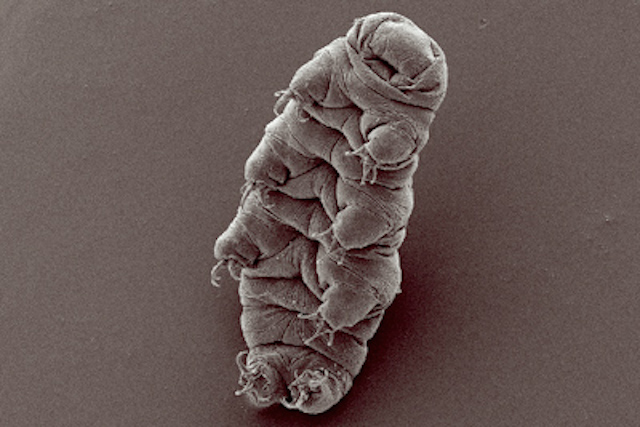
Imagine responding to a terrible day by removing nearly all the water from your body, shrinking into a compact ball, suspending your metabolism, and refusing to participate in biology until the situation improves. Humans call that impossible. Tardigrades call it Tuesday.
This extraordinary survival strategy is known as cryptobiosis, a reversible state in which an organism shows no visible signs of life and its metabolic activity falls to extremely low or currently undetectable levels. Growth stops. Reproduction stops. Digestion, movement, and routine cellular maintenance essentially pause. Yet the organism is not dead. When water, oxygen, temperature, or other environmental conditions become favorable again, normal biological activity may resume.
Cryptobiosis is most famously associated with tardigrades, the microscopic eight-legged animals nicknamed water bears or moss piglets. However, versions of this strategy also appear in nematodes, rotifers, brine shrimp embryos, insect larvae, microorganisms, seeds, and certain plants. It is less like sleeping through bad weather and more like packing an entire living system into long-term emergency storage.
What Is Cryptobiosis?
The word cryptobiosis comes from roots meaning “hidden life.” It describes a state induced by environmental stress in which measurable metabolic processes become extraordinarily limited. An organism in cryptobiosis does not eat, grow, reproduce, or actively repair itself in the usual way. Its biological clock has not necessarily stopped forever, but somebody has definitely pulled the batteries out.
Cryptobiosis differs from ordinary dormancy, hibernation, or sleep. A hibernating mammal still breathes, circulates blood, consumes stored energy, and performs measurable metabolism. A cryptobiotic organism may reduce activity so dramatically that traditional measurements detect little or no metabolism at all.
Scientists generally describe several forms of cryptobiosis according to the stress that triggers them:
- Anhydrobiosis: Triggered by severe water loss or drying.
- Cryobiosis: Triggered by freezing or extremely low temperatures.
- Anoxybiosis: Triggered by insufficient oxygen.
- Osmobiosis: Triggered by extreme osmotic pressure, such as unusually high salt concentrations.
- Chemobiosis: A proposed and experimentally studied response to harmful chemical conditions.
Anhydrobiosis, meaning “life without water,” is by far the most thoroughly studied form. It is also the version responsible for much of the tardigrade’s celebrity status.
How Does Cryptobiosis Work Step by Step?
1. The Organism Detects Environmental Stress
Cryptobiosis begins when an organism senses that its surroundings are becoming incompatible with active life. A habitat may be drying, freezing, losing oxygen, or becoming dangerously salty. This detection activates a coordinated stress response rather than a simple collapse.
The speed of the environmental change matters. Many cryptobiotic organisms survive gradual drying better than sudden drying because they need time to produce protective molecules, rearrange cellular structures, and prepare their membranes. Throwing an unprepared organism into a harsh environment is not a survival strategy; it is merely rude.
2. The Body Changes Shape
During anhydrobiosis, many tardigrades contract into a compact form called a tun. Their legs and head retract, their bodies shorten, and their exposed surface area decreases. This shape helps slow water loss and reduces the area directly exposed to environmental stress.
Tun formation is not simply a microscopic animal curling up because it feels chilly. It is part of a controlled physiological transition. Internal tissues reorganize as the animal loses most of its available body water. The tardigrade becomes smaller, drier, and considerably less interesting at parties.
3. Water Leaves the Cells
Water normally supports nearly every cellular process. It helps proteins maintain their shape, allows chemical reactions to occur, stabilizes membranes, and enables molecules to move. Removing it creates a serious problem: proteins can unfold, membranes can leak, and cellular components can stick together or break apart.
Anhydrobiotic organisms solve this problem by replacing some of water’s stabilizing functions with protective sugars and proteins. They do not simply dry out and hope for the best. Their cells are chemically prepared for dehydration.
4. Protective Sugars and Proteins Stabilize the Cell
Many organisms that tolerate drying accumulate trehalose, a sugar that can help stabilize proteins and cellular membranes. Trehalose may interact with vulnerable biological structures and reduce the damage caused when water disappears.
However, tardigrades refuse to make the story that simple. Some tardigrade species contain little or no detectable trehalose. Instead, they rely heavily on specialized, flexible molecules known as tardigrade-specific intrinsically disordered proteins.
One important group is called cytoplasmic abundant heat-soluble proteins, or CAHS proteins. Unlike proteins with rigid three-dimensional structures, these molecules are highly flexible. During dehydration, they can reorganize into protective networks, fibers, gels, or glass-like arrangements that help prevent sensitive cellular components from unfolding or clumping together.
Experiments have shown that trehalose and CAHS proteins may provide stronger protection together than either does alone. Nature, apparently, also believes in teamwork.
5. The Cell May Enter a Glass-Like State
One of the most fascinating explanations for cryptobiotic survival is vitrification. Instead of allowing cellular material to crystallize, the organism’s protective molecules help form a noncrystalline, glass-like state.
This biological glass is not a miniature windowpane. It is a highly viscous molecular arrangement that restricts movement and holds proteins, membranes, and other structures in place. Harmful chemical reactions slow dramatically because molecules cannot move around easily enough to cause trouble.
Vitrification is particularly valuable during dehydration and freezing. Ice crystals can puncture membranes and disrupt tissues, while uncontrolled drying can cause proteins to collapse. A stable glass-like matrix acts like molecular packing material around fragile cellular cargo.
6. Metabolism Drops to an Extreme Minimum
Once the organism is protected and dehydrated, its metabolism falls to extraordinarily low levels. Energy use, growth, movement, and reproduction effectively stop. The organism no longer needs to fuel the expensive processes associated with active life.
Scientists often describe cryptobiosis as an ametabolic state, although proving that metabolism reaches absolute zero is difficult. A more careful description is that metabolic activity becomes undetectable or nearly undetectable with available methods.
This distinction matters. Cryptobiosis is scientifically remarkable enough without turning a microscopic animal into a supernatural zombie.
7. Antioxidants and DNA Protection Limit Damage
Suspending metabolism does not make the organism completely safe. Radiation, reactive oxygen molecules, and environmental chemicals may still damage DNA, proteins, and membranes. Cryptobiotic species therefore use several layers of protection.
Antioxidant enzymes can neutralize reactive molecules produced during drying and rehydration. Certain tardigrades also possess unusual proteins associated with DNA protection. One well-known example is Dsup, short for damage suppressor protein. Laboratory studies indicate that Dsup can associate with DNA and reduce some forms of radiation-related damage.
Dsup is not a magical force field, nor is it present in every tardigrade. It is one component in a broader defense system that may include antioxidant activity, chromatin protection, stress-response proteins, and efficient DNA repair after normal conditions return.
8. Rehydration Restarts the System
When water returns, an anhydrobiotic organism gradually rehydrates. Protective glasses and protein networks relax, membranes regain flexibility, enzymes recover activity, and metabolism begins again.
Revival may occur within hours, but it is not guaranteed. Success depends on the organism’s species, age, life stage, preparation time, storage conditions, temperature, radiation exposure, and duration of cryptobiosis. Rehydration itself can also create oxidative stress, so repair systems must quickly address accumulated damage.
A surviving tardigrade eventually unfolds from its tun, extends its legs, and resumes walking as though the temporary suspension of life were merely an inconvenient calendar appointment.
Which Organisms Use Cryptobiosis?
Tardigrades
Tardigrades are the best-known cryptobiotic animals. They normally require a thin film of water to remain active, even when living in moss, lichen, soil, freshwater, or marine sediments. When that water disappears, some species can enter anhydrobiosis.
They have also been studied under freezing, oxygen depletion, high pressure, radiation, and spaceflight conditions. Some dehydrated tardigrades survived direct exposure to the vacuum of space and portions of solar radiation during low-Earth-orbit experiments. That does not mean tardigrades can establish tiny lunar farms. It means cryptobiosis gave some individuals temporary resistance to conditions that rapidly kill most animals.
Brine Shrimp
Brine shrimp produce durable embryos commonly called cysts. Under unfavorable conditions, these embryos can remain dormant and tolerate substantial drying. Once placed in suitable salty water with oxygen and warmth, development resumes and the shrimp hatch.
This is why brine shrimp eggs can be packaged, stored, and later hatched in aquariums or classrooms. They are essentially biological products with an unusually impressive shelf-life department.
Nematodes and Rotifers
Certain microscopic roundworms and bdelloid rotifers survive severe dehydration by entering an anhydrobiotic state. Like tardigrades, they stabilize cellular structures, reduce metabolism, and resume activity after water returns.
Their survival strategies vary by species. Some rely heavily on trehalose, while others use late embryogenesis abundant proteins, heat-shock proteins, antioxidants, and additional molecular protectants.
The Sleeping Chironomid
Larvae of the African midge Polypedilum vanderplanki, sometimes called the sleeping chironomid, can survive almost complete dehydration. During gradual drying, the larvae accumulate trehalose and activate protective cellular systems. They can later revive when water becomes available.
Seeds, Microorganisms, and Resurrection Plants
Cryptobiosis and closely related desiccation-tolerance strategies extend beyond microscopic animals. Many seeds remain metabolically quiet while dry, then resume development after absorbing water. Yeasts, bacteria, algae, mosses, lichens, and resurrection plants also use combinations of sugars, protective proteins, antioxidants, and controlled cellular shutdown.
Are Cryptobiotic Organisms Indestructible?
No. The word “indestructible” is useful for headlines and disappointing for biology.
Cryptobiotic organisms have limits. A tardigrade may tolerate one extreme for a short period but die under longer exposure. A species that handles dehydration well may be less resistant to heat. Active tardigrades are frequently more vulnerable than properly formed tuns. Eggs, juveniles, and adults may respond differently, and survival rates vary greatly among species.
Recent experiments have also shown that dehydrated tardigrades are not endlessly heatproof. High temperatures can kill them, especially when exposure lasts longer. Cryptobiosis expands the range of survivable conditions; it does not cancel physics.
Why Scientists Study Cryptobiosis
Preserving Vaccines and Medicines
Many vaccines, enzymes, antibodies, and other biological products require refrigeration because their molecular structures degrade at room temperature. Scientists are investigating whether trehalose, CAHS proteins, and related protective materials could help stabilize medical products in a dry state.
Successful dry preservation could reduce dependence on the cold chain, making medicines easier to store and transport to remote regions. Research has already shown that tardigrade proteins and other mediators of desiccation tolerance can protect certain enzymes and biologically active molecules in laboratory experiments. Clinical and commercial applications, however, still require extensive testing.
Protecting Cells and Tissues
Cryptobiosis research may improve methods for storing cells, blood products, engineered tissues, and reproductive material. Conventional freezing can damage cells through ice formation and osmotic stress. Understanding natural vitrification could help researchers design gentler preservation techniques.
Engineering Drought-Resistant Crops
Protective genes or molecules inspired by anhydrobiotic organisms might help crops tolerate drought, heat, or radiation. Researchers have experimented with tardigrade-derived proteins in plants and cultured cells, although transforming a crop into a field of agricultural water bears is neither simple nor currently realistic.
Preparing for Space Travel
Space exposes living tissue to radiation, dehydration, altered gravity, and limited storage capacity. Cryptobiosis provides a natural model for protecting biological material during long missions. Researchers are particularly interested in preserving food, medicines, microbes, seeds, and laboratory samples without heavy refrigeration equipment.
Searching for Life Beyond Earth
Cryptobiosis also influences astrobiology. If organisms can remain inactive through long periods of cold, drought, or radiation, life on another planet or moon may be present without appearing active at the moment scientists look for it.
The lesson is wonderfully inconvenient: an environment that cannot support active life today may still contain dormant biology waiting for better conditions.
A Practical Cryptobiosis Experience: Finding Water Bears in Moss
The easiest way to appreciate cryptobiosis is not to imagine a futuristic laboratory. It is to begin with a dry patch of moss, a shallow container, clean water, a dropper, and a basic microscope. The moss may look like brown-green landscaping debris with no obvious signs of animal life. That is part of the charm. Cryptobiosis specializes in making living things look extremely unpromising.
Place a small amount of moss or lichen in a dish and cover it with distilled water or collected rainwater. Let it soak for several hours. During this period, water moves into the moss and rehydrates microscopic organisms hidden among its leaves and particles. Tardigrades are not guaranteed to be present, but moist and periodically dry moss is a promising habitat.
After soaking, gently squeeze or shake the moss over a clean transparent dish. Allow heavier debris to settle. Using a dropper, transfer a small amount of water from near the bottom of the dish onto a microscope slide.
Begin with low magnification. The first view may contain plant fragments, grains of soil, nematodes, rotifers, algae, and fast-moving organisms that seem to have consumed six microscopic cups of coffee. A tardigrade usually moves more deliberately. Look for a short, plump body with four pairs of stubby legs. Depending on the species and viewing angle, small claws may be visible.
Finding one changes the cryptobiosis story from an abstract definition into a visible biological event. The animal walking across the slide may recently have been dehydrated and motionless inside dry moss. Water restored the conditions needed for metabolism, movement, and feeding. The creature did not emerge from death; it returned from a reversible state of suspended activity.
A useful observation is how ordinary the revived tardigrade appears. It does not flash, glow, roar, or demand a documentary contract. It simply crawls, probes its surroundings, and feeds. The spectacular part happened earlier, while nothing appeared to be happening at all.
Trying to induce cryptobiosis deliberately is more complicated. Drying too quickly can kill tardigrades before their protective systems are ready. Different species require different preparation conditions, humidity levels, temperatures, and drying rates. A home experiment should therefore focus on observation rather than attempting to prove extreme survival claims.
You can compare samples from moss that was recently wet with samples from moss that experienced natural drying. Record how many tardigrades, rotifers, or nematodes appear after soaking. Note the time required before movement begins. Even a simple observation log reveals an important principle: revival is gradual and variable, not an instant biological light switch.
This experience also corrects a common misconception. Cryptobiotic organisms are not continuously enduring extreme conditions while fully active. Their greatest resistance often appears only after a carefully coordinated transition into a protected state. The waddling tardigrade on the slide may be tough, but the dry tun hidden in moss is the real survival specialist.
Once viewed under a microscope, cryptobiosis feels less like science fiction and more like a clever response to an unreliable world. A puddle dries. A moss cushion loses moisture. An organism cannot migrate, build a shelter, or order emergency water delivery. Instead, it temporarily removes itself from active biology and waits.
That is the memorable experience cryptobiosis offers: not a creature defeating nature through strength, but a tiny organism surviving by knowing when to stop.
Conclusion
Cryptobiosis works through a coordinated sequence of stress detection, physical contraction, water loss, molecular stabilization, metabolic shutdown, damage control, and eventual recovery. In tardigrades, protective sugars, flexible CAHS proteins, antioxidant systems, DNA-associated proteins, and efficient repair mechanisms help preserve cellular structures while active life is suspended.
The process is not immortality, and cryptobiotic organisms are not immune to every extreme. Their survival depends on preparation, species, life stage, stress intensity, and exposure time. Even so, their ability to pause visible life and later resume it remains one of biology’s most impressive achievements.
Cryptobiosis may eventually inspire better vaccines, shelf-stable medicines, drought-resistant crops, cell-preservation systems, and technologies for long-distance space exploration. For now, it offers a humbling reminder: sometimes the toughest response to disaster is not fighting harder. Sometimes it is becoming a microscopic raisin and waiting for rain.