Note: This article is based on publicly reported interviews, entertainment journalism, podcast statements, and documented events surrounding Dan Harmon, Chevy Chase, Community, and the broader conversation about accountability in creative workplaces.
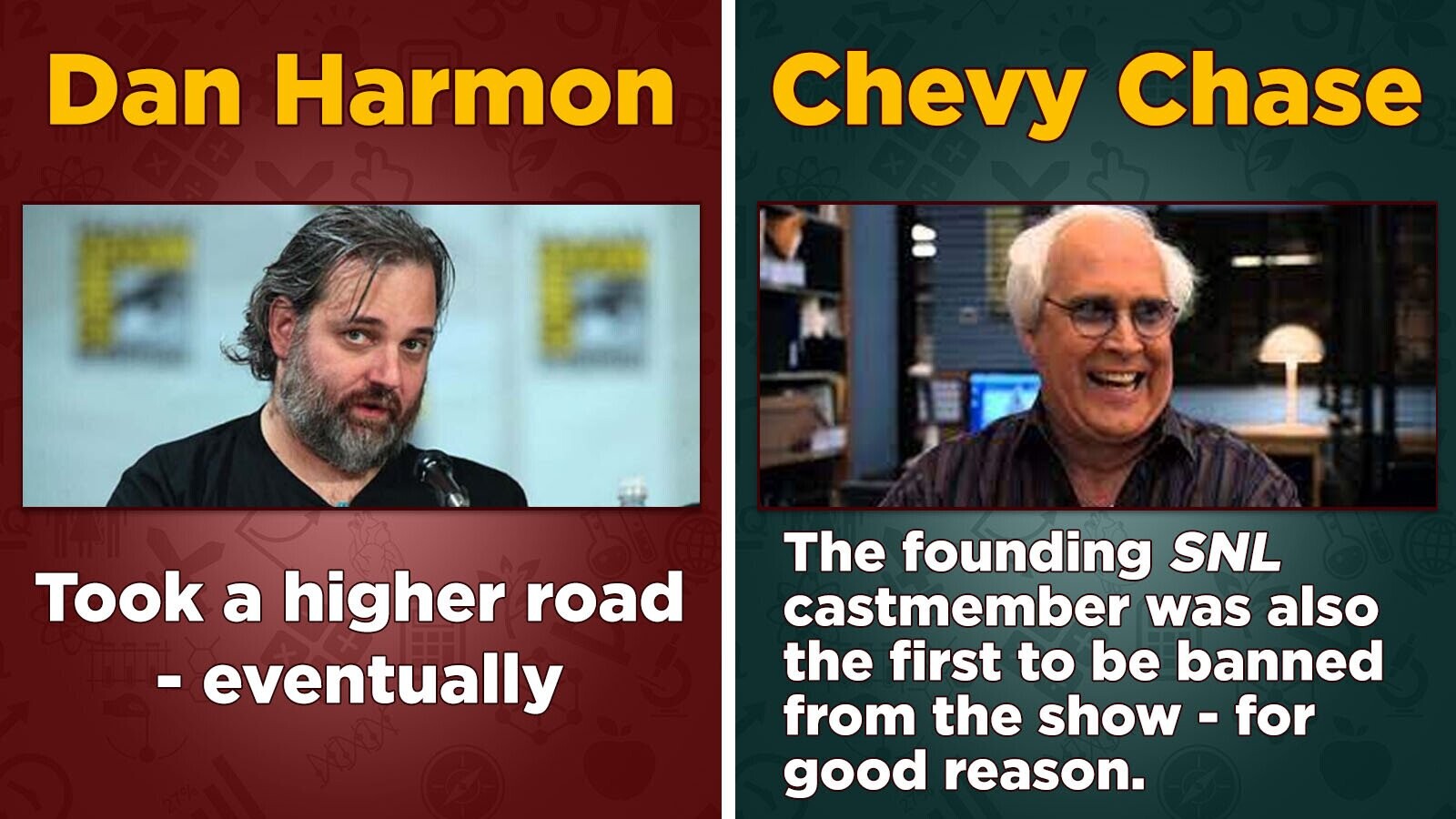
There is a strange kind of Hollywood mirror in the story of Dan Harmon and Chevy Chase. On one side stands Harmon, the restless creator of Community, a writer-producer famous for brainy jokes, emotional chaos, story circles, and the occasional public self-own. On the other side stands Chase, one of the original stars of Saturday Night Live, a comedy legend whose later reputation became tangled with stories of difficult behavior, creative clashes, and a stubborn refusal to read the room after the room had already filed a complaint with human resources.
The title “How Dan Harmon Kept From Becoming Chevy Chase” is not about pretending Harmon was always the hero of the story. He was not. That is exactly the point. Harmon did not avoid becoming a cautionary tale because he never behaved badly. He avoided it because, at crucial moments, he seemed willing to notice the monster in the mirror before it fully moved in, hung up posters, and started demanding a better trailer.
In the history of Community, the Harmon-Chase feud became more than backstage gossip. It became a case study in ego, insecurity, creative control, generational comedy, public accountability, and the difference between being brilliant and being safe to work with. The story is messy, human, and deeply uncomfortable. In other words, it is very Dan Harmon.
The Setup: A Genius Show With a Pressure-Cooker Soul
Community premiered in 2009 as a sitcom about a study group at Greendale Community College. On paper, it sounded like a simple network comedy. In practice, it was a pop-culture laboratory with a cafeteria. The show could turn a paintball game into an action movie, a bottle episode into a psychological autopsy, and a pillow fight into a Ken Burns-style documentary. It was clever, strange, affectionate, and often too weird for the ratings chart to understand without a tutor.
Dan Harmon’s strength was also his danger zone: he cared too much. He cared about structure, tone, jokes, character truth, emotional payoff, and whether a single line made the story wobble like a shopping cart with one haunted wheel. That obsessive precision helped make Community beloved. It also contributed to long hours, production stress, and friction with people who did not share his appetite for controlled chaos.
Then there was Chevy Chase, cast as Pierce Hawthorne, an older, wealthy, socially clueless member of the study group. It was brilliant casting in theory. Chase’s real-life history as a sharp, unpredictable comedy figure gave Pierce a dangerous spark. But the overlap between character and performer soon became less “delicious tension” and more “somebody unplug the smoke machine.”
The Feud That Became a Warning Label
The conflict between Harmon and Chase reportedly involved creative disagreements, resentment over the writing of Pierce, and arguments about the direction of the show. Chase had been a movie star. Harmon was the showrunner. Both men had strong ideas about comedy. Both could be combative. Put them in the same room and you did not get oil and water; you got oil, water, and a podcast microphone rolling somewhere in the background.
The most infamous moment came after a Community wrap party, when Harmon publicly mocked Chase in front of others. Chase later left Harmon an angry voicemail, and Harmon played that voicemail at a live event. Harmon later apologized, calling his own behavior childish and unprofessional. That apology mattered because it showed the first major difference between Harmon’s path and Chase’s reputation: Harmon did not merely say, “Well, comedy is messy.” He admitted that he had made the mess worse.
That does not erase the harm. A public apology is not a magic sponge. But it does establish a pattern. Harmon’s career has included ugly mistakes, but it has also included unusually direct public reflection on those mistakes. He turned self-criticism into part of his survival mechanism. Sometimes that self-criticism was awkward. Sometimes it was uncomfortable. Sometimes it sounded like a man live-commentating his own character development arc while the episode was still filming. But it was there.
Chevy Chase as the Shadow Version of Dan Harmon
To understand why the comparison sticks, it helps to see Chase not only as Harmon’s antagonist but as his possible future. Chase was a gifted comedian whose timing helped shape modern television comedy. His work on SNL, Caddyshack, Fletch, and the Vacation films made him a household name. Yet over time, stories about his difficult behavior often became louder than conversations about his talent.
That is the nightmare for any creative person with a large ego and a fragile interior: one day, the work is no longer what people discuss first. The behavior is.
Harmon could have gone down a similar road. He had the ingredients: brilliance, insecurity, intensity, a sharp tongue, a loyal fan base, and a tendency to turn conflict into performance. The difference is that Harmon seemed increasingly aware that talent is not a moral exemption card. You cannot walk into the workplace, yell “I made a cult classic!” and expect everyone to treat that as a valid fire exit.
The Megan Ganz Apology: Accountability Without Jazz Hands
The clearest example of Harmon choosing a different path came years after the Chase feud, when writer Megan Ganz publicly addressed Harmon’s past misconduct toward her during their time working together. Harmon later gave a detailed apology on his podcast, acknowledging that he had abused his power, behaved inappropriately, and treated Ganz unfairly after she rejected him.
This apology became widely discussed because it was unusually specific. Harmon did not hide behind vague phrases like “mistakes were made,” which is the official motto of people hoping grammar will take the blame. He identified what he did, explained the power dynamic, described how he rationalized it, and told listeners not to excuse the behavior. Ganz publicly recognized the apology as meaningful.
Again, the point is not that apology transforms harm into confetti. It does not. The point is that Harmon modeled something rare in entertainment culture: he resisted making himself the victim of being held accountable. That is one of the major ways he avoided becoming a permanent cautionary figure. He learned, publicly and painfully, that being the smartest person in the room means very little if the room is exhausted, uncomfortable, or quietly updating its résumé.
Why Self-Awareness Became Harmon’s Escape Hatch
Dan Harmon’s public persona has always included self-analysis. His famous “story circle” is a writing tool, but it also feels like a personality diagnosis in diagram form. A character wants something, enters an unfamiliar situation, adapts, pays a price, returns changed. Harmon’s life, at its best, has followed the same shape. Unfortunately for him, the “pays a price” part was not optional. It never is. Ask any protagonist. They hate that part.
After being fired from Community following its third season, Harmon did not vanish. He toured with Harmontown, spoke openly with fans, and eventually returned to Community for its fifth season. That return was not simply a victory lap. It was a reminder that a creator can lose control of the thing he built and still come back with a different understanding of what control should mean.
Harmon’s later success with Rick and Morty also complicates the story. He did not become less strange, less ambitious, or less emotionally messy as a creator. He became more aware that creative freedom and personal accountability have to live in the same house. They may argue over the thermostat, but they cannot be separated.
The Difference Between Explaining Yourself and Excusing Yourself
One reason Harmon’s public reckoning landed differently from many celebrity apologies is that he often explained his thinking without using that explanation as a shield. There is a huge difference between saying, “Here is why I acted badly,” and saying, “Here is why my bad behavior should be treated as a weather event.”
Chase’s public image, fairly or unfairly, often hardened around the impression that he did not fully understand why people were upset with him. Later interviews about Community gave many readers the sense that he still viewed the show mainly through his own dissatisfaction. Harmon, by contrast, often seemed painfully aware that his own dissatisfaction could injure other people when backed by power.
This is the key lesson for creative leaders. Your insecurity is not automatically someone else’s emergency. Your standards are not automatically permission to humiliate people. Your genius does not get to invoice the staff for emotional damages.
Comedy Changed, and Harmon Tried to Change With It
Another major factor is generational awareness. Chevy Chase came from an era of comedy where cruelty was often treated as proof of sharpness. If someone got hurt, the old defense was simple: take a joke. But modern audiences and workplaces increasingly ask better questions: Who is the joke aimed at? Who has power? Who has to keep smiling because their paycheck depends on it?
Community itself was obsessed with these questions before many sitcoms knew what to do with them. Pierce Hawthorne was often funny because he represented outdated attitudes crashing into a more self-aware group. The tragedy is that behind the scenes, the same collision appeared to be happening in real time.
Harmon did not always pass the test. But he appeared to understand that the test existed. That awareness made change possible. The person who says, “I may be wrong,” has at least opened a window. The person who says, “Everyone else is too sensitive,” has usually locked the door and swallowed the key.
What Creative People Can Learn From the Harmon-Chase Divide
1. Talent Can Open Doors, But Behavior Decides Whether People Keep Them Open
Both Harmon and Chase are talented. That was never the issue. The issue is what happens when talent becomes entitlement. Harmon’s escape route was learning that the room matters as much as the joke. Writers, actors, assistants, and crew members are not props in the epic film of one person’s tortured brilliance.
2. Public Accountability Works Best When It Is Specific
Harmon’s strongest apologies avoided fog. He named behaviors, admitted power imbalances, and resisted turning himself into the misunderstood victim. That specificity is why people still discuss those apologies as examples of what accountability can look like when it is not assembled by a corporate crisis team during lunch.
3. Growth Requires Consequences
Being fired from Community, facing criticism, and revisiting his own misconduct were not pleasant experiences for Harmon. But growth without discomfort is usually just branding. The uncomfortable parts forced him to examine whether he wanted to be known only as brilliant or also as capable of change.
4. Humor Is Not a License to Harm
Comedy can be rude, risky, and wild. It can challenge polite society and punch holes in hypocrisy. But “I was joking” is not a universal solvent. It does not dissolve racism, harassment, humiliation, or abuse of power. The best comedians know the difference between danger and laziness.
How Dan Harmon Kept From Becoming Chevy Chase
So how did Dan Harmon keep from becoming Chevy Chase? Not by being nicer from the beginning. Not by avoiding ego. Not by having a spotless record. He avoided that fate by developing a habit Chase’s public persona has often seemed to lack: the willingness to look directly at his own worst behavior and say, “That was me. I did that. It was wrong.”
That sentence is not glamorous. It will not win an Emmy. Nobody puts it on a lunchbox. But in creative life, it may be the difference between being remembered as complicated and being dismissed as impossible.
Harmon’s story is not a fairy tale of redemption. It is more useful than that. It is a working model of imperfect accountability. He still remains a polarizing figure. He is still associated with chaos, intensity, and a very advanced ability to make a simple story structure sound like a mystical IKEA manual. But he also demonstrated that a person can interrupt their own decline.
Chevy Chase’s legacy includes classic comedy and a long shadow of conflict. Dan Harmon saw enough of that shadow to recognize the shape. The reason he did not fully become it is that he learned to treat self-awareness not as a personality quirk, but as a survival skill.
Experience-Based Reflections: The Workplace Lesson Behind the Hollywood Story
Anyone who has worked on a creative team knows a smaller version of this story. Maybe it was not a network sitcom. Maybe it was a school project, a startup brainstorm, a YouTube channel, a theater group, a marketing team, or a group chat that somehow became a constitutional crisis over font choice. Creative work attracts strong opinions. Strong opinions attract conflict. Conflict attracts snacks. Then the snacks run out, and everyone has to deal with the actual problem.
The Harmon-Chase story is useful because it shows how easily a workplace can confuse brilliance with permission. A talented person says the cutting thing, misses the deadline, derails the meeting, or makes everyone walk on eggshells. At first, people excuse it because the work is good. Then they excuse it because the person is famous. Then they excuse it because “that is just how he is.” That phrase may be the most dangerous sentence in any workplace. It sounds harmless, but it often means the group has agreed to let one person’s habits become everyone else’s weather.
The better path is not to demand that creative people become bland, silent, and perfectly polished. Nobody wants a writers’ room that feels like a tax seminar with chairs. The better path is to separate intensity from disrespect. You can care deeply without humiliating someone. You can argue for a better joke without turning the room into a hostage situation. You can be eccentric without making other people responsible for translating your chaos into professionalism.
Harmon’s evolution suggests that the most valuable creative skill is not cleverness. It is repair. Repair means noticing when you have damaged trust. It means apologizing without secretly auditioning for sympathy. It means changing the behavior after the apology, because otherwise the apology is just a trailer for a movie nobody wants to see.
In everyday work, the same lesson applies. If you interrupt people, stop and invite them back in. If you make a joke that lands badly, do not cross-examine the room about why it failed. If you hold power, assume your words are heavier than you think. If someone tells you that you hurt them, resist the instinct to become your own defense attorney. Most of us are not at our best when we are scared, embarrassed, or criticized. That is exactly why accountability has to be practiced before the emergency.
The story also teaches something important about aging in creative fields. Nobody stays the hot new voice forever. Trends move. Audiences change. Younger collaborators arrive with different values, references, and expectations. A person can respond to that with curiosity or resentment. Curiosity keeps you alive. Resentment turns you into the person complaining that the room changed, while everyone else quietly remembers why it had to.
Dan Harmon did not become Chevy Chase because he did something both simple and rare: he let the criticism reach him. He did not always respond perfectly. He did not become a symbol of flawless workplace behavior. But he showed that self-knowledge can interrupt ego, that apology can be more than damage control, and that a creative legacy is built not only by what you make but by how people feel after making it with you.
That may be the most practical takeaway of all. In any creative life, you are building two bodies of work. One is the finished product: the episode, article, campaign, performance, or script. The other is the memory people carry of working with you. The first can make you famous. The second decides whether people are relieved when you leave the room.
Conclusion
“How Dan Harmon kept from becoming Chevy Chase” is ultimately a story about accountability catching up with talent before talent could become an excuse. Harmon’s career shows that being difficult, brilliant, wounded, funny, and wrong can all be true at the same time. What matters is what happens next.
Chevy Chase remains an important figure in American comedy, but his later reputation is inseparable from reports of conflict and resistance to change. Harmon, facing his own public failures, chose a more self-examining path. He apologized, reflected, and allowed consequences to become part of his growth rather than proof that everyone else was against him.
That does not make him perfect. It makes him instructive. In comedy, television, and any creative workplace, the real test is not whether someone has flaws. Everyone does. The test is whether they can recognize those flaws before they become the whole biography.