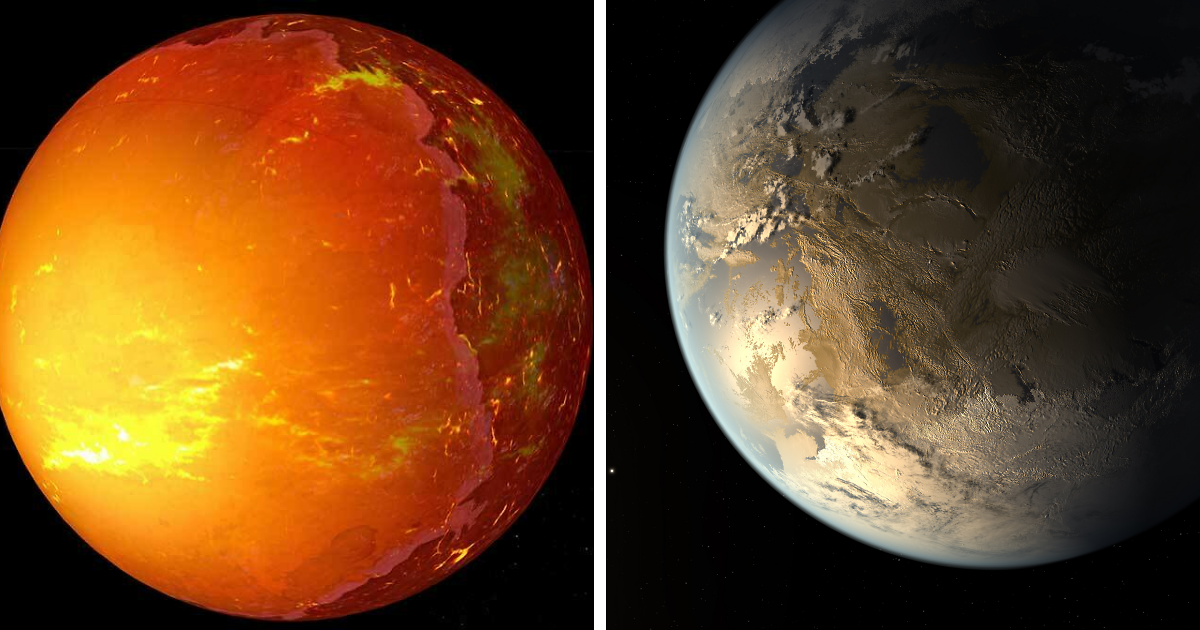
Outer space has never been accused of being normal. Just when humans got comfortable with the idea of eight planets, one asteroid belt, and a few dramatic moons, astronomers started finding planets around other starsand the universe immediately turned into a cosmic weirdness contest. Some exoplanets rain glass. Some orbit two suns. Some are darker than coal. One may be the exposed core of a giant planet, which is basically the astronomy version of finding a car engine rolling down the highway without the car.
An exoplanet is any planet outside our solar system. As of May 2026, astronomers have confirmed more than 6,000 of them, and the list keeps growing as missions like Kepler, TESS, Hubble, and the James Webb Space Telescope continue revealing strange worlds in stunning detail. These planets are not just “Earth, but somewhere else.” Many are extreme, unstable, scorching, frozen, oversized, underweight, backward, or so unusual that scientists have to double-check the math before saying, “Yes, apparently the universe did that.”
Below is a tour of some of the weirdest exoplanets we’ve discovered so farworlds that make science fiction look like it was playing it safe.
What Makes an Exoplanet Weird?
A planet can earn “weird” status in several ways. It might have bizarre weather, an impossible-looking orbit, a strange density, a star-melting temperature, or an atmosphere that behaves like a chemistry experiment left unsupervised. Some exoplanets are strange because of where they orbit. Others are strange because of what they are made ofor what they appear to have lost.
For astronomers, weird does not mean useless. These extreme planets help scientists test models of planet formation, atmosphere loss, orbital migration, and stellar radiation. In other words, every cosmic oddball is also a laboratory. A terrifying laboratory, yes, but a useful one.
HD 189733 b: The Blue Planet That Rains Glass Sideways
At first glance, HD 189733 b looks almost friendly. It has a rich blue color that might remind people of Earth. Unfortunately, that is where the vacation brochure ends. This gas giant is a hot Jupiter, meaning it is a Jupiter-like planet orbiting extremely close to its star. Its year lasts only about 2.2 Earth days, which is great if you enjoy birthdays and terrible if you enjoy survival.
The planet’s striking blue color likely comes from hazy clouds containing silicate particles. Under extreme heat and brutal winds, those particles could form glass-like rain blown sideways through the atmosphere. Imagine a hurricane, except the raindrops are tiny shards of glass and the whole planet is an oven. HD 189733 b is one of the best examples of how appearances can be hilariously misleading in astronomy. Blue does not always mean ocean. Sometimes blue means “absolutely do not land here.”
WASP-76 b: The World Where It May Rain Iron
WASP-76 b is another ultra-hot gas giant with a flair for dramatic weather. It orbits its star in just 1.8 days and is so intensely heated on its dayside that metals can vaporize. Scientists have studied evidence suggesting that iron may exist as vapor in the atmosphere and condense on the cooler nightside, creating the possibility of iron rain.
The planet is likely tidally locked, meaning one side always faces the star while the other side remains in permanent night. That creates a massive temperature contrast and powerful winds that can carry material around the planet. If Earth has “partly cloudy with afternoon showers,” WASP-76 b has “blazing metal vapor with a chance of molten weirdness.” Weather apps would simply give up.
55 Cancri e: A Lava World With Sparkling Skies
55 Cancri e, also called Janssen, is a super-Earth located about 41 light-years away. “Super-Earth” sounds cozy, but in this case it means a rocky planet larger than Earth that orbits its star in less than one Earth day. Its surface is believed to be extremely hot, possibly featuring a global ocean of molten rock.
For years, people nicknamed it the “diamond planet” because early studies raised the possibility of a carbon-rich interior. That idea remains debated, and scientists now focus more on its heat, molten surface, and possible atmosphere. Recent observations from the James Webb Space Telescope suggest 55 Cancri e may have gases surrounding itpossibly a secondary atmosphere created by outgassing from a magma ocean.
That is what makes this planet scientifically exciting. It is not habitable, not comfortable, and not somewhere to wear sandals. But it may help researchers understand how rocky planets keep, lose, or rebuild atmospheres under extreme stellar radiation.
TrES-2 b: The Darkest Planet Ever Found Around a Star
TrES-2 b is the space equivalent of a black hoodie in planet form. It reflects less light than coal, making it one of the darkest known exoplanets. This gas giant orbits very close to its star, and its atmosphere may absorb nearly all incoming light rather than reflecting it back into space.
Scientists think it may glow faintly red because of its heat, which only makes it sound more like a villain’s hideout. The planet is not just dark; it is bafflingly dark. Researchers still study why its atmosphere is so light-absorbing. Possible explanations include a lack of reflective clouds and the presence of chemicals that soak up starlight. Either way, TrES-2 b proves the universe has a goth phase.
WASP-12 b: The Planet Being Torn Apart
WASP-12 b is a hot Jupiter orbiting so close to its star that it is being stretched and stripped by gravitational forces. Its year lasts just about 1.1 Earth days. The planet is so near its host star that material may be pulled away from it, forming a disk or stream of gas around the star.
This makes WASP-12 b one of the most dramatic examples of planetary destruction in progress. It is not simply orbiting its star; it is losing a tug-of-war with it. Astronomers study planets like WASP-12 b to understand how close-in gas giants evolve, shrink, and eventually disappear. It is a reminder that planets are not permanent decorations. In the wrong neighborhood, even a giant world can become lunch.
KELT-9 b: A Planet Hotter Than Some Stars
KELT-9 b is one of the hottest exoplanets ever discovered. This ultra-hot Jupiter orbits a very hot star in only about 1.5 days. Its dayside temperature is so extreme that molecules can be torn apart, only to possibly recombine on the cooler nightside.
Calling KELT-9 b “hot” feels unfair to regular heat. A sidewalk in July is hot. Soup is hot. KELT-9 b is “molecules are filing complaints” hot. Because its star blasts it with intense radiation, the planet’s atmosphere is a testing ground for physics under extreme conditions. It also helps astronomers understand how planets surviveor fail to survivearound massive, energetic stars.
Kepler-16 b: The Real-Life Tatooine
Kepler-16 b is famous because it orbits two stars. That makes it a circumbinary planet, the real-world version of a science-fiction sky with twin sunsets. It is a gas giant, roughly Saturn-like, orbiting a pair of stars about 245 light-years from Earth.
Before discoveries like Kepler-16 b, scientists were not sure how common stable planets around binary stars could be. Two stars create a more complicated gravitational environment than one, which sounds like a recipe for orbital chaos. Yet Kepler-16 b showed that planets can form and survive in these systems. The sunsets would be spectacular. The surface, sadly, is not a place you could stand, because it is a gas giant. Still, points for style.
PSR B1257+12 b: A Planet Orbiting a Dead Star
Some of the earliest confirmed exoplanets were found around a pulsar called PSR B1257+12. A pulsar is the rapidly spinning remnant of a dead star, sending out beams of radiation like a lighthouse with a grudge. PSR B1257+12 b is a tiny terrestrial planet in this system, and its neighbors have equally spooky names such as Poltergeist and Phobetor.
Pulsar planets are weird because they challenge simple ideas about planet formation. How does a planet survive near a star that has gone through a violent death? Did it form after the stellar explosion from leftover material? Did it survive in some altered form? These questions make pulsar planets some of the strangest objects in the exoplanet catalog. They are not cozy Earth cousins. They are cosmic survivors in a haunted neighborhood.
TOI-849 b: The Possible Naked Core of a Giant Planet
TOI-849 b is strange because of what it may no longer have. It is a dense world about Neptune-sized, but it may be the exposed core of a gas giant that lost its thick atmosphere. Think of it as a planet stripped down to its interior, like a cosmic onion with the outer layers removed.
Scientists are especially interested in TOI-849 b because the cores of giant planets are usually hidden under enormous blankets of gas. We cannot easily see inside Jupiter or Saturn, but a world like TOI-849 b may provide clues about what giant planets are made of deep down. It is weird, yes, but it may also be a rare window into planetary anatomy.
WASP-193 b: The Cotton-Candy Planet
WASP-193 b is enormous, but shockingly light. Researchers have described its density as comparable to cotton candy, which is not a sentence anyone expected to write about a planet. It is about 50% larger than Jupiter but far less massive, making it one of the least dense exoplanets known.
This kind of “super-puff” planet creates a puzzle. How does a planet get so large and remain so airy? How does its atmosphere stay inflated? What prevents it from shrinking or being stripped away? WASP-193 b is not weird because it is violent; it is weird because it seems almost too delicate to exist. Somewhere in the galaxy, there is a planet with the structural confidence of carnival food.
J1407b: The Planet With a Possible Super-Sized Ring System
J1407b is often nicknamed “Super Saturn” because observations suggest it may have an enormous ring system far larger than Saturn’s. The object may be a giant planet or possibly a brown dwarf, and its rings were inferred from a long, complex dimming event seen around its host star.
If the ring interpretation is correct, the system is astonishing. The rings may contain gaps, which could hint at moon formation. Saturn already has the most fashionable accessories in our solar system, but J1407b may have taken the ring concept and turned it into a full architectural project. It reminds scientists that young planetary systems can be messy, dusty, and spectacular.
Why Weird Exoplanets Matter
The weirdest exoplanets are not just trivia for space fans, although they are excellent trivia. They expand the boundaries of what scientists think planets can be. Before the first hot Jupiters were discovered, many researchers expected other planetary systems to look somewhat like ours: small rocky planets near the star, gas giants farther out. Then 51 Pegasi b and other close-in giants came along and politely wrecked that assumption.
Today, exoplanets have taught astronomers that planetary systems are wildly diverse. Planets migrate. Atmospheres escape. Stars roast their companions. Some planets orbit two stars. Some are puffy, some are scorched, some are dark, and some may be planetary leftovers from violent histories. The more astronomers discover, the clearer it becomes that our solar system is only one possible arrangementnot the default setting.
How Scientists Find These Strange Worlds
The Transit Method
Many exoplanets are discovered when they pass in front of their stars from our point of view. This causes a tiny dip in the star’s brightness. By studying these dips, scientists can estimate a planet’s size, orbit, and sometimes even atmospheric properties.
The Radial Velocity Method
Planets tug gravitationally on their stars. This causes the star to wobble slightly. By measuring that wobble, astronomers can estimate the planet’s mass and orbital details.
Atmosphere Studies
When starlight passes through a planet’s atmosphere, gases leave chemical fingerprints in the light. Telescopes like Hubble and Webb can help identify molecules, clouds, metals, and signs of atmospheric escape.
Personal Experience: Why Weird Exoplanets Capture Our Imagination
Reading about weird exoplanets feels a little like opening the universe’s junk drawer. You expect stars, rocks, maybe a few gas giants, and then suddenly you find a planet darker than coal, another one losing its atmosphere, and a world so fluffy that “cotton candy” becomes a scientific comparison. That sense of surprise is part of what makes exoplanet science so addictive. It reminds us that nature is not limited by what feels reasonable to the human brain.
For many people, the first hook is the drama. A planet that rains glass sideways is instantly memorable. A world with two suns feels cinematic. A lava planet with a possible atmosphere sounds like something from a video game. These images make astronomy feel close, even when the objects are dozens, hundreds, or thousands of light-years away. They turn abstract data into places we can imagine, even if we would not survive there for one heroic second.
But the deeper experience is more thoughtful. Weird exoplanets make Earth feel both ordinary and miraculous. Ordinary, because planets are everywhere. Our solar system is not the only stage in the galaxy. Miraculous, because Earth’s balance of temperature, atmosphere, water, magnetic protection, and stable orbit starts to look incredibly precious when compared with worlds where iron may rain from the sky or molecules break apart in the heat.
There is also a humbling lesson in how often scientists have had to update their expectations. Before exoplanet discoveries exploded, many models were based heavily on our own solar system. That made sense; it was the only example available. But the universe had no obligation to follow our local pattern. Hot Jupiters, super-Earths, mini-Neptunes, circumbinary planets, and super-puffs all forced researchers to widen the definition of “planetary system.” In a way, every weird exoplanet is the universe saying, “Nice theory. Now explain this.”
That is why these discoveries are not just cool facts; they are invitations. They invite students to study science, writers to imagine new worlds, engineers to build better telescopes, and everyday readers to look up at the night sky with fresh curiosity. Somewhere out there, beyond the stars we can see with our eyes, there are planets we have not yet discoveredprobably stranger than the ones on this list. The next weird exoplanet may be darker, puffier, hotter, colder, faster, or more chemically bizarre than anything we currently know.
And that is the best part. Exoplanet science still feels young. We are not reading the final encyclopedia of alien worlds; we are watching the first chapters being written. The galaxy is big, the data is growing, and the weirdness budget appears to be unlimited.
Conclusion
The weirdest exoplanets we’ve discovered prove that the universe is far more creative than any planet-building checklist. HD 189733 b may rain glass. WASP-76 b may rain iron. TrES-2 b barely reflects light. KELT-9 b is hot enough to tear molecules apart. Kepler-16 b orbits two suns. WASP-193 b is so low-density that cotton candy comparisons are somehow reasonable. These planets are extreme, but they are not just cosmic curiosities. They help scientists understand how planets form, migrate, lose atmospheres, survive stellar violence, and sometimes become stranger than anyone predicted.
For readers, they offer something just as valuable: wonder. Every strange world reminds us that space is not empty, boring, or predictable. It is active, diverse, and occasionally ridiculous in the best possible way. The search for exoplanets is really the search for contextwhere Earth fits, how rare it may be, and what else nature can build when given enough stars, dust, gravity, and time.