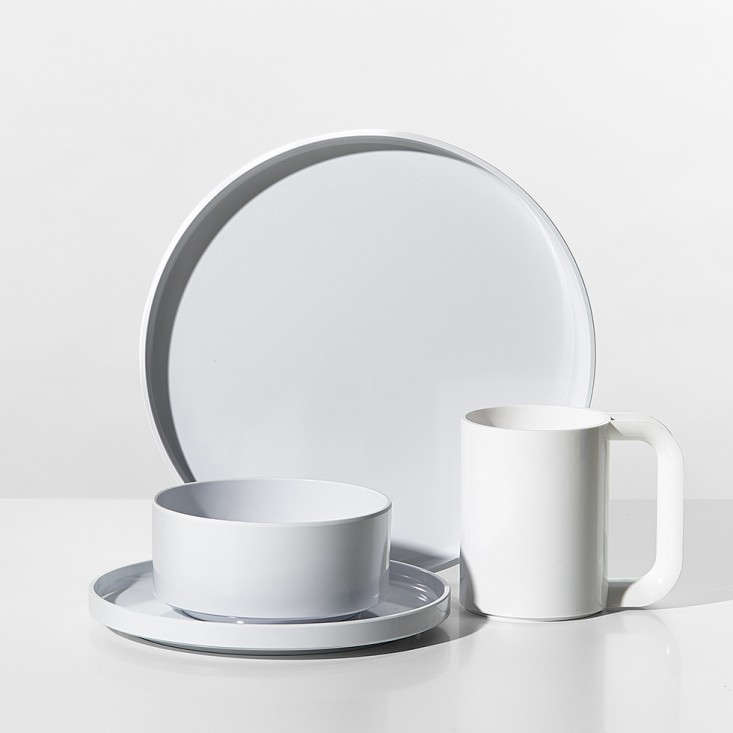
Some dinnerware politely sits in a cupboard and waits for soup. Heller Massimo Vignelli dinnerware does something more ambitious: it organizes the cupboard, brightens the table, doubles as a sculptural object, and quietly reminds everyone that practical household goods do not have to look as though they were designed by a committee trapped in a beige conference room.
Created in 1964 by Lella and Massimo Vignelli, the compact stacking tableware combined crisp geometry, molded plastic, bold color, and unusually efficient storage. Heller later brought the design to the American market, turning it into the company’s inaugural product and one of the most recognizable examples of modern dinnerware.
How a Stack of Plates Became a Design Classic
The story begins in Italy, where the Vignellis developed a melamine table service known as Compact. Instead of treating every plate, bowl, cup, and lid as an unrelated object, they approached the collection as a coordinated system. Pieces could be nested and stacked into tidy vertical columns, reducing the amount of shelf space required.
The design received the Compasso d’Oro in 1964. The award jury praised its space-saving concentration, suitability for collective settings, accessible cost, and intelligent use of melamine technology. In other words, the set was not honored merely because it looked handsome. It solved real problems while looking handsome, which is much harder.
Research basis:
During the late 1960s, entrepreneur Alan Heller encountered the compact dinnerware after its original producer had ceased operating. He approached Lella and Massimo Vignelli about returning it to production. When Heller launched his company in 1971, the dinnerware became its first product in the United States.
That partnership extended well beyond a licensing agreement. The Vignellis contributed to Heller’s visual identity, packaging, product development, and broader design direction. Hellerware consequently feels less like a product selected from a catalog and more like part of a carefully managed design program.
Research basis:
What Makes Hellerware So Distinctive?
A Stacking System Rather Than Random Dishes
The most important feature is right there in the silhouette. Heller Massimo Vignelli dinnerware was designed to form stable, straight stacks rather than the slightly tipsy towers created by ordinary mismatched plates. A small lip underneath each piece helps it fit securely with the one below it.
That lip performs another visual trick. It raises a plate slightly above the tabletop, creating a thin shadow that makes the object appear to hover. This detail is subtle enough to miss at first, yet it gives the dinnerware much of its architectural character.
Geometric Forms Without Decorative Clutter
There are no floral borders, embossed grapes, imitation gold rims, or mysterious roosters staring at your scrambled eggs. The Vignellis relied on circular forms, clean edges, disciplined proportions, and the natural sheen of molded material.
This reduction was not cold minimalism for its own sake. The lack of ornament allows the shapes, food, and colors to do the work. Pasta looks graphic against a white plate. Citrus fruit becomes almost poster-like in a yellow bowl. Even toast seems to have hired an art director.
Material Used as a Design Tool
MoMA identifies the original 1964 stacking dinnerware as melamine resin. The material made it possible to create lightweight, durable pieces with consistent dimensions and precise molded details. Those qualities were essential to the nesting system; poorly controlled dimensions would have produced stacks with all the elegance of a leaning pile of cafeteria trays.
The Vignelli archive also describes plastic molding as the technology that allowed the collection to achieve precision, geometric clarity, and consistent proportions across multiple pieces.
Research basis:
Color That Behaves Like Architecture
Hellerware is strongly associated with saturated red, orange, yellow, green, blue, and purple pieces. The rainbow editions turn an ordinary stack into a vertical color composition. Leave one on an open shelf and it begins behaving less like stored tableware and more like a small domestic sculpture.
White versions express the same forms more quietly. They work well in restrained kitchens, while multicolored sets bring the energetic optimism associated with late-1960s and 1970s design. Neither approach is more authentic in spirit. One emphasizes form; the other makes the system impossible to ignore.
Lella and Massimo Vignelli: Design as a Unified System
The collection is frequently described with Massimo Vignelli’s name alone, but Heller and MoMA credit both Lella and Massimo Vignelli. That distinction matters. The couple worked across architecture, interiors, furniture, graphics, exhibitions, transportation systems, packaging, and household products.
Their best-known projects include New York transportation graphics, corporate identity programs, furniture, retail interiors, and publications. Although these assignments varied dramatically in scale, they shared an emphasis on order, proportion, consistency, and long-term usefulness.
Hellerware translates that philosophy into a kitchen object. A subway information system must help people find their destination. A dinnerware system must help people store, carry, serve, and clean dishes. Both become easier to use when relationships among the parts are carefully controlled.
The Vignelli Center for Design Studies at Rochester Institute of Technology now preserves an extensive archive of their work. Its collection demonstrates how thoroughly the pair considered design a connected discipline rather than a row of isolated specialties.
Research basis:
Why Museums and Design Collectors Value Hellerware
Heller dinnerware occupies an unusual position. It is affordable enough to serve lunch, recognizable enough to interest collectors, and historically significant enough to enter major design collections. MoMA holds a monochromatic 1964 stacking set and describes it as one of the most successful product designs created by the Vignelli studio.
Its museum status does not depend on rarity or luxurious materials. The set matters because it demonstrates how industrial design can improve ordinary routines. The plates are not pretending to be handcrafted porcelain. They proudly express mass production, molding technology, modularity, and modern domestic life.
This combination gives Hellerware an appealing tension. It looks serious in a display case but cheerfully accepts a sandwich. It can be discussed in a design seminar and then carried outside for lunch. Very few museum pieces are equally comfortable holding potato salad.
Research basis:
How the Collection Expanded
The Heller line evolved after its American introduction. Stacking mugs were added in 1972. According to archival material, the mug extended the form of the original coffee cup and became especially popular. A pitcher followed in 1978.
The pitcher illustrates how the Vignellis used form to communicate function. Its lid could indicate whether the vessel was open or closed depending on the alignment of an indentation with the handle. No blinking light, app notification, or eighteen-page instruction booklet was required.
Additional pieces, color arrangements, and reissues appeared over time. Certain rainbow versions have moved in and out of production, while white editions have often represented the collection’s quieter modernist side. As a result, “Hellerware” can refer to several production periods rather than one completely uniform specification.
Research basis:
Original Hellerware Versus Modern Reissues
Shoppers should distinguish the historic design from the specifications of a particular contemporary product. Modern Hellerware offerings may differ in color, manufacturing origin, number of pieces, and plastic formulation.
For example, current rainbow pieces offered through the MoMA Design Store list melamine for plates and bowls but polystyrene for mugs. Other Heller Max sets are described as melamine collections. Product care requirements can also vary, so instructions for the exact set should take priority over generalized advice found in an old catalog or enthusiastic online listing.
Practical Care Guidelines
Current authorized listings generally describe the pieces as dishwasher-safe, often specifying the top rack. They also warn against microwave ovens, conventional ovens, warming drawers, and other high-heat appliances. Melamine is excellent at being lightweight tableware. It is less enthusiastic about impersonating a casserole dish.
Use soft sponges rather than aggressive abrasives, particularly on glossy colored surfaces. Wash promptly after serving highly pigmented or acidic foods, and avoid stacking dirty plates when gritty crumbs could rub between them. These small habits help preserve the finish.
Research basis:
How to Style Heller Massimo Vignelli Dinnerware
Let a Rainbow Set Lead the Table
When every place setting uses a different color, keep the rest of the table relatively simple. A white cloth, natural wood surface, clear glassware, and plain stainless flatware allow the dishes to provide the visual rhythm.
Pair White Hellerware With Texture
White pieces benefit from linen napkins, woven placemats, dark tabletops, or richly colored food. The floating edge becomes more visible against a contrasting surface, emphasizing the object’s sculptural profile.
Display the Stack
Open shelving is practically an invitation. Instead of hiding every piece behind cabinet doors, arrange bowls, salad plates, and dinner plates in deliberate columns. The storage system is part of the design, not an embarrassing stage that must be concealed before company arrives.
Mix Colors With Restraint
Collectors often accumulate sets from different periods. Mixing can look lively, but repetition helps prevent visual chaos. Try matching the same plate size across several colors or repeating two colors throughout the table rather than assigning every object a new personality.
Buying Vintage Hellerware
Vintage examples can be rewarding, but buyers should evaluate them as usable objects rather than color samples floating attractively on a resale page.
Check the Underside
Inspect manufacturer marks, mold details, labels, and other identifying information. Since Hellerware has appeared in multiple production runs, markings may help distinguish older pieces from later reissues. Sellers should provide clear photographs rather than describing every bright plastic plate as “Vignelli style.”
Look for Surface Wear
Fine scratches are common on used melamine, especially on dinner plates. Deep knife marks, cloudy patches, cracks, burns, and rough edges deserve more caution. Ask for photographs taken in angled light, which exposes damage that disappears in a perfectly flattering front-facing image.
Test the Stack
Warping undermines one of the collection’s defining features. A slightly distorted plate may still hold food, but it can disrupt the clean vertical profile. When buying a large set, ask whether pieces stack evenly and whether lids fit the corresponding bowls.
Compare Color Consistency
Sunlight, washing habits, age, and production differences can affect color. A set assembled from multiple sellers may contain several interpretations of orange, all of which believe they are the correct one. Decide whether exact matching matters or whether variation adds character.
Is Hellerware Suitable for Everyday Dining?
For many households, yes. Its light weight, compact storage, visual energy, and durable construction make it especially appealing for breakfast rooms, apartments, casual meals, covered patios, studios, and homes where dinnerware is used rather than kept in ceremonial hibernation.
It is not ideal for everyone. People who strongly prefer the weight of stoneware, the refinement of porcelain, or microwave-safe plates may find the practical limitations frustrating. Glossy plastic also develops wear differently from ceramic glaze.
The best buyer appreciates Hellerware for what it is: an industrially produced modern design that balances function, form, color, and affordability. Purchasing it while wishing it behaved exactly like bone china is a little like buying a convertible and complaining that the roof seems temporary.
The Hellerware Experience: What Living With It Feels Like
The first noticeable experience is not eating from the dinnerware. It is opening the cabinet. Conventional dishes create horizontal layers of rims, handles, saucers, and bowls that never seem to agree on personal boundaries. Hellerware produces compact columns. The cupboard looks calmer before breakfast has even started, which is a generous achievement at 7:15 in the morning.
Taking a plate from the stack reinforces the system’s precision. The pieces separate cleanly, yet they feel visually connected. A salad plate does not appear to be a smaller object accidentally invited into the collection. It follows the same geometry and repeats the same raised base.
During breakfast, the lightness becomes immediately practical. Carrying several settings to a table is easier than transporting heavy stoneware, particularly when mugs, bowls, and plates are needed at once. Children and older adults may also appreciate the lower weight, although normal care is still required because durable does not mean indestructible.
The colors change the atmosphere of an ordinary meal. Cereal in a yellow bowl feels sunnier. Strawberries against green create a sharp complementary contrast. Tomato soup in a red bowl becomes an exercise in tonal coordination, although perhaps not the best choice for anyone who wants to locate the soup quickly.
Guests tend to notice the stackability before they identify the designer. That reaction captures the success of the collection. Its cleverness is visible without requiring a lecture. Plates form straight towers, mugs align, and the objects explain much of their own logic through use.
Hellerware is particularly convincing in a small apartment. A compact set can serve several people without occupying the cabinet space demanded by irregular ceramic pieces. On open shelves, the stack becomes intentional decoration. This is helpful when the kitchen has limited storage and every object is forced to audition for both a functional and visual role.
Outdoor meals are another natural setting. The dinnerware looks lively against greenery, weathered wood, or a plain picnic table. It feels less formal than porcelain but far more considered than disposable plates. The result is casual without looking careless, which is the sweet spot for a lunch where nobody wants to iron a tablecloth.
Dinner reveals the limits as well as the strengths. The plates are suitable for serving prepared food, but they should not be used in a microwave or oven. Anyone accustomed to reheating a meal directly on the plate will need to transfer food from a microwave-safe container. That additional step is minor, though it becomes significant in households where the microwave is considered an honorary family member.
Cleanup is straightforward when the manufacturer’s care directions are followed. Smooth surfaces wash easily, and approved pieces can generally go on the dishwasher’s top rack. Careful stacking after washing helps prevent unnecessary rubbing. Owners who treat the dishes as immortal camping equipment will see wear sooner than those who recognize them as durable design objects.
Over time, the greatest pleasure may be repetition. The same geometry appears at breakfast, lunch, and dinner. Bowls become lids, pieces form orderly groups, and color combinations shift with the meal. The set does not demand constant attention, yet it repeatedly rewards attention when someone pauses to look.
That quality explains why Hellerware survives beyond nostalgia. It is not appealing only because it resembles an optimistic 1970s interior. It remains relevant because the central experiencefitting useful objects efficiently into everyday lifehas not become outdated. Kitchens are still crowded. Shelves are still too small. People still enjoy color. Plates still need somewhere to go.
Why the Design Still Matters
Heller Massimo Vignelli dinnerware demonstrates that good design can operate at several levels simultaneously. It stores efficiently, communicates through form, exploits its material intelligently, creates a recognizable visual identity, and adds pleasure to ordinary meals.
Its longevity also challenges the idea that plastic household goods must be visually disposable. Although contemporary conversations about plastics require serious attention to manufacturing, durability, and responsible consumption, a long-lived, carefully maintained object occupies a different cultural position from a throwaway product designed for minutes of use.
More than six decades after the original Compact service appeared, the design still looks coherent because it was not built around a temporary decorative trend. Its personality comes from proportion, stacking, material, and colorthe fundamental structure of the object rather than surface styling applied afterward.
Conclusion
Hellerware is cheerful without being childish, minimal without being sterile, and collectible without becoming too precious for Tuesday-night pasta. Lella and Massimo Vignelli transformed a familiar category into a disciplined system whose storage arrangement is as thoughtfully designed as its place setting.
Whether selected in classic white, assembled as a rainbow, purchased new, or collected from vintage production runs, Heller Massimo Vignelli dinnerware offers a practical lesson in modernism: remove what is unnecessary, improve what remains, and never underestimate the emotional power of a perfectly organized stack of orange plates.