Some family stories begin with a carefully packed hospital bag. Others begin with a phone call that turns an ordinary Tuesday into a sprint involving emergency childcare, airline tickets, paperwork, and enough nervous energy to power a small city. For Sarah and David Olson, the first moment they saw their adopted baby was the emotional finish line of one journeyand the starting line of a much bigger one.
Their first meeting with newborn Tilly Pearl became a widely shared heartwarming adoption story because the photographs captured something almost impossible to stage: two exhausted adults realizing that the child they had hoped for was finally in front of them. Yet the real meaning of the moment goes beyond happy tears. It is also a story about uncertainty, commitment, respectful adoption, infant bonding, birth-family loss, and the quiet daily work through which strangers become family.
A Phone Call That Changed the Olson Family
Sarah and David Olson, then living in Minnesota, already had two sons, Zakary and Levi. They had always imagined raising three children, but Sarah’s pregnancies had been physically difficult. Levi was born with spina bifida and underwent multiple surgeries, while Sarah’s own pregnancy complications included serious illness and a fractured pelvis. After trying for another pregnancy without success, the couple began discussing adoption.
Adoption was not an unfamiliar idea in their extended family. David’s father and sister-in-law had been adopted, and Sarah had a niece adopted from China. Still, deciding that adoption might complete their family was only the beginning. The Olsons worked with an adoption consultant, completed the preparation expected of prospective parents, and endured four possible matches that did not result in placement.
Then came the call. A newborn girl in Tallahassee, Florida, needed an immediate adoptive placementa situation sometimes informally described as a “stork drop.” The couple had little time to move from hopeful waiting to practical action. They arranged care for their sons, booked an early flight, and invited their friend, photographer Kristen Prosser, to document the trip.
Airports are famously indifferent to emotional deadlines, and the journey stretched to about 14 hours because of delays. When Sarah and David finally reached the hospital, they encountered one more agonizing pause: the room was empty, and a busy nurse could not bring the baby immediately. Twenty minutes is not long unless the person you have crossed the country to meet is on the other side of it.
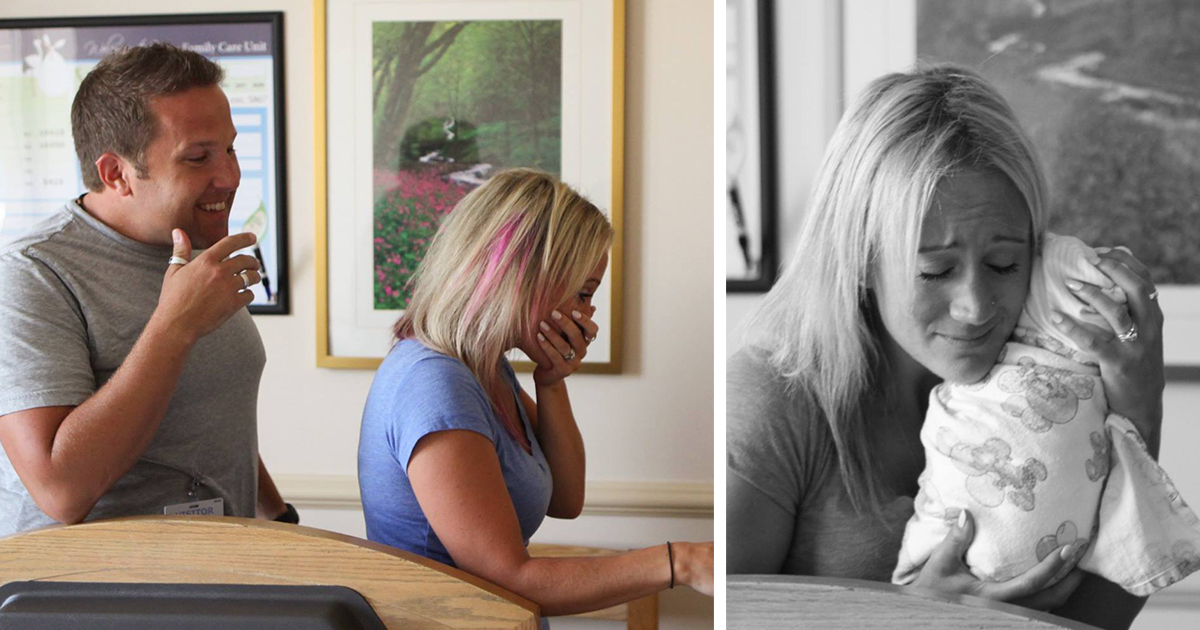
At last, Tilly was wheeled into the room. The photographs show Sarah covering her mouth, David leaning toward the bassinet, and both parents dissolving into the kind of tears that make tissues feel like inadequate technology. Within roughly 30 hours of receiving the call, they were holding their daughter. They chose the name Tilly Pearl, connecting “Tilly” with strength through adversity and “Pearl” with something precious.
Why the First Meeting Feels So Powerful
The images resonate because they compress months or years of uncertainty into a few seconds. Prospective adoptive parents often live with two competing realities: they are preparing emotionally and practically for a child, yet they cannot control whenor whethera particular placement will happen. The first meeting releases that tension all at once.
Love Can Arrive Before Familiarity
Sarah and David’s expressions suggest instant love, but instant emotion should not be confused with instant attachment. Attachment is not a magical switch that flips when a baby enters the room. It develops through repeated, responsive interactions: feeding, holding, soothing, talking, making eye contact, noticing cues, and returning again and again when the baby needs comfort.
That distinction is reassuring, not disappointing. Adoptive parents do not need to produce a movie-perfect bond on day one. Some feel overwhelming joy immediately. Others feel protective, stunned, frightened, tired, or strangely calm. A parent may think, “I would do anything for this baby,” while also thinking, “Where did the hospital put the instruction manual?” Both thoughts can occupy the same brain.
Small Responses Build a Big Relationship
Infant-development experts often describe healthy interaction as a back-and-forth exchange. A baby “serves” with a cry, glance, movement, or coo; the caregiver “returns” by responding. Over time, those ordinary exchanges help the child associate a familiar face, voice, smell, and touch with safety.
For an adopted newborn, bonding may look wonderfully unglamorous. It can be the fifth nighttime bottle, a slow walk across the living room, a familiar lullaby, or a parent learning that one particular bounce works while three others are apparently offensive. These moments rarely go viral, but they are where family life takes root.
Adoption Is More Than a Beautiful Photograph
A joyful first meeting can be celebrated without turning adoption into a simple rescue story. Every adoption begins with circumstances that prevent a child from being raised by the family into which the child was born. That reality can involve love, grief, relief, pressure, uncertainty, or several conflicting feelings at once.
Responsible adoption storytelling keeps the child at the center and recognizes all members of the adoption constellation: the adopted person, the birth family, and the adoptive family. The Olsons’ happiness was real. So was the significance of the decision made by Tilly’s birth family. Holding both truths does not diminish the celebration; it makes the story more honest.
The Unseen Legal and Practical Work
The hospital photographs show emotion, not the folders behind it. Domestic infant adoption commonly involves a home study, background checks, education, legal representation, medical information, consent procedures, post-placement supervision, and court finalization. Requirements vary by state and by the circumstances of the adoption.
Because Tilly was born in Florida and the Olsons lived in Minnesota, interstate procedures also mattered. The Interstate Compact on the Placement of Children helps coordinate placements across state lines and requires approval before an adoptive family returns to its home state with the child.
This explains why Sarah and Tilly remained in Florida while paperwork moved through the appropriate channels. The wait after meeting a baby can feel oddly suspended: you are doing the work of parenting, but you are not yet home, the suitcase is exploding, and every meal seems to come in a paper bag.
Birth-Family Connections and Open Adoption
Many modern domestic adoptions include some degree of openness, although the form varies widely. Contact might involve letters and photographs, scheduled video calls, occasional visits, or an ongoing extended-family relationship. Open adoption does not mean shared legal parenting; it means the child may have access to relationships, information, and an adoption story that is not hidden behind silence.
When safe and appropriate, openness can help an adopted person understand medical history, ancestry, identity, and the reasons surrounding the adoption. It also gives parents a healthier foundation for honest, age-appropriate conversations. Children should not have to discover that their origin story was treated like a family password nobody was allowed to say aloud.
What Happens After an Adopted Baby Comes Home?
The emotional airport arrival or hospital meeting is memorable, but the transition home is where an adoptive family begins building rhythm. Experts generally encourage predictability, responsive care, support, and realistic expectations rather than a packed social calendar.
Create a Calm, Predictable Routine
Newborns need feeding, sleep, comfort, medical care, and repeated contact with reliable caregivers. Adoptive parents can support bonding by limiting unnecessary disruptions, learning the baby’s signals, and keeping basic routines as consistent as possible.
Consistency does not require military precision. Babies are not known for respecting spreadsheets. It means that care feels dependable even when the clock is not.
Prepare Siblings for Real Life, Not a Commercial
Older children may be excited about a new sibling and still feel jealous, confused, or displaced. Parents can protect the sibling relationship by explaining changes ahead of time, preserving familiar rituals, inviting age-appropriate involvement, and making room for one-on-one attention. A child can love the new baby while also wondering why this tiny person has received 47 blankets and everyone’s full attention.
The Olsons’ sons were not merely supporting characters in Tilly’s arrival. They were also experiencing a family transition. Helping siblings talk about adoption, answer questions respectfully, and understand that every child’s story is private can establish a healthier family culture from the beginning.
Build a Support Team Early
Post-adoption support should not be treated as evidence that a family is failing. It is simply good preparation. Useful support may include an adoption-competent therapist, pediatrician, social worker, parent group, trusted relatives, cultural mentors, or other adoptive families.
Parents also need practical help: meals, laundry, rides, and the heroic friend who will hold the baby while someone takes a shower longer than 90 seconds.
Paid or protected family leave can give parents time to establish routines and respond consistently to a newly adopted child. Bonding is not a luxury reserved for biological families, and adoptive placement is not a standard household delivery that can be signed for and handled after office hours.
What Viral Adoption Stories Get Rightand What They Can Miss
Stories like the Olsons’ can broaden public understanding of how families are formed. They show that parenthood may begin through biology, foster care, kinship care, domestic adoption, intercountry adoption, or other paths. They can also reassure prospective parents that nervousness, waiting, paperwork, and sudden changes are normal parts of many adoption journeys.
However, a viral image is not the whole life of the child in it. Adopted children eventually become teenagers and adults with their own views about privacy, identity, birth relatives, religion, race, disability, and how their stories were shared. Parents who publish photos or personal details should ask not only, “Will people find this moving?” but also, “Will my child be comfortable owning this story later?”
A child’s medical information, birth-family history, and circumstances of placement deserve particular care. Celebration and privacy can coexist. The internet does not require every document, diagnosis, and difficult detail as an admission fee for empathy.
What the Olson Family’s First Meeting Says About Family
The heartwarming moment when the couple saw their adopted baby for the first time was powerful because it revealed recognition before routine. Sarah and David had not yet learned Tilly’s cries, favorite sleeping position, or future personality. They simply understood that they were ready to care for her.
That commitment is more durable than a single emotional photograph. Family is built when adults keep returning: at 2 a.m., at pediatric appointments, during hard questions about adoption, through ordinary school mornings, and when a child needs reassurance that curiosity about a birth family is not disloyalty. The first meeting matters because it begins that promisenot because it completes it.
Experiences Related to Meeting an Adopted Baby for the First Time
The details vary from family to family, but adoptive parents often describe several shared experiences around the first meeting. These experiences are not a script, and no parent should worry if their emotions arrive in a different order.
The Rush Can Feel Both Practical and Surreal
In a sudden newborn placement, parents may move from normal life to parenthood with astonishing speed. One minute they are answering email; the next they are comparing flights, calling relatives, checking car-seat instructions, and trying to remember whether newborns require size-one diapers or something even smaller. The practical checklist can temporarily protect them from the size of the emotional event.
Travel adds another layer. Delayed flights, rental cars, unfamiliar hospitals, and missing luggage do not pause because a family is having a life-changing day. Many parents later remember absurdly specific detailsthe airport coffee, a nurse’s shoes, the song playing in a hallwaybecause intense emotion makes ordinary surroundings unusually vivid.
The First Hold May Not Feel the Same for Both Parents
One parent may cry immediately while the other becomes very still. One may talk nonstop; the other may focus on whether the baby is warm enough. These reactions do not measure love. People process relief, responsibility, and fear differently. A calm parent is not less connected, and a tearful parent is not more prepared.
Some parents also feel guilt about their happiness because they understand that another family is experiencing loss. That emotional complexity is normal. Gratitude does not require pretending the adoption has no painful dimension. In fact, empathy for the birth family can help adoptive parents speak about the child’s history with greater respect.
The First Night Often Replaces Ceremony With Care
After the photographs and phone calls, the baby still needs to eat. Diapers remain spectacularly unimpressed by symbolism. Parents may spend the first night studying every sound, checking breathing, rereading discharge instructions, and wondering whether sleep is now a historical concept.
This is when the adoption journey becomes parenting. The baby learns the caregivers through repeated sensory experiences: the same voices, hands, rhythms, and responses. The parents learn the baby by trial, attention, and correction. Bonding grows not from performing perfectly but from showing up consistently.
Coming Home Can Bring Joy and an Unexpected Emotional Dip
Once the urgency fades, some adoptive parents experience exhaustion, anxiety, or post-adoption depression. The contrast between a long-awaited placement and the relentless demands of newborn care can be disorienting. Parents may feel ashamed because they believe gratitude should cancel stress. It does not.
Asking for help is a responsible response. Sleep, food, counseling, medical care, peer support, and honest conversations with a partner can protect the entire household. Adoptive parents are allowed to be delighted and depleted at the same time; newborns are talented at producing both conditions.
The Meaning of the First Meeting Changes Over Time
Years later, the first photographs may become part of the child’s life story. Parents can share them in a way that emphasizes welcome without implying that the child’s life began at adoption. The baby had a history, family connections, and an identity before entering the adoptive parents’ arms.
As the child grows, the story should grow too. A preschool explanation may be simple; a teenager may need fuller information and room for complicated feelings. The healthiest version of the story is not frozen as a sentimental headline. It becomes an ongoing conversation in which the adopted person is increasingly allowed to interpret, question, and own the experience.
Conclusion
Sarah and David Olson’s first meeting with Tilly Pearl remains moving because the photographs caught a family changing shape in real time. The rushed flight, empty hospital room, final wait, and first embrace created a dramatic beginning. Yet the deeper beauty lies in everything that followed: responsive care, sibling adjustment, legal steps, difficult conversations, ordinary routines, and a lifelong commitment to protect the child’s complete story.
A heartwarming adoption moment can invite happy tearsand this one certainly earned them. It can also remind us that adoption deserves mature language and a wide lens. There is joy, but there may also be loss. There is an unforgettable first look, but attachment grows through thousands of later looks that say the same thing: “I see you, I am here, and I will keep coming back.”
Note: This article discusses a publicly reported family story alongside general U.S. adoption and child-development guidance. Adoption laws and individual circumstances vary, and families should seek qualified legal, medical, and adoption-competent professional advice.