Note: This article discusses public controversy, career fallout, and mental health-related claims. It treats disputed allegations as allegations, not established facts.
Hollywood feuds are rarely subtle. They arrive with microphones, memoirs, podcast clips, old tweets, new interviews, and enough emotional shrapnel to make a sitcom writers’ room look like a courtroom with better snacks. But the long-running tension between Roseanne Barr and Sara Gilbert has a particularly sharp edge because it is not just about a canceled TV show. It is about loyalty, public accountability, personal pain, and who gets to control the story after a cultural explosion.
The headline claim is dramatic: Roseanne Barr has accused Sara Gilbert, her longtime TV daughter on Roseanne, of helping get her canceled and contributing to a spiral so dark that Barr says she believed people were trying to push her toward suicide. That is a serious allegation, and it must be handled carefully. Barr has made those claims in interviews, but they remain her interpretation of events. The documented public record shows something more complicated: ABC canceled the Roseanne revival in 2018 after Barr posted a racist tweet about Valerie Jarrett, a former adviser to President Barack Obama. Sara Gilbert publicly condemned the tweet. The network moved fast. The show ended. Then The Conners rose from the ashes, minus Roseanne Barr.
In other words, this is not a simple story of one villain, one victim, and one perfectly timed tweet. It is a story about a hit sitcom revival that became a cultural bonfire in less time than it takes to microwave leftovers from the Lanford Lunch Box.
The Background: Why Roseanne Still Mattered
Before the controversy, Roseanne was not just another reboot trying to make nostalgia pay rent. The original sitcom, which aired from 1988 to 1997, was one of the most distinctive working-class comedies in American television. It gave viewers a family that argued about bills, jobs, marriage, kids, politics, and the price of existing without turning everyone into glossy catalog models. The Conners looked tired because they were tired. That was part of the charm.
When ABC revived Roseanne in 2018, the return was a ratings smash. Millions tuned in to see whether the old Lanford magic still worked. It did. The premiere drew huge numbers, and the show became one of the biggest comedy events of the year. Networks love many things, but they especially love big ratings. Big ratings are television’s version of a golden retriever bringing you money in its mouth.
The revival also arrived at a tense political moment. Barr’s own public persona had become deeply political and polarizing, while the show attempted to use the Conner family to reflect a divided America. That tension was part of the publicity. It was also part of the risk. ABC had a hit, but it also had a star whose social media presence could turn a corporate victory lap into a damage-control sprint.
The Tweet That Changed Everything
On May 29, 2018, Barr posted a tweet about Valerie Jarrett that was widely condemned as racist. Barr later apologized and offered different explanations over time, including saying she did not know Jarrett was Black and that the post was meant as political commentary. She also referenced Ambien in the aftermath, which led to widespread criticism and even a public response from the drug’s manufacturer. None of that saved the revival.
ABC canceled Roseanne the same day. The network’s statement was short, blunt, and unmistakable: Barr’s comment was described as abhorrent, repugnant, and inconsistent with the company’s values. For a show that had recently been renewed and looked like a major win for the network, the cancellation was extraordinary. It was also a defining example of how fast social media controversy can become a corporate decision.
Valerie Jarrett responded by calling the moment a teaching opportunity. That response mattered because it shifted some public attention away from celebrity drama and back toward the broader issue: racist language, workplace standards, and the people harmed by public dehumanization. In the entertainment business, scandals often become personality contests. Jarrett’s response pushed the conversation toward consequences and culture.
Where Sara Gilbert Entered the Story
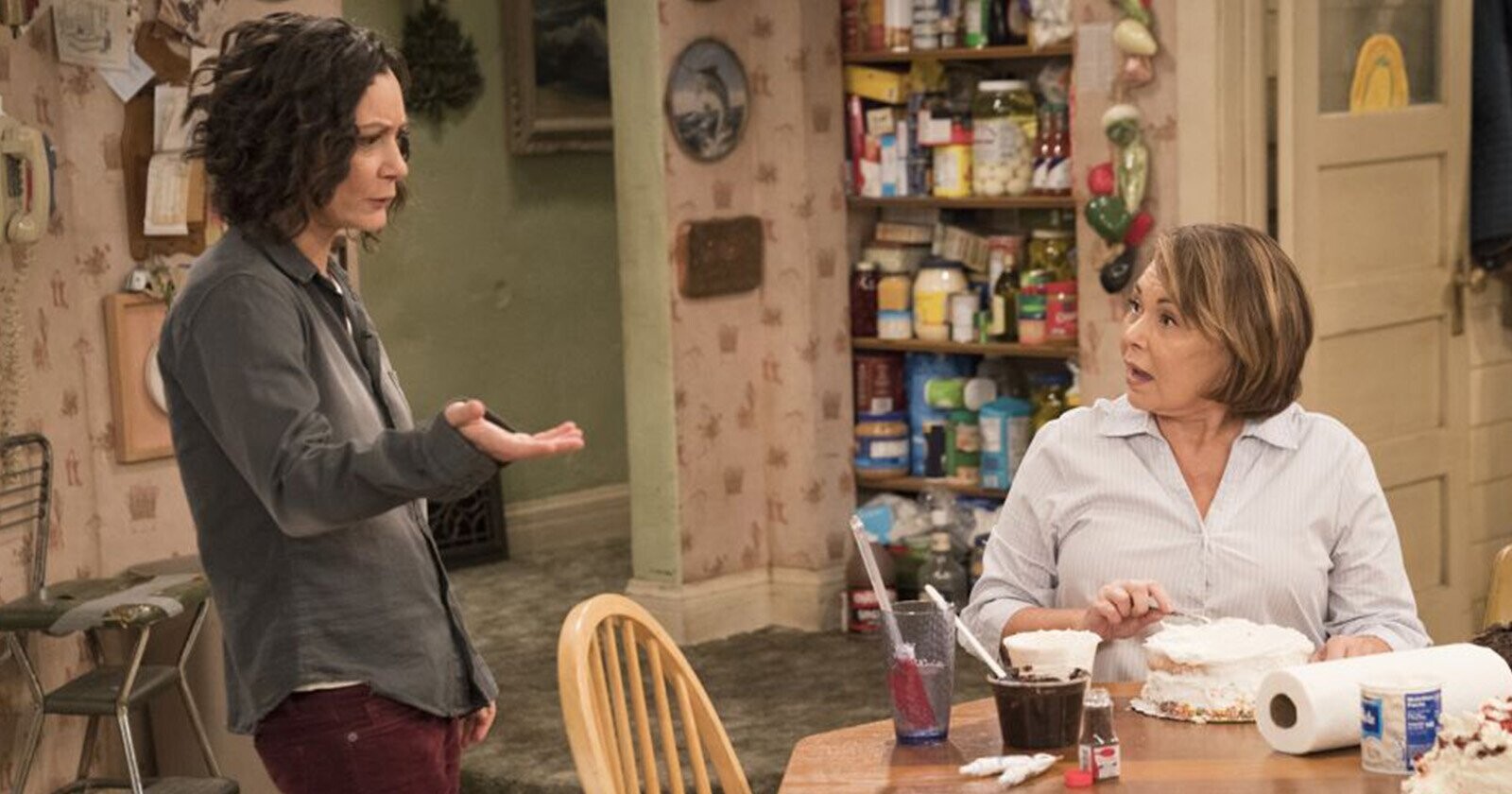
Sara Gilbert, who played Darlene Conner and was also an executive producer on the revival, publicly criticized Barr’s tweet. She said Barr’s comments did not reflect the beliefs of the cast, crew, or anyone associated with the show. Later, on The Talk, Gilbert said the cancellation was sad and difficult but that ABC had made the right decision.
From a corporate and public relations perspective, Gilbert’s response was understandable. She was not merely a co-star; she was attached to the revival as a producer and had professional responsibilities beyond family-style loyalty to a longtime colleague. The show employed writers, actors, crew members, production staff, and many others whose livelihoods were suddenly affected. Public silence would have been interpreted too. In a scandal, silence does not sit quietly in the corner. It puts on a hat and becomes a statement.
But Barr saw Gilbert’s comments very differently. In later interviews, Barr accused Gilbert of betrayal, saying Gilbert had stabbed her in the back. In a 2019 interview, Barr blamed Gilbert’s public statement for destroying the show and her life. In a 2023 interview with Megyn Kelly, Barr repeated and intensified her criticism, saying she felt Gilbert’s actions were especially painful because of their long relationship and because Gilbert had played her on-screen daughter for years.
Did Sara Gilbert “Have Roseanne Canceled”?
The most important question is also the easiest one to oversimplify: Did Sara Gilbert have Roseanne Barr canceled?
Based on the public record, ABC canceled Roseanne after Barr’s own tweet. Gilbert criticized the tweet before ABC’s announcement, but there is no public evidence proving that Gilbert alone caused the cancellation or had the power to make ABC end a highly rated series. Network decisions involve executives, advertisers, brand risk, public reaction, legal concerns, employee relations, and business strategy. A single tweet from a cast member can influence the atmosphere, but it is not the same as holding the corporate kill switch.
That said, Barr’s emotional interpretation is part of the story because the relationship between Barr and Gilbert was not random. They had decades of shared history. Gilbert was not an anonymous commentator. She was Darlene, the sarcastic daughter who had grown up inside Barr’s fictional household. When someone close publicly distances themselves during a scandal, the emotional blow can feel heavier than criticism from strangers. A thousand angry tweets from strangers may sting. One public rebuke from someone you considered family can feel like a hammer with a personalized engraving.
The Conners: A Spinoff, a Death, and a Deeper Wound
After ABC canceled Roseanne, the network found a way to keep the Conner family alive. The result was The Conners, a spinoff featuring much of the original cast, including Sara Gilbert, John Goodman, Laurie Metcalf, Lecy Goranson, and others. Barr was not creatively or financially involved. Her character, Roseanne Conner, was written out through an off-screen death connected to an opioid overdose storyline.
For viewers, the choice gave the spinoff a serious dramatic foundation. The original show had already explored working-class pain, health issues, prescription medication, and family grief. From that angle, Roseanne Conner’s death fit the show’s long-standing interest in hard realities. But for Barr, the decision felt personal and cruel. She has said she interpreted the death of her character as a message aimed at her, especially given her own mental health history.
That is where the suicide-related claim enters the controversy. Barr has said she believed people were trying to push her toward suicide. This is a statement about how she says she experienced the fallout. It is not proof of anyone else’s intent. That distinction matters. Mental health pain is real. Public humiliation can be devastating. But proving that another person intended such harm requires evidence beyond one person’s interpretation.
Public Accountability Versus Personal Destruction
The Roseanne Barr and Sara Gilbert controversy sits at the uncomfortable intersection of accountability and punishment. Many people believed ABC was right to cancel the show after Barr’s tweet. Others argued the response was too severe, especially given the number of people who lost work. Some saw Barr as facing consequences for racist language. Others saw her as a casualty of cancel culture. Both sides often talked past each other, which is practically the official sport of the internet.
Accountability means actions have consequences. In television, those consequences can be swift because networks sell trust, advertising, and brand identity. A star’s public behavior can affect everyone attached to a project. If a network believes a comment damages its values or business, it may act quickly.
But personal destruction is a different matter. When public consequences become humiliation, isolation, or a pile-on that seems endless, the human cost can become severe. Barr has spoken about feeling abandoned and devastated. Even people who strongly condemn her tweet can acknowledge that public shaming can become emotionally dangerous. The hard part is holding two truths at once: a harmful comment can deserve consequences, and a person facing those consequences can still be in genuine pain.
Why Sara Gilbert Became the Focus of Barr’s Anger
Barr’s anger toward Gilbert appears to come from a mix of professional loss and personal betrayal. Gilbert helped bring the revival back. She had deep ties to the show. She was part of the continuation that became The Conners. To Barr, this may have felt like being removed from her own house while the rest of the family stayed for dinner.
From Gilbert’s side, the public comments she made were framed around the cast, crew, and the values of the production. She also expressed sadness about the show ending. In a past interview, Gilbert indicated that she still considered Barr family and loved her, even while being heartbroken by what happened. That is the kind of statement that sounds compassionate to some readers and insufficient to others. In a feud, even a soft sentence can be heard as a cymbal crash.
The emotional puzzle is that both women were attached to the same legacy in different ways. Barr created and embodied the original force of Roseanne. Gilbert grew up in it, helped revive it, and then helped carry the family story forward without Barr. That creates a painful question: Who owns a cultural legacy when the central figure becomes too controversial for the institution that profits from it?
The Business Lesson Behind the Drama
One reason this story still attracts attention is that it reveals how modern entertainment works. A hit show is not just art. It is also contracts, advertisers, unions, distribution, streaming value, executive risk, public sentiment, and brand safety. The 2018 Roseanne revival was a huge success until it became a liability. ABC’s decision showed that even strong ratings may not protect a star when controversy threatens the network’s reputation.
The spinoff showed another lesson: intellectual property can outlive the person most associated with it. The Conners continued for seven seasons, proving that audiences were willing to watch the family without Barr. That fact likely deepened Barr’s sense of injury. It also demonstrated the resilience of the supporting cast and the strength of the fictional world created around the Conners.
For Hollywood, the case became a template. Networks learned that revival success comes with revival risk. Social media history matters. Star behavior matters. Public reaction can move faster than boardroom calendars. And when a brand crisis hits, companies may choose separation over repair, even if the decision costs money in the short term.
How the Story Looks Years Later
With distance, the controversy looks less like a single moment and more like a chain reaction. Barr’s tweet triggered outrage. ABC canceled the show. Gilbert’s comments became a focal point for Barr’s anger. The Conners continued. Barr gave interviews defending herself, apologizing at times, blaming others at times, and returning repeatedly to the pain of losing her show and character.
Meanwhile, The Conners built its own identity. It leaned into grief, financial struggle, family conflict, and working-class survival. Its final season revisited Roseanne Conner’s death and offered closure for the fictional family. Whether viewers found that moving, awkward, necessary, or impossible to separate from real-life conflict depended largely on what they brought to the show.
The strange thing about sitcom families is that audiences often feel they know them. The Conners were fictional, but they became emotionally real to many viewers. That is why the off-screen conflict felt so loaded. It was not just Roseanne Barr versus Sara Gilbert. It was Roseanne versus Darlene, creator versus continuation, mother figure versus daughter figure, past versus future.
Experience-Based Takeaways: What This Controversy Teaches About Betrayal, Pressure, and Reputation
Anyone who has been through a public professional rupture, even on a much smaller scale, can recognize parts of this story. Maybe it was not a television cancellation watched by millions. Maybe it was a workplace conflict, a business breakup, a social media mistake, or a falling-out with someone who once felt like family. The scale changes, but the emotional mechanics are familiar. When trouble comes, people look around to see who stands beside them. Sometimes the most painful discovery is not that strangers are criticizing you. It is that someone close has stepped away.
That is one reason Barr’s comments about Gilbert resonate with some people, even among those who do not defend Barr’s original tweet. Betrayal is rarely measured by legal responsibility. It is measured by expectation. If you expect a stranger to condemn you, it hurts less. If you expect a friend or colleague to protect you, even a carefully worded public statement can feel like abandonment. In professional settings, this happens all the time. A colleague may believe they are setting a necessary boundary. The person at the center of the controversy may experience that boundary as disloyalty. Both experiences can be sincere.
Another lesson is that public pressure distorts everything. When a controversy becomes national news, nobody has the luxury of processing events slowly. Companies want statements. Reporters want comments. Fans want sides. Critics want accountability. Supporters want defense. Social media wants a fresh log for the outrage fireplace. In that environment, a person’s worst day can become permanent content. That does not erase responsibility, but it does explain why people in crisis may feel hunted rather than corrected.
The Roseanne controversy also shows why mental health language should be handled with care. Saying that someone felt pushed toward suicide is not the same as proving that others intended that outcome. Still, the feeling itself should not be mocked. Public disgrace can be psychologically brutal. People can be responsible for harmful actions and still need support, compassion, and room to survive the aftermath. Accountability should not require dehumanization. The goal should be repair, safety, and truth, not seeing how much pain can be piled onto one person before the crowd gets bored.
For creators, the practical takeaway is simple but not easy: reputation is part of the work. A show, brand, or public career can be built over decades and damaged in minutes. That may feel unfair, but it is the reality of modern media. For colleagues, the lesson is equally difficult: public statements during a crisis may be necessary, but they can permanently alter private relationships. Words meant to protect a team can be heard as a personal attack.
Finally, for audiences, this story is a reminder to resist turning real people into cartoon characters. Roseanne Barr is not only her worst tweet, though that tweet had real consequences. Sara Gilbert is not automatically a villain because Barr felt betrayed. ABC was not simply a moral hero or a heartless machine; it was a corporation managing risk after a public scandal. The truth is messier, and messier is usually where the human story lives.
Conclusion
The controversy between Roseanne Barr and Sara Gilbert remains compelling because it combines celebrity, family symbolism, workplace loyalty, racism, cancellation, mental health, and television history into one tangled American media knot. Barr says Gilbert betrayed her and helped cause the cancellation that devastated her. The public record shows ABC canceled Roseanne after Barr’s racist tweet about Valerie Jarrett, while Gilbert publicly condemned Barr’s remarks and later supported the network’s decision as painful but right.
What cannot be proven from public evidence is Barr’s claim that Gilbert or others intended to push her toward suicide. What can be understood is that Barr experienced the fallout as deeply personal, especially after The Conners continued without her and killed off her character. The result is a feud that feels less like a standard Hollywood argument and more like a family fight staged under stadium lights.
In the end, this story is not only about who said what. It is about what happens when a beloved cultural property collides with a star’s public behavior, a network’s values, a cast’s survival, and an audience’s divided expectations. Like the best episodes of Roseanne, it is uncomfortable, funny in bitter flashes, and full of people who are hurt, angry, flawed, and still impossible to ignore.