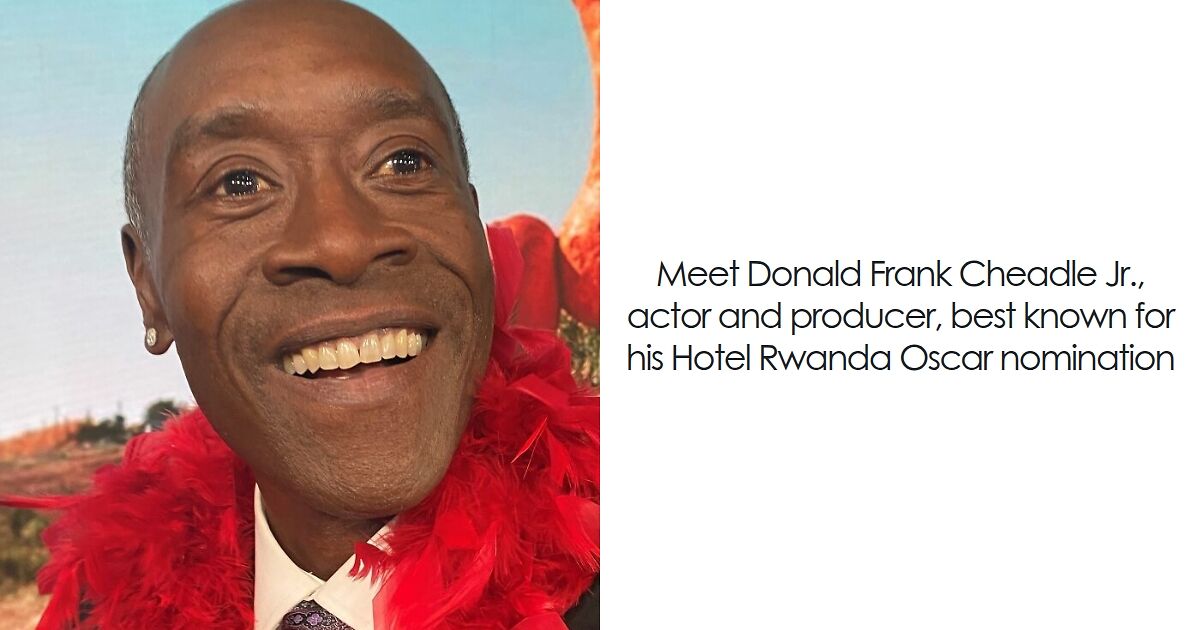
Don Cheadle has built the kind of career that makes a filmography look less like a résumé and more like an exceptionally well-curated streaming queue. He is an actor who can turn a three-minute scene into the part everyone remembers, lead a historical drama with bruising emotional control, crack a joke inside a suit of armored superhero hardware, and then direct a jazz-infused feature about Miles Davis. The phrase “versatile actor” gets tossed around like confetti at an awards show, but in Cheadle’s case, it is simply accurate.
Don Cheadle at a Glance
Donald Frank Cheadle Jr. was born on November 29, 1964, in Kansas City, Missouri. Over a career spanning film, television, theater, producing, and directing, he has earned major recognition for projects ranging from The Rat Pack and Hotel Rwanda to House of Lies, Miles Ahead, and the Marvel Cinematic Universe. Cheadle’s reputation rests on a rare mix of precision, range, and an ability to look completely unconvinced by nonsensea useful skill both on-screen and, presumably, at meetings.
Early Life, Education, and the Making of an Actor
From Kansas City to Denver to CalArts
Cheadle spent part of his childhood moving with his family before graduating from Denver’s East High School. His early interests included music and theater, two passions that would remain visible throughout his career. Later, he earned a Bachelor of Fine Arts in theater from the California Institute of the Arts in 1986. That combination of performance training and musical curiosity helps explain a career built on rhythm, listening, and seemingly effortless shifts in tone.
Before the prestige roles and blockbuster franchises, Cheadle completed the reliable actor’s apprenticeship: smaller parts, television appearances, and films where the call sheet did not yet put his name in extra-large type. Credits in the late 1980s and early 1990s included Hamburger Hill, Colors, Hill Street Blues, and The Golden Palace. These were not instant-launchpad roles. They were working-actor rolesthe kind that teach timing, professionalism, and how to make an entrance without blowing the catering budget.
The Breakthrough: Don Cheadle Becomes Unmissable
Mouse Alexander in Devil in a Blue Dress
Cheadle’s breakthrough arrived with 1995’s Devil in a Blue Dress, Carl Franklin’s adaptation of Walter Mosley’s detective novel. He played Mouse Alexander, the loyal but volatile friend of Denzel Washington’s Easy Rawlins. Mouse could be terrifying, funny, protective, and utterly unpredictable, sometimes in the span of one sideways look. The performance was not simply scene-stealing; it was scene-rearranging. Viewers walked away remembering how much menace and humor Cheadle could place in the same sentence.
That performance opened a run of sharp supporting work in movies that have aged unusually well: Rosewood, Boogie Nights, Bulworth, and Out of Sight. He worked with filmmakers such as John Singleton, Paul Thomas Anderson, and Steven Soderbergh without becoming trapped in one character type. In Boogie Nights, his Buck Swope is warm, ambitious, and unexpectedly tender. In Out of Sight, he is part of Soderbergh’s elastic, coolly chaotic ensemble. Cheadle’s gift was never about demanding a spotlight; it was about making the world around his character feel more lived-in.
Becoming Sammy Davis Jr. in The Rat Pack
Television gave him another major early showcase. In HBO’s The Rat Pack, Cheadle portrayed Sammy Davis Jr., taking on the daunting job of playing a real entertainer whom audiences already knew through recordings, photographs, and legend. The performance earned him a Golden Globe Award and an Emmy nomination. It revealed a crucial Cheadle trait: research may get an actor to the starting line, but emotional interpretation is what makes an impersonation feel human rather than museum-ready.
From Ensemble Favorite to Leading Man
The early 2000s turned Cheadle from a cherished character actor into a leading man with broad commercial reach. Steven Soderbergh’s Traffic cast him as DEA agent Montel Gordon, placing him inside a sprawling, morally tangled story about the drug trade. Then came Ocean’s Eleven, where he played Basher Tarr, the explosives expert with a motor-mouth delivery and a talent for making technical exposition sound like a pub argument you would gladly eavesdrop on. Cheadle reprised the role in Ocean’s Twelve and Ocean’s Thirteen, helping make the trilogy feel like a genuine ensemble rather than a famous-people roll call.
Hotel Rwanda and an Oscar-Nominated Performance
In 2004, Hotel Rwanda became one of the defining dramatic performances of Don Cheadle’s career. As Paul Rusesabagina, the hotel manager at the center of a story set during the 1994 Rwandan genocide, Cheadle played courage without turning it into superheroics. His performance balances fear, calculation, decency, and exhaustionthe emotional math of a person trying to protect others in an impossible situation. The role earned him an Academy Award nomination for Best Actor and remains essential to any serious account of his career.
Cheadle followed that acclaim with choices that emphasized range over repetition. He appeared in Crash, Talk to Me, Reign Over Me, The Guard, and Flight, moving between drama, social commentary, comedy, and flawed authority figures. He often selects characters who are carrying something: a moral burden, a private disappointment, a dangerous secret, or occasionally a deeply questionable jacket. That pattern makes his work feel connected even when the genres are wildly different.
Television Success and the Marvel Years
Marty Kaan, Mo Monroe, and J.D. Hudson
Cheadle’s television career is equally significant. On Showtime’s House of Lies, he played Marty Kaan, a brilliant, ruthless management consultant whose charm was both a weapon and a warning label. The series earned him a second Golden Globe Award and multiple Emmy nominations. Later, Black Monday let him lean into loud, acid-tipped Wall Street satire as Mo Monroe. In Fight Night: The Million Dollar Heist, he played detective J.D. Hudson, bringing grit and grounded authority to a period crime story set against 1970s Atlanta.
War Machine and the Marvel Cinematic Universe
For a generation of moviegoers, however, Cheadle is also James “Rhodey” Rhodes, better known as War Machine in the Marvel Cinematic Universe. He inherited the role in Iron Man 2 and developed Rhodey into more than Tony Stark’s dependable friend with access to heavy machinery. Cheadle gave him moral clarity, dry humor, military discipline, and the weary patience of a man who has watched geniuses improvise with lasers one too many times.
Across the Avengers films, Captain America: Civil War, and Secret Invasion, Rhodey serves as a steady human center amid cosmic chaos. Marvel has also confirmed Cheadle’s continued connection to the character through Armor Wars, which focuses on the consequences of Stark technology falling into the wrong hands. It is one of the most enduring roles in Cheadle’s career, and he has made the character feel essential without trying to turn him into a loudest-person-in-the-room superhero.
Creative Ambition: Miles Ahead, Theater, and Producing
Miles Ahead, Cheadle’s 2016 film about Miles Davis, revealed a different layer of ambition. He starred as Davis, co-wrote the screenplay, made his feature-directing debut, and produced the project. Rather than build a conventional cradle-to-credits biopic, Cheadle and his collaborators created a stylized, time-bending portrait of the musician’s creative turbulence. The film’s soundtrack won a Grammy Award, a fitting result for a project that treats music as more than background decoration. In Cheadle’s hands, Miles Davis is not a tidy legend; he is a difficult, brilliant artist in motion.
One reason Cheadle is difficult to typecast is that he plays reactions as seriously as declarations. In a crime story, he may let the audience notice the calculation before the character says a word. In a comedy, he can make arrogance funny precisely because a flicker of panic is hiding underneath it. In a historical drama, he avoids the tempting shortcut of turning dignity into a statue. This is performance built on listening: to the scene partner, to the rhythm of dialogue, and to the information a character refuses to give away. It is why a Don Cheadle role often rewards a second viewing. The first pass gives you the plot; the next one reveals the gears.
Cheadle’s stage work and producing demonstrate that his interests extend beyond the screen. He originated the role of Booth in Suzan-Lori Parks’s Topdog/Underdog at the Public Theater, a reminder that his roots are firmly theatrical. In 2026, he made his Broadway acting debut in a revival of David Auburn’s Proof, playing Robert opposite Ayo Edebiri. The return to live theater did not read as a nostalgic detour. It looked like the next logical test for an actor who has spent decades choosing difficult material.
Humanitarian and Environmental Advocacy
Outside performance, Cheadle has used his profile for humanitarian and environmental advocacy. His work connected to Darfur helped lead to Not On Our Watch, co-written with human rights advocate John Prendergast. He has also been a United Nations Environment Programme Goodwill Ambassador and worked on Years of Living Dangerously, a documentary series focused on people confronting climate change. The through line is not celebrity as decoration; it is celebrity as a microphone that should occasionally be pointed toward something larger than a premiere.
Why Don Cheadle’s Career Still Stands Out
What makes Don Cheadle’s career last is not just the number of notable projects. It is the repeated decision to avoid the easy lane. He can play intense without becoming stiff, funny without chasing punchlines, and famous without allowing fame to flatten the work. His career highlightsfrom Mouse Alexander and Sammy Davis Jr. to Paul Rusesabagina, Marty Kaan, Miles Davis, War Machine, and Robert in Proofshow an artist who treats each role as a new problem to solve.
Sometimes the problem includes moral tragedy. Sometimes it includes a rocket-powered suit. Either way, Cheadle arrives prepared. That discipline, paired with curiosity and range, is why his work continues to appeal to film fans, television audiences, theatergoers, and anyone who appreciates an actor capable of making a line, a pause, or a raised eyebrow do far more work than it has any right to do.
Experiences and Career Lessons Inspired by Don Cheadle’s Work
Watching Don Cheadle’s career in order is a useful experience for anyone who likes movies, television, theater, or the complicated craft of becoming good at something over time. The first lesson is patience. His story does not begin with an overnight explosion of fame. It begins with small credits, recurring television work, and years spent learning in public without the public necessarily noticing. That is not the glamorous version of success, but it is the version most people actually live.
For emerging performers, Cheadle’s early work suggests a practical approach: treat the small role as a laboratory, not an insult. Mouse in Devil in a Blue Dress may have less screen time than the lead, but the character is unforgettable because Cheadle commits fully to every beat. The experience for viewers is a tiny master class in specificity. A pause, a glance, a change in posturethose choices can make a supporting character feel like he had a life before the camera entered the room.
For movie fans, Cheadle’s filmography offers a satisfying genre-hopping challenge. Watch Traffic, Ocean’s Eleven, Hotel Rwanda, Talk to Me, The Guard, Flight, and Miles Ahead close together. The experiment makes one thing clear: range is not about wearing different costumes. It is about changing the internal temperature of a performance. In one film he is cool and quick-witted; in another, he is frayed, guarded, furious, or quietly compassionate. The actor remains recognizable, but the character never feels like a recycled template with a new mustache.
His work as War Machine offers another experience: notice what he does when the movie around him gets very large. Marvel stories are packed with spectacle, callbacks, portals, gadgets, and enough glowing blue light to power a medium-size county. Cheadle gives Rhodey gravity. He reacts, challenges, worries, and jokes in ways that keep the character grounded. It is a useful reminder that even the biggest franchise role needs a human point of view.
Miles Ahead is especially valuable for creators. Cheadle did not choose the safest route for a music biopic. He did not try to summarize every important date in Miles Davis’s life and call it a day. Instead, he pursued mood, memory, conflict, sound, and creative instability. The lesson is not that every biography should become nonlinear. The lesson is that form should match subject. A story about restless art should probably feel restless.
There is also a broader experience in seeing Cheadle move between acting and advocacy. His public work on genocide prevention and climate issues does not require every audience member to agree with every position. It does show a willingness to spend reputation on something other than self-promotion. For creative professionals, that raises a productive question: What is your platform for? It can be used to sell a project, certainly. It can also amplify people and problems that do not have access to the same microphone.
Finally, Cheadle’s Broadway debut after a long screen career offers a bracing late-career lesson: mastery does not cancel curiosity. Going back to live theater is a reminder that even established artists can choose a fresh kind of risk. For anyone feeling stuck in a career, that may be the most useful Don Cheadle experience of all. Keep building skill. Keep changing rooms. Never assume the part of your story that feels unfamiliar is the part you are unqualified to try. That kind of disciplined flexibility is a far more durable definition of career success than a single viral moment.