There are gardens that behave politely. They bloom, they bow, they wait for applause, and then they fade like a dinner guest who knows not to overstay. A Piet Oudolf garden does the opposite. It lingers. It changes its mind. It looks glorious in June, mysterious in October, and strangely moving in February, when lesser gardens are wearing the horticultural equivalent of sweatpants.
That is the secret behind today’s growing obsession with Piet Oudolf, the Dutch garden designer whose naturalistic planting style has reshaped how cities, museums, parks, and home gardeners think about beauty. Oudolf is best known in the United States for the High Line in New York City, Lurie Garden in Chicago, The Battery Bosque in Lower Manhattan, Oudolf Garden Detroit on Belle Isle, the meadow at Delaware Botanic Gardens, and the newly opened Calder Gardens in Philadelphia. His work has made grasses, seed heads, perennials, and seasonal decay feel not only acceptable but downright glamorous. Somewhere, a dried coneflower is blushing.
What makes Oudolf’s gardens so captivating is not a single plant or color palette. It is the way he choreographs time. His landscapes are not floral snapshots; they are long-form stories. Flowers matter, of course, but so do stems, silhouettes, movement, shadows, seed heads, wildlife, and the emotional weather of a place. In an era when many people want gardens that are beautiful, resilient, lower-input, pollinator-friendly, and less obsessed with lawn perfection, Oudolf’s approach feels less like a trend and more like a very elegant wake-up call.
Who Is Piet Oudolf, and Why Is Everyone Still Talking About Him?
Piet Oudolf, born in the Netherlands in 1944, is widely associated with the New Perennial movement, also called the Dutch Wave. This approach favors long-lived perennials, ornamental grasses, strong plant structure, seasonal transformation, and plant communities that feel inspired by nature rather than forced into stiff decorative poses. Think less “formal garden wearing a necktie” and more “meadow with a master’s degree.”
Oudolf’s influence grew from decades of plant observation, experimentation, and design work. At his former nursery in Hummelo, he and his wife, Anja, explored perennials and grasses not as background filler but as main characters. His gardens often rely on plants that earn their keep through more than flower color. A plant may be valuable because it stands upright in winter, catches frost beautifully, feeds pollinators, repeats rhythm across a bed, or creates a smoky veil around brighter blooms.
This is why Oudolf’s work feels so different from traditional seasonal bedding. A typical flower display can peak like a fireworks show: dazzling, brief, and then someone has to clean up the mess. Oudolf’s plantings are more like music. There is tempo, repetition, contrast, silence, and return. The garden is designed to be read over months, not glanced at between errands.
The Oudolf Look: Wild, YesBut Not Random
One of the funniest misconceptions about naturalistic garden design is that it means tossing seeds into the air and hoping Mother Nature has excellent project management skills. Oudolf’s gardens may look spontaneous, but they are deeply planned. His planting plans can resemble abstract art: colorful blocks, dots, waves, and symbols that translate into complex living compositions.
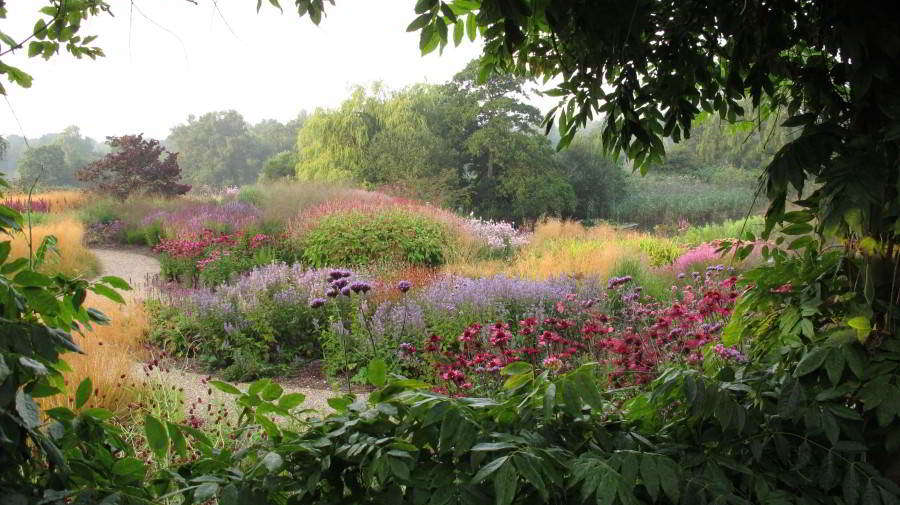
The “Oudolf look” often includes drifting perennials, grasses that move in the wind, seed heads left standing through winter, and a restrained color palette that lets texture do serious heavy lifting. Plants such as echinacea, rudbeckia, salvia, allium, molinia, panicum, sanguisorba, helenium, persicaria, and asters often appear in naturalistic planting conversations because they bring shape, rhythm, wildlife value, or late-season strength. The specific plant list changes by climate and project, but the principle remains consistent: choose plants for behavior, not just beauty.
Structure Comes Before Color
Oudolf has long emphasized plant structure. A flower may be lovely for two weeks, but a sturdy stem or sculptural seed head can hold the garden together for months. This idea is revolutionary for gardeners raised to believe that a plant’s worth is measured by how loudly it blooms. In an Oudolf-inspired garden, a brown seed head can be as important as a pink flower. That is not neglect; that is design maturity wearing a very tasteful scarf.
Four Seasons Are Not Enough
The documentary Five Seasons: The Gardens of Piet Oudolf captures one of the central ideas behind his work: the garden has more than the standard four seasons. There is the season of emergence, the season of bloom, the season of fullness, the season of decline, and the season of quiet structure. Oudolf makes room for all of them. Instead of treating fall and winter as gardening failures, he turns them into chapters.
The High Line: A Garden Above the City
For many Americans, the High Line in New York City was their first full-strength encounter with Oudolf’s style. Built on an abandoned elevated railway, the park became a landmark example of how post-industrial infrastructure could be transformed into a layered public landscape. The planting design drew inspiration from the self-seeded vegetation that had colonized the rail tracks before redevelopment, but it refined that wildness into a durable, walkable, cinematic experience.
What makes the High Line so powerful is its contrast. Steel, glass, concrete, and traffic surround a ribbon of grasses and perennials that seem to be quietly reclaiming the city without making a big speech about it. Visitors move through waves of texture, from airy grasses to bold flowering perennials, with the skyline acting like an expensive backdrop the garden did not have to pay for.
The High Line also helped popularize a new urban planting language. It showed that public landscapes did not need to rely only on clipped shrubs, annual beds, and obedient lawns. A city garden could be seasonal, loose, ecological, and still incredibly designed. In other words, it could have bedhead and a PhD.
Lurie Garden: Prairie Drama in Downtown Chicago
Chicago’s Lurie Garden, located in Millennium Park, is another major Oudolf-associated masterpiece. Designed with Gustafson Guthrie Nichol and Robert Israel, it combines naturalistic plantings with ecologically sensitive maintenance in the middle of a dense urban setting. The garden sits within one of the city’s most visited public spaces, yet it feels like a living refuge for people, birds, bees, and anyone who has ever needed a moment away from architectural bravado.
Lurie Garden is often described through its contrast between “light” and “dark” plates, with plantings that reference prairie, woodland edges, and Chicago’s layered history. Oudolf’s perennial design gives the space its emotional electricity. In summer, the garden hums with color and insect life. In fall, it deepens into bronze, russet, and gold. In winter, the remaining stems and grasses hold the snow like calligraphy.
For home gardeners, Lurie offers a practical lesson: ecological planting does not have to look messy. It can be rich, legible, and intensely beautiful when plant selection, spacing, maintenance, and seasonal structure are handled with intention.
The Battery Bosque: Shade, Texture, and Urban Relief
At The Battery in Lower Manhattan, Oudolf’s work helped transform public space at the city’s edge. The Battery Bosque is a four-acre woodland garden set among mature London plane trees, offering shade and softness near New York Harbor. It is a reminder that Oudolf’s approach is not limited to sunny meadows. His planting ideas can also operate under trees, along paths, and in heavily used urban parks.
The Bosque matters because it proves that naturalistic planting can be civic infrastructure. It gives people a place to pause, sit, cool down, and reconnect with seasonal change. In a city where everyone is apparently late to something, that is no small achievement.
Oudolf Garden Detroit: A Public Garden with a Volunteer Heart
Oudolf Garden Detroit on Belle Isle may be one of the most fascinating American examples of his work because it is both ambitious and deeply community-driven. The project began after a “love letter” from Detroit reached Oudolf, inviting him to imagine a public garden for Belle Isle. Today, the garden includes the Main Garden, Rain Garden, Native Meadows, and Bird Border, with tens of thousands of plants arranged across a site that changes daily.
The Main Garden is especially notable because it showcases multiple planting styles: block, matrix, and grouping plans. That makes it a living classroom for anyone trying to understand how Oudolf organizes plants at scale. Block planting can create bold, readable masses. Matrix planting uses repeated base layers to weave species together. Grouping creates rhythm and surprise. Together, they show that “natural” does not mean “unplanned.” It means planned so skillfully that the plan disappears into experience.
The Rain Garden adds another layer of relevance. Designed to collect and filter stormwater, it demonstrates how beauty and environmental function can work together. This is a major reason Oudolf’s work resonates now: his gardens do not simply decorate land. They help land perform.
Calder Gardens: Art, Architecture, and Plants in Motion
Calder Gardens in Philadelphia, which opened in 2025, brings Oudolf’s planting language into dialogue with the work of Alexander Calder and architecture by Herzog & de Meuron. The landscape includes tens of thousands of perennials and a wide plant palette designed to shift throughout the year. It is a fitting pairing: Calder’s mobiles move through air, while Oudolf’s gardens move through time.
This project shows why Oudolf remains relevant decades into his career. His gardens are not nostalgic replicas of countryside meadows. They are contemporary cultural spaces. They can sit beside sculpture, museums, stormwater systems, industrial ruins, or downtown skylines and still feel emotionally direct. They ask visitors to slow down and notice movement, shadow, seed, wind, and the strange luxury of paying attention.
Why Oudolf’s Gardens Feel So Modern
The modern obsession with Piet Oudolf is not only about aesthetics. It reflects a larger shift in how people think about outdoor space. Homeowners, designers, and cities are increasingly interested in gardens that support biodiversity, tolerate climate stress, reduce chemical inputs, and offer year-round interest. Oudolf’s work answers those desires without making the garden feel like homework.
His approach is also emotionally modern. Many people are tired of perfection. Perfect lawns, perfect hedges, perfect flower beds, perfect social media patios with pillows that have never met rainenough already. Oudolf offers a more generous kind of beauty, one that includes aging, fading, leaning, reseeding, and returning. His gardens remind us that change is not the enemy of design. Change is the material.
How to Bring Piet Oudolf’s Ideas into a Home Garden
You do not need a museum budget or a 3-acre public site to borrow from Oudolf’s thinking. The goal is not to copy the High Line into a suburban side yard. That would be like trying to park a symphony in a closet. Instead, start with principles.
Choose Plants for Shape and Longevity
Look for perennials and grasses that offer more than a short bloom window. Strong stems, attractive seed heads, interesting foliage, and good winter presence matter. A plant that looks compelling after flowering is a better long-term partner than a diva that gives you ten good days and then collapses dramatically like it has read too much poetry.
Plant in Repetition
Oudolf-inspired gardens often rely on repetition to create rhythm. Repeating a grass, a vertical flower spike, or a rounded seed head across a bed helps the eye move through the space. Repetition is what separates a designed meadow from a plant shopping accident.
Think in Layers
A strong naturalistic planting may include a matrix layer, seasonal highlights, structural perennials, bulbs, and occasional shrubs or trees. The matrix layer acts like a living fabric. Seasonal plants rise through it. Structural plants hold the scene together. Bulbs add early surprise. Shrubs provide bones. Suddenly, the garden has more plot than some streaming shows.
Let Winter Stay Interesting
Instead of cutting everything down the moment flowers fade, consider leaving stems and seed heads through winter where appropriate. This can provide visual interest and habitat benefits. The result is a garden that still has presence in the quiet months, especially when frost, snow, or low sunlight catches the dried forms.
The Emotional Side of Naturalistic Planting
What separates Oudolf’s work from ordinary meadow-style planting is emotion. His gardens are not just “good for pollinators,” though many are. They are not just “low maintenance,” which is a phrase that should always be treated with mild suspicion because plants are alive and therefore have opinions. His gardens create atmosphere.
Walk through an Oudolf garden and you may feel nostalgia without knowing exactly what you are remembering. The plants suggest fields, prairies, roadsides, childhood walks, abandoned lots, and wild edges. But the composition is heightened, edited, and intensified. It is nature translated through art.
That emotional quality explains why his gardens photograph beautifully but cannot be fully understood through photographs. A picture captures color and form, but not the sound of grasses moving, the slow arrival of bees, the shift in light, or the way a path reveals a planting gradually. Oudolf designs for the body in motion, not just the eye standing still.
Common Mistakes When Trying the Oudolf Style
The first mistake is assuming that naturalistic means maintenance-free. Oudolf gardens require knowledge, editing, and timing. They may reduce certain inputs, but they are not self-cleaning ovens. Someone still needs to understand weeds, plant competition, seasonal cutbacks, and how the composition is supposed to evolve.
The second mistake is using too many species in a small space. Oudolf can work with large, complex palettes because he understands plant behavior at an expert level. In a home garden, fewer species repeated well usually look stronger than a tiny botanical circus. Unless the goal is chaos, in which case congratulations, the garden center clearance rack is ready for you.
The third mistake is forgetting local conditions. A plant that thrives in one Oudolf project may fail elsewhere. Soil, rainfall, heat, cold, deer pressure, and maintenance capacity matter. The real lesson is not “use this exact plant.” The lesson is “understand what the plant does.”
Experience Notes: Spending Time in an Oudolf-Inspired Garden
The best way to understand the Oudolf obsession is to spend time in a garden that changes while you are looking at it. Not literally in a time-lapse, of courseunless you have brought a folding chair, snacks, and a heroic tolerance for pollen. But even during a single visit, the garden shifts. Clouds pass. Grasses brighten and dim. A clump of purple flowers that looked dominant from one angle becomes a background haze from another. Seed heads you almost ignored suddenly line up against the sky like punctuation marks.
In a traditional flower garden, the visitor often hunts for peak bloom. In an Oudolf-inspired garden, peak bloom is only one pleasure among many. The experience is slower and more layered. You begin by noticing color, because humans are easily bribed by flowers. Then texture takes over. Fine grasses soften the scene. Large leaves create weight. Umbel-shaped flowers hover like tiny chandeliers. Spiky forms add energy. Rounded seed heads repeat like drumbeats. Before long, you are not asking, “What is blooming?” You are asking, “How is this whole thing working?”
One of the most memorable experiences is seeing how these gardens handle imperfection. A leaning stem does not automatically look wrong. A fading flower does not seem like a failure. Brown, tan, copper, straw, and gray become part of the palette. This is surprisingly relaxing. The garden is not screaming for constant correction. It is asking for observation. For gardeners used to deadheading everything into submission, this can feel almost rebellious. Put down the pruners. Step away from the compost bag. The seed head has artistic rights.
Another experience that stands out is the wildlife. Naturalistic plantings often feel alive because they are alive in a visible way. Bees move through flowers. Birds investigate seed heads. Butterflies drift across sunny openings. Even the wind becomes part of the design, especially when grasses are used well. A static garden can be beautiful, but a moving garden feels companionable. It has moods.
For home gardeners, the most useful takeaway is patience. Oudolf-style planting does not always deliver instant gratification. Young perennials need time to knit together. Grasses need seasons to gain presence. Some combinations reveal their logic only after plants mature. This can be difficult in a culture that expects everything to look finished by next Tuesday. But the reward is a garden that deepens instead of expires.
There is also a personal lesson tucked inside the planting philosophy. Oudolf’s gardens make space for youth, maturity, decline, rest, and return. They do not treat aging as something to hide. They show that beauty can be structural, quiet, and weathered. That may be why people respond to them so strongly. Beneath the horticulture is a humane idea: life is not less beautiful because it changes. Sometimes it becomes beautiful because it changes.
Conclusion: Why Piet Oudolf Still Feels Like the Future
Piet Oudolf’s gardens have become current obsessions because they meet the moment without chasing fashion. They are artistic but practical, ecological but not preachy, wild-looking but carefully composed. From the High Line to Lurie Garden, from The Battery to Detroit, from Delaware to Calder Gardens, his work shows how planting can transform public space and private imagination.
At the heart of the Oudolf approach is a simple but profound shift: the garden is not a decoration. It is a living performance. Flowers enter and exit. Grasses whisper. Seed heads remain after the applause. Winter is not an empty stage; it is the final act before renewal. For anyone tired of flat lawns and disposable color, stepping into an Oudolf-inspired garden can feel like discovering that plants have been speaking in paragraphs all along.
And once you hear it, good luck going back to boring shrubs lined up like office furniture.
Note: This HTML article is prepared for web publishing with body-only markup, no visible source links, and no citation placeholders.