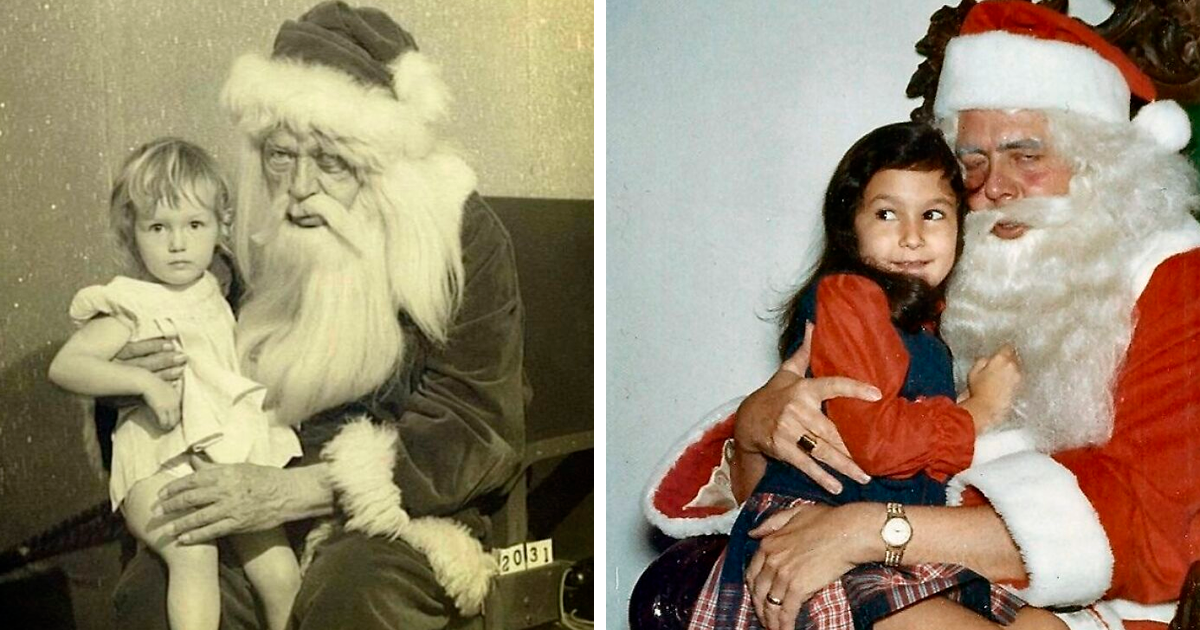
Santa Claus is supposed to be the comforting CEO of Christmas cheer: rosy cheeks, fluffy beard, twinkly eyes, and a belly laugh that sounds like a plate of cookies learned how to giggle. But spend five minutes scrolling through vintage holiday photos, awkward family Christmas portraits, or old illustrated Santa cards, and you may discover another Santa entirely. This version looks less like he came down the chimney and more like he lives in the chimney.
Creepy Santa photos have become a strange little holiday tradition of their own. They appear in old family albums, antique postcards, mall photo archives, online galleries, and viral “Christmas fail” roundups. Some are funny. Some are charmingly bizarre. Others look like evidence from a North Pole incident report. From stiff department-store Santas with frozen smiles to vintage illustrations where Santa seems one candle away from joining a gothic novel, these images prove that holiday nostalgia has a shadow sideand it is wearing red velvet.
So why do creepy and unhinged pics of Santa fascinate us? The answer blends history, photography, psychology, pop culture, and the universal truth that no toddler wants to be placed on a stranger’s lap while surrounded by fake snow and blinking reindeer.
Why Creepy Santa Photos Are Everywhere
The modern American Santa did not arrive fully formed, polished, and ready for a soda commercial. His look evolved over centuries, drawing from Saint Nicholas legends, Dutch “Sinterklaas” traditions, 19th-century illustrations, department-store marketing, and advertising campaigns. Before Santa became the rounded, jolly figure most Americans recognize today, he could appear tall, thin, stern, elf-like, shaggy, or downright alarming.
That visual inconsistency explains many creepy vintage Santa pictures. Early illustrators and costume makers did not all agree on what Santa should look like. One Santa might wear a hooded robe and stare like a medieval tax collector. Another might have a mask with tiny eye holes, a beard that looks borrowed from a mop, and gloves large enough to deliver presents by forklift.
Old Photography Made Everything Look More Haunted
Vintage photography did Santa no favors. Early cameras required longer exposure times, which meant people had to stay still. Smiles were often subtle or absent. Lighting was harsh. Flash photography could create ghostly shadows. Add a fake beard, a stiff costume, and a child who clearly wants to resign from Christmas, and suddenly the family keepsake looks like a scene from a holiday-themed thriller.
In older black-and-white photos, Santa’s red suit becomes a dark mass, his beard becomes a pale blur, and his eyes can disappear under a hat brim. Even a perfectly nice man can look like a fireplace goblin when photographed under bad lighting in 1937.
The Mall Santa Tradition: Joy, Commerce, and Mild Panic
Department-store Santas helped turn Christmas into a public spectacle. By the late 19th and early 20th centuries, American stores realized that a live Santa could draw families, sell toys, and transform shopping into an event. Eventually, the “photo with Santa” became a seasonal ritual. Parents lined up. Children rehearsed wish lists. Cameras clicked. Somewhere in the background, retail capitalism jingled all the way.
For many families, the Santa photo is sweet. For others, it becomes comedy gold. The child screams. Santa stays professionally cheerful. The parent, determined to preserve the memory, smiles like everything is fine. It is not fine. The baby has seen the beard. The baby has filed a complaint with the universe.
These crying Santa pictures are often shared because they capture the gap between adult expectations and child reality. Adults see magic. Small children see a large stranger in costume who knows where they sleep. Honestly, fair.
What Makes a Santa Picture Creepy?
Not every awkward Santa photo is creepy. Some are merely funny, nostalgic, or painfully 1980s. But certain details push a picture from “cute holiday fail” into “please hide this in the attic.”
1. The Mask Is Too Human, But Not Human Enough
Santa masks are responsible for many crimes against holiday cheer. A mask can freeze Santa’s expression into a permanent grin, and the human brain does not love a permanent grin. When a face looks almost human but slightly wrong, it can trigger what psychologists often call the “uncanny valley.” The result is a weird emotional dip: we recognize the face, but something feels off. Santa becomes less “jolly old elf” and more “wax museum employee after closing time.”
2. The Eyes Are Hidden
Eyes carry warmth, emotion, and trust. When Santa’s eyes vanish behind glasses, shadows, fake brows, or a rubber mask, viewers lose the most expressive part of the face. That is why so many creepy Santa pics have the same energy: a giant white beard, a dark hat, and two mysterious dots where holiday spirit should be.
3. The Beard Has Entered Its Own Era
A good Santa beard says, “I bake cookies with Mrs. Claus.” A bad Santa beard says, “I was found in a storage bin labeled ‘miscellaneous winter.’” Vintage fake beards were often stringy, uneven, yellowed, or aggressively woolly. Some looked like Santa had been attacked by a sheep and decided to keep the evidence.
4. The Child Is Clearly Not On Board
Nothing intensifies a creepy Santa image like a child’s expression of pure betrayal. The contrast is brutal: Santa beams, parent waves, child silently communicates, “I will remember this during your retirement years.” These photos are funny because they are dramatic, but they also reveal how strange the ritual can feel from a child’s perspective.
5. The Setting Looks Accidentally Sinister
Some Santa photos are not creepy because of Santa himself but because of the surroundings. A dim basement community hall. A folding chair near a fake fireplace. A lonely plastic tree. Tinsel hanging like crime-scene tape. One flickering bulb. Suddenly, the North Pole looks like it lost its business license.
Vintage Santa Illustrations Were Sometimes Wildly Unhinged
Old Christmas cards and illustrations could be stranger than modern audiences expect. Today, Christmas imagery is heavily polished: glowing fireplaces, perfect trees, soft snow, matching pajamas, and cookies that look assembled by architecture students. Earlier holiday art was far more experimental. Santa appeared with unusual companions, odd facial expressions, strange props, and sometimes a level of intensity better suited to folklore than greeting cards.
This is partly because Christmas itself absorbed many traditions: religious observance, winter festivals, European folklore, gift-giving customs, and commercial advertising. Santa has always been a mashup. Before he became brand-safe and mall-approved, he could be mysterious, stern, mischievous, or supernatural. That older Santa had one boot in childhood wonder and the other in “don’t go into the woods after dark.”
The Folklore Side: Santa Was Not Always Soft and Cuddly
Modern American Santa is mostly reward-based. Be good, get gifts. But older European winter folklore often included darker figures who punished bad behavior, warned children, or represented the danger of winter. Traditions involving figures like Krampus, Belsnickel, or other stern holiday visitors remind us that Christmas folklore was not always sugar cookies and matching stockings.
That history matters because creepy Santa images often tap into the older, weirder side of the season. A shadowy Santa with a sack over his shoulder can look charming in one context and deeply alarming in another. The same traits that make him magicalhe travels at night, enters homes, watches behavior, keeps listscan sound suspiciously like the plot of a supernatural surveillance thriller when described without sleigh bells.
Why We Love Creepy Santa Pics Anyway
For all their weirdness, creepy Santa photos are popular because they are honest. Perfect holiday images can feel exhausting. They show a Christmas where everyone is smiling, the tree is symmetrical, the dog is wearing a bow, and nobody has cried in the parking lot of a craft store. Creepy and awkward Santa pictures tell a more relatable truth: holidays are messy.
They also give families something to laugh about years later. The baby screaming on Santa’s lap becomes a teenager who pretends not to care. The strange costume becomes a family legend. The photo that once felt like a disaster becomes the most beloved picture in the album.
Creepy Santa Photos Are Nostalgia With Teeth
Nostalgia is not always soft. Sometimes it is scratchy, blurry, and wearing a homemade Santa suit. These pictures remind us that the past was not as polished as we imagine. People used what they had. Costumes were handmade or reused. Photo setups were improvised. Nobody could check the picture instantly and demand a retake because Santa’s left eyebrow looked cursed.
That imperfection gives vintage Santa photos their strange power. They are not optimized. They are not filtered. They are not trying to win social media. They are just weird little artifacts of real holiday life.
Should Creepy Santa Pics Make You Switch Holiday Traditions?
Maybe. Or at least they should make you rethink how you celebrate. If a child is terrified of Santa, forcing the photo rarely creates magic. It creates a memory, yesbut possibly the kind discussed later in therapy with dramatic hand gestures.
Families can keep the fun without the fear. A child can wave from a distance, hand Santa a letter, visit a sensory-friendly Santa event, pose with a parent, or skip the photo entirely. Santa should feel like wonder, not a hostage negotiation near a gingerbread backdrop.
Alternative Holiday Traditions That Still Feel Magical
If Santa photos are not your family’s style, try traditions that give children more comfort and control. Write letters to Santa and “mail” them together. Bake cookies for neighbors. Drive around to see holiday lights. Make handmade ornaments. Read a Christmas story by the tree. Donate toys. Host a pajama movie night. Create a family scavenger hunt. Build a blanket fort and call it the North Pole annex.
These traditions create the same emotional coreconnection, anticipation, generosity, laughterwithout requiring a nervous child to sit beside a man in a synthetic beard under fluorescent lighting.
How to Take a Santa Photo That Won’t Haunt the Family Group Chat
Some families still love Santa photos, and that is perfectly fine. The key is making the experience gentle rather than forced. Visit during a quieter time. Let the child watch Santa from a distance first. Avoid rushing. Bring a comfort item. Stay close. Ask the photographer to capture candid moments instead of demanding the perfect pose.
Also, inspect the Santa setup. Is the beard believable? Is the lighting warm? Does Santa look cheerful rather than like he just emerged from a Victorian snowstorm with unfinished business? These things matter.
The Internet Turned Creepy Santa Into a Holiday Genre
Online culture has given creepy Santa pictures a second life. Websites and social media accounts dedicated to awkward family photos, vintage oddities, and holiday fails regularly collect strange Christmas images. The internet loves a visual contradiction, and creepy Santa delivers: wholesome subject, unsettling execution.
These images spread because they are instantly understandable. You do not need a long caption to grasp why a rubber-faced Santa holding a silent toddler in a wood-paneled room feels wrong. The comedy is right there, staring through the fake beard.
Experiences Related to Creepy And Unhinged Pics Of Santa
Almost every family has some version of the Santa photo story. It may not be framed as “creepy” at the time. Usually, it begins with optimism. A parent dresses the child in a tiny holiday outfit that took twenty minutes, three bribes, and one missing shoe to assemble. Everyone drives to the mall, community center, school fundraiser, church event, or local holiday market. There is music playing. There are candy canes. The adults are feeling festive. The child is suspicious.
Then Santa appears.
To adults, he is a friendly seasonal character. To a toddler, he is a towering red stranger with a thunder-laugh, mysterious gloves, and facial hair that may or may not be attached to his actual body. The child freezes. The parent whispers, “Look, it’s Santa!” in the overly bright voice adults use when disaster is already unfolding. Santa waves. The child clings harder. Somewhere, a photographer says, “Ready?” Nobody is ready.
The final picture often captures a perfect emotional triangle: Santa trying his best, the parent smiling through regret, and the child broadcasting pure holiday alarm. Years later, this photo becomes legendary. It comes out every December. Relatives laugh. The grown child groans. Someone says, “You were so scared!” and the grown child replies, “Because he looked terrifying, Linda.”
Other experiences are less dramatic but equally memorable. Maybe Grandma hired a neighborhood Santa whose costume had seen better decades. The hat was too small, the beard kept slipping, and his boots looked suspiciously like rain galoshes. Maybe the school Santa smelled like coffee and peppermint and forgot half the children’s names. Maybe the town parade Santa waved from a fire truck with such intense eye contact that several children reconsidered their wish lists.
There are also the old family photos discovered in storage boxes: faded prints where Santa’s suit looks almost black, the wallpaper is aggressively floral, and every child appears trapped between politeness and survival instinct. These pictures become more interesting with age. They are not just funny; they are tiny time capsules. They show what holidays looked like before digital editing, coordinated décor, and instant photo approval. They show the homemade, imperfect, slightly chaotic Christmas that many people actually lived.
The best part is that creepy Santa experiences often become bonding material. Families retell the story while decorating the tree. Friends exchange photos in group chats. Parents compare “Santa fail” pictures like festive trading cards. What once caused tears becomes laughter. What looked unhinged becomes tradition.
That is the secret charm of creepy Santa pics: they remind us that holiday magic does not have to be flawless. Sometimes the memory that lasts is not the perfect portrait but the one where Santa’s beard is crooked, the baby is furious, the backdrop is leaning, and everyone somehow survived. In a season obsessed with sparkle, these photos offer something betterproof that weird can be wonderful, especially when wrapped in tinsel.
Conclusion: The Scary Santa Era Is Part of the Fun
Creepy and unhinged pics of Santa might make you question a few holiday traditions, but they also reveal why Christmas culture is so endlessly fascinating. Santa is not just one image. He is folklore, advertising, family ritual, childhood imagination, retail theater, vintage photography, and internet comedy all rolled into one red suit.
Some Santa photos are magical. Some are hilarious. Some look like they should come with a flashlight and a warning label. But together, they show the wonderfully imperfect side of the holidays. Whether you keep the Santa photo tradition, reinvent it, or switch to cookie decorating forever, remember this: Christmas does not need to be picture-perfect to be memorable. In fact, the weird pictures are usually the ones people keep.
Note: This article is based on synthesized research from reputable U.S.-relevant sources covering Santa Claus history, department-store Santa traditions, vintage Christmas imagery, holiday pop culture, and psychological explanations for why certain faces, masks, and staged photos can feel unsettling.