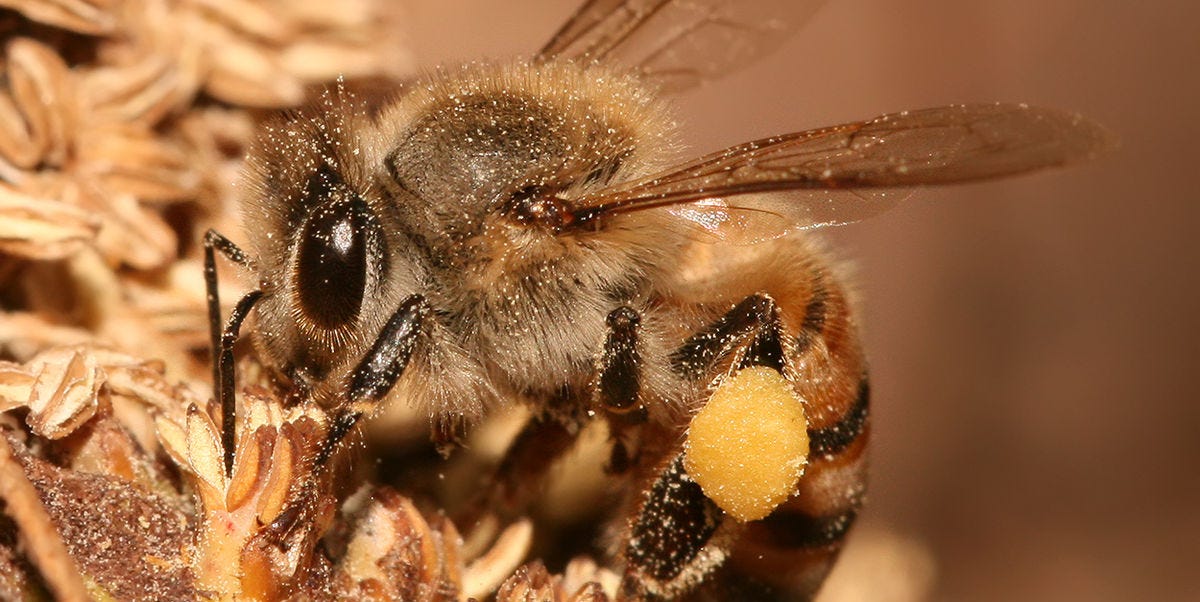
If you still think math belongs only in classrooms, calculators, and mildly traumatic pop quizzes, bees would like a word. Actually, they would like a waggle. For years, scientists have been uncovering evidence that honeybees and other bees do far more than buzz around flowers looking adorable and slightly judgmental. These tiny insects show abilities that look surprisingly mathematical: they can tell more from less, handle simple quantity judgments, learn rule-based tasks that resemble arithmetic, navigate with angle-and-distance information, and build combs that would make a geometry teacher sit up straighter.
No, bees are not secretly filing taxes, solving algebra worksheets, or arguing about whether zero is natural or invented. But they do seem to process information in ways that reveal real numerical and spatial intelligence. And that matters. It changes how we think about insect cognition, how intelligence evolves, and how much brainpower is really needed to solve practical problems. In other words, the insect kingdom’s most famous pollinator may also be its most impressive little number nerd.
Why Bees and Math Belong in the Same Conversation
When people hear the phrase bee math, they usually picture honeycomb. That is fair. Honeycomb is the poster child for natural geometry: neat rows of hexagons packed together so efficiently that the whole structure looks like nature hired an architect with a ruler and a very good coffee habit. But the math story goes well beyond six-sided wax cells.
Researchers studying bee cognition have found that bees are capable of numerositythe ability to judge quantity. In plain English, they can often tell whether one set has more items than another. That may sound modest until you remember we are talking about an animal with a brain smaller than a raindrop. The important point is not that bees think exactly like humans do. It is that they can extract useful numerical information from the world and act on it.
That makes excellent biological sense. A bee constantly faces decisions that reward quick, efficient judgment. Which flower patch has more blossoms? Which route is shorter? Which visual pattern matches a remembered reward? In the wild, these are survival questions. In the lab, they become windows into how bees process number, space, and pattern.
Bees Can Tell More from Less
One of the clearest findings in bee cognition research is that bees can distinguish different quantities. In controlled experiments, bees have learned to choose displays with more or fewer elements, even when the shapes, layouts, and appearances change. That is important because it suggests they are not simply memorizing one picture. They are extracting something more abstract: quantity.
Scientists have long noted that bees do best with small numbers, which is not exactly embarrassing. Plenty of humans become dramatically less confident once a restaurant bill arrives. In many experiments, bees handle low quantities especially well, but research has also shown that they can succeed in tasks involving larger comparisons, such as recognizing that six items are more than four. That does not mean bees count in the same step-by-step way a child might. Sometimes they appear to use approximate quantity judgments, and sometimes they inspect items one after another. Either way, the result is impressive: a tiny insect brain can separate “more” from “less” in a meaningful, flexible way.
Not Human Math, But Real Numerical Cognition
It is worth keeping the claim honest. Bees are not mathematicians in the human sense. They do not sit around the hive debating proofs or inventing trigonometry before lunch. What they do show is numerical cognition: the ability to represent quantity well enough to solve tasks. That distinction matters because it keeps the science exciting without turning it into insect fan fiction.
Even so, bee numerosity is a big deal. For a long time, people assumed that complex quantity processing required a much larger brain. Bees keep showing that nature is comfortable doing more with less. Their brains are compact, but they are efficient, specialized, and built for rapid learning in a busy environment full of patterns, motion, color, and risk.
The Tiny-Brain Zero Breakthrough
Now for the real show-off move: zero. Humans took a very long time to fully develop and formalize the concept of zero. It was not an obvious idea in the history of mathematics. So when researchers reported that honeybees could treat an empty set as less than one, two, or more items, the finding got a lot of attentionand rightly so.
In experiments, bees were trained with images containing different numbers of shapes. When later tested with an image that contained nothing at all, the bees tended to place that empty set at the low end of the number scale. In other words, they appeared to understand that “nothing” belonged below “something.” That does not mean bees philosophize about absence in the hive after dark. But it does suggest their brains can represent zero-like information as part of an ordered quantity system.
This is one of the most fascinating things about bee intelligence: it repeatedly reminds us that cognitive sophistication does not always arrive wearing a large skull. Sometimes it arrives fuzzy, striped, and obsessed with flowers.
Yes, Bees Can Learn Simple Arithmetic
If zero was not enough, researchers pushed further and tested whether bees could learn simple arithmetic rules. The setup was clever. Bees were trained to associate one color with “add one” and another color with “subtract one.” Then they were shown a small number of elements and had to choose the correct answer after applying the rule. The result? Bees could be trained to perform simple addition and subtraction by one.
This does not mean your local bee can help with calculus homework, and it definitely does not mean the hive is secretly running a tutoring service. But it does mean bees can combine several mental operations: remember a rule, identify a starting quantity, hold information briefly in working memory, and choose the correct outcome. That is a lot of processing for an insect brain.
Researchers have also found evidence that bees can connect symbols with quantities, which pushes their numerical abilities beyond simple pattern matching. Again, this is limited, highly specific, and learned under controlled conditions. But taken together, the evidence paints a clear picture: bees are not doing random guesswork. They can learn abstract relationships involving number.
The Waggle Dance Is Geometry with Wings
Math in bees is not only about counting. It is also about space. The honeybee waggle dance is one of the most famous communication systems in the natural world, and for good reason. When a forager returns to the hive after finding a valuable food source, she performs a dance that encodes directional and distance information for her nestmates.
The logic is astonishingly elegant. The angle of the waggle run corresponds to the direction of the food source relative to the sun, while the duration of the waggle phase helps communicate distance. Bees receiving the message can use that information to head toward the target. It is not just communication; it is symbolic, spatially meaningful communication. In effect, bees turn the hive into a moving geometry board.
Even better, this dance is useful at the colony level. Studies have shown that the dance language helps colonies allocate foragers to better food sources and improve foraging efficiency. That means bee math is not merely an individual trick. It becomes a collective information system, where many small minds contribute to a smart, adaptive whole.
Nature’s Data-Sharing Network
If that sounds suspiciously modern, it should. A bee colony often works like a distributed network. Scout bees gather information, communicate resource value, and recruit others. The colony then adjusts behavior based on quality, distance, and opportunity. Put differently, bees do not just collect nectar. They collect, compress, transmit, and act on data.
That is one reason bee research keeps inspiring ideas in robotics, machine learning, and efficient system design. Scientists are not copying bees because they are cute. Well, not only because they are cute. They are copying them because bees solve hard information problems with startling efficiency.
Honeycomb Design Is Practical Geometry
Then there is the honeycomb: the bee world’s greatest architectural flex. Hexagons are famously efficient. They tile a flat plane with no wasted gaps, and they do so while using less boundary material than many alternative shapes. For bees, that matters because wax is expensive to make. A structure that holds a lot while wasting little is not just beautiful. It is biologically smart.
For a long time, the honeycomb was treated almost like proof that bees were born geometers. The truth is more interesting. The familiar hexagonal pattern likely emerges from a mix of evolved behavior and physical processes, including the way soft wax and neighboring cells interact. So the comb is not evidence that bees sit down with compasses and drafting tools. It is evidence that evolution, materials, and behavior can work together to create remarkable efficiency.
And the story gets even better. Researchers have found that when bees and some wasps need to transition between different cell sizes, they often solve the problem by inserting pairs of five-sided and seven-sided cells. Those “imperfect” shapes are not mistakes. They are elegant transition pieces that allow the structure to keep working. In other words, the comb does not just show geometry. It shows adaptive geometry.
What Bee Math Teaches Us About Intelligence
The biggest lesson in all of this is not that bees are secretly tiny professors. It is that intelligence comes in many forms. Human beings often imagine cognition as a ladder, with ourselves dramatically posing at the top. Bees suggest a different picture. Intelligence may be better understood as a toolbox. Different species evolve different tools for the problems they actually face.
Bees do not need abstract mathematics in the human sense. They need efficient ways to judge quantity, remember patterns, encode space, compare options, and coordinate with nestmates. So that is what evolution gave them. The result is a form of intelligence that is compact, fast, and beautifully practical.
This also helps scientists rethink how much hardware is necessary for sophisticated behavior. If a bee can process quantity, use rule-based learning, and communicate navigational geometry with a miniature brain, then some of the core ingredients of intelligence may be simplerand more flexiblethan we once assumed.
Why This Matters Beyond the Hive
Bee cognition is not just a fun science story to bring up at lunch and accidentally turn into a monologue. It has real implications. Understanding how bees learn and make decisions can improve pollinator conservation, sharpen ecological research, and inspire better designs in computing and robotics. Bee behavior shows how complex systems can arise from simple units following efficient rules.
And there is a philosophical side too. Learning that bees can handle zero-like concepts, quantity judgments, and symbolic tasks nudges us toward humility. It reminds us that the natural world is packed with minds that do not resemble ours but are still capable of astonishing things. Sometimes intelligence hums instead of speaks.
So yes, bees are essential pollinators. Yes, they help feed ecosystems and agriculture. But they also deserve credit as one of nature’s most unexpectedly capable problem-solvers. The next time a bee zips past you on its way to a flower patch, remember: that little insect may be running a navigation algorithm, evaluating resource quality, and working with geometry so smoothly it barely looks like math at all.
Experiences That Make Bee Math Feel Real
One of the best ways to understand the phrase Bees Are the Math Whizzes of the Insect Kingdom is not by reading a lab result first, but by watching bees for a while. Stand near a patch of lavender, rosemary, sunflowers, or clover on a warm afternoon and try not to move too much. At first it seems chaotic. Bees dart in, circle, hover, land, vanish, and return. It looks like a tiny airborne traffic jam with no stoplights and no one wearing a reflective vest.
But then the pattern starts to emerge. A bee approaches a flower, checks it, and moves on almost instantly if the reward is poor. Another returns to the same area with suspicious confidence, like someone who absolutely knows where the good snacks are. If you keep watching, the whole scene begins to feel less random and more like a flowing system built on memory, comparison, and efficient decision-making.
That is where the “math” becomes real in a human, almost everyday sense. You can imagine the bee making quick judgments: this cluster is richer than that one, this route worked before, this flower has likely already been visited, this patch is worth returning to. Of course, the bee is not narrating these thoughts in English and wearing reading glasses. But the behavior has structure. It has logic. It feels like the physical version of calculation.
People who spend time around hives often describe a similar shift in perception. At first, a hive looks like pure motion. Then it starts to look like organized motion. Foragers leave with purpose, return with purpose, and fit themselves into a constant exchange of information. Watching bees move across comb is especially striking. Nothing seems wasted. The spacing, the building, the traffic floweverything has an economy to it. It is as if the colony has a quiet agreement that inefficiency is deeply embarrassing.
Even gardening can turn into a front-row seat for bee intelligence. Many gardeners notice that bees learn their yards. Once certain flowers open, bees begin visiting them with remarkable consistency. Some patches get checked quickly; others receive repeat attention. Over time, you start to sense that the bees are not merely wandering. They are sampling, updating, and optimizing. It becomes much easier to believe the research once you have seen how purposeful they look in action.
There is also something oddly comforting about realizing that nature is full of invisible problem-solving. A bee visiting a flower does not look like a math lesson. A honeycomb does not look like an engineering lecture. A waggle dance does not look like data transmission. Yet all of those things are happening in forms that feel natural, elegant, and alive. That may be the most delightful part of the whole topic: bees make intelligence look effortless.
And maybe that is why people become so fascinated by them. Bees shrink the distance between science and wonder. They show that serious cognition can exist in tiny packages. They make the world feel smarter than it looked five minutes earlier. Once you have seen that, it is hard to go back to thinking of bees as just background buzz. They become what they really are: tiny flying specialists in pattern, memory, geometry, and practical decision-making. Basically, math whizzeswith wings.
Conclusion
Bees earn their reputation as the math whizzes of the insect kingdom not because they behave like miniature humans, but because they solve numerical and spatial problems with extraordinary efficiency. From judging quantity and handling zero-like concepts to learning simple arithmetic rules, dancing out navigational geometry, and building material-smart combs, bees prove that real intelligence can come in very small bodies. Their story is funny, surprising, and deeply humbling. The next time a bee buzzes by, it may not be doing algebrabut it is almost certainly doing something smarter than it looks.