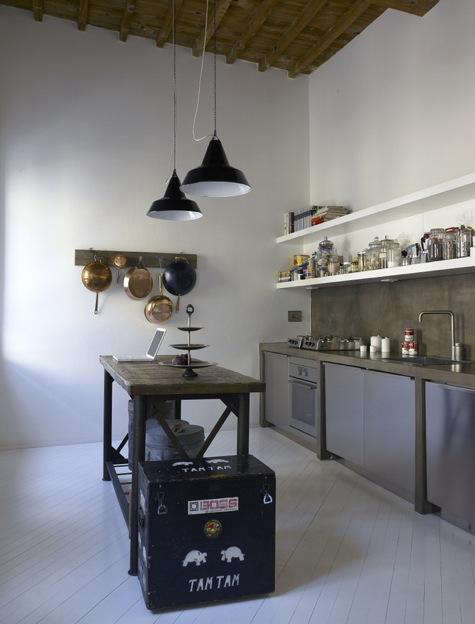
Architect Visit: B-Arch Studio in Prato, Italy is not just a tour of a design office. It is a walk into a particular Italian way of seeing: old walls are not obstacles, historic rooms are not museum props, and contemporary furniture is allowed to sit confidently beneath a fresco without apologizing for being born a few centuries late.
Based in Prato, Tuscany, B-Arch Studio has built a reputation for architecture and interior design that feels layered, tactile, and delightfully unafraid of contrast. The studio’s work often brings together restoration, modern living, vintage pieces, custom details, hospitality spaces, residential interiors, and the kind of visual intelligence that makes a room look effortless even when every hinge, chair, and shadow has clearly been debated over espresso.
Why Prato Is the Perfect Home for B-Arch Studio
Prato sits near Florence, but it has its own personality. While Florence gets the postcards, the crowds, and the “yes, we know, Michelangelo was very good” energy, Prato offers something more industrial, more experimental, and arguably more useful for an architect interested in transformation. It is a city of textiles, medieval streets, contemporary art, workshops, warehouses, palaces, churches, and practical creativity.
This matters because B-Arch Studio does not design in a vacuum. Its projects feel connected to Prato’s DNA: fabric, reuse, craft, memory, and reinvention. The city’s textile history gives architecture here a special sensitivity to surfaces. Walls, floors, fabrics, patinas, and materials are not background noise. They are the main characters, occasionally wearing excellent shoes.
Prato’s historic center contains elegant medieval spaces, the Emperor’s Castle, Piazza Duomo, Santo Stefano Cathedral, Palazzo Pretorio, and cultural landmarks that show how the city has balanced heritage with contemporary ambition. The Luigi Pecci Center for Contemporary Art and the Textile Museum add another layer: Prato is not simply preserving the past; it is actively arguing with it, updating it, and sometimes inviting it to dinner.
Meet B-Arch Studio: A Practice Built on Layers
B-Arch Studio was founded by Sabrina Bignami and Alessandro Capellaro, architects whose work moves between architecture, interior design, restoration, hospitality, retail, residential projects, and creative consulting. Their studio identity is often described through the idea of mixing: old and new, formal and informal, crafted and found, poetic and pragmatic.
That mix is not random. In the best B-Arch projects, contrast behaves like a well-trained orchestra. A restored fresco may meet a sharp modern sofa. A historic palazzo may hold playful objects. A former industrial space may become a refined office, restaurant, showroom, or home. The surprise is not that these elements are different; the surprise is that they seem to enjoy each other’s company.
The studio’s approach is especially relevant now because adaptive reuse has moved from niche design topic to major architectural conversation. Reusing existing buildings can preserve cultural memory, reduce waste, and create richer urban experiences than simply demolishing and starting over. B-Arch’s work shows that reuse is not just an environmental strategy. It can also be emotional, witty, luxurious, and deeply personal.
The B-Arch Signature: Ancient Bones, Modern Nerve
The most recognizable quality in B-Arch Studio’s work is the confident relationship between history and contemporary life. The studio does not treat old buildings as fragile antiques that must be tiptoed around forever. Instead, it asks a better question: how can a historic structure keep living?
That question is at the heart of many strong Italian interiors. The challenge is not merely to “decorate” a room; it is to negotiate with generations of use, repair, neglect, and beauty. A ceiling may carry traces of an earlier century. A floor may be imperfect. A doorway may be stubborn. B-Arch’s talent lies in turning those conditions into atmosphere rather than inconvenience.
Palazzo Orlandi: A Manifesto in the Form of a Home
One of the studio’s best-known projects is Palazzo Orlandi, also known through earlier coverage as Casa Orlandi, a restored eighteenth-century residence in Prato associated with Sabrina Bignami. The project has been admired because it combines formal historic interiors with modern and vintage furnishings in a way that feels neither stiff nor gimmicky.
The lesson from Palazzo Orlandi is simple but powerful: restoration does not have to produce a frozen room. A home can preserve frescoes, old floors, and classical proportions while still making space for contemporary living. In other words, a palazzo can wear sneakers. Very tasteful sneakers, naturally.
Box House: Memory Becomes Material
B-Arch’s Box House is another revealing example. The project transformed an old workshop-like space into a loft, using found objects and unexpected materials to create a home that feels open, personal, and full of memory. The idea of incorporating hundreds of old ballot boxes into the design is not just clever recycling; it is storytelling through objects.
In lesser hands, reused materials can look like a flea-market accident. In B-Arch’s hands, they become structure, furniture, rhythm, and character. The result is not nostalgia. It is continuity. The old object is not placed on a shelf and admired from a safe distance; it is given a job.
Residential Work: Homes That Remember and Evolve
B-Arch Studio’s residential portfolio includes historic apartments, Tuscan country houses, coastal residences, restored farmhouses, lofts, and contemporary interventions inside older shells. These projects often begin with a strong existing condition: a farmhouse in the hills, an apartment overlooking an important urban view, a former workshop, a period residence, or a building with deeply specific traces of use.
The studio’s best residential work does not erase those traces. Instead, it edits them. That is an important distinction. To erase is easy. To edit is harder. Editing requires knowing what to keep, what to reveal, what to repair, what to contrast, and what to leave slightly imperfect because perfection can be oddly lifeless.
This is why B-Arch interiors often feel collected rather than staged. A room may include antiques, mid-century pieces, contemporary lighting, custom furniture, industrial details, raw surfaces, and quiet luxury. Yet the effect is rarely chaotic. The studio uses proportion, color discipline, material balance, and spatial clarity to keep the composition calm.
Hospitality, Retail, and Public Spaces: Designing Atmosphere
B-Arch Studio’s work also extends into restaurants, hotels, retail spaces, offices, showrooms, and public or semi-public environments. This is where the studio’s skill with atmosphere becomes especially valuable. A private home can be deeply personal, but a restaurant or hotel must create a mood quickly. It has to welcome strangers, guide movement, support service, photograph well, and still feel authentic after the novelty wears off.
Projects such as I Vivai al Parugiano in the Tuscan countryside show how B-Arch approaches hospitality through a dialogue between restored buildings, new structures, landscape, and regional architectural elements. Rather than treating rural Tuscany as a decorative theme, the project works with farmhouse restoration, local texture, and contemporary comfort.
Retail and restaurant projects demand another kind of precision. A jewelry boutique, fashion office, restaurant, or showroom must communicate identity without turning into a billboard. B-Arch often solves this through materials and spatial storytelling: rough with polished, old with new, intimate with theatrical. The result can feel branded without shouting the brand name every three feet, which is a mercy for everyone involved.
Design Analysis: What Makes B-Arch Studio’s Work Stand Out?
1. The Studio Respects History Without Worshiping It
Many historic renovations fall into one of two traps. They either preserve everything so carefully that the space feels unusable, or they modernize so aggressively that the past becomes a decorative rumor. B-Arch avoids both. The studio tends to preserve atmosphere while allowing contemporary life to enter the building with confidence.
2. Materials Carry the Story
In B-Arch projects, materials rarely feel accidental. Stone, plaster, wood, metal, glass, vintage fabric, ceramics, and painted surfaces often do narrative work. They tell the user where the building has been and where it is going. This is especially fitting in Prato, a city where material culture is not an abstract idea but a working tradition.
3. Furniture Is Architecture’s Co-Conspirator
B-Arch interiors show how furniture can shape architecture rather than merely fill it. A chair, table, lamp, cabinet, or found object can change the rhythm of a room. The studio’s use of vintage and contemporary pieces creates interiors that look lived-in from day one. That is a rare achievement, because many newly designed spaces look as though they are waiting for humans to be delivered separately.
4. Craft and Control Work Together
The studio’s projects often appear relaxed, but that relaxed feeling comes from control. Sightlines, transitions, proportions, lighting, and details are carefully managed. This is the paradox of good design: it looks easy because someone did the hard thinking in advance.
5. The Work Feels Local Without Becoming Touristic
B-Arch’s Tuscan projects are unmistakably connected to place, yet they do not rely on postcard clichés. There is no need to cover every surface with rustic cosplay. Instead, the studio draws from real conditions: historic structures, craft traditions, landscape, industrial memory, and the practical beauty of buildings that have already lived several lives.
Lessons for Homeowners, Designers, and Architecture Lovers
A visit to B-Arch Studio offers useful lessons even if your own home is not an eighteenth-century palazzo in Tuscany. First, do not be afraid of contrast. Old and new can work together when they are balanced by proportion, tone, and intention. A modern chair can sit beautifully in a historic room if it understands the assignment.
Second, reuse can be elegant. Salvaged materials, vintage objects, and inherited furniture do not have to feel messy. When selected carefully, they add depth that brand-new pieces cannot fake. A room with memory usually feels better than a room with only a shopping cart history.
Third, restoration should not erase personality. The goal is not to make a building look as though time never happened. The goal is to make time visible, useful, and beautiful. Cracks, patina, irregular floors, and old openings can become part of the design language.
Finally, good interiors need tension. Too much harmony becomes sleepy. Too much contrast becomes chaos. B-Arch’s work often succeeds because it keeps tension alive: refined but playful, historic but modern, polished but imperfect, Italian but international.
Experience Notes: Visiting B-Arch Studio and Prato Through an Architect’s Eye
To experience the topic of Architect Visit: B-Arch Studio in Prato, Italy, imagine beginning not with a building, but with the city itself. Prato rewards slow looking. The first impression may be quieter than Florence, but that is part of the charm. You walk through streets where medieval stone, shop windows, textile references, and contemporary culture sit close together. It is not a city trying to perform beauty at maximum volume. It is a city that lets you notice.
A design-minded visit would begin in the historic center, where scale becomes the first lesson. The streets are compact, the piazzas open suddenly, and buildings carry the weight of many periods at once. This is the perfect mental preparation for understanding B-Arch Studio. Their work is not about isolated objects; it is about relationships. A restored wall relates to a chair. A ceiling relates to light. A vintage object relates to a new function. In Prato, the whole city behaves like that.
Walking into a B-Arch project, the experience is less like entering a showroom and more like entering a conversation already in progress. You notice the old surface first, then the modern intervention, then the small decision that connects them. Maybe it is a lamp positioned with almost theatrical accuracy. Maybe it is a dining table that makes a formal room feel casual. Maybe it is a material detail that reminds you this place was once something else entirely.
The strongest impression is that nothing feels too precious to use. This is important. Historic architecture can sometimes intimidate people into bad posture. B-Arch’s spaces tend to do the opposite. They invite living. You can imagine someone reading, cooking, hosting friends, checking emails, arguing about where to put a vase, or sneaking one more cantuccio after dinner. Architecture becomes daily life, not a velvet rope.
For travelers, Prato adds another layer to the experience. Visit the Textile Museum and you begin to understand why surfaces matter here. Look at the city’s industrial heritage and you see why reuse is not just fashionable, but logical. Explore contemporary art at the Luigi Pecci Center and B-Arch’s mix of old and new feels less like a personal style and more like a local condition. Prato itself is a collage, and B-Arch designs with collage-like intelligence.
The best way to carry the experience home is to change how you look at your own space. Instead of asking, “How do I make this room look new?” ask, “What story is already here, and what should I add next?” That question is very B-Arch. It respects memory, welcomes experiment, and leaves room for humor. Because sometimes the most sophisticated design move is not buying the newest object. Sometimes it is noticing that the old one has been waiting patiently for its second act.
Conclusion: Why B-Arch Studio Matters
B-Arch Studio in Prato matters because it shows how architecture can be both intelligent and emotionally generous. Its work does not flatten history into decoration or modernity into cold minimalism. Instead, the studio creates spaces where different periods, objects, materials, and memories can coexist with style.
For anyone interested in Italian interior design, adaptive reuse, Tuscan architecture, or the art of making old buildings feel alive again, B-Arch offers a compelling model. Their projects remind us that design is not only about what is new. It is about what can be renewed, reinterpreted, and loved again. And in a world full of disposable interiors, that idea feels not only beautiful, but quietly radical.
SEO Tags
Note: This article is written as an original, publish-ready synthesis in standard American English. It contains no copied passages, no source-link section, and no unnecessary citation placeholders.