Heath Ledger’s Joker didn’t arrive in The Dark Knight like a comic-book character. He arrived like a power outage: sudden, confusing, and somehow personal. One minute you’re watching a Batman sequel. The next, you’re watching a villain who feels uncomfortably… modern. Like he has a burner phone, a grievance, and a group chat.
Ledger’s performance didn’t just “update” the Joker for the 2000sit helped define what a 21st-century movie villain could be: less cackling mastermind, more chaotic theorist; less “I want money,” more “I want you to admit your rules are fragile.” And he pulled it off with smeared makeup, a voice that slithered between jokes and threats, and the unsettling sense that the character was always one step aheadeven when he seemed to be improvising his own pulse.
Why Ledger’s Joker Felt Like a Villain From Our Century
Chaos as a worldview (and a weapon)
Earlier big-screen Jokers tended to come with a recognizable “type”: gangster clown, prankster, showman. Ledger’s Joker comes with a thesis. He’s not trying to win Gothamhe’s trying to break it. The point isn’t control; it’s proof. Proof that people are only “good” when the lights are on and the rules are enforced.
That idea lands because it mirrors how modern fear often works: less about a single monster and more about systems collapsing. Ledger’s Joker turns social order into a stress test. He runs Gotham like a lab experimentthen smiles like he just discovered gravity.
Gotham as a post-9/11 city, not a cartoon
Christopher Nolan’s Gotham isn’t a neon funhouse. It’s closer to a real American metropolisfinance, politics, media, organized crime, public transit, and the anxiety that everything is held together by paperwork and vibes. In that setting, the Joker doesn’t feel like a “supervillain.” He feels like a crisis.
Ledger’s genius is that he never begs for sympathy, but he does weaponize uncertainty: contradictory scar stories, shifting tone, jokes that land like threats. The character refuses to be pinned downand that’s exactly what makes him feel 21st century.
The Prep: Building a Joker Without a Safety Rail
The “Joker diary” mindset
Ledger’s approach was famously immersive. He wasn’t aiming for a cute twist on the characterhe was building an internal logic for a man who treats civilization like a bad improv show. Reports from production coverage describe him isolating himself, experimenting with voice and personality, and keeping a diary of the Joker’s thoughtsbasically, method acting meets villain journaling (the least relaxing form of journaling, for the record).
That prep matters because the Joker’s confidence in The Dark Knight doesn’t feel rehearsed. It feels inevitable. Ledger plays him like someone who already decided the endingand is now just enjoying the middle.
Punk energy and Kubrick menace
Ledger’s Joker carries a scrappy, punk ugliness: the posture, the greasy hair, the “I slept in a coat because beds are for the compliant” vibe. Accounts of his inspirations often point to punk-era figures and the threatening youth-gang energy of Kubrick’s A Clockwork Orange. That’s not cosplayit’s a tonal blueprint. This Joker isn’t polished evil. He’s the evil you meet behind a gas station at 2 a.m. when your phone is at 1%.
Designing the Monster: Makeup, Costume, and the “Slept-In” Smile
Makeup that looks like it survived the night
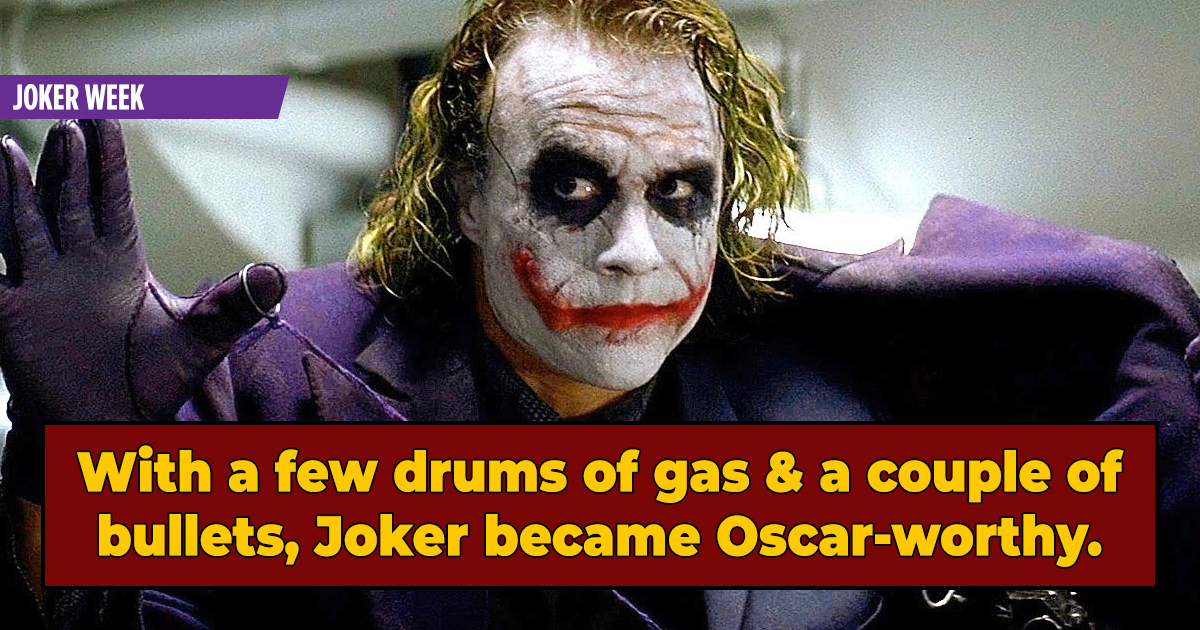
Ledger’s Joker makeup is brilliant because it’s not “performance-ready.” It’s lived-incracked white, smudged black around the eyes, lipstick that looks applied by someone riding in a moving car while laughing. Industry coverage around the film’s awards season highlights how the makeup design aimed for an “organic” messiness, collaborating with Ledger to create something horrific and human, not crisp or theatrical.
That choice changes everything. The Joker’s face becomes a story: a mask that’s been worn too long, a clown paint job turning into rot. It’s not “look at my villain makeup.” It’s “I have not known peace in years.”
Character tics that weren’t just “tics”
Ledger’s Joker is full of small behaviors that feel spontaneous but read as character. One famous example: the lip-licking. Reported behind-the-scenes explanations suggest it was partly practicalhelping manage scar prosthetics during long shooting days and it evolved into a signature mannerism. That’s the secret sauce: a technical necessity becomes psychology on camera.
It’s also why the performance doesn’t feel like a collection of actor tricks. It feels like a nervous system. Like the Joker has a body that’s always reacting, always recalibrating, always hunting for the next lever to pull.
Performance Craft: Voice, Movement, and Controlled Unpredictability
The voice: a threat disguised as a joke
Ledger’s Joker voice is one of the most copied and least duplicated performances in modern film. It’s not just “weird.” It’s intentionally unstablegliding from playful to vicious, leaning into consonants, dragging vowels, sounding like someone performing friendliness the way a shark performs “not biting” (for now).
The brilliance is in the rhythm. Ledger keeps you listening because you can’t predict the cadence. A line might land as a punchline, or it might land as a warning. Often it’s both. That ambiguity is the character’s superpower.
The physicality: predator stillness, sudden motion
Watch Ledger’s movement and you’ll notice something oddly animal: the head tilt, the slouch, the loose limbs, the sudden bursts of speed. He doesn’t move like a villain making a point. He moves like a creature testing boundaries. It’s body language as disruption.
Even when he’s “quiet,” he’s active. His stillness feels like a coiled spring. The Joker isn’t calmhe’s waiting.
Scenes That Built a Myth (and Why They Work)
The bank heist: a villain who audits his own crew
The opening bank heist is a masterclass in introduction. Before the Joker even fully appears, the movie teaches you his logic: everyone is disposable, trust is a weapon, and the “plan” includes betrayal as a feature, not a bug. When Ledger finally shows up, the mask comes off like a reveal in a horror filmnot because he looks supernatural, but because he looks real.
The mob meeting and the pencil trick: shock as punctuation
The “pencil trick” is not just a gross-out moment. It’s a mission statement: the Joker can turn a room full of powerful men into stunned bystanders in seconds. Accounts from an oral history of the scene describe how the effect was achieved with practical staging and editing rather than an elaborate “trick pencil,” which fits Nolan’s preference for tangible impact. The result is fast, surprising, and memorablelike a magic trick performed by someone who hates you.
The interrogation scene: Batman vs. the idea of Batman
Nolan has highlighted the interrogation sequence as a central fulcrum of the filmbare-bones lighting, no spectacle, just psychology. Ledger’s Joker doesn’t “win” by escaping punches. He wins by reframing the entire conflict. He tells Batman the real fight isn’t fists; it’s whether Batman’s moral code can survive contact with an enemy who doesn’t share reality’s rules.
Ledger plays the Joker like he’s delighted to be hit, because it confirms his theory: the mask of civility slips fast when the stakes rise. It’s not pain he’s after. It’s proof.
The hospital sequence: comedy with a fuse
The hospital scene is Ledger at peak “funny-until-it-isn’t.” He strolls through catastrophe like he’s running errands. The humor is disarming, which makes the violence feel worse. This is a Joker who treats mass harm like a prankbut the prank is on everyone else, and the punchline is despair.
The Ripple Effect: How Ledger Rewired the Joker (and the Genre)
From “comic-book villain” to awards-season performance
Ledger’s Joker didn’t just earn praisehe changed the conversation about what superhero films could do. His posthumous Academy Award win for Best Supporting Actor became a landmark moment: a genre performance treated like top-tier acting, not just fan service. In the years since, the Joker became one of the most prestigious (and risky) roles in pop cinema.
Why the internet can’t let this Joker go
Part of the Joker’s 21st-century resonance is cultural: he feels like a figure built for the attention economyprovocation, spectacle, moral confusion, crowds watching. Commentary has even argued that The Dark Knight was prescient about “troll” behavior: disruption as entertainment, chaos as identity, cruelty as performance.
Ledger’s Joker doesn’t want your money. He wants your reaction. In 2026 terms: he’s farming engagement, and Gotham is the algorithm.
The shadow he cast on every Joker after
You can see Ledger’s influence in how later iterations approach the character: more realism, more psychological grit, more emphasis on trauma, ideology, or social fracture. Even when filmmakers try to avoid copying Ledger, they still have to respond to himbecause he reset the baseline for menace. He made the Joker feel less like a villain you defeat and more like a crisis you survive.
Conclusion: The Clown Prince as a Modern Myth
Heath Ledger’s Joker endures because it’s a complete piece of character architecture: the prep, the voice, the physicality, the makeup, the scene-to-scene volatility, and the philosophical menace all lock together. Ledger didn’t play the Joker as a collection of “crazy” behaviors. He played him as a force that exposes hypocrisysometimes with a joke, sometimes with a knife, always with a smile that looks like it hurts.
In the end, Ledger created a 21st-century Joker by making the character feel like he belongs to our world: a world where narratives are unstable, trust is fragile, and people will do almost anything to feel safe. Gotham thought it had criminals. Ledger’s Joker showed it something worse: a man who can turn fear into a gameand make everyone play.
Experiences & Takeaways (Extra): How to Feel Ledger’s Joker on a Deeper Level
You don’t need to be an actoror to own a purple coat with villain energyto appreciate what Ledger pulled off. But you can turn your next rewatch into an experience that reveals new layers. Here are a few ways fans, film nerds, and curious humans can engage with Ledger’s Joker beyond “wow, that’s intense” (which is still a totally valid reaction).
1) Do a “voice-and-silence” rewatch
On one pass, focus only on Ledger’s voice: pace, pitch, when he goes soft, when he goes sharp, how he lands certain words like they’re darts. On another pass, focus on his silencesthose moments when he watches people the way you watch a door that might open. You’ll notice he doesn’t fill space like a chatterbox villain. He uses space like a trap.
2) Track the makeup like it’s a mood ring
Ledger’s Joker makeup isn’t a static costume; it’s storytelling. Pay attention to when it looks freshly smeared versus when it looks like it’s been through war. The “worn for days” texture helps sell the idea that the Joker is always in motionalways plotting, always operating, always a little bit sweaty in the worst way. This isn’t a villain who clocks out. This is a villain who leaks.
3) Watch how he “listens” (yes, villains can listen)
Great acting isn’t just what’s said; it’s what’s received. Ledger’s Joker is constantly adjusting to the room. He mirrors, he interrupts, he waits, he pounces. In group sceneslike the mob meetinglook at how he positions himself as the center without demanding it. He makes powerful people lean toward him, like gravity just changed.
4) Reframe the big set pieces as psychological stunts
The pencil trick, the interrogation, the hospital sequencethese aren’t only “cool scenes.” They’re psychological stunts designed to humiliate certainty. In the pencil moment, the shock isn’t just violence; it’s the speed with which the room loses control. In the interrogation scene, the point isn’t that Batman can hit hard; it’s that Batman can’t hit his way out of a moral riddle. If you watch the movie as a series of experiments the Joker runs on Gotham, the entire film becomes a chess match where the Joker’s pieces are people.
5) Try the “Joker philosophy” thought experiment (no, not the crime part)
Ledger’s Joker works because his worldview is clear, even if his backstory isn’t. He believes society is a thin coat of paint. You can test that idea safelywithout burning anything downby watching how the film stages ethical pressure: the ferry dilemma, the public panic, the temptation to compromise rules. Ask yourself: Which moments feel plausible? Which feel theatrical? And why do some scenes still sting years later? The answers tell you as much about modern anxiety as they do about Batman.
6) A small creative exercise: write one page of “character logic”
Ledger reportedly used a diary to explore the Joker’s interior world. You can borrow the craft idea without borrowing the chaos: pick any fictional character (hero, villain, or your favorite emotionally unavailable wizard) and write one page explaining how they justify their choices. When you return to Ledger’s performance, you’ll better appreciate why it feels so coherent. The Joker’s actions are wild, but the character logic is disciplined. That’s the paradox: the chaos is engineered.
After 2008, “Joker” stopped being just a role and started being a cultural benchmark. Ledger didn’t merely leave an iconic performance he left a template for how to build a villain who feels like a headline, a nightmare, and a punchline all at once. Rewatching with intention turns that template into something you can actually see: a performance that’s funny in the way lightning is funnybriefly, right before you realize something just caught fire.