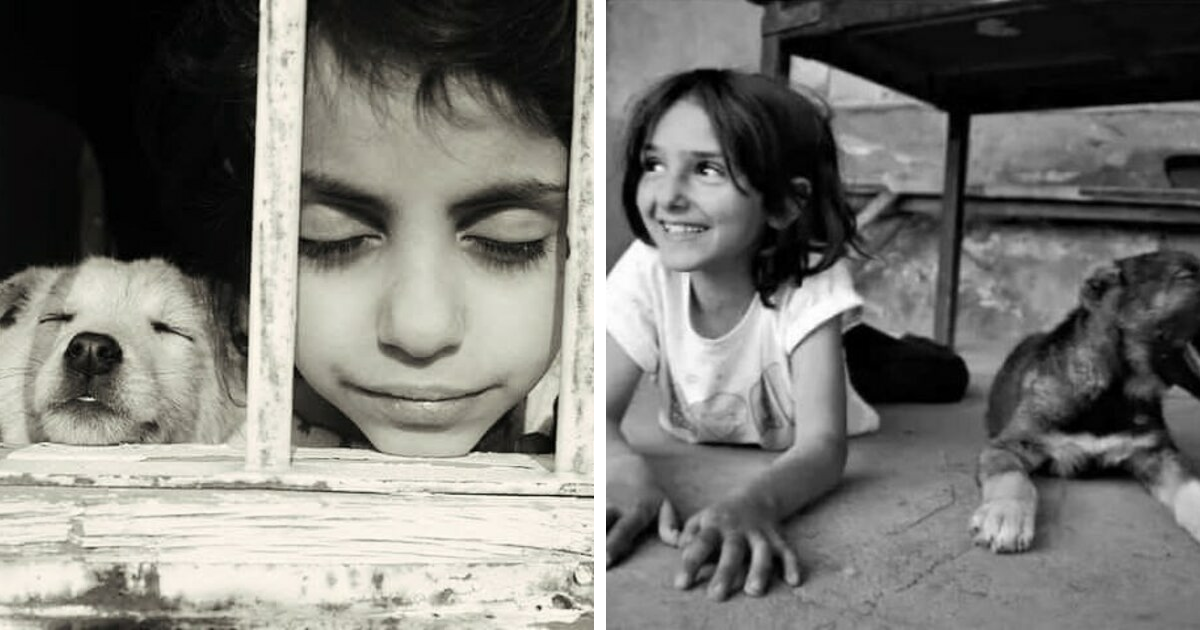
Childhood photography often arrives wearing its Sunday best: coordinated outfits, spotless cheeks, rehearsed smiles, and at least one adult whispering, “Please look at the camera for three seconds.” Samuel Voskanyan’s photographs take a very different route. His young subjects do not appear to be auditioning for a cereal commercial. They stare, wander, sulk, play, wait, daydream, and occasionally look as though they have already developed strong opinions about the adult world.
Across a collection of 32 captivating photos, the Armenian photographer explores childhood as a complicated emotional landscape rather than a nonstop parade of giggles. Working largely in black and white and frequently photographing children in rural Armenia, Voskanyan places expressive faces within fields, weathered homes, stone walls, animals, hanging laundry, old vehicles, and the ordinary clutter of daily life. The results feel intimate and cinematic without losing their rough edges.
These are beautiful childhood photos, but “beautiful” does not always mean cheerful. Some frames contain mischief and freedom. Others suggest uncertainty, concentration, loneliness, patience, or quiet defiance. Together, they remind viewers of something adults regularly forget: children do not experience smaller emotions simply because they have smaller shoes.
Samuel Voskanyan’s Unpolished Vision of Childhood
Voskanyan’s strength lies in his refusal to flatten childhood into a single mood. He does not appear interested in presenting children as permanently innocent, endlessly energetic, or conveniently adorable. Instead, his portraits leave room for contradiction.
A child can be vulnerable and stubborn at the same time. A serious expression can belong to someone who was laughing five seconds earlier. A messy yard can be a kingdom, a laboratory, a racetrack, and the scene of a major diplomatic crisis involving one missing stick. Childhood is rarely tidy, and Voskanyan does not waste energy pretending otherwise.
Published galleries of his work describe children photographed in the Armenian countryside with windblown hair, dirt-marked hands, animals, modest household surroundings, and direct, unguarded expressions. Rather than isolating the children against polished studio backgrounds, the images allow their environments to remain visible and meaningful.
That decision changes everything. The surroundings do not function as decorative scenery. They tell us how a day feels, how a place is used, what materials are close at hand, and how children interact with the world they actually inhabit.
Why the Black-and-White Photography Feels So Powerful
Color steps aside, but life does not
Black-and-white photography is sometimes treated as an automatic “serious art” button. Remove the color, increase the contrast, and suddenly a photograph of someone eating toast looks like a meditation on mortality. Voskanyan’s monochrome style works for a better reason: it helps organize emotionally and visually busy scenes.
Without bright clothing or colorful backgrounds competing for attention, the viewer notices the curve of a cheek, the direction of a glance, the texture of a wall, the softness of fog, or the contrast between a child’s skin and a rough wooden doorway. Light and shadow become structural elements rather than simple illumination.
Museum discussions of major portrait photographers have noted how stark black-and-white presentation can emphasize a subject’s psychological, emotional, and physical presence instead of flattering or decorating that person. Voskanyan’s portraits create a similar sense of concentration, although his visual world is less formal and far more playful.
The eyes become the center of gravity
Several images depend on direct eye contact. A child faces the camera, and the viewer is immediately pulled into a silent exchange. In one widely shared portrait, loops of wire form circular shapes around a girl’s face as she looks directly through them. Her expression is calm but impossible to summarize neatly. She may appear curious, guarded, patient, or simply aware that a photographer is standing nearby.
That uncertainty is part of the photograph’s power. A weaker portrait tells the audience exactly what to feel. A stronger one gives the audience enough visual information to become interested but not enough to close the case.
Children’s emotional regulation and their ability to understand, express, and manage feelings continue developing alongside attention, language, planning, and other cognitive skills. A still image may capture one point in that process, but it cannot provide a complete explanation of what a child is thinking.
Ordinary objects become storytelling devices
Voskanyan often lets everyday objects remain in the frame: a bathtub, a window, laundry, a fence, an old car, a wall, a field, or a length of wire. None of these items is glamorous, but each gives the photograph physical and cultural texture.
Among the images highlighted in published galleries are a child sharing a tub with a dog, two children framed by a window beneath hanging laundry, and a child standing in a field near a donkey and an aging automobile. These details prevent the portraits from floating in an abstract world called “childhood.” They belong to actual places, even when the photographs leave the exact story open.
What the 32 Childhood Photos Reveal
Joy that does not need instructions
The joyful images succeed because the happiness appears connected to action. Children interact with animals, move through open spaces, gather near one another, or become absorbed in whatever is happening just outside the frame.
This kind of play is not merely a pleasant break between more “important” activities. Child-development research connects play with exploration, relationships, problem-solving, coping skills, emotional expression, and resilience. It gives children opportunities to test the world while maintaining some control over what happens next.
A photographer who understands this does not need to manufacture excitement. Give children enough time and space, and they will usually produce something visually interesting. It might be graceful. It might also involve mud, a confused chicken, and a plan nobody has properly reviewed.
Solitude without immediate tragedy
Other photographs show children alone or emotionally separated from the people around them. A lowered head, distant gaze, or small figure in a large landscape may create a feeling of loneliness. Yet responsible viewing requires restraint.
A quiet expression is not proof of sadness. A child standing alone is not necessarily abandoned. Children pause, observe, become bored, retreat into thought, and enjoy solitude just as adults do. Voskanyan’s best images preserve that ambiguity rather than forcing every serious face into a tragic biography.
This distinction matters because viewers often bring their own childhood memories to photographs. Someone who grew up in the countryside may see freedom. Someone else may see hardship. A third person may mostly wonder whether the donkey was cooperative. The image becomes a meeting place between the child’s visible presence and the viewer’s private experience.
Resilience shown through participation, not mythology
The word “resilience” is frequently attached to portraits of children, especially children photographed in modest or rural settings. It can be appropriate, but it can also become a shortcut that romanticizes difficulty. Real resilience does not mean a child should endure anything with a photogenic expression.
Developmental research describes resilience as something built through supportive relationships, manageable challenges, active skill-building, and environments that help children cope. It does not arise from hardship alone, and it should not be used to make hardship look noble.
Voskanyan’s photographs are most compelling when they show children actively participating in their surroundings: balancing, watching, carrying, touching, playing, or negotiating space with siblings and animals. Their strength is visible in agency rather than in an invented story about suffering.
Relationships appear even when adults do not
Although many portraits focus on individual children, relationships remain present throughout the series. Siblings crowd a window. Friends share space. A dog becomes a playmate, guardian, accomplice, or all three before lunch.
Trusting relationships are central to children’s social and emotional development. Responsive caregivers and supportive communities help children regulate stress, build security, and learn how to interact with others. Children also rehearse these skills through peer play and imaginative activity.
A photograph cannot show the complete network surrounding a child, but small gestures can suggest connection: bodies leaning together, shared attention, relaxed proximity, or the casual physical confidence of children who know one another well.
The Cinematic Quality of the Series
Calling a photograph “cinematic” can be vague, especially now that the word is applied to everything from luxury advertising to videos of sandwiches. In Voskanyan’s case, the description fits because many frames appear to contain a before and an after.
A child looks beyond the edge of the image, creating a question about what is happening off-camera. Two figures pause in a doorway as though they have interrupted a conversation. An animal introduces unpredictability. A road, field, fence, or window suggests movement between spaces.
The compositions rarely feel emotionally complete. They resemble frames removed from a longer film whose plot the viewer must imagine. This narrative incompleteness encourages slower looking. Instead of registering “cute child” and scrolling onward, the viewer starts searching for clues.
The approach also resembles documentary family photography that values small, unmasked moments over conventional milestones. Photographers working in this tradition often describe being drawn to scenes that feel ordinary, fleeting, strange, or emotionally exposed rather than perfectly arranged.
How to Appreciate the Photos Without Inventing a Life Story
Powerful portraits invite interpretation, but interpretation should not become mind reading. Viewers can describe what is visiblethe lighting, posture, environment, expression, distance, and compositionwithout claiming to know a child’s private history.
For example, it is reasonable to say that a large empty field makes a child appear physically small. It is less reasonable to declare that the child feels powerless. A direct stare may create intensity, but intensity is an effect of the image, not necessarily a diagnosis of the subject.
The photographer’s choices shape that effect. Lens distance, cropping, timing, contrast, and editing can make a fleeting expression appear monumental. The Library of Congress encourages viewers to consider how a photographer’s intention and an image’s context influence meaning. Photographs are evidence of a moment, but they are also carefully constructed points of view.
This awareness does not weaken the emotional response. It makes the response more thoughtful. Viewers can feel moved while remembering that the child in the photograph is a complete person, not a symbol created for adult nostalgia.
Lessons for Photographers Who Want More Authentic Child Portraits
Wait longer than feels comfortable
Children need time to forget the camera, test the photographer, inspect nearby objects, and abandon the expression adults requested. The strongest moment may arrive after the planned portrait has technically finished.
Instead of repeating “Smile!” until the word loses all meaning, photographers can observe where the child naturally looks, how they move, and what captures their attention. Some child photographers deliberately allow their subjects to wander and daydream because self-directed behavior produces more believable images.
Use the environment instead of fighting it
A cracked wall, low window, overgrown path, or cluttered yard can provide shape, scale, and narrative. Removing every imperfect object may also remove the sense of place.
The goal is not to make disorder look picturesque. It is to recognize that real environments contain information. A child’s relationship with a doorway, animal, chair, tree, or piece of fabric may say more than an expensive prop ever could.
Photograph gestures, not only faces
Emotion lives in hands, shoulders, distance, balance, and movement. A tight grip can suggest concentration. A body leaning toward a friend indicates interest. Feet turned away from the camera may reveal where the child actually wants to go.
Faces naturally attract attention, but a portrait becomes richer when the entire frame participates in the story.
Protect dignity before chasing impact
Photographing children carries responsibilities that extend beyond obtaining an attractive frame. Parents or guardians may provide legal permission, but ethical practice should also consider the child’s comfort, willingness, privacy, safety, and future digital footprint.
Professional visual-journalism guidelines emphasize dignity, compassion, accuracy, and special consideration for vulnerable subjects. Photography organizations also stress appropriate releases and clear agreements, particularly when minors are involved.
A child who turns away, becomes uncomfortable, or asks to stop has communicated something important. No photograph is so brilliant that it deserves to be made at the expense of the person inside it.
Why Adults Find These Childhood Photos So Moving
Adults rarely look at childhood photography with neutral eyes. We compare the images with what we remember, what we have forgotten, what we wish had happened, and what we fear has disappeared.
Black-and-white photographs intensify that reaction because they seem detached from a specific year. An old car may suggest the past, but the expressions feel immediate. The photographs can appear historical and present at once.
They also challenge the polished version of childhood commonly preserved in family albums. Traditional photographs record birthdays, holidays, school events, and smiling groups. Voskanyan’s images give equal importance to waiting, wandering, staring, getting dirty, and doing nothing obvious. Those in-between moments often form the largest part of childhood, even though they are photographed the least.
A Personal Viewing Experience: Spending Time With the 32 Images
The most revealing way to experience this collection is to resist the modern habit of racing through it. At first, the photographs can look visually consistent: black-and-white portraits, rural surroundings, expressive children, textured light. After several minutes, however, each image begins to establish its own emotional temperature.
One frame may feel warm because the children are physically close. Another feels cooler because a single figure occupies a wide, open space. A face partly hidden by an object creates curiosity, while a direct gaze creates confrontation. The collection gradually stops looking like a gallery of “children’s photos” and starts resembling a gathering of distinct personalities.
That shift is important. Adults often talk about children collectively: children are innocent, children are resilient, children are imaginative, children are noisy. The photographs gently resist those generalizations. One child appears confident; another cautious. One seems delighted by attention; another looks prepared to negotiate stricter camera regulations.
While viewing the series, I found myself repeatedly inventing stories and then questioning them. A solemn face tempted me to assume sadness. A bare landscape suggested isolation. An animal beside a child looked like a loyal companion. Yet none of those conclusions was guaranteed. The camera had provided visual clues, while my own memory supplied the plot.
This is one of the collection’s most valuable experiences: it exposes how quickly viewers turn expressions into narratives. We see a face for a fraction of a second and begin writing an entire childhood around it. Good photography encourages that imaginative response, but ethical viewing asks us to keep the story provisional.
The images also brought back memories that were not attached to major events. I remembered the sensation of standing outside in cold air, the boredom of waiting for adults to finish talking, the strange seriousness of childhood games, and the absolute importance of objects that adults considered useless. A stick was not a stick. It was equipment. A wall was not a wall. It was a border, a hiding place, or the headquarters of an organization with three members and no budget.
Voskanyan’s photographs understand that children assign meaning differently. Their worlds are built from proximity, texture, repetition, imagination, and relationships. A dog can become central to the day. A window can become a stage. A field can be enormous even when it ends just beyond the house.
By the final images, the collection feels less like a sentimental tribute to childhood and more like a reminder to observe it carefully. Childhood contains delight, but it also contains impatience, embarrassment, fear, pride, boredom, courage, and private thought. The camera does not have to simplify those emotions to make them beautiful.
Conclusion: Childhood Is Larger Than a Smile
Samuel Voskanyan’s 32 captivating childhood photos succeed because they do not demand a single reaction. They can be tender without becoming sugary, serious without becoming hopeless, and visually poetic without erasing the physical reality of rural life.
Through monochrome light, expressive faces, ordinary objects, animals, landscapes, and patient observation, Voskanyan presents childhood as a complete human experience. His subjects are not decorations for adult nostalgia. They are individuals occupying their own complicated present.
The photographs also offer a useful lesson for anyone holding a camera: honest childhood photography begins with attention. Not every child needs to smile. Not every background needs to be cleaned. Not every expression needs an explanation. Sometimes the photographer’s most important job is simply to notice the moment before an adult asks everyone to stand up straight.
SEO Tags
Note: The emotional meanings discussed in this article are visual interpretations, not diagnoses or confirmed accounts of the children’s private experiences. A photograph can suggest a story, but it cannot reveal an entire life.