Open a historical wardrobe and you may find more than embroidered coats, elegant gowns, and hats large enough to require their own postal code. You may also discover clothing designed to conceal identity, announce disease, enforce punishment, survive chemical warfare, or keep imagined poisonous air away from the body.
Many eerie items of clothing from the past look frightening because we encounter them without their original context. A pointed hood may resemble a costume from a horror movie, yet represent religious penance. A monstrous steel face may appear ready for battle, although it was created for a festive tournament. Other garments are unsettling for a more direct reason: they exposed makers and wearers to toxic substances, flames, physical pain, or social humiliation.
The following examples reveal the darker side of historical clothing. Some were practical, some ceremonial, and some cruel. All prove that fashion history is much stranger than a row of dusty dresses behind museum glass.
1. The Plague Doctor’s Beaked Uniform
A medical outfit shaped by the fear of poisoned air
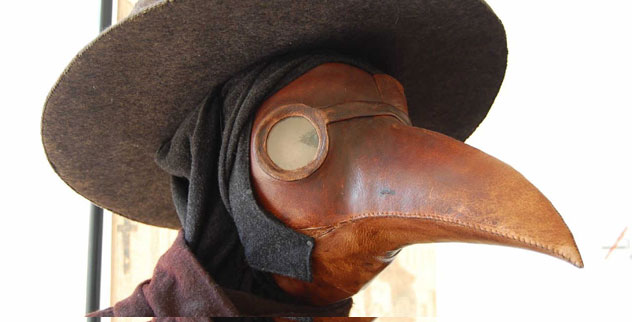
The plague doctor costume is regularly described as medieval, but its famous beaked form is associated more closely with seventeenth-century European outbreaks. The ensemble typically included a long waxed or leather coat, gloves, boots, a broad-brimmed hat, and a mask with glass-covered eye openings.
The beak was not added simply to make the doctor resemble an unusually judgmental crow. It could be filled with aromatic herbs, flowers, spices, or other fragrant materials. Physicians working under the miasma theory believed disease traveled through foul-smelling air, so pleasant scents were expected to filter or neutralize dangerous vapors.
Modern medicine identifies plague as an infection caused by Yersinia pestis, commonly transmitted through infected fleas or contact with infected animals. The herbs therefore could not perform the protective magic expected of them. However, the full-length coat, gloves, and physical separation may sometimes have reduced direct exposure.
The uniform became terrifying because of what its arrival announced. Seeing the beaked figure in your neighborhood meant the epidemic was no longer a distant rumor. The bird-faced doctor was not necessarily death, but he was rarely delivering good news.
2. Early World War I Gas Masks
Protective equipment that looked almost inhuman
When chemical weapons spread across World War I battlefields, armies had to develop respiratory protection with horrifying urgency. Early solutions ranged from treated cloth pads to increasingly sophisticated masks connected to filters or breathing canisters.
The resulting equipment transformed soldiers into blank-faced figures with round glass eyes and rubberized heads. A gas mask erased nearly every recognizable expression. Fear, exhaustion, and confusion disappeared behind the same rigid face, making entire units look like silent mechanical creatures.
Gas masks could also be hot, restrictive, uncomfortable, and difficult to see through. Soldiers had to put them on quickly when alarms sounded, sometimes while shells were exploding and poisonous clouds were already drifting toward the trenches. A mask was lifesaving equipment, but its presence confirmed that the surrounding air might kill anyone who removed it.
Horses, dogs, and other military animals also received protective masks. Images of masked soldiers moving beside masked horses remain among the most surreal photographs of the war. Apparently, ordinary trench warfare was not nightmarish enough.
3. The Scold’s Bridle
A wearable punishment built to silence and shame
The scold’s bridle, also known as the branks, was not fashion in any voluntary sense. It was an iron framework locked around the head and used as an instrument of punishment and public humiliation, particularly in early modern Scotland and England.
A metal plate or gag entered the wearer’s mouth and pressed against the tongue. Some surviving examples include spikes or sharp edges that made attempts to speak intensely painful. Certain bridles were fashioned with exaggerated noses, ears, or grimacing features, turning the victim’s head into a public caricature.
Authorities frequently targeted women accused of being argumentative, disruptive, insulting, or too outspoken. The wearer might be displayed in a public place or led through town, transforming punishment into a community performance. It was not merely an effort to stop speech; it was a warning about who was permitted to speak and how.
The scold’s bridle is often casually called a medieval torture device, but documented use belongs largely to the sixteenth and seventeenth centuries. Somehow, “early modern instrument of gendered public oppression” does not make it any less disturbing.
4. The Capirote
A pointed hood whose appearance can mislead modern viewers
The capirote is a tall, conical head covering associated with penitential traditions in Spain and other Catholic communities. Combined with a robe and a fabric hood covering the face, it creates a dramatic silhouette that can appear sinister to people unfamiliar with its religious meaning.
Historically, pointed caps were connected with penance and, in some periods, public humiliation. In later Holy Week traditions, members of religious brotherhoods wore conical hoods during solemn processions. Covering the face could preserve anonymity, emphasizing repentance rather than the social identity of the participant.
American viewers must be especially careful when interpreting this garment. Its shape resembles hoods later worn by the Ku Klux Klan, but Spanish penitential clothing predates that racist organization by centuries and belongs to a different cultural and religious history. Treating the two as interchangeable erases that history.
At night, a long procession of hooded figures carrying candles can certainly feel otherworldly. Yet the atmosphere is intentionally solemn, not threatening. Context is doing most of the frightening work here.
5. Distinctive Clothing Forced on People with Leprosy
Garments that turned illness into a public identity
In parts of medieval Europe, people believed to have leprosy could be isolated from society and required to wear distinctive garments. Practices varied by location and period, but historical accounts describe recognizable clothing accompanied by bells, clappers, or other devices used to announce the person’s approach.
The clothing itself was not necessarily elaborate or frightening. Its eeriness came from its purpose. It transformed a medical diagnosisor sometimes a mistaken diagnosisinto a permanent public label. Anyone who saw or heard the wearer was encouraged to keep away.
People affected by eczema, psoriasis, disfigurement, and other conditions may also have been categorized as having leprosy because medieval diagnosis was imprecise. Religious interpretations sometimes treated the disease as evidence of impurity or divine punishment, intensifying social exclusion.
Modern medicine calls the condition Hansen’s disease. It is caused by bacteria, is difficult to spread through casual contact, and can be cured with multidrug therapy. The truly unsettling part of the historical outfit is therefore not the fabric. It is how efficiently clothing was used to turn fear and medical misunderstanding into discrimination.
6. Grotesque Mask Visors
Renaissance armor with a sense of humor from the underworld
During the early sixteenth century, some German and Austrian armorers created helmets fitted with masklike visors shaped as distorted human or animal faces. Surviving examples have hooked noses, bulging cheeks, mustaches, grimaces, and expressions suggesting that the wearer has just smelled five hundred years of unwashed armor.
These visors were not standard battlefield equipment. They were associated with tournaments, ceremonial displays, and festive events such as Shrovetide celebrations. The designs could function as jokes, caricatures, or demonstrations of the armorer’s remarkable skill.
Nevertheless, the humor has not aged in a comforting direction. A steel face remains expressionless while the person inside moves, creating an effect similar to an oversized metal doll. Scratches and weapon marks found on certain surviving pieces indicate that at least some were used during mock combat.
Imagine attending a lively Renaissance festival and watching an armored rider approach with a wrinkled demon face hammered into his helmet. Everyone else may be laughing. You, quite reasonably, are checking the location of the nearest exit.
7. The Executioner’s Hood
An iconic garment that history used less often than Hollywood
The black executioner’s hood has become one of the most recognizable symbols of historical punishment. It hides the face, removes individual identity, and transforms a government employee into an anonymous figure of death. There is only one problem: the hood was never the universal executioner uniform suggested by movies, games, and costume shops.
Executioners were often known members of their communities. In many European cities, everyone already knew who performed executions, administered corporal punishments, or disposed of animal remains. A hood would have provided approximately as much anonymity as wearing a paper bag to your weekly staff meeting.
Masks or face coverings were sometimes used when anonymity was genuinely desired, including politically sensitive executions. However, many historical images show executioners barefaced or dressed like other officials and tradespeople of their period.
The hood remains eerie because it represents the deliberate removal of personality. It allows the public to imagine that no ordinary human stands beneath it. In that sense, the legendary version may reveal more about our discomfort with organized execution than about an actual dress code.
8. Arsenic-Green Dresses and Accessories
When the season’s hottest color was genuinely toxic
Nineteenth-century consumers adored brilliant green clothing, artificial flowers, gloves, and decorative accessories. Some of those vivid shades were produced with pigments containing arsenic, a highly toxic element that also appeared in wallpaper, paint, toys, and household goods.
The greatest danger frequently fell on workers who manufactured dyed textiles and artificial foliage. They could inhale pigment dust, absorb contamination through their skin, or work in poorly ventilated rooms surrounded by toxic materials. Finished garments could continue shedding colored particles as they were handled or worn.
An arsenic-green dress is disturbing because its beauty hides the hazard so effectively. Nothing about a shimmering green skirt announces that making it may have sickened workers. It simply looks fashionable, expensive, and ready for a ballroom.
Today, museum conservators may test suspicious green textiles and use gloves or specialized storage procedures when arsenic is detected. The gown has completed an unusual career transition: once a glamorous evening outfit, it may now be treated like hazardous material wearing lace.
9. Mercury-Treated Felt Hats
The industrial danger behind the “mad hatter” image
Felt hat production once used mercury compounds to help prepare animal fur. Workers repeatedly exposed to mercury vapor and contaminated materials could develop tremors, speech difficulties, irritability, anxiety, memory problems, and other neurological symptoms.
This occupational illness contributed to the cultural image expressed by the phrase “mad as a hatter.” The danger was concentrated primarily in the manufacturing process rather than in every finished hat perched innocently on a customer’s head. Hat makers performed their work in enclosed spaces where heating and handling treated fur could create sustained exposure.
The eerie object is therefore not just the top hat. It is the polished product viewed beside the invisible cost of producing it. A fashionable customer might leave the shop looking dignified while the person who made the hat slowly became ill.
Few objects summarize industrial-age fashion more efficiently: elegance on the outside, poison in the workshop, and a catchy phrase that outlived many of the workers it described.
10. Victorian Mourning Veils and Crepe Dresses
Clothing that made private grief publicly visible
Victorian mourning clothing followed detailed social conventions. Black dresses, crinkled crepe, gloves, veils, bonnets, and subdued accessories could communicate both bereavement and the stage of mourning a person was observing.
Long black veils are especially eerie to modern eyes because they obscure the face and move independently in the wind. In nineteenth-century society, however, the veil had a clear function. It offered privacy while publicly identifying the wearer as someone in grief. Mourning clothes still followed fashionable silhouettes, including bustles, fitted bodices, and elaborate trimming.
The system could be emotionally and financially demanding. Widows were often expected to maintain mourning dress for extended periods, while changing fabrics and accessories as they moved through recognized stages. Entire businesses supplied suitable clothing to bereaved families, proving that even sorrow can acquire a retail department.
Unlike poisonous dresses or metal bridles, mourning clothes were not created to injure. Their haunting quality comes from the way they gave grief a uniform. The wearer did not have to explain that death had entered the household. Her clothes had already announced it.
An Immersive Experience with Eerie Historical Clothing
What these garments feel like when encountered in a museum
Imagine entering a quiet costume gallery shortly before closing time. The room is cool, the lights are low, and every display case seems to contain a person who has politely agreed not to move while you are watching.
The first object is a Victorian mourning dress. From a distance, it appears to be an elegant black silhouette. Up close, the details become more intimate: narrow sleeves, delicate crepe, careful stitching, and a bodice shaped for an individual body. The mannequin has no head, but the dress still seems occupied. You begin wondering who wore it, whose death required it, and whether putting it on each morning made grief easier or simply impossible to escape.
Across the room, a bright green gown seems almost cheerful. Then you read that similar fabrics may contain arsenic. The color changes without changing at all. What looked lively a moment ago now appears suspiciously luminous. You resist the irrational urge to hold your breath, even though the garment is sealed behind glass and the museum’s conservation team knows considerably more about toxic textiles than you do.
The military display creates a different reaction. A World War I gas mask has cracked eye lenses and a long, sagging face. Photographs show soldiers wearing similar masks in trenches. Looking at the empty mask is uncomfortable; imagining a frightened nineteen-year-old breathing through it is worse. Its ugliness suddenly seems irrelevant. The mask was not intended to be attractive. It was intended to provide a few more minutes of life.
The grotesque visor is easier to admire because its craftsmanship is extraordinary. Steel has been shaped into eyebrows, cheeks, a nose, and a crooked mouth. The museum label explains that such pieces could be worn at tournaments and festive events. You understand the historical joke, but the visor continues staring with the emotional warmth of a locked furnace.
Finally, you reach the plague doctor display. The beaked mask is so familiar from games and movies that it initially feels fictional. Historical context restores its seriousness. The wearer entered homes where families were sick, death was common, and the cause of infection was poorly understood. The strange mask was not designed by someone trying to invent a monster. It was designed by someone trying not to die.
That realization changes the entire gallery. These eerie historical garments are not frightening merely because they look strange. They preserve human reactions to danger, authority, illness, faith, grief, and uncertainty. Behind every empty hood was once a face. Behind every stiff dress was a breathing body. The museum cases are quiet, but the clothing is still telling stories.
Conclusion: The Darker Meaning Hidden in Historical Dress
The eeriest clothing from the past was rarely created for the purpose of frightening future generations. Its unsettling appearance grew from the problems it was meant to address: contagious disease, chemical warfare, public punishment, religious penance, occupational hazards, social exclusion, and death.
Historical clothing also warns us against judging an object only by its silhouette. Some terrifying garments were protective. Some beautiful garments were poisonous. Some supposedly universal uniforms were largely products of later storytelling. The wardrobe of history is not just full of old styles; it is full of evidence about what people feared, valued, misunderstood, and endured.